논문 해설
Learning When to Think: Adaptive Internal Computation for Reinforcement Learning
언제 생각할지 학습하기: 강화학습을 위한 적응형 내부 계산
- 연구 문제 반복형 정책은 모든 상태에 같은 정제 깊이를 쓰므로, 추가 정제의 효용이 낮은 상태에도 계산을 낭비할 수 있습니다.
- 연구 방법 AIC는 각 깊이의 정지 확률로 정지 깊이 분포를 만들고, 행동과 정지 결정의 결합 확률을 PPO 목표와 기대 깊이 페널티로 함께 학습합니다.
- 주요 결과 AIC는 최대 8회 상한에서 평균 3.3회를 실행하며, 12개 과제 중 보상이 고정 깊이 최고 기준선을 넘는 과제가 일곱, 뒤처지는 과제가 넷입니다.
고정 깊이 정책의 낭비 문제
반복형 신경 정책은 결정마다 같은 횟수만큼 표현을 정제하지만, 추가 정제가 도움이 되는 정도는 상태마다 다릅니다. 일상적인 움직임에는 짧은 처리로 충분하고 예기치 않은 접촉에서 빠져나오는 상황에는 더 많은 반복이 필요할 수 있습니다. 따라서 계산 비용이 큰 환경에서는 모든 상태에 같은 깊이를 쓰면 일부 상태에는 과하게, 다른 상태에는 부족하게 계산을 쓰게 됩니다. 이 논문은 정책이 각 상태에서 정제를 더 할지 지금 행동할지를 환경 보상으로부터 학습할 수 있는지를 묻습니다. 선행 연구인 ACT와 PonderNet도 입력별 반복 횟수를 학습하지만, 이 논문은 정지 결정이 행동을 바꾸고 이후 상태와 보상에 영향을 준다는 점을 강조합니다.
AIC의 공동 정책과 정지 깊이
Adaptive Internal Computation(AIC)은 행동 선택과 정지 결정을 같은 정책의 두 결정으로 취급합니다. 인코더가 상태 s_t로부터 z_0을 만들고, 깊이 d마다 공유된 잔차 블록이 z_d를 갱신합니다. 각 깊이에는 행동 헤드 π_d, 가치 헤드 V_d와 정지 확률 h_d ∈ [0,1]을 읽는 정지 머리가 있으며, 최대 깊이에서는 정지가 강제됩니다. 실행 중 정지 깊이 분포 q_θ(d|s)는 각 깊이까지 도달할 확률 S_d = ∏_{j<d}(1−h_j)에서 정해지며, 결합 확률 p_θ(a,d|s) = q_θ(d|s)π_{θ,d}(a|z_{θ,d}(s))로 표현됩니다. 이 결합 확률이 PPO 비율에 들어가므로 정지 결정의 로그 확률도 보상 신호로 갱신됩니다.
기대 깊이 페널티는 정지 분포로부터 계산한 E[τ|s]를 최대 깊이로 나눈 값에 λ_c를 곱한 항으로 추가됩니다. 가치 헤드는 같은 GAE 목표를 예측하도록 학습되는 보조 감독이며, 추론 시에는 가치 출력을 읽지 않고 정지 결정은 h_d가 0.5를 넘는 첫 깊이로 이뤄집니다.
상태 의존 할당이 유리한 조건
정리 1은 쉬운 상태와 어려운 상태가 섞인 분포에서 상태 독립 정지 규칙이 같은 기대 깊이를 쓰더라도 가치 손실이 남는다는 점을 보입니다. 정리는 쉬운 상태 질량 1−ε이 모든 깊이에서 기준 가치 W*에 도달하고, 어려운 상태 질량 ε은 깊이 K 이상에서만 도달한다고 가정합니다. 이상적 할당기는 쉬운 상태에 깊이 1, 어려운 상태에 깊이 K를 주어 기대 깊이 b = 1 + ε(K−1)에서 손실 0을 얻습니다. 같은 기대 깊이를 쓰는 어떤 상태 독립 정지 분포도 Rµ ≥ ε∆(1−b/K) > 0입니다. 이 결과는 쉬운/어려운 분할을 알고 있는 이상적 할당기와 고정된 행동 정책 가정에 조건부이며, 학습된 정지 정책이 이 할당을 회복한다는 결론을 주지 않습니다.
12개 과제에서의 고정 깊이 비교
주요 실험은 최대 8회 정제 단계 아래에서 AIC를 고정 깊이 정책과 비교합니다. 고정 기준선은 같은 인코더, 정제 블록과 PPO 목표를 쓰되 학습 깊이 K_train ∈ {1,2,4,8}에서 멈추며, 각 예산에 대해 별도 학습 스윕을 거칩니다. B=8에서 AIC는 아홉 과제에서 예산별 고정 기준선보다 높고 일곱 과제에서 p<.05입니다. 모든 예산에서 가장 강한 고정 기준선과 비교하면 AIC는 일곱 과제에서 앞서고 한 과제에서 같으며 네 과제에서 뒤집니다. 뒤처진 대표 사례는 RareEvent에서 깊이 1 기준선이 .6338을 기록하고 저 이질성 AntMaze에서 .6916을 기록하는 경우입니다. 이 결과는 12개 과제 집합과 다섯 시드 평균에 대한 것이며 평균 3.3회 정제가 함께 보고됩니다.
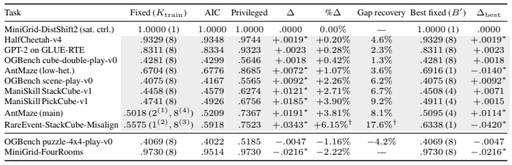
Table 1 :Benchmark comparison at nominalB=8.∆: AIC minus the per-budget fixed baseline, whose selected training depths appear in parentheses with seed counts as superscripts. Gap recovery is measured toward the privileged reference and is undefined when the reference does not exceed the fixed baseline. Best fixed: strongest fixed baseline at any budgetB ′ ≤8in Table 14, withB ′ in parentheses;∆ best is AIC minus that value. ∗:p < .05, two-sided Welch’st-test over five seeds with the standard deviations of Table 14.
원문 · CC BY 4.0 · Rohit Kumar Salla, Simon Stepputtis · Learning When to Think: Adaptive Internal Computation for Reinforcement Learning · 원문 그림 인용 · 원본 PDF 5쪽에서 그림 영역을 추출했습니다.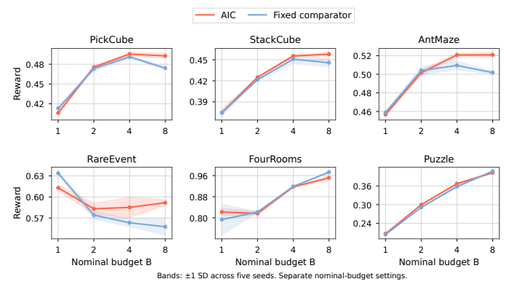
Figure 2 :Performance across nominal budgets on six tasks.Points are five-seed means with±1 standard-deviation bands (Table 14); each point is a separate budget setting and realized depth can differ between methods. RareEvent peaks atB= 1for both methods. Figure 4 shows the remaining six tasks.
원문 · CC BY 4.0 · Rohit Kumar Salla, Simon Stepputtis · Learning When to Think: Adaptive Internal Computation for Reinforcement Learning · 원문 그림 인용 · 원본 PDF 6쪽에서 그림 영역을 추출했습니다.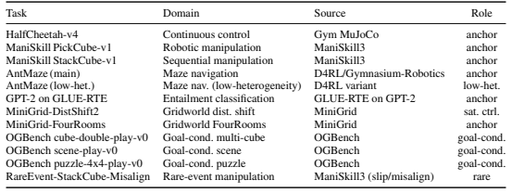
Table 8 :Tasks.Every benchmark setting, including DistShift, uses five seeds; Section S summarizes the protocols of the additional studies.
원문 · CC BY 4.0 · Rohit Kumar Salla, Simon Stepputtis · Learning When to Think: Adaptive Internal Computation for Reinforcement Learning · 원문 그림 인용 · 원본 PDF 29쪽에서 그림 영역을 추출했습니다.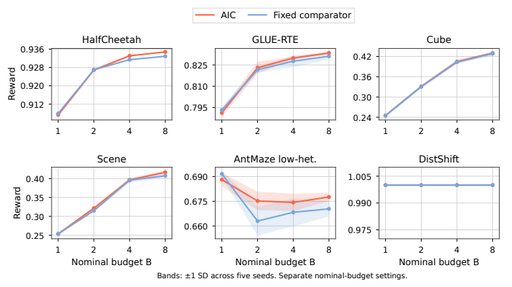
Figure 4 :Performance across nominal budgets on the remaining six benchmark tasks.Points are five-seed means and shaded bands are±1standard deviation from Table 14. The budget conven- tion and fixed-baseline definitions match Figure 2. DistShift is saturated at every budget; the other tasks respond differently to a larger budget.
원문 · CC BY 4.0 · Rohit Kumar Salla, Simon Stepputtis · Learning When to Think: Adaptive Internal Computation for Reinforcement Learning · 원문 그림 인용 · 원본 PDF 34쪽에서 그림 영역을 추출했습니다.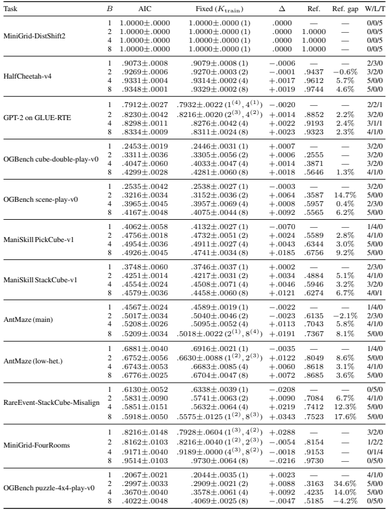
Table 14 : Full comparison at nominalB∈ {1,2,4,8}. Means±sample standard deviation over 5 seeds. Parentheses list training depths selected across seeds, with seed counts as superscripts when more than one depth was selected; executed depth ismin(K train, B). Ref.: reward of the budget- specific privileged reference. Gap recovery is undefined when the reference does not exceed the fixed baseline and is omitted atB= 1, where every method executes one refinement. MiniGrid- DistShift2 is the saturated control. AIC trails on MiniGrid-FourRooms and OGBench puzzle-4x4- play-v0 atB=8.
원문 · CC BY 4.0 · Rohit Kumar Salla, Simon Stepputtis · Learning When to Think: Adaptive Internal Computation for Reinforcement Learning · 원문 그림 인용 · 원본 PDF 39쪽에서 그림 영역을 추출했습니다.절단과 데이터, 보조 감독의 분리
절단 연구는 높은 깊이의 결정을 깊이 1로 강제했을 때의 보상 하락을 같은 개수의 무작위 절단과 비교합니다. 데이터 원천 절제는 PickCube와 StackCube에서 수집기와 학습자를 바꿔 봅니다. 정지와 감독 절제는 네 구성을 독립적으로 학습하며, PickCube와 AntMaze에서는 정지 효과가 감독 효과보다 크고 RareEvent에서는 감독 효과가 큽니다. 비적응 구성은 깊이 1을 쓰고 적응 구성은 1.8–3.9회를 쓰므로 정지 효과에는 추가 계산이 섞여 있습니다.
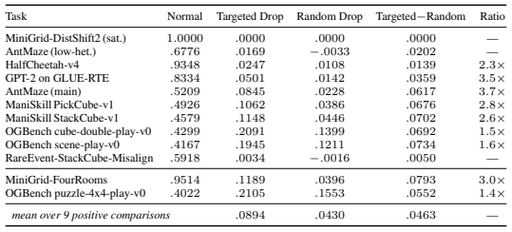
Table 3 :Sensitivity to targeted and random truncation.Targeted: decisions at or above the 75th- percentile depth, forced tod=1. Random: count-matched random early exits. Targeted drops exceed random drops on every non-saturated task, including the final two rows; ratios are omitted when the random drop is non-positive. Table 16 gives selected fractions, removed refinements and a random control matched on removed work.
원문 · CC BY 4.0 · Rohit Kumar Salla, Simon Stepputtis · Learning When to Think: Adaptive Internal Computation for Reinforcement Learning · 원문 그림 인용 · 원본 PDF 7쪽에서 그림 영역을 추출했습니다.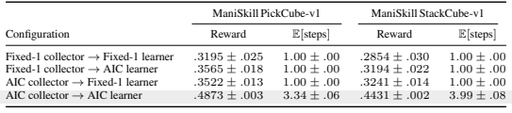
Table 4 :Data-source ablation.Rows are collector–learner pairs; columns give reward and the learner’s mean halting depthE[steps]. The combined gain exceeds the sum of the separate gains. Values are means±standard deviation over five learner seeds, each collector produced one dataset.
원문 · CC BY 4.0 · Rohit Kumar Salla, Simon Stepputtis · Learning When to Think: Adaptive Internal Computation for Reinforcement Learning · 원문 그림 인용 · 원본 PDF 8쪽에서 그림 영역을 추출했습니다.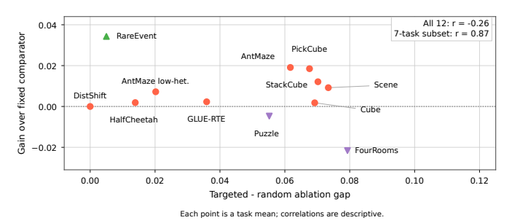
Figure 5 :Allocation diagnostic and fixed-baseline gain.Each point is a task mean from the twelve-task benchmark. The seven-task subset (DistShift, HalfCheetah, low-heterogeneity AntMaze, RTE, AntMaze, PickCube, StackCube) has Pearsonr= 0.87; including Cube and Scene givesr= 0.62and all twelve points giver=−0.26. The horizontal axis is count-matched trunca- tion sensitivity; the correlation depends on the included task set.
원문 · CC BY 4.0 · Rohit Kumar Salla, Simon Stepputtis · Learning When to Think: Adaptive Internal Computation for Reinforcement Learning · 원문 그림 인용 · 원본 PDF 35쪽에서 그림 영역을 추출했습니다.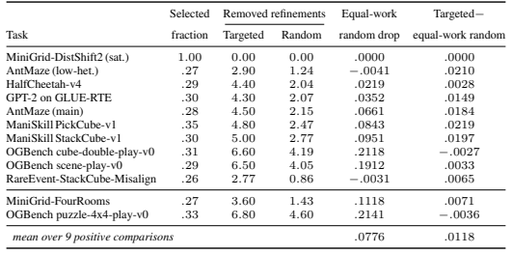
Table 16 :Removed-work accounting for the truncation study.Selected fraction: share of de- cisions at or above the seed’s 75th-percentile depth, including ties. Removed refinements are per intervened decision. Equal-work random: random truncation matched to the targeted set’s total re- moved refinements. Targeted drops are those of Table 3.
원문 · CC BY 4.0 · Rohit Kumar Salla, Simon Stepputtis · Learning When to Think: Adaptive Internal Computation for Reinforcement Learning · 원문 그림 인용 · 원본 PDF 40쪽에서 그림 영역을 추출했습니다.POGP와 학습된 정지 방법과의 비교
POGP와의 비교에서 AIC는 HalfCheetah, Walker2d, Ant, Hopper의 네 MuJoCo 과제에서 행동당 반복을 22–28% 적게 쓰면서 평균 반환은 POGP와 3–5 범위 안에 머뭅니다. 이는 POGP의 디퓨전 백본과 여덟 단계 상한에서 얻은 결과입니다. 학습된 정지 방법과의 비교에서는 ACT-ponder와 학습된 non-VoC 임계값을 포함해 일곱 과제를 봅니다. AIC는 세 방법 가운데 가장 낮은 평균 깊이를 쓰며, FourRooms에서는 낮은 깊이가 더 낮은 보상과 함께 나타납니다. 이 비교는 같은 인코더와 정제 블록을 공유하는 구현 안에서 정지 학습 방식만 바꾼 결과입니다.
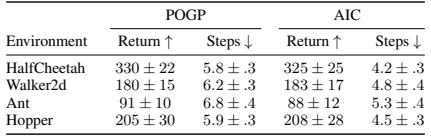
Table 2 :POGP–AIC comparison with an eight-step cap.Undiscounted return over 100-step episodes (Section D.2) and iterations per action, mean±standard deviation over five seeds.
원문 · CC BY 4.0 · Rohit Kumar Salla, Simon Stepputtis · Learning When to Think: Adaptive Internal Computation for Reinforcement Learning · 원문 그림 인용 · 원본 PDF 6쪽에서 그림 영역을 추출했습니다.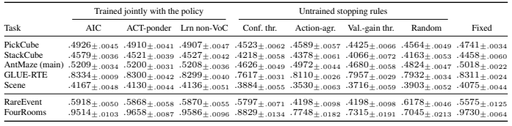
Table 6 :Adaptive halting baselines atB=8across 7 tasks.Mean reward over five seeds, with the seed standard deviation as a subscript; AIC and Fixed repeat Table 14. The trained methods reach similar rewards on several tasks at different mean depths. ACT-ponder leads on FourRooms and the random schedule, which executes one refinement there, leads on RareEvent.
원문 · CC BY 4.0 · Rohit Kumar Salla, Simon Stepputtis · Learning When to Think: Adaptive Internal Computation for Reinforcement Learning · 원문 그림 인용 · 원본 PDF 9쪽에서 그림 영역을 추출했습니다.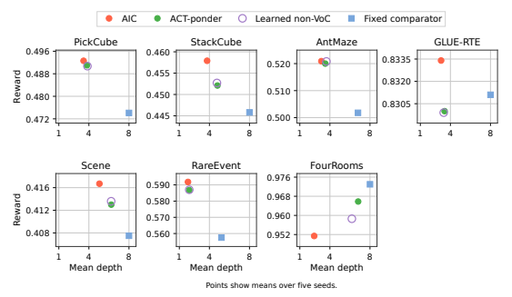
Figure 3 :Reward versus mean halting depth at nominalB= 8.Panels show AIC, ACT-ponder, learned non-V oC and fixed baselines, using Tables 6 and 10. A fixed baseline’s depth is the seed average ofmin(K train,8)over its selected checkpoints.
원문 · CC BY 4.0 · Rohit Kumar Salla, Simon Stepputtis · Learning When to Think: Adaptive Internal Computation for Reinforcement Learning · 원문 그림 인용 · 원본 PDF 9쪽에서 그림 영역을 추출했습니다.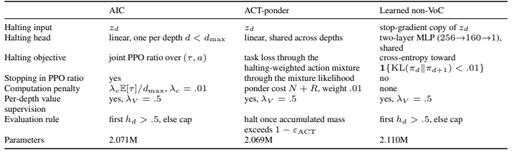
Table 9 :Jointly trained halting methods.All three share the encoder, refinement block, depth- specific action heads and value heads and use five seeds atB= 8.
원문 · CC BY 4.0 · Rohit Kumar Salla, Simon Stepputtis · Learning When to Think: Adaptive Internal Computation for Reinforcement Learning · 원문 그림 인용 · 원본 PDF 31쪽에서 그림 영역을 추출했습니다.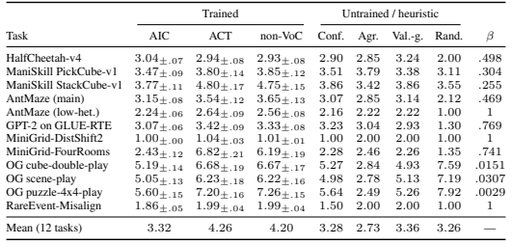
Table 10 :Mean refinement depth atB=8on all twelve tasks.Mean steps per state for the seven stopping methods; trained-method entries carry the seed standard deviation as a subscript andβis the random schedule’s per-task stopping probability (Section G). Fixed-Kcontrols execute exactlyK refinements. ACT and non-V oC halt deeper than AIC on eleven tasks; HalfCheetah is the exception. The final row is the unweighted task mean.
원문 · CC BY 4.0 · Rohit Kumar Salla, Simon Stepputtis · Learning When to Think: Adaptive Internal Computation for Reinforcement Learning · 원문 그림 인용 · 원본 PDF 31쪽에서 그림 영역을 추출했습니다.적용 범위와 남은 한계
이 연구의 결과는 작은 정제 모듈, 시뮬레이션 과제, 특정 백본과 깊이 상한에서 얻은 것입니다. FourRooms는 시험한 손실 가중치 격자 전체에서 고정 깊이 기준선보다 낮게 남으며, 퍼즐은 가치 감독 가중치에 따라 부호가 바뀝니다. 절단 연구는 계산량을 맞춘 대조에서도 상태와 깊이의 연관을 완전히 분리하지 못하며, 깊이 재배정 실험이 추가로 필요하다고 저자가 밝힙니다. 공유 GAE 목표는 강제 깊이의 반사실적 반환을 식별하지 않으며, 정책의 가치 출력을 바꿔도 동결된 정지 정책은 변하지 않습니다.
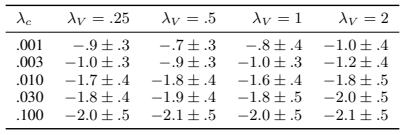
Table 11 : FourRooms: difference from the mean-depth-matched fixed baseline in percentage points of normalized reward (one point is.01in the units of Table 1), mean±standard error over five seeds.
원문 · CC BY 4.0 · Rohit Kumar Salla, Simon Stepputtis · Learning When to Think: Adaptive Internal Computation for Reinforcement Learning · 원문 그림 인용 · 원본 PDF 32쪽에서 그림 영역을 추출했습니다.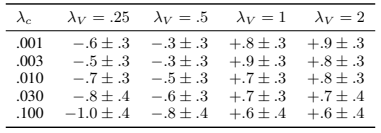
Table 12 : Puzzle: difference from the mean-depth-matched fixed baseline in percentage points of normalized reward, mean±standard error over five seeds.
원문 · CC BY 4.0 · Rohit Kumar Salla, Simon Stepputtis · Learning When to Think: Adaptive Internal Computation for Reinforcement Learning · 원문 그림 인용 · 원본 PDF 32쪽에서 그림 영역을 추출했습니다.논문 정보
- 저자
- Rohit Kumar Salla, Simon Stepputtis
- 학회·저널
- arXiv · 프리프린트
- 최초 공개일
- 2026년 11월 7일
- 등록일
- 2026년 11월 10일
- 수정일
- 2026년 11월 7일
- 버전
- v1
- arXiv
- 2611.10822
- 분류
- cs.LG · cs.RO
- 원문 이용 조건
- CC BY 4.0
- 제공 범위
- 논문 정보, 해설, 허용된 원문 그림
AI 해설은 논문 원문과 별개의 설명이며 오류가 있을 수 있습니다. 원문과 그림은 각 출처의 이용 조건과 따로 표시된 권리를 따릅니다.
초록
Iterative neural policies usually spend the same computation on every decision, although the benefit of additional processing varies across states. We introduce Adaptive Internal Computation (AIC), an iterative policy that learns when to stop refining its latent representation and act. In AIC, we train action selection and stopping jointly, an expected-depth penalty values computation and intermediate value predictions provide auxiliary supervision. We show that when only some states benefit from further refinement, an ideal state-dependent allocator outperforms every state-independent stopping schedule at the same expected depth. With at most eight refinement steps per decision, AIC executes 3.3 steps on average across twelve benchmark tasks and lowers per-decision latency by 31--44% relative to a fixed eight-step policy on four control and robotics tasks. Its mean reward exceeds the best fixed-depth policy on seven tasks and trails it on four. Ablating adaptive stopping and value supervision separately shows that stopping accounts for most of the reward gain on PickCube and AntMaze, where it also executes more refinement steps and that supervision accounts for most of it on RareEvent.
원문 인용
Rohit Kumar Salla, Simon Stepputtis (2026). Learning When to Think: Adaptive Internal Computation for Reinforcement Learning. arXiv:2611.10822v1. https://arxiv.org/abs/2611.10822v1
BibTeX
@misc{salla2026learning,
  title = {{Learning When to Think: Adaptive Internal Computation for Reinforcement Learning}},
  author = {Rohit Kumar Salla and Simon Stepputtis},
  year = {2026},
  eprint = {2611.10822},
  archivePrefix = {arXiv},
  url = {https://arxiv.org/abs/2611.10822v1}
}