논문 해설
Policy Filtration for RLHF to Mitigate Noise in Reward Models
보상 모델의 노이즈를 완화하기 위한 RLHF용 정책 필터링
- 연구 문제 보상 모델이 부정확한 상황에서 RLHF 정책 학습이 잡음이 많은 보상에 흔들리는 문제를 다룹니다.
- 연구 방법 샘플링 단계에서 보상 순위에 따라 응답을 걸러 학습 신호를 개선하는 PF-PPO를 제안합니다.
- 주요 결과 HumanEval에서 PF-PPO(BR)는 pass@1 82.9로 PPO-S의 78.1보다 높았고, Ape210K에서도 PF-PPO + ORM이 86.2로 PPO-S + ORM의 84.1보다 높았습니다.
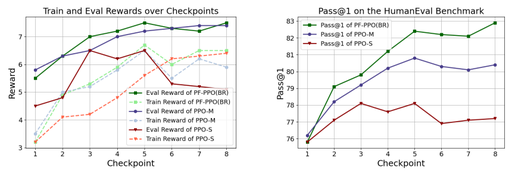
Figure 2 . Left: The training and evaluation reward of PPO-S, PPO-M, and FP-PPO on HumanEval. The training reward and the evaluation reward are evaluated on the samples generated by the filtered policy µθ and the unfiltered policy πθ respectively. Right: The pass@1 of PPO-S, PPO-M, and PF-PPO on the HumanEval benchmark.
원문 · CC BY 4.0 · Zhang, Chuheng, Shen, Wei, Zhao, Li, Zhang, Xuyun, Xu, Xiaolong, Dou, Wanchun, Bian, Jiang · Policy Filtration for RLHF to Mitigate Noise in Reward Models · 원문 그림 인용 · 원본 PDF 7쪽에서 그림 영역을 추출했습니다.RLHF에서 보상 모델의 잡음 문제
RLHF에서 언어 모델은 학습된 보상 모델이 매기는 점수를 신호로 삼아 정책을 개선합니다. 그런데 보상 모델은 복잡한 추론이 필요한 과제에서 응답의 실제 품질을 정확히 반영하지 못하는 경우가 많습니다. 이 논문은 보상 모델을 더 정확하게 만드는 대신, 보상 모델을 그대로 두고 정책 학습 과정에서 신뢰하기 어려운 샘플을 걸러내는 문제를 다룹니다.
저자들은 HumanEval 실험에서 보상 모델의 신뢰도가 보상 값의 구간에 따라 다르다는 관찰에서 출발합니다. 높은 보상이나 낮은 보상을 준 응답들은 비슷한 보상끼리 묶었을 때 실제 점수와 잘 맞지만, 중간 보상 구간에서는 그렇지 않은 경우가 많다고 보고합니다.
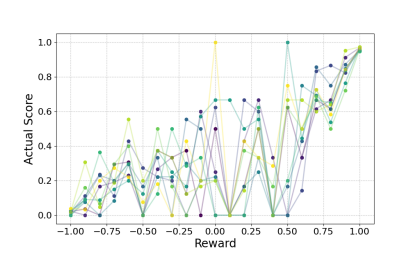
Figure 1 . The reward model can beinaccurate, i.e., the actual score of the response does not align well with the reward given by the reward model. However, the reward model in specific regions (e.g., when it gives rewards higher than 0.8) is more reliable, i.e., the responses with similar rewards result in consistent performance. We use a fine-tuned policy to generate 10 responses for each of the 164 prompts in the HumanEval dataset and use a reward model trained with the common recipe to generate their rewards. We group the responses with similar rewards and calculate the average of their actual scores (i.e., the average correctness), indicating each group by one point. To evaluate the reliability of the reward model, we repeat the process ten times corresponding to the ten lines.
원문 · CC BY 4.0 · Zhang, Chuheng, Shen, Wei, Zhao, Li, Zhang, Xuyun, Xu, Xiaolong, Dou, Wanchun, Bian, Jiang · Policy Filtration for RLHF to Mitigate Noise in Reward Models · 원문 그림 인용 · 원본 PDF 1쪽에서 그림 영역을 추출했습니다.PF-PPO의 필터링 방식
PF-PPO는 표준 PPO 기반 RLHF를 거의 그대로 두고 샘플링 단계만 수정합니다. 각 프롬프트에 대해 현재 정책 πθ가 N개의 응답을 생성하고, 보상 모델이 이를 보상 순위로 정렬합니다. 이후 가중치 벡터 w에 따라 범주형 분포에서 하나의 응답을 고르고, 그 응답만 PPO 버퍼에 넣어 학습에 씁니다.
대표 전략은 최고 응답만 고르는 best-of-N(BoN), 최고 응답과 나머지 중 무작위 응답을 고르는 best-random(BR), 최고 응답과 최저 응답을 각각 절반의 확률로 고르는 best-worst(BW)입니다. 세 전략 모두 보상 순위에 기반하지만, BoN은 가중치가 최고 응답에만 몰리고 BR과 BW는 상위와 하위 또는 무작위 응답을 함께 포함한다는 점에서 다릅니다.
R2를 이용한 필터링 전략 선택
필터링 전략을 고르기 위해 저자들은 필터링된 샘플에서 보상과 실제 점수 사이의 결정계수 R2를 계산합니다. 보상으로 실제 점수를 선형 모델로 예측할 때 설명되는 비율을 나타내며, 값이 클수록 보상이 실제 성능을 잘 드러낸다고 해석합니다. 저자들은 이 지표가 최종 성능과 잘 상관되며 과최적화 정도를 가늠하는 데 쓸 수 있다고 주장합니다.
표 1에서 BR과 BW는 SFT와 RLHF 정책 모든 경우에서 필터링하지 않은 정책보다 높은 R2를 보였고, BoN은 SFT 정책에서 0.454로 낮았습니다. 다만 저자들은 R2가 필터링 전략을 고르는 데 완벽한 도구가 아니라고 밝힙니다.
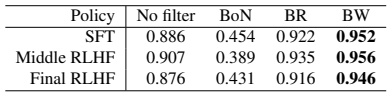
Table 1 . The coefficient of determination ( R2) of the unfiltered policy πθ and different filtered policies µθ between the rewards given by the reward model and the actual scores. This metrics correlates well with the final performance (see Section 5) and helps us to determine the weight vector (or the policy filtering strategy) in our algorithm PF-PPO. We choose the SFT policy and the middle/final RLHF policy as the unfiltered policy πθ respectively.
원문 · CC BY 4.0 · Zhang, Chuheng, Shen, Wei, Zhao, Li, Zhang, Xuyun, Xu, Xiaolong, Dou, Wanchun, Bian, Jiang · Policy Filtration for RLHF to Mitigate Noise in Reward Models · 원문 그림 인용 · 원본 PDF 4쪽에서 그림 영역을 추출했습니다.코드 생성 벤치마크 결과
코드 생성 실험에서 기반 모델은 deepseek-6.7B이며, 평가는 greedy decoding과 pass@1로 이루어졌습니다. 각 방법의 점수는 5개 에폭 중 벤치마크별 최고 점수를 사용했고, 비교 기준선은 같은 코드 베이스와 데이터셋에서 재구현되었습니다.
표 2에서 PF-PPO(BR)의 HumanEval pass@1은 82.9이고 PPO-S는 78.1입니다. PF-PPO(BW)는 MBPP와 HumanEval에서 높은 점수를 보였습니다. PF-PPO(BoN)은 HumanEval 75.8로 PPO-S보다 낮아, 저자들은 BoN 필터링이 RL 설정에서 충분하지 않다고 해석합니다. 특히 LeetCode Contest에서 BR과 BW가 더 큰 차이를 보였는데, 저자들은 이 영역에서 보상 모델이 중간 보상 구간에서 덜 신뢰할 만하기 때문이라고 해석합니다.
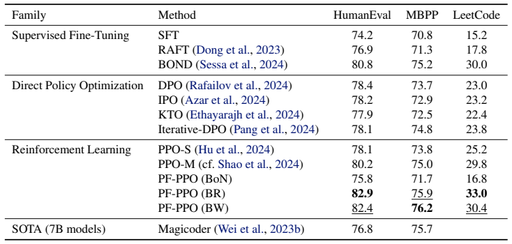
Table 2 . The performance of different algorithms on Code Generation. We compare pass@1 of PF-PPO (our algorithm) against baseline methods. For each benchmark, we select the best score across 5 epochs for each method. The highest and the second highest scores on each benchmark are highlighted in bold and underline respectively. All experiments are based on the same code base for fair comparison, except for the scores reported by Magicoder which is the best 7B model so far.
원문 · CC BY 4.0 · Zhang, Chuheng, Shen, Wei, Zhao, Li, Zhang, Xuyun, Xu, Xiaolong, Dou, Wanchun, Bian, Jiang · Policy Filtration for RLHF to Mitigate Noise in Reward Models · 원문 그림 인용 · 원본 PDF 6쪽에서 그림 영역을 추출했습니다.수학 추론 실험
수학 추론 실험에서는 ORM, Oracle, CRM 세 종류의 보상 유형을 비교했습니다. Ape210K에서 PF-PPO + ORM은 86.2이고 PPO-S + ORM은 84.1입니다. CMATH에서도 PF-PPO는 같은 보상 유형에서 PPO-S보다 높은 점수를 보고합니다.
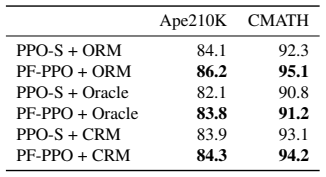
Table 4 . Comparison between PF-PPO and PPO-S on two math benchmarks (Ape210K and CMATH) using three different reward functions (the original reward model, the oracle model, and the combined reward model). Better results for each reward model is highlighted in bold.
원문 · CC BY 4.0 · Zhang, Chuheng, Shen, Wei, Zhao, Li, Zhang, Xuyun, Xu, Xiaolong, Dou, Wanchun, Bian, Jiang · Policy Filtration for RLHF to Mitigate Noise in Reward Models · 원문 그림 인용 · 원본 PDF 8쪽에서 그림 영역을 추출했습니다.저자들은 Oracle 보상이 실제 정답 정보에 접근하더라도 보상 모델을 쓰는 설정보다 잘 작동하지 않는다는 점도 보고합니다. 이 결과는 수학 추론 과제와 Qwen1.5-7B 기반 설정에서 얻은 것입니다.
논문 정보
- 저자
- Zhang, Chuheng, Shen, Wei, Zhao, Li, Zhang, Xuyun, Xu, Xiaolong, Dou, Wanchun, Bian, Jiang
- 학회·저널
- arXiv · 프리프린트
- 최초 공개일
- 2024년 9월 11일
- 등록일
- 2026년 10월 29일
- 수정일
- 2025년 6월 7일
- 버전
- v5
- arXiv
- 2409.06957
- 원문 이용 조건
- CC BY 4.0
- 제공 범위
- 논문 정보, 해설, 허용된 원문 그림
AI 해설은 논문 원문과 별개의 설명이며 오류가 있을 수 있습니다. 원문과 그림은 각 출처의 이용 조건과 따로 표시된 권리를 따릅니다.
초록
While direct policy optimization methods exist, pioneering LLMs are fine-tuned with reinforcement learning from human feedback (RLHF) to generate better responses under the supervision of a reward model learned from preference data. One major challenge of RLHF is the inaccuracy of the intermediate reward model, especially in the tasks that requires complex reasoning for the reward model to score a response. We find that the reliability of the reward model varies across responses assigned with different rewards. This motivates us to filter the samples whose rewards may be unreliable to improve the signal-to-noise ratio during policy learning, resulting in Policy Filtration for Proximal Policy Optimization (PF-PPO). To choose a proper policy filtering strategy, we use the coefficient of determination (R2) between the rewards and actual scores on filtered samples as the metrics to help us find promising strategies since it measures how well the rewards filtered by PF-PPO indicate real performance. We provide extensive experiments to validate the effectiveness of PF-PPO in code generation and math reasoning tasks. In code generation, PF-PPO achieves the state-of-the-art performance of 7-billion-parameter models on HumanEval (+7.9%), MBPP (+0.7%), and LeetCode Contest (+10.0%) which is a more challenging benchmark created by us. In math reasoning, PF-PPO yields performance increase using different reward models and benchmarks (Ape210K and CMATH). Code is available on https://github.com/DtYXs/verl/tree/pf-ppo.
원문 인용
Zhang, Chuheng, Shen, Wei, Zhao, Li, Zhang, Xuyun, Xu, Xiaolong, Dou, Wanchun, Bian, Jiang (2024). Policy Filtration for RLHF to Mitigate Noise in Reward Models. arXiv:2409.06957v5. https://arxiv.org/abs/2409.06957v5
BibTeX
@misc{chuheng2024policy,
  title = {{Policy Filtration for RLHF to Mitigate Noise in Reward Models}},
  author = {Zhang, Chuheng and Shen, Wei and Zhao, Li and Zhang, Xuyun and Xu, Xiaolong and Dou, Wanchun and Bian, Jiang},
  year = {2024},
  eprint = {2409.06957},
  archivePrefix = {arXiv},
  url = {https://arxiv.org/abs/2409.06957v5}
}