논문 해설
Zero-Shot VLA Adaptation with Retrieved Guidance
검색된 가이던스를 활용한 제로샷 VLA 적응
- 연구 문제 사전학습된 VLA는 카메라 시점, 배경, 객체, 로봇 형태가 바뀌면 성능이 크게 떨어지며, 기존 검색 기반 방법은 동일 embodiment 데이터나 과제별 미세조정에 의존하는 경우가 많습니다.
- 연구 방법 RAGu는 도메인이 다른 시연을 의미 대응으로 대상 장면에 워핑하고, DTW로 검색 풀을 줄인 뒤 추론 시점에 정책 호환성 기준으로 궤적 하나를 골라 flow-matching denoising에 에너지 가이던스로 적용합니다.
- 주요 결과 실세계 과제에서 RAGu는 20%였던 unguided π0.5 성공률을 80%로 높였고, RoboLab 9개 과제 평균에서는 23.6%를 36.4%로 높였습니다.
VLA의 도메인 이동 문제와 검색 기반 접근
사전학습된 Vision-Language-Action(VLA) 모델은 대규모 시연 데이터로 범용 조작을 학습하지만, 카메라 시점, 배경, 객체 종류, 로봇 형태가 조금만 달라져도 성능이 쉽게 떨어집니다. 이 논문은 언어 모델에서 성능을 높이는 Retrieval-Augmented Generation(RAG)의 발상을 가져와, 도메인이 다른 대규모 'in-the-wild' 시연 데이터셋(예: DROID)에서 관련 궤적을 검색해 새 대상 도메인의 VLA 행동을 안내하려고 합니다. 로봇 데이터에서는 카메라 시점, 장면 배치, 로봇 형태의 분포 이동이 크기 때문에 가장 비슷해 보이는 궤적도 여전히 도메인 차이를 가집니다.
기존 로봇 검색 방법은 검색 풀을 동일 embodiment 데이터셋으로 제한하거나 정책 네트워크를 과제별로 미세조정하는 경우가 많아, 이 논문은 추가 학습 없이 동결된 VLA를 적응시키는 방법을 제안합니다.
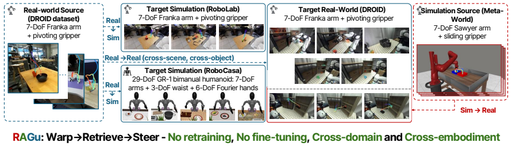
Figure 2 : RAGu enables zero-shot adaptation across domains and embodiments. RAGu transfers manipulation knowledge across four settings: Real→Real, Real→Sim, Sim→Real with different morphologies with the base VLA’s weights completely frozen without any parameter update.
원문 · CC BY 4.0 · Subin Kim, Anh-Quan Pham, Dinesh Jayaraman · Zero-Shot VLA Adaptation with Retrieved Guidance · 원문 그림 인용 · 원본 PDF 3쪽에서 그림 영역을 추출했습니다.RAGu의 워핑, 검색, 에너지 가이던스 구성
RAGu는 Warp, Retrieve, Steer의 세 단계로 구성됩니다. 먼저 과제 범주 키워드(예: pick과 place)로 대규모 실세계 데이터의 시연을 거른 뒤, Grounding DINO로 대상 장면의 과제 관련 객체 bounding box를 찾아 소스 궤적의 waypoint를 대상 장면의 대응 waypoint W′로 옮깁니다. 이 대응은 객체 유사성이 아니라 과제 안에서의 기능적 역할에 따라 정해집니다. 이후 과제 범주마다 참조 궤적 하나를 정하고 Dynamic Time Warping(DTW)으로 각 에피소드 후보를 top-N까지 가지치기하여 오프라인 검색 풀을 만듭니다. 추론 시점에는 VLA가 추정한 행동 청크 Â_τ를 forward kinematics로 Cartesian end-effector 경로 X_t로 바꾸고, 각 후보 W(i)_t와 비교하는 비용 C_i(X_t)를 계산합니다.
선택 기준은 식 (4)의 arg min over i of ‖∇_{A0} C_i(X_t)‖₂이며, 기울기 노름이 작은 후보가 VLA의 학습된 사전 분포를 크게 벗어나지 않게 참조를 제공한다고 저자들은 해석합니다. 선택은 첫 denoising 단계에서 한 번 수행되고 나머지 단계에서는 고정됩니다. 선택된 궤적으로 L_warp(A_τ) = C_{i⋆}(X_t)를 만들고, 식 (2)의 guided velocity v_guided = v − γ∇_{A_τ}L_y에서 L_y를 L_warp로 바꿔 denoising을 조정합니다. 이때 정책 가중치와 맥락 창은 변경하지 않습니다.

Figure 3 :Real-to-Sim Cross-Embodiment Warping.Real-world DROID demonstrations are warped to provide structural priors in simulated environments. The background streams visualize the distribution of candidate trajectories retrieved via coarse-grained DTW filtering.
원문 · CC BY 4.0 · Subin Kim, Anh-Quan Pham, Dinesh Jayaraman · Zero-Shot VLA Adaptation with Retrieved Guidance · 원문 그림 인용 · 원본 PDF 4쪽에서 그림 영역을 추출했습니다.실세계·시뮬레이션 전이에서의 성공률 비교
실세계 DROID 7-DoF Franka 과제 5개에서 RAGu는 80%의 성공률을 보였고, 같은 실험 설정에서 RICL은 0%였으며 unguided π0.5 기준선은 20%였습니다. Omniguide는 40%였습니다. 이 비교는 과제당 10회 rollout으로 측정되었습니다. 원문 표에서 GR00T-N1.7과 π0.5의 평균은 이 표의 3개 과제 열 평균과 구분해 읽어야 합니다. RICL과 RAGu는 같은 100개 워핑 DROID 시연 풀을 사용했으므로, 이 비교는 맥락 토큰 입력과 궤적 가이던스의 차이를 보여 줍니다. Omniguide와 VLS는 희소한 VLM 목표 지점에 가이던스를 주는 방식이며, 접촉이 많은 Wipe Table 과제에서 Omniguide는 중간 waypoint 사이에서 표면 접촉을 잃는다고 원문은 설명합니다.
이 결과는 특정 기반 정책(π0.5)과 특정 과제 집합에서 얻은 것입니다.
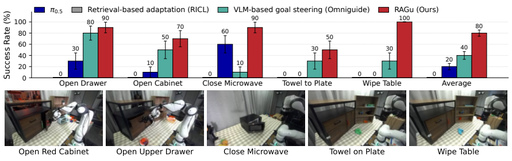
Figure 4 :Real-World Success Rates.Comparing RAGu against the base flow-matching policy ( π0.5), retrieval-based in-context learning baseline (RICL) and a VLM-based goal steering baseline (Omniguide). We evaluate the models across 5 diverse manipulation tasks: Open Drawer , Open Cabinet , Close Microwave , Towel to Plate , & Wipe Table.
원문 · CC BY 4.0 · Subin Kim, Anh-Quan Pham, Dinesh Jayaraman · Zero-Shot VLA Adaptation with Retrieved Guidance · 원문 그림 인용 · 원본 PDF 4쪽에서 그림 영역을 추출했습니다.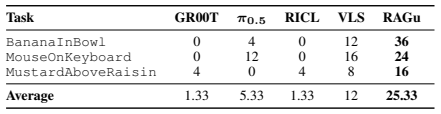
원문 그림 Table I:RoboLab Real-to-Sim Success Rates.Comparing RAGu vs. base VLA policies ( π0.5, GR00T-N1.7), RiCL, and VLS. For fair comparison, RiCL and RAGu use the same pool of 100 demonstrations from DROID. VLS uses π0.5 as the base model. Also see Tab IV
원문 · CC BY 4.0 · Subin Kim, Anh-Quan Pham, Dinesh Jayaraman · Zero-Shot VLA Adaptation with Retrieved Guidance · 원문 그림 인용 · 원본 PDF 4쪽에서 그림 영역을 추출했습니다.Sim-to-real 전이와 휴머노이드 교차 embodiment
Sim-to-real 실험에서는 MetaWorld Sawyer의 bin-picking 궤적 100개를 실세계 DROID 설정으로 워핑했습니다. 객체 전이 설정 중 Cabinet→Shelf에서 π0.5와 Omniguide는 0%였고 RAGu는 60%였습니다. 이 결과는 Cartesian 궤적 가이던스가 렌더링된 소스와 실제 기록 소스에 대해 어느 정도 무관하게 작동함을 시사한다고 저자들은 해석합니다. 교차 embodiment 실험에서는 7-DoF Franka DROID 시연을 29-DoF Fourier GR-1 휴머노이드의 RoboCasa 5개 과제에 가이던스로 사용했습니다. 두 향상 수치는 각 체크포인트의 unguided 기준선에 대한 차이이며, 같은 정책 조건을 넘어 공통 효과로 합산하지 않습니다.
원문은 이 전이가 텍스트로 정의된 관절 매핑이나 역운동학 없이 Cartesian wrist 경로를 미분 가능한 forward kinematics로 맞추어 이뤄진다고 설명합니다.
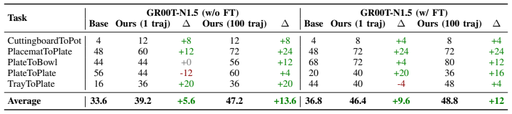
원문 그림 Table II:Cross-embodiment humanoid manipulation with in-context trajectory guidance.We report success rates on RoboCasa tasks using the base GR00T-N1.5 model and its fine-tuned variant. The ∆ columns indicate absolute improvement over the corresponding unguided baseline. Refer to the project website for confidence intervals.
원문 · CC BY 4.0 · Subin Kim, Anh-Quan Pham, Dinesh Jayaraman · Zero-Shot VLA Adaptation with Retrieved Guidance · 원문 그림 인용 · 원본 PDF 5쪽에서 그림 영역을 추출했습니다.Secondary Retrieval 규칙과 검색 풀 크기의 영향
정책 호환성 기반 선택을 검증하기 위해 RoboLab의 세 과제에서 단일 휴리스틱 궤적, 최근접 거리 기준 min dist, 기울기 노름 기준 min grad를 비교했습니다. min grad는 평균 EE SPARC −10.30, 속도 8.37 cm/s, 경로 길이 5.67 m였고, min dist는 EE SPARC −11.74, 속도 7.09 cm/s, 경로 길이 5.79 m였습니다. 따라서 최근접 거리 선택은 비슷한 경로 길이에서 더 느리고 덜 매끄러운 움직임을 보였습니다. 단일 참조 궤적은 더 매끄러운 움직임을 보였지만, 본문 수치에서 성공률은 17.3%였고 100개 궤적 풀은 25.3%였습니다. 이 수치는 RoboLab 9개 과제 평균 Table IV의 28.4%, 36.4%와 비교 범위가 다르므로 함께 해석하지 않습니다.
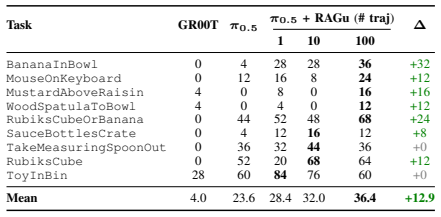
검색 풀을 1, 10, 30, 50, 100개로 늘린 결과에서 9개 과제 평균 성공률은 π0.5 기준선 23.6%에서 1개 궤적 28.4%, 100개 궤적 36.4%로 올랐습니다. 추가로 Table V에서 100개 궤적 풀은 경로 길이를 5.25 m로 줄였습니다. 이 결과는 RoboLab의 9개 과제에 대한 것이며, 원문은 학습이 아닌 검색 규칙 차이를 분리해 비교했다고 설명합니다.
원문 그림 Table III:Utility of policy-aware secondary retrieval. Trajectory metrics on RoboLab for three tasks in Table I, 25 rollouts per task. We use the same pool of 100 warped DROID demonstrations, while only the rule that picks the guiding trajectory changes.1 trajuses only a single heuristically selected trajectory.min distselects arg mini Ci(Xt) (Eq. 3), andmin gradselects arg mini ∥∇A0 Ci(Xt)∥2 (Eq. 4) from a 100 trajectory pool. Refer toSecondary Retrieval ablation in the project website.
원문 · CC BY 4.0 · Subin Kim, Anh-Quan Pham, Dinesh Jayaraman · Zero-Shot VLA Adaptation with Retrieved Guidance · 원문 그림 인용 · 원본 PDF 6쪽에서 그림 영역을 추출했습니다.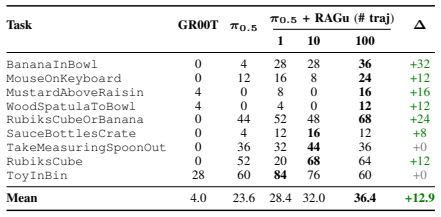
원문 그림 Table IV:Scaling the retrieval pool on Real-to-Sim RoboLab.Task-wise success rates (%, 25 rollouts per task) for GR00T-N1.7, π0.5, and π0.5 + RAGu guided by 1, 10, or 100 warped DROID demonstrations. ∆ is the absolute gain of the 100-trajectory pool over π0.5; bold marks the best entry in each row. Expanding the pool consistently helps: mean success rises from 23.6% (unguided) to 28.4% with a single trajectory and 36.4% with 100. See Table VII in the Appendix for the full version.
원문 · CC BY 4.0 · Subin Kim, Anh-Quan Pham, Dinesh Jayaraman · Zero-Shot VLA Adaptation with Retrieved Guidance · 원문 그림 인용 · 원본 PDF 6쪽에서 그림 영역을 추출했습니다.적용 범위와 확인되지 않은 조건
원문은 RAGu가 소스 데이터베이스에 대상 과제 범주와 대략 일치하는 시연이 있다고 가정한다고 밝힙니다. 또 카메라 배치와 가림에 대해 불변이 아니며, 의미 대응 실패가 3D 워핑을 저하시켜 가이던스 신호를 손상시킬 수 있습니다. 가이던스는 VLA의 사전 분포 안에서만 운동을 재형성할 수 있으므로, 정책이 수행할 수 없는 궤적을 만들어 내지는 못합니다. RoboLab 워핑 성공률은 65.1%로 추정되며 나머지 34.9%의 실패 가운데 데모 파싱 오류가 장면 대응 실패보다 약 두 배 큽니다. π0.5-DROID의 비가이던스 RoboLab 평균 성공률은 재측정에서 14.0%였고, 원 RoboLab 보고의 28.0%와 차이가 있어 저자들은 샘플 수 차이 때문일 수 있다고 해석합니다.
부록의 신뢰구간은 성공률 표 전체에 대한 것이 아니라 Wilson 방식으로 계산된 값이므로 비교 해석 시 구분해야 합니다.
논문 정보
- 저자
- Subin Kim, Anh-Quan Pham, Dinesh Jayaraman
- 학회·저널
- arXiv · 프리프린트
- 최초 공개일
- 2026년 11월 7일
- 등록일
- 2026년 11월 10일
- 수정일
- 2026년 11월 7일
- 버전
- v1
- arXiv
- 2611.10894
- 분류
- cs.RO · cs.AI · cs.LG
- 원문 이용 조건
- CC BY 4.0
- 제공 범위
- 논문 정보, 해설, 허용된 원문 그림
AI 해설은 논문 원문과 별개의 설명이며 오류가 있을 수 있습니다. 원문과 그림은 각 출처의 이용 조건과 따로 표시된 권리를 따릅니다.
초록
Pre-training large parametric "Vision-Language-Action" (VLA) models on large demonstration datasets has recently yielded promising results for general-purpose manipulation. However, these models still struggle under even small domain shifts relative to the training data, such as changes in camera viewpoint, background, object identity, or robot morphology. Motivated by the success of Retrieval-Augmented Generation (RAG) in language models, we pursue retrieval to boost VLA performance. Specifically, we seek to leverage retrieval from domain-mismatched, "in-the-wild" demonstration datasets like DROID to guide a VLA's behavior in a new target domain. To achieve this, we introduce RAGu, which overcomes robotics-specific challenges for RAG: (1) It incorporates simple geometric calibration to transform source demonstrations into the target setup and reduce cross-domain differences. (2) It uses a coarse-to-fine retrieval strategy that selects, from a large pool of pre-warped candidates, the trajectory most compatible with the base VLA. (3) It guides the VLA's flow-matching inference procedure rather than seeking to retrain the base model or expand its limited context window. We evaluate RAGu across real-world, simulation, sim-to-real transfer, and cross-embodiment humanoid manipulation. We find it improves real-world VLA success rates from 20% to 80% and outperforms the closest-related baselines in sim. Project website: raguvla.github.io
원문 인용
Subin Kim, Anh-Quan Pham, Dinesh Jayaraman (2026). Zero-Shot VLA Adaptation with Retrieved Guidance. arXiv:2611.10894v1. https://arxiv.org/abs/2611.10894v1
BibTeX
@misc{kim2026zero,
  title = {{Zero-Shot VLA Adaptation with Retrieved Guidance}},
  author = {Subin Kim and Anh-Quan Pham and Dinesh Jayaraman},
  year = {2026},
  eprint = {2611.10894},
  archivePrefix = {arXiv},
  url = {https://arxiv.org/abs/2611.10894v1}
}