논문 해설
Robot Hand-Eye Calibration using Structure-from-Motion
Structure-from-Motion을 이용한 로봇 핸드-아이 캘리브레이션
- 연구 문제 교정 리그를 쓸 수 없는 현장에서 카메라와 로봇 엔드이펙터 사이의 hand-eye 변환을 자체 보정하는 방법을 다룹니다.
- 연구 방법 Structure-from-motion으로 얻은 카메라 운동의 미지 스케일을 포함해 hand-eye 방정식을 Kronecker 곱과 vec 연산으로 선형 시스템으로 바꿉니다.
- 주요 결과 순수 병진과 두 축이 평행하지 않은 순수 회전 등 운동 조건에 따라 회전과 스케일, 일부 병진 성분이 복원되며, 실험에서 선형 방법은 회전 오차가 가장 작게 보고되었습니다.
교정 리그 없이 하는 현장 hand-eye 보정
로봇에 장착된 카메라와 엔드이펙터 사이의 강체 변환을 hand-eye 변환 X=(Rx, tx)라고 합니다. 기존 방법은 보통 3D 좌표를 알고 있는 교정 리그를 두고 카메라 자세를 추정하는데, 이동 로봇이나 우주 응용처럼 리그를 실을 수 없는 경우에는 이 방식을 쓸 수 없습니다. 또한 현장의 작업 공간은 제한되어 있어 큰 운동을 하기 어렵습니다. 이 논문은 이러한 조건에서 주변 환경의 특징점을 추적하여 카메라 운동을 얻고, 교정 리그 없이 hand-eye 변환을 추정하는 것을 목표로 합니다.
Structure-from-motion 운동과 미지 스케일의 결합
기존 방법은 카메라 운동을 교정 리그에 대한 자세 추정으로 구하지만, 이 논문은 structure-from-motion으로 카메라 운동을 구합니다. 이 경우 카메라 병진은 공통의 미지 스케일 λ 배만큼 불확실하며, 회전은 완전히 복원됩니다. 이에 따라 hand-eye 방정식 A_i(λ)X=XB_i의 미지수에 회전, 병진과 함께 λ를 포함시킵니다. 이 식은 회전 부분 R_ai R_x = R_x R_bi와 병진 부분 R_ai t_x + λ u_ai = R_x t_bi + t_x로 나뉩니다.
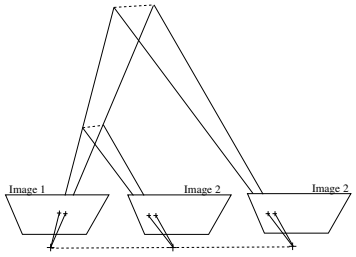
Figure 4 . Given two images, structure-from-motion methods determine the direction of the baseline between the two camera positions, but not the baseline length. Thus, the size of the reconstructed object is not determined since it is proportional to the unknown baseline length.
원문 · CC BY 4.0 · Nicolas Andreff, Radu Horaud, Bernard Espiau · Robot Hand-Eye Calibration using Structure-from-Motion · 원문 그림 인용 · 원본 PDF 3쪽에서 그림 영역을 추출했습니다.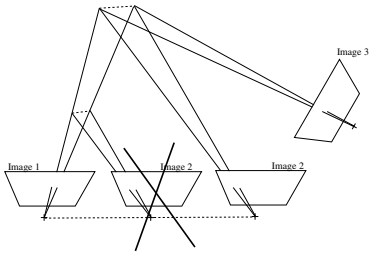
Figure 5 . Once the scale factor is resolved between the first two images, the second camera position is uniquely defined with respect to the first one and consequently, the following camera positions are also uniquely defined.
원문 · CC BY 4.0 · Nicolas Andreff, Radu Horaud, Bernard Espiau · Robot Hand-Eye Calibration using Structure-from-Motion · 원문 그림 인용 · 원본 PDF 4쪽에서 그림 영역을 추출했습니다.Kronecker 곱으로 만든 선형 시스템
저자들은 회전을 직교 행렬로 표현하여 회전 조건을 선형으로 다룹니다. 회전 식 R_ai R_x = R_x R_bi는 Sylvester 방정식과 비슷하므로, Kronecker 곱과 vec 연산을 이용해 (R_ai ⊗ R_bi) vec(R_x) = vec(R_x) 형태로 바꿉니다. 병진 식에는 (I3 ⊗ t_bi^T) vec(R_x) + (I3 − R_ai) t_x − λ u_ai = 0을 적용해 전체를 vec(R_x), t_x, λ에 대한 동차 선형 시스템으로 만듭니다. 이때 직교성 제약은 선형 노름 제약으로 바뀌는 것으로 설명됩니다.
운동 조건별 해의 분석
선형 시스템의 rank에 따라 해의 유일성과 복원되는 성분이 달라집니다. 순수 병진 운동에서는 엔드이펙터 회전이 항등행렬이므로 두 개 이상의 선형 독립 병진이 있으면 회전 Rx와 스케일 λ를 추정할 수 있습니다. 명제 2는 최소 두 개의 독립 순수 병진이 필요하다고 기술합니다. 반면 hand-eye 병진 tx는 관측되지 않습니다. 순수 회전 운동에서는 두 축이 평행하지 않은 n≥2개의 회전이 있을 때 Lemma 1로 null space가 1차원이 되고, Rx가 null space 행렬 V에서 μ=sgn(det V)|det V|^{1/3}로 정해집니다. 평면 운동에서는 병진의 평면 법선 성분 α가 결정되지 않습니다.
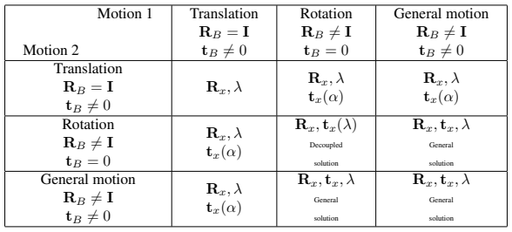
Table 1 . Summary of the results for two independent motions.
원문 · CC BY 4.0 · Nicolas Andreff, Radu Horaud, Bernard Espiau · Robot Hand-Eye Calibration using Structure-from-Motion · 원문 그림 인용 · 원본 PDF 6쪽에서 그림 영역을 추출했습니다.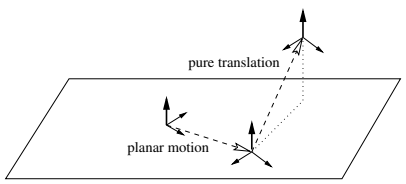
Figure 7 . One planar motion with non-identity rotation and one non-zero pure translation which is not parallel to the rotation axis of the planar motion.
원문 · CC BY 4.0 · Nicolas Andreff, Radu Horaud, Bernard Espiau · Robot Hand-Eye Calibration using Structure-from-Motion · 원문 그림 인용 · 원본 PDF 7쪽에서 그림 영역을 추출했습니다.잡음과 실제 데이터에서의 비교
시뮬레이션에서는 잡음 비율 ν를 0부터 20%까지 바꾸어 Tsai and Lenz 방법(M1), 이중 쿼터니언 방법(M2), 비선형 최소화(M3), 선형 방법(M4)을 비교했습니다. 첫 번째 설정은 운동당 최대 1 m 병진과 180 deg 회전을 사용했고, 원문은 M1과 M4가 회전 정확도에서 가장 높다고 보고합니다. 병진에서는 잡음이 커질수록 M2나 M3보다 정확도가 낮다고 보고됩니다. 실제 데이터 실험 1에서는 33개 위치의 보정 격자 영상으로 자체 보정 방법(M5)을 기준 추정과 비교했습니다. 이 실험의 회전 오차는 선형 방법 M4가 가장 작고 M5는 더 큰 오차를 보였습니다.
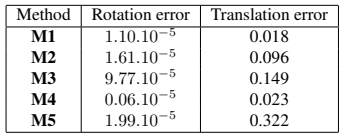
Table 2 . Comparison with a reference estimation of the hand-eye transformation.
원문 · CC BY 4.0 · Nicolas Andreff, Radu Horaud, Bernard Espiau · Robot Hand-Eye Calibration using Structure-from-Motion · 원문 그림 인용 · 원본 PDF 11쪽에서 그림 영역을 추출했습니다.적용 범위와 남은 한계
평면 운동에서는 hand-eye 병진의 법선 성분 α가 복원되지 않으므로 차량 높이 같은 값은 이 방법만으로 확정되지 않습니다. 또한 Euclidean reconstruction에 사용한 Christy and Horaud 방법은 점들을 궤적 끝까지 추적해야 하는 강한 제약이 있다고 저자들이 지적합니다. 저자들은 스테레오 비전을 이 문제의 가능한 해법으로 제시하지만, 이 논문이 그 방법을 구현하여 검증한 것은 아닙니다.
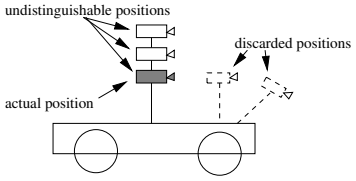
Figure 8 . In the case of planar motions, one can not determine the altitude of a camera which is rigidly mounted onto the base.
원문 · CC BY 4.0 · Nicolas Andreff, Radu Horaud, Bernard Espiau · Robot Hand-Eye Calibration using Structure-from-Motion · 원문 그림 인용 · 원본 PDF 7쪽에서 그림 영역을 추출했습니다.논문 정보
- 저자
- Nicolas Andreff, Radu Horaud, Bernard Espiau
- 학회·저널
- arXiv · 프리프린트
- 최초 공개일
- 2023년 11월 20일
- 등록일
- 2026년 11월 6일
- 수정일
- 2023년 11월 21일
- 버전
- v2
- arXiv
- 2311.11808
- DOI
- 10.1177/02783640122067372
- 분류
- cs.RO · cs.CV
- 원문 이용 조건
- CC BY 4.0
- 제공 범위
- 논문 정보, 해설, 허용된 원문 그림
AI 해설은 논문 원문과 별개의 설명이며 오류가 있을 수 있습니다. 원문과 그림은 각 출처의 이용 조건과 따로 표시된 권리를 따릅니다.
초록
In this paper we propose a new flexible method for hand-eye calibration. The vast majority of existing hand-eye calibration techniques requires a calibration rig which is used in conjunction with camera pose estimation methods. Instead, we combine structure-from-motion with known robot motions and we show that the solution can be obtained in linear form. The latter solves for both the hand-eye parameters and for the unknown scale factor inherent with structure-from-motion methods. The algebraic analysis that is made possible with such a linear formulation allows to investigate not only the well known case of general screw motions but also such singular motions as pure translations, pure rotations, and planar motions. In essence, the robot-mounted camera looks to an unknown rigid layout, tracks points over an image sequence and estimates the camera-to-robot relationship. Such a self calibration process is relevant for unmanned vehicles, robots working in remote places, and so forth. We conduct a large number of experiments which validate the quality of the method by comparing it with existing ones.
원문 인용
Nicolas Andreff, Radu Horaud, Bernard Espiau (2023). Robot Hand-Eye Calibration using Structure-from-Motion. arXiv:2311.11808v2. https://doi.org/10.1177/02783640122067372
BibTeX
@article{andreff2023robot,
  title = {{Robot Hand-Eye Calibration using Structure-from-Motion}},
  author = {Nicolas Andreff and Radu Horaud and Bernard Espiau},
  year = {2023},
  eprint = {2311.11808},
  archivePrefix = {arXiv},
  doi = {10.1177/02783640122067372},
  url = {https://arxiv.org/abs/2311.11808v2}
}