논문 해설
Bi-Touch: Bimanual Tactile Manipulation with Sim-to-Real Deep Reinforcement Learning
Bi-Touch: 시뮬레이션에서 실제로 전이하는 심층 강화학습 기반 양손 촉각 조작
- 연구 문제 양팔 촉각 조작은 로봇 시스템 통합과 고가 장비, 그리고 고해상도 촉각을 쓰는 양팔 제어기 설계의 어려움 때문에 충분히 연구되지 않았습니다.
- 연구 방법 저비용 Dobot MG400 두 대와 TacTip 촉각 센서로 구성한 Bi-Touch 시스템에서, 시뮬레이션 PPO 정책을 GAN 기반 real-to-sim 촉각 이미지 번역을 거쳐 실제 로봇에 적용합니다.
- 주요 결과 시뮬레이션과 실제 로봇에서 bi-pushing, bi-reorienting, bi-gathering 과제가 수행되었으며, GUM은 perturbation이 있는 bi-gathering 학습을 가능하게 했습니다. 실제 결과는 객체와 perturbation 조건에 따라 달랐습니다.
양팔 촉각 조작의 어려움
양팔 로봇은 큰 물체나 서로 연결된 물체를 다룰 때 단일 팔보다 유리하지만, 시스템 통합과 제어기 설계가 복잡하고 고가의 장비가 많아 연구 접근성이 낮습니다. 촉각 센서는 접촉 힘을 조절하고 시각이 가려진 상황에서 안정적인 조작을 돕지만, 고해상도 촉각을 쓰는 양팔 제어기를 미지의 물체와 불확실한 환경에서 설계하는 과제는 아직 열려 있습니다. 이 논문은 저비용 양팔 촉각 로봇 플랫폼을 만들고, 시뮬레이션에서 학습한 심층 강화학습 정책을 실제 로봇으로 옮기는 문제를 다룹니다. 실제 적용에서는 시뮬레이션과 실제 사이의 차이, 팔 충돌, 반복 리셋, 센서 손상 같은 문제가 함께 나타납니다.
Bi-Touch 시스템과 sim-to-real 학습 흐름
Bi-Touch는 Tactile Gym 2.0 설정을 바탕으로 두 대의 Dobot MG400 로봇 팔 끝에 TacTip 촉각 센서를 장착한 시스템입니다. 학습은 세 단계로 이루어집니다. 첫째, 시뮬레이션에서 두 TacTip의 합성 촉각 이미지와 고유수용 감각 정보를 관측으로 사용하여 PPO 정책을 학습합니다. 둘째, 실제 촉각 이미지와 시뮬레이션 촉각 이미지 쌍으로 GAN 기반 real-to-sim 번역 모델을 학습합니다. 셋째, 실제 촉각 이미지를 번역 모델로 시뮬레이션 형태로 바꾼 뒤 학습된 정책에 입력하여 실제 로봇에서 과제를 수행합니다. 정책의 행동 공간은 bi-reorienting에서 6차원이며, bi-pushing과 bi-gathering에서는 4차원입니다.
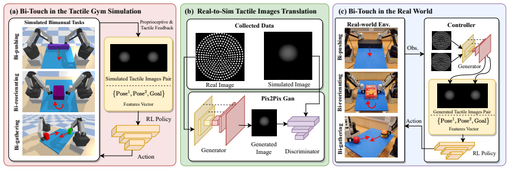
Figure 1 . Overview of the proposed dual-arm tactile robotic system (Bi-Touch) with sim-to-real deep RL. a) Deep RL is applied to learn policies for three simulated bimanual tactile manipulation tasks (red arrows show desired displacements) using Tactile Gym. b) Real-to-sim tactile image generator learnt for the surface feature. c) The real-world evaluation feeds real tactile images through the generator into the RL policy concatenated with proprioceptive information.
원문 · CC BY 4.0 · Yijiong Lin, Alex Church, Max Yang, Haoran Li, John Lloyd, Dandan Zhang, Nathan F. Lepora · Bi-Touch: Bimanual Tactile Manipulation with Sim-to-Real Deep Reinforcement Learning · 원문 그림 인용 · 원본 PDF 2쪽에서 그림 영역을 추출했습니다.세 가지 양팔 촉각 과제와 보상 설계
Bi-pushing은 두 TacTip이 큰 물체를 주어진 목표 궤적을 따라 밀도록 하며, 보상은 목표 위치와 물체 위치의 차이, 물체 방향 오차, 각 TCP의 방향 정렬 항으로 구성됩니다. Bi-reorienting은 작업 공간 중앙의 물체를 목표 각도로 돌리되 물체 중심을 원래 위치에 고정하는 과제이며, 목표 각도 항과 위치 유지 항, TCP 방향 항, 원하는 접촉점 유지 항을 함께 씁니다. Bi-gathering은 두 물체를 서로 향해 밀어 모으는 과제로, 목표가 상대 물체의 현재 위치로 계속 바뀌므로 정적 목표보다 탐색이 어렵습니다. 이 과제의 보상은 두 물체 사이 거리 항, TCP 방향 정렬 항, 접촉점 유지 항으로 이루어집니다.
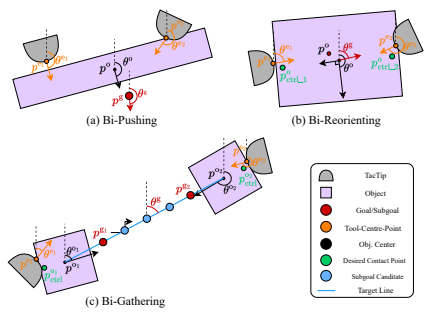
Figure 2 . Illustration of the reward functions for all three proposed bimanual tasks: (a) bi-pushing, (b) bi-reorienting, and (c) bi-gathering. The notations in red are the goals (or subgoals) and those in orange are the proprioceptive information that is part of the observation.
원문 · CC BY 4.0 · Yijiong Lin, Alex Church, Max Yang, Haoran Li, John Lloyd, Dandan Zhang, Nathan F. Lepora · Bi-Touch: Bimanual Tactile Manipulation with Sim-to-Real Deep Reinforcement Learning · 원문 그림 인용 · 원본 PDF 3쪽에서 그림 영역을 추출했습니다.목표 갱신 메커니즘(GUM)과 curriculum
Bi-gathering에서 저자들은 물체 위치를 다른 물체의 목표로 두는 방식이 perturbation이 있는 희소 목표에서 잘 작동하지 않는다고 보고 GUM을 제안합니다. GUM은 목표선 위에 n개의 정적 subgoal 점을 같은 간격으로 생성하고, 목표선을 h 시간 스텝마다 갱신합니다. 각 팔에는 자기 쪽에서 가까운 물체에 가까운 subgoal이 할당되며, 이 항이 목표선 방향 보조 보상을 제공합니다. 원문은 n=10이 n=[5,10,20] 가운데 약간 더 좋았고, h=75가 h=[25,50,75,100] 가운데 가장 좋았다고 보고합니다. 실제 로봇에서는 물체 위치를 알 수 없어 TCP 위치로 목표선을 만들며, 시뮬레이션에서는 TCP로만 처음부터 학습하면 실패하므로 물체 중심 기반 목표선으로 먼저 학습한 뒤 TCP로 전환하는 2단계 curriculum을 사용합니다.
시뮬레이션 과제 결과
시뮬레이션 bi-pushing의 정확도는 20회 테스트(궤적 유형별 10회)에서 12.3 ± 4.8 mm로 보고됩니다. Bi-reorienting의 시뮬레이션 결과는 10회 테스트에서 translation error 10.2 ± 4.8 mm, orientation error 3.4 ± 1.8◦입니다. Bi-gathering에서는 GUM을 적용한 정책이 perturbation이 없을 때 더 짧은 에피소드 시간으로 과제를 수행했고, perturbation이 있을 때에도 GUM이 없는 경우와 달리 학습이 성공했습니다. perturbation 조건의 GUM 정책은 5회 시뮬레이션 테스트에서 perturbation 시점을 달리한 성공률 100%를 보였습니다.
실제 로봇 과제 결과와 조건
실제 bi-pushing은 tripod box, shuttle tube, loudspeaker 세 객체에서 각 20회 테스트(궤적 유형별 10회)로 평가되었으며, 정확도는 각각 14.2 ± 6.4 mm, 16.6 ± 7.7 mm, 17.4 ± 8.1 mm입니다. 실제 bi-reorienting에서는 삼각기둥을 제외한 객체의 translation error가 12.5 ± 5.3 mm에서 19.5 ± 7.0 mm 범위였고, orientation error는 7.5 ± 3.9◦에서 13.4 ± 6.5◦ 범위였습니다. 실제 bi-gathering은 perturbation 없이 각 객체 쌍에서 10회 시도를 모두 성공했으며, perturbation 횟수별 성공률은 Table III에 보고됩니다.
벽돌 실험은 별도로 20회 시험에서 95% 성공률을 보였습니다. 이 결과들은 저자가 제시한 특정 객체와 실험 설정에서 얻은 것입니다.
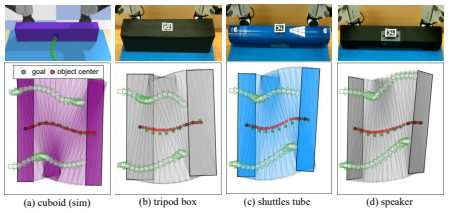
Figure 5 . The objects’ trajectories plots (in red) of the bi-pushing task with (a) a cuboid (simulation), (b) a tripod box, (c) a shuttles tube and (d) a loudspeaker. The TacTips’ trajectories are indicated with green arrows.
원문 · CC BY 4.0 · Yijiong Lin, Alex Church, Max Yang, Haoran Li, John Lloyd, Dandan Zhang, Nathan F. Lepora · Bi-Touch: Bimanual Tactile Manipulation with Sim-to-Real Deep Reinforcement Learning · 원문 그림 인용 · 원본 PDF 5쪽에서 그림 영역을 추출했습니다.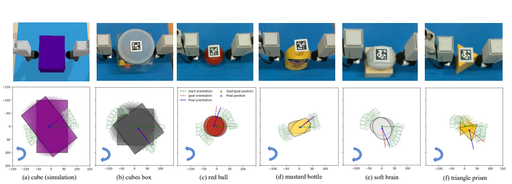
Figure 6 . Object trajectories for the bi-reorienting task for the (a) cuboid (simulation), (b) cubes box, (c) plastic ball, (d) mustard bottle, (e) soft brain toy and (j) triangular prism. End-effector positions during the trajectories (green arrows) are shown, and the start, goal and final object orientations (lines).
원문 · CC BY 4.0 · Yijiong Lin, Alex Church, Max Yang, Haoran Li, John Lloyd, Dandan Zhang, Nathan F. Lepora · Bi-Touch: Bimanual Tactile Manipulation with Sim-to-Real Deep Reinforcement Learning · 원문 그림 인용 · 원본 PDF 6쪽에서 그림 영역을 추출했습니다.한계와 향후 방향
Bi-reorienting의 초기 sim-to-real 적용에서는 큰 목표 각도에서 정책이 물체를 squeeze하는 현상이 관찰되었습니다. 저자들은 이를 시뮬레이션에서 TacTip의 stiffness와 damping을 더 탄력 있게 조정하여 완화했으며, 해당 변경이 성공에 가장 크게 기여했다고 보고합니다. 정책은 시뮬레이션에서 cube 형태 객체로만 학습되었으므로 round 객체에서 상대적으로 낮은 정확도가 나타났고, 삼각기둥은 날카로운 모서리에서 slippage가 발생해 실패했습니다. 전단 변형은 아직 시뮬레이션에 반영되지 않았으며, 마찰력 제어가 필요한 복잡한 과제에서는 추가 연구가 필요합니다. 예비적으로 제안된 bi-lifting 과제도 이 논문의 주요 검증 범위에는 포함되지 않습니다.
논문 정보
- 저자
- Yijiong Lin, Alex Church, Max Yang, Haoran Li, John Lloyd, Dandan Zhang, Nathan F. Lepora
- 학회·저널
- arXiv · 프리프린트
- 최초 공개일
- 2023년 7월 12일
- 등록일
- 2026년 11월 6일
- 수정일
- 2023년 7월 12일
- 버전
- v1
- arXiv
- 2307.06423
- 분류
- cs.RO
- 원문 이용 조건
- CC BY 4.0
- 제공 범위
- 논문 정보, 해설, 허용된 원문 그림
AI 해설은 논문 원문과 별개의 설명이며 오류가 있을 수 있습니다. 원문과 그림은 각 출처의 이용 조건과 따로 표시된 권리를 따릅니다.
초록
Bimanual manipulation with tactile feedback will be key to human-level robot dexterity. However, this topic is less explored than single-arm settings, partly due to the availability of suitable hardware along with the complexity of designing effective controllers for tasks with relatively large state-action spaces. Here we introduce a dual-arm tactile robotic system (Bi-Touch) based on the Tactile Gym 2.0 setup that integrates two affordable industrial-level robot arms with low-cost high-resolution tactile sensors (TacTips). We present a suite of bimanual manipulation tasks tailored towards tactile feedback: bi-pushing, bi-reorienting and bi-gathering. To learn effective policies, we introduce appropriate reward functions for these tasks and propose a novel goal-update mechanism with deep reinforcement learning. We also apply these policies to real-world settings with a tactile sim-to-real approach. Our analysis highlights and addresses some challenges met during the sim-to-real application, e.g. the learned policy tended to squeeze an object in the bi-reorienting task due to the sim-to-real gap. Finally, we demonstrate the generalizability and robustness of this system by experimenting with different unseen objects with applied perturbations in the real world. Code and videos are available at https://sites.google.com/view/bi-touch/.
원문 인용
Yijiong Lin, Alex Church, Max Yang, Haoran Li, John Lloyd, Dandan Zhang, Nathan F. Lepora (2023). Bi-Touch: Bimanual Tactile Manipulation with Sim-to-Real Deep Reinforcement Learning. arXiv:2307.06423v1. https://arxiv.org/abs/2307.06423v1
BibTeX
@misc{lin2023touch,
  title = {{Bi-Touch: Bimanual Tactile Manipulation with Sim-to-Real Deep Reinforcement Learning}},
  author = {Yijiong Lin and Alex Church and Max Yang and Haoran Li and John Lloyd and Dandan Zhang and Nathan F. Lepora},
  year = {2023},
  eprint = {2307.06423},
  archivePrefix = {arXiv},
  url = {https://arxiv.org/abs/2307.06423v1}
}