논문 해설
Re-Search: Dissecting LLM Ideation Through a Two-Player Questioning Game
Re-Search: 두 플레이어 질문 게임을 통한 LLM 아이디어 발상 분석
- 연구 문제 기존 평가는 연구 아이디어가 반복 탐색으로 어떻게 바뀌는지 가려 왔습니다.
- 연구 방법 질문 게임 RE-SEARCH에서 질문자가 예/아니오 질문으로 논문의 핵심 아이디어를 재발견하며, 심사위원이 아이디어 카드를 점수화합니다.
- 주요 결과 대부분의 모델은 약 30개 질문 이후 정체되며, 설문에 핵심 아이디어가 포함되면 약한 모델의 점수가 크게 오릅니다.
연구 문제: 아이디어 탐색 과정은 왜 가려지는가
연구 아이디어 생성은 한 번의 제안이 아니라 피드백을 받으며 아이디어를 다듬는 반복 과정입니다. 기존 평가는 한 번의 제안을 LLM 심사위원으로 채점하거나, 코딩과 실험이 섞인 종단간 벤치마크로 측정해 왔습니다. 이 때문에 아이디어가 어떻게 바뀌는지와 실행 실패와 구분되는 탐색 실패를 따로 보기 어렵습니다. 이 논문은 질문 게임 RE-SEARCH로 이 탐색 과정을 분리해 관찰하려고 합니다. 게임에서 질문자 모델은 연구 문제 p만 보고 예/아니오 질문을 던지며, 답변자 모델은 논문 전문을 읽고 응답합니다. 정해진 시점마다 질문자는 아이디어 카드를 작성하고, 심사위원이 이를 숨겨진 해법과 비교해 점수를 매깁니다.
질문 게임의 구성과 점수 계산
질문자 모델 M_i는 p와 이전 질문·응답 이력 h_{t-1}로 질문 q_t를 만듭니다. 답변자 M_a는 논문 d와 q_t만 받아 YES, NO, UNKNOWN 중 하나를 답합니다. 0번과 10번 간격 시점에서 질문자는 현재 아이디어 카드 c_t를 씁니다. 이후 세 심사위원이 저장된 카드들을 숨겨진 해법 s와 비교해 1–10점으로 평가하며, 복원 점수 r_t는 세 평점의 평균입니다. 심사위원은 게임 중 피드백을 받지 않으며, 질문 수 T 동안 정보량은 최대 T log2 3 비트로 상한이 잡힙니다. 이 상한은 주어진 문제 조건에서의 정보량에 관한 것이며 특정 복원 점수를 보장하지는 않습니다.
실험 설정과 질문 수에 따른 복원 점수 변화
실험은 ICML 2026에서 선정된 논문 200편을 사용하며, 각 논문에 대해 게임을 세 번 수행합니다. 질문은 최대 100개이며, 답변자로는 Gemma-4-31B를 사용합니다. 여섯 모델의 결과를 보면, 대부분의 점수 상승은 첫 30개 질문 안에서 일어나고 이후 대부분 모델의 향상은 둔화됩니다. 이 논문은 이 현상을 같은 모델의 점수 궤적으로 보여 주며, 30번째 질문 시점의 점수가 최종 점수를 잘 예측한다고 보고합니다. 다만 GPT-5.4만은 이후에도 꾸준히 오릅니다. 이 결과는 본 게임 설정과 해당 모델 집합에서 얻은 것입니다.
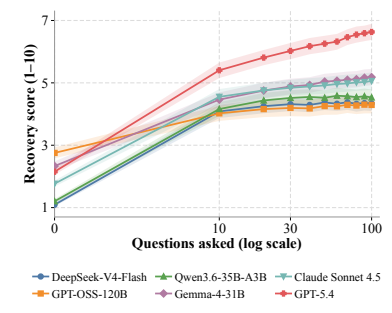
Figure 3 : Recovery score of the games over 100 rounds, averaged over 200 papers and three games per paper. The patterns of models are different: three models gain little after the first 30 questions, Gemma and Sonnet slowly climb, while GPT-5.4 has consistent improve- ment. (§4.1)
원문 · CC BY 4.0 · Muhan Gao, Hangxiao Zhu, Xinqi Su, Yu Zhang, Daniel Khashabi, Kuan-Hao Huang · Re-Search: Dissecting LLM Ideation Through a Two-Player Questioning Game · 원문 그림 인용 · 원본 PDF 4쪽에서 그림 영역을 추출했습니다.지식 부족과 후보 생성 능력의 차이
논문은 모델 간 격차가 지식 부족 때문인지 확인하기 위해 닫힌 책 탐침을 사용합니다. 따라서 지식이 격차의 일부만 설명한다고 해석됩니다. 다음으로 약한 모델이 여러 모델이 제안한 후보 질문 중에서 고르도록 하면, 네 모델의 점수가 5.19–5.34로 모이며 약한 모델의 단독 기준선보다 1점 이상 높아집니다. 무작위 선택은 4.43으로 단독 수행과 유의하게 다르지 않습니다. 이는 후보 생성이 중요하다는 근거이며, 선택 능력 자체가 전적으로 부족하다는 뜻은 아닙니다.
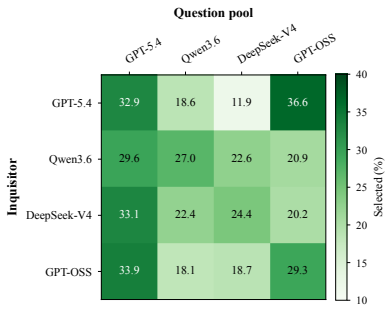
Figure 5 : Share of questions (%) each inquisitor (row) chooses from each proposer (column) in the four-model pool on 200 papers. All models favor questions from GPT-5.4 and themselves. While the proportions differ across inquisitors, the final scores are close. All four score between 5.19 and 5.34, with no significant differ- ence. (§5.2)
원문 · CC BY 4.0 · Muhan Gao, Hangxiao Zhu, Xinqi Su, Yu Zhang, Daniel Khashabi, Kuan-Hao Huang · Re-Search: Dissecting LLM Ideation Through a Two-Player Questioning Game · 원문 그림 인용 · 원본 PDF 6쪽에서 그림 영역을 추출했습니다.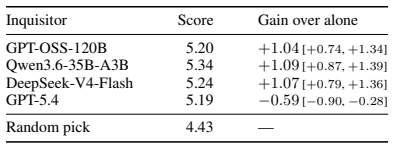
Table 2 : Score after 30 questions for each inquisitor on the same four-model pool on 200 papers. The last column gives the difference from each model’s solo baseline, with 95% confidence intervals. (§5.2)
원문 · CC BY 4.0 · Muhan Gao, Hangxiao Zhu, Xinqi Su, Yu Zhang, Daniel Khashabi, Kuan-Hao Huang · Re-Search: Dissecting LLM Ideation Through a Two-Player Questioning Game · 원문 그림 인용 · 원본 PDF 7쪽에서 그림 영역을 추출했습니다.설문 문맥 조건이 가설 공간을 넓히는 방식
실험의 설문 조건은 연구 문제의 가설 공간을 차원과 후보 접근법으로 제시합니다. Cfull은 핵심 아이디어를 설문에 포함하고, Cdecoy는 같은 줄의 그럴듯한 대체 기법으로 바꿉니다. Cnone은 설문이 없는 경우입니다. 두 조건의 차이는 핵심 아이디어 한 줄뿐이므로, 그 차이는 핵심 아이디어가 설문에 들어 있는지에서 비롯됩니다. 질문 100개 시점에서 Cfull은 여러 모델의 곡선을 Cdecoy와 Cdummy보다 확실히 위로 올리며, 최종 점수 향상은 최대 1.25점입니다. 점수 향상은 Cdecoy에서 점수가 낮았던 모델일수록 큽니다. 다만 모델들이 설문 항목을 순서대로 훑어서 얻은 결과는 아니며, 명명된 아이디어를 중앙값 3–6번째 질문에서 집중적으로 묻는 것으로 보고됩니다.
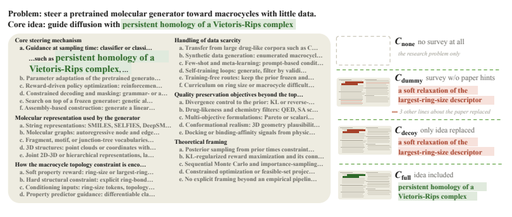
Figure 4 : An example survey under Cfull.Left:the Cfull survey given before the game, which names the core idea as one option, with no extra hint.Right:how the four context conditions differ. Cdecoy replaces only that phrase with a plausible decoy, Cdummy also replaces the other lines that point to the paper, and Cnone gives no survey. Because Cfull and Cdecoy differ in a single phrase, any difference between them only comes from whether the core idea is in the survey. (§5.3)
원문 · CC BY 4.0 · Muhan Gao, Hangxiao Zhu, Xinqi Su, Yu Zhang, Daniel Khashabi, Kuan-Hao Huang · Re-Search: Dissecting LLM Ideation Through a Two-Player Questioning Game · 원문 그림 인용 · 원본 PDF 6쪽에서 그림 영역을 추출했습니다.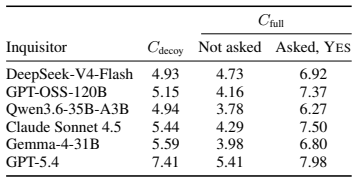
Table 8 : Score at question 100 under Cdecoy, and under Cfull split by whether the game asked about the core idea and got a YES. (§C)
원문 · CC BY 4.0 · Muhan Gao, Hangxiao Zhu, Xinqi Su, Yu Zhang, Daniel Khashabi, Kuan-Hao Huang · Re-Search: Dissecting LLM Ideation Through a Two-Player Questioning Game · 원문 그림 인용 · 원본 PDF 15쪽에서 그림 영역을 추출했습니다.탐색 나무가 보여 주는 두 가지 실패 양상
논문은 질문 기록을 나무로 바꾸어 각 질문이 기존 질문의 자식인지, 새 최상위 가지를 여는지 봅니다. 최상위 가지 수로 보면 DeepSeek-V4-Flash와 Qwen3.6은 게임당 5.2–5.5개의 가지만 열어 한 방향의 변형을 반복하는 과잉 활용 양상을 보입니다. GPT-OSS-120B는 13.7개의 가지를 열어 피드백과 관계없이 새 방법으로 자주 옮겨 가는 과잉 탐색 양상을 보입니다. 나머지 강한 모델들은 7.2–8.2개의 가지를 열어 균형 잡힌 양상을 보입니다. 두 실패 양상은 반대 방향이지만 모두 30개 질문 이후의 정체를 설명하는 데 쓰입니다.
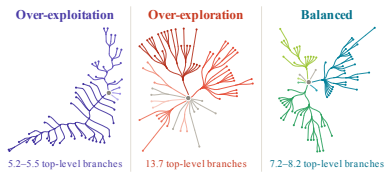
Figure 8 : Three patterns of traces in games. The grey dot is the research problem, and each color is one top- level branch. Below each tree: mean top-level branches per game on 200 papers, as a range over the models with that pattern (per-model means in Figure 11). See more examples in §G.
원문 · CC BY 4.0 · Muhan Gao, Hangxiao Zhu, Xinqi Su, Yu Zhang, Daniel Khashabi, Kuan-Hao Huang · Re-Search: Dissecting LLM Ideation Through a Two-Player Questioning Game · 원문 그림 인용 · 원본 PDF 8쪽에서 그림 영역을 추출했습니다.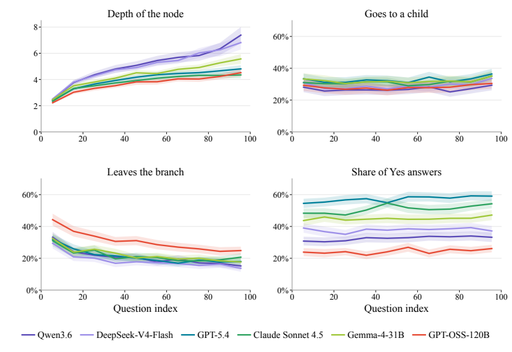
Figure 10 : How the search changes over the 100 questions of a game (1,200 games on 200 papers). Questions are grouped into bins of ten.Depth of the node: mean depth of the questions in the bin.Goes to a childandleaves the branch: how often the next question is a child of the current question, or lies in another top-level branch, as in Figure 9 (left) but over all answers.Share of Yes answers: share of the questions answered Yes.
원문 · CC BY 4.0 · Muhan Gao, Hangxiao Zhu, Xinqi Su, Yu Zhang, Daniel Khashabi, Kuan-Hao Huang · Re-Search: Dissecting LLM Ideation Through a Two-Player Questioning Game · 원문 그림 인용 · 원본 PDF 18쪽에서 그림 영역을 추출했습니다.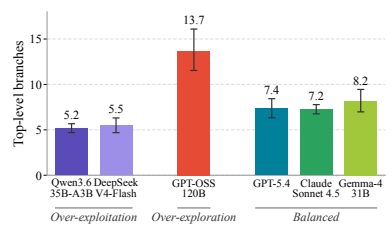
Figure 11 : Top-level branches per game for each model on 200 papers. The brackets group the models by search pattern, as in Figure 8.
원문 · CC BY 4.0 · Muhan Gao, Hangxiao Zhu, Xinqi Su, Yu Zhang, Daniel Khashabi, Kuan-Hao Huang · Re-Search: Dissecting LLM Ideation Through a Two-Player Questioning Game · 원문 그림 인용 · 원본 PDF 18쪽에서 그림 영역을 추출했습니다.해석의 한계와 적용 범위
테스트베드는 머신러닝 논문 200편이며, 다른 분야에 적용한 결과는 아직 검증되지 않았습니다. 복원 점수는 세 LLM 심사위원의 평가이고 탐색 나무도 LLM으로 주석을 달았습니다. 인간 평가와 심사위원의 일치는 91.2%로 보고되지만, 해법이 모호하거나 여러 동등한 정식화가 가능한 논문에서는 오류가 남을 수 있습니다. 심사위원 중 세 명이 질문자이기도 하므로 자기 선호 편향을 확인했으나 완전히 배제하지는 못했습니다. 또한 지식 오염을 피하기 위해 최신 모델은 사용하지 않았습니다.
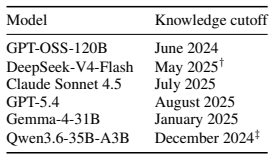
Table 3 : Knowledge or training-data cutoffs of the in- quisitor models, as stated in each provider’s model card or documentation. †DeepSeek’s public summary of training content states that some of the data were col- lected no later than about May 2025 (DeepSeek-AI, 2026b); a behavioral audit estimates an effective cutoff of July 2025 (Jia, 2026). ‡Not reported by the provider; effective cutoff estimated by the same audit (Jia, 2026). (§A)
원문 · CC BY 4.0 · Muhan Gao, Hangxiao Zhu, Xinqi Su, Yu Zhang, Daniel Khashabi, Kuan-Hao Huang · Re-Search: Dissecting LLM Ideation Through a Two-Player Questioning Game · 원문 그림 인용 · 원본 PDF 14쪽에서 그림 영역을 추출했습니다.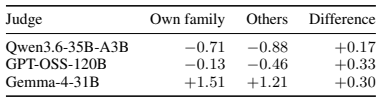
Table 4 : Rating of each judge minus the mean rating of the other two judges, for the inquisitor of the judge’s own family and for the other inquisitors (survey experi- ment, all conditions, question 100). (§B)
원문 · CC BY 4.0 · Muhan Gao, Hangxiao Zhu, Xinqi Su, Yu Zhang, Daniel Khashabi, Kuan-Hao Huang · Re-Search: Dissecting LLM Ideation Through a Two-Player Questioning Game · 원문 그림 인용 · 원본 PDF 14쪽에서 그림 영역을 추출했습니다.논문 정보
- 저자
- Muhan Gao, Hangxiao Zhu, Xinqi Su, Yu Zhang, Daniel Khashabi, Kuan-Hao Huang
- 학회·저널
- arXiv · 프리프린트
- 최초 공개일
- 2026년 11월 10일
- 등록일
- 2026년 11월 12일
- 수정일
- 2026년 11월 10일
- 버전
- v1
- arXiv
- 2611.14487
- 분류
- cs.AI
- 원문 이용 조건
- CC BY 4.0
- 제공 범위
- 논문 정보, 해설, 허용된 원문 그림
AI 해설은 논문 원문과 별개의 설명이며 오류가 있을 수 있습니다. 원문과 그림은 각 출처의 이용 조건과 따로 표시된 권리를 따릅니다.
초록
Research ideation is iterative: researchers refine their ideas step by step based on feedback. Yet existing evaluations obscure this search process, making it difficult to understand how LLMs explore the space of research ideas and what limits their progress. We introduce Re-Search, which adapts the format of Twenty Questions to research ideation: given only the research problem of a published paper, a model must rediscover the paper's core idea by asking yes-or-no questions. Built from 200 ICML 2026 papers, Re-Search tracks how a model's idea evolves as it asks questions and receives binary oracle feedback, isolating ideation from execution. Across six recent LLMs, nearly all progress happens within the first 30 of 100 questions, which largely decide how the game ends; after that, most models plateau. Through controlled interventions on the candidate questions and the hypothesis space, we find that the bottleneck is generation, not judgment: models recognize a good idea or a good question when one is offered, but often cannot produce it on their own. We further analyze the ideation traces and find that models fail by either over-exploiting one direction or over-exploring too many. These findings point to concrete design principles for autoresearch systems: since models can judge candidates they cannot produce, enriching the search with externally sourced ideas and questions may be more effective than improving any single model's generation ability.
원문 인용
Muhan Gao, Hangxiao Zhu, Xinqi Su, Yu Zhang, Daniel Khashabi, Kuan-Hao Huang (2026). Re-Search: Dissecting LLM Ideation Through a Two-Player Questioning Game. arXiv:2611.14487v1. https://arxiv.org/abs/2611.14487v1
BibTeX
@misc{gao2026search,
  title = {{Re-Search: Dissecting LLM Ideation Through a Two-Player Questioning Game}},
  author = {Muhan Gao and Hangxiao Zhu and Xinqi Su and Yu Zhang and Daniel Khashabi and Kuan-Hao Huang},
  year = {2026},
  eprint = {2611.14487},
  archivePrefix = {arXiv},
  url = {https://arxiv.org/abs/2611.14487v1}
}