논문 해설
Steer, Don't Tell: Breaking Reasoning Plateaus with Reachability-Aligned Self-Distillation
말하지 말고 유도하라: 도달 가능성 정렬 자기 증류로 추론 정체 돌파
- 연구 문제 플래토에 도달한 추론 모델은 정답 궤적이 거의 샘플링되지 않는 어려운 문제에서 RL 신호를 얻기 어렵습니다. 기존 특권 자기 증류는 참조 해답을 이용하지만 교사의 정답성이 학생의 도달 가능성을 보장하지 않습니다.
- 연구 방법 SSR은 특권 교사 분포를 학생 확률 임계값으로 정한 국소 지지집합에 투영하고, 실패 궤적의 진단과 KL 기반 개입 지점을 이용해 접미를 반복 재생성한 뒤 검증된 정답 궤적만 학습에 씁니다.
플래토 이후 정답 궤적 부족 문제
대규모 추론 모델은 검증 가능한 문제에 대한 강화학습으로 성능이 향상되지만, 가장 어려운 문제에서는 정답 궤적이 거의 샘플링되지 않아 RL 신호가 거의 없습니다. 외부 전문가 궤적이나 더 강한 모델을 쓸 수 없는 상황을 가정하면, 모델은 문제와 참조 해답만으로 자기 개선을 해야 합니다.
기존 자기 증류 방법은 참조 해답을 조건으로 준 특권 교사를 만들어 정답 궤적을 얻습니다. 그러나 교사가 정답을 낸다고 해서 학생이 그 행동을 도달할 수 있다는 보장은 없습니다. 원문은 해답 조건화가 학생이 거의 쓰지 않는 행동 쪽으로 교사 분포를 옮겨, 그럴듯하지만 학생에게 도달 불가능하거나 형식이 잘못된 학습 목표를 만든다고 설명합니다.
학생 지지 투영과 반복 정제
SSR은 특권 교사 분포를 학생의 국소 행동 집합 안으로 제한합니다. 학생 지지집합은 각 접두에서 학생 확률이 임계값 δ를 넘는 토큰들로 정의됩니다. 투영 연산은 교사의 확률 질량을 이 지지집합에 한정한 뒤 남은 질량으로 재정규화하며, 지지집합 안의 교사 상대 선호는 그대로 보존합니다.
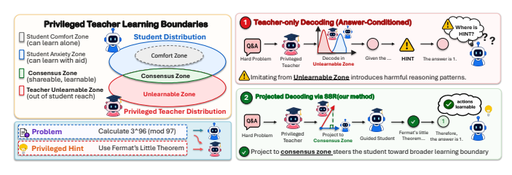
Figure 1 : RLVR can extend the model’s ability in its comfort zone, but it meets obstacles when coming to anxiety zone where correct trajectories are hard to sample. Privileged-teacher can provide aid signals on anxiety zone, but it can also select actions outside the student’s reachable region, producing unlearnable traces. Directly imitating these actions can corrupt the student’s reasoning ability(e.g., learning to hallucinate a non-existent hint). By projecting privileged preferences into the consensus region, SSR retains the learnable steering signals within the privileged preferences, effectively expands the student’s learning boundary.
원문 · CC BY 4.0 · Zijian Wu, Lingkai Kong, Lin Yang, Haiteng Zhao, Kuikun Liu, Kai Chen, Dahua Lin, Wenwei Zhang · Steer, Don't Tell: Breaking Reasoning Plateaus with Reachability-Aligned Self-Distillation · 원문 그림 인용 · 원본 PDF 2쪽에서 그림 영역을 추출했습니다.원문은 이 투영이 학생 지지집합 위에서 교사 분포에 대한 역방향 KL을 최소화하는 해와 일치한다고 증명합니다. 반복 정제에서는 실패한 궤적을 요약하고 참조 해답과 대조해 정답을 노출하지 않는 진단 지시문을 만듭니다. 이후 교사와 학생의 KL 발산이 큰 위치 가운데 상위 열 위치에서 개입 지점을 고르고, 그 앞의 접두는 유지한 채 접미만 투영 디코딩으로 다시 생성합니다. 검증을 통과한 궤적만 학습 집합에 저장됩니다.
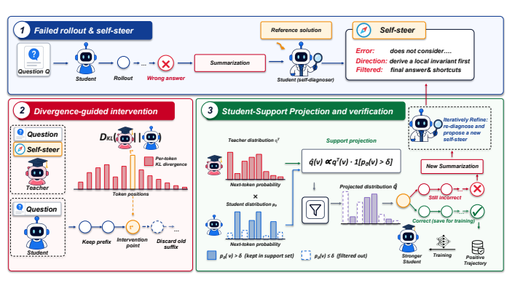
Figure 2 :Overview of the SSR framework.1. Given a very hard question Q, we sample failed rollouts from the student model. The failed rollout is then summarized and diagnosed against the reference solution to produce a self-steer. The self-steer describes the error and provide fixing di- rections while avoiding directly offering the answer. 2. The self-steer is then used to construct the privileged self-teacher. The KL-divergence between teacher and student is calculated on the failed rollout to determine the proper intervention point. Everything after that point is discarded. 3. After the intervention point, for every decoding prefix, the student first calculate its support-set by retain- ing every token with a student possibility above a certain thresholdδ. The teacher then rewights these tokens and choose the next token. For each new trajectory generated, it will be stored for further training if correct, and send back to a new round of refinement if incorrect. After the iterative refinement succeeds, the saved positive trajectory can be used to improve the student model.
원문 · CC BY 4.0 · Zijian Wu, Lingkai Kong, Lin Yang, Haiteng Zhao, Kuikun Liu, Kai Chen, Dahua Lin, Wenwei Zhang · Steer, Don't Tell: Breaking Reasoning Plateaus with Reachability-Aligned Self-Distillation · 원문 그림 인용 · 원본 PDF 3쪽에서 그림 영역을 추출했습니다.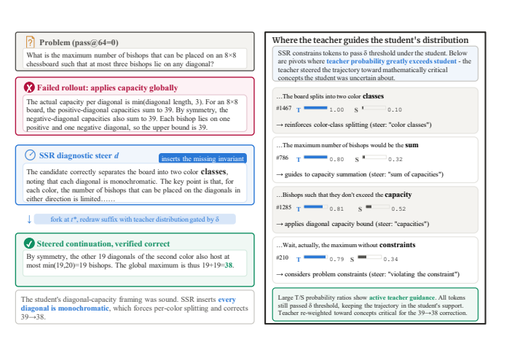
Figure 4 : One SSR correction round. A failed trajectory is summarized and diagnosed, continued under student-support projection, and retained after verification.
원문 · CC BY 4.0 · Zijian Wu, Lingkai Kong, Lin Yang, Haiteng Zhao, Kuikun Liu, Kai Chen, Dahua Lin, Wenwei Zhang · Steer, Don't Tell: Breaking Reasoning Plateaus with Reachability-Aligned Self-Distillation · 원문 그림 인용 · 원본 PDF 22쪽에서 그림 영역을 추출했습니다.플래토 어려운 문제에서의 후처리 성능
주요 평가는 Qwen3-8B를 100 step RLVR 후 플래토 체크포인트에서 시작해 AIME2025, AIME2026, HMMT February 2026에서 수행됩니다. 각 벤치마크의 avg@8을 비가중 평균한 aggregate 정확도로 비교하며, 기준선은 계속 진행하는 Vanilla RLVR과 여러 자기 증류 방법입니다.
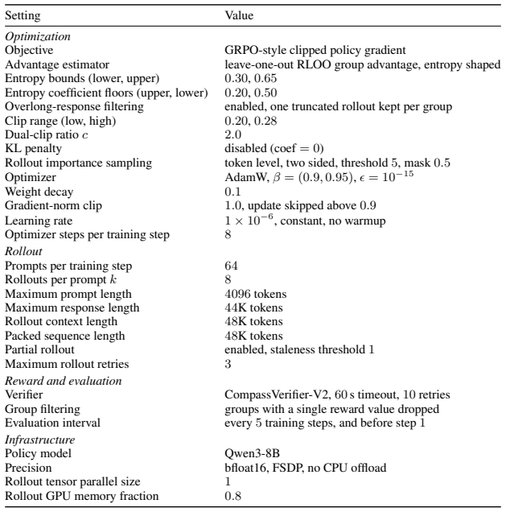
Table 7 : Qwen3-8B resumed-RL configuration.
원문 · CC BY 4.0 · Zijian Wu, Lingkai Kong, Lin Yang, Haiteng Zhao, Kuikun Liu, Kai Chen, Dahua Lin, Wenwei Zhang · Steer, Don't Tell: Breaking Reasoning Plateaus with Reachability-Aligned Self-Distillation · 원문 그림 인용 · 원본 PDF 23쪽에서 그림 영역을 추출했습니다.Qwen3-8B에서 SSR의 aggregate 정확도는 66.8이고 Vanilla RLVR은 61.9입니다. 따라서 차이는 4.9 퍼센트포인트입니다. 보조 모델 Qwen3-4B-Instruct-2507에서도 aggregate 정확도가 52.2에서 57.4로 높아졌습니다. 이 결과는 해당 두 모델과 본문에 기록된 평가 조건에서 얻은 것입니다.
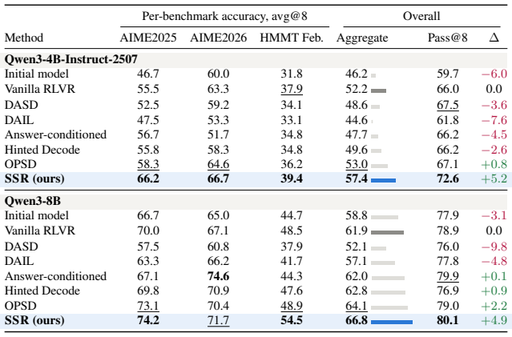
Table 1 :Peak post-plateau performance, reported in percent. Aggregate is the unweighted mean over AIME2025, AIME2026, and HMMT February 2026. Both model blocks use eight samples per problem.∆is the aggregate difference from Vanilla RLVR.
원문 · CC BY 4.0 · Zijian Wu, Lingkai Kong, Lin Yang, Haiteng Zhao, Kuikun Liu, Kai Chen, Dahua Lin, Wenwei Zhang · Steer, Don't Tell: Breaking Reasoning Plateaus with Reachability-Aligned Self-Distillation · 원문 그림 인용 · 원본 PDF 6쪽에서 그림 영역을 추출했습니다.투영과 반복 정제의 통제 비교
학생 지지 투영의 효과는 197개 Qwen3-8B 어려운 문제의 첫 라운드 실험에서 분리되었습니다. 원시 가이드 디코딩과 투영 디코딩은 같은 실패 궤적, 진단 지시문, 개입 지점과 접두를 공유하고 연속 분포만 다릅니다.

Table 2 :Controlled effect of student-support projectionon 197 Qwen3-8B hard problems. Both decoders share all inputs and differ only in the continuation distribution. Shared Prob. reports the mean and median, in parentheses, on the 60 problems solved by both decoders.
원문 · CC BY 4.0 · Zijian Wu, Lingkai Kong, Lin Yang, Haiteng Zhao, Kuikun Liu, Kai Chen, Dahua Lin, Wenwei Zhang · Steer, Don't Tell: Breaking Reasoning Plateaus with Reachability-Aligned Self-Distillation · 원문 그림 인용 · 원본 PDF 8쪽에서 그림 영역을 추출했습니다.반복 정제는 같은 64개 연속 예산에서 16개 독립 계통을 최대 4 라운드까지 진행합니다. 원문은 이 방식이 147/197개 문제를 회복하고, 64개 초기 실패에 각각 한 번씩 교정하는 방식은 102/197개를 회복한다고 보고합니다.
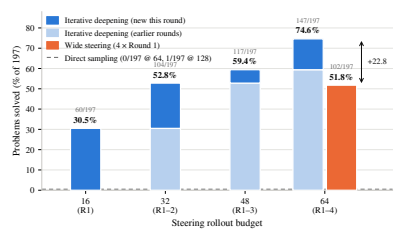
Figure 3 :Equal-budget search allocation.Iterative refinement recovers 147/197 problems, compared with 102/197 when all 64 initial failures receive one correc- tion.
원문 · CC BY 4.0 · Zijian Wu, Lingkai Kong, Lin Yang, Haiteng Zhao, Kuikun Liu, Kai Chen, Dahua Lin, Wenwei Zhang · Steer, Don't Tell: Breaking Reasoning Plateaus with Reachability-Aligned Self-Distillation · 원문 그림 인용 · 원본 PDF 8쪽에서 그림 영역을 추출했습니다.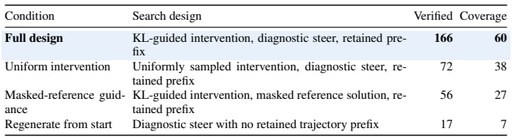
Table 4 :Search-design ablations.All variants use student-support projected decoding and 16 continuations per problem.
원문 · CC BY 4.0 · Zijian Wu, Lingkai Kong, Lin Yang, Haiteng Zhao, Kuikun Liu, Kai Chen, Dahua Lin, Wenwei Zhang · Steer, Don't Tell: Breaking Reasoning Plateaus with Reachability-Aligned Self-Distillation · 원문 그림 인용 · 원본 PDF 9쪽에서 그림 영역을 추출했습니다.적용 범위와 해석의 한계
δ=0.02는 별도 진단 스윕에서 검증 문제 수와 누출 지표의 절충으로 선택되었으며, 낮은 임계값은 검증 문제를 더 늘리지만 누출을 크게 키운다고 보고됩니다. 따라서 이 설정은 해당 실험의 선택이며 모든 모델과 과제에 대한 보편 값으로 볼 수 없습니다.
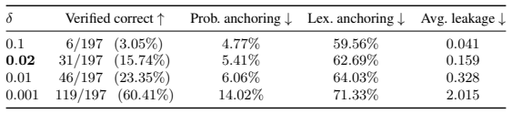
Table 5 :Selection of the student-support threshold.The passrate, degree of anchoring and leak- age of different threshold values. Higher verified correctness is better, while lower anchoring and leakage are better.
원문 · CC BY 4.0 · Zijian Wu, Lingkai Kong, Lin Yang, Haiteng Zhao, Kuikun Liu, Kai Chen, Dahua Lin, Wenwei Zhang · Steer, Don't Tell: Breaking Reasoning Plateaus with Reachability-Aligned Self-Distillation · 원문 그림 인용 · 원본 PDF 20쪽에서 그림 영역을 추출했습니다.특권 의존도 지표는 lexical anchoring, probabilistic anchoring, 평균 누출을 함께 사용하지만, 원문은 이 지표들이 모든 누출 형태를 배제하지 않는다고 설명합니다. 평가 결과는 AIME2025, AIME2026, HMMT February 2026과 두 모델에 한정되며, 다른 과제나 모델로의 일반화는 본문에서 측정하지 않았습니다.
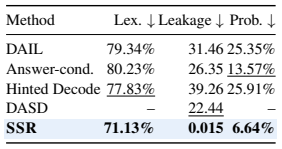
Table 3 :Privileged dependence of constructed trajectories.Four tra- jectories per method are evaluated on the 147 problems recovered by SSR. Lower is better.
원문 · CC BY 4.0 · Zijian Wu, Lingkai Kong, Lin Yang, Haiteng Zhao, Kuikun Liu, Kai Chen, Dahua Lin, Wenwei Zhang · Steer, Don't Tell: Breaking Reasoning Plateaus with Reachability-Aligned Self-Distillation · 원문 그림 인용 · 원본 PDF 8쪽에서 그림 영역을 추출했습니다.논문 정보
- 저자
- Zijian Wu, Lingkai Kong, Lin Yang, Haiteng Zhao, Kuikun Liu, Kai Chen, Dahua Lin, Wenwei Zhang
- 학회·저널
- arXiv · 프리프린트
- 최초 공개일
- 2026년 10월 31일
- 등록일
- 2026년 11월 7일
- 수정일
- 2026년 10월 31일
- 버전
- v1
- arXiv
- 2611.00796
- 분류
- cs.CL
- 원문 이용 조건
- CC BY 4.0
- 제공 범위
- 논문 정보, 해설, 허용된 원문 그림
AI 해설은 논문 원문과 별개의 설명이며 오류가 있을 수 있습니다. 원문과 그림은 각 출처의 이용 조건과 따로 표시된 권리를 따릅니다.
초록
Post training for large reasoning models remains insufficient on challenging problems, whose correct trajectories are hard to sample. Though prior works address this difficulty by integrating supervised fine tuning on expert trajectories with reinforcement learning, such external experts are not always available. Existing self improvement methods instead use reference solutions to create a privileged self-teacher. Yet privileged teacher correctness does not imply student reachability. Solution conditioning shifts the teacher distribution toward actions unlikely under the unprivileged student, producing seemingly "correct" trajectories that are unreachable or even mal-formed learning targets. Accordingly, we identify reachability alignment as the key to self constructed supervision and propose Self-Steered Reasoner (SSR). SSR realizes this principle through student support projection, which transforms the privileged teacher distribution into a directional signal only over reasoning actions locally reachable under the unguided student. Verification then retains correct trajectories sampled from this reachable space. To further boost the sampling efficiency, an iterative refinement framework is adopted, using diagnostic guidance based on current trajectories. On problems with pass@64 = 0 even after extensive RL, SSR recovers correct and learnable trajectories for 74.6% without parameter updates. Fine tuning on these trajectories followed by resumed reinforcement learning improves aggregate accuracy by 4.9 percentage points on AIME25/26 and HMMT26. These results show that privileged guidance becomes effective self-improvement data when aligned with the reasoning actions the student can reach.
원문 인용
Zijian Wu, Lingkai Kong, Lin Yang, Haiteng Zhao, Kuikun Liu, Kai Chen, Dahua Lin, Wenwei Zhang (2026). Steer, Don't Tell: Breaking Reasoning Plateaus with Reachability-Aligned Self-Distillation. arXiv:2611.00796v1. https://arxiv.org/abs/2611.00796v1
BibTeX
@misc{wu2026steer,
  title = {{Steer, Don't Tell: Breaking Reasoning Plateaus with Reachability-Aligned Self-Distillation}},
  author = {Zijian Wu and Lingkai Kong and Lin Yang and Haiteng Zhao and Kuikun Liu and Kai Chen and Dahua Lin and Wenwei Zhang},
  year = {2026},
  eprint = {2611.00796},
  archivePrefix = {arXiv},
  url = {https://arxiv.org/abs/2611.00796v1}
}