논문 해설
Internal Causal Mechanisms Robustly Predict Language Model Out-of-Distribution Behaviors
내부 인과 메커니즘은 언어 모델의 분포 외 행동을 견고하게 예측한다
- 연구 문제 언어 모델의 정답 여부를 분포 이동 아래에서도 예측하는 방법을 찾는 것이 문제입니다.
- 연구 방법 분포 내 데이터에서 DAS로 고수준 인과 변수를 국소화한 뒤, 반사실 시뮬레이션과 value probing으로 정답 여부를 예측합니다.
- 주요 결과 내부 인과 특징을 쓰는 방법은 분포 이동 설정에서 비인과 특징 방법보다 우수하며, 반사실 시뮬레이션은 10개 OOD 과제 중 8개에서 가장 좋은 전체 성능을 보입니다.
분포 이동에서 정답 여부를 예측하는 문제
언어 모델은 점점 개방형 상황에 배치되고 있으며, 학습 분포를 벗어난 입력에서 틀린 출력을 내는 문제가 중요해졌습니다. 기존의 신뢰도 점수 방법은 출력 토큰 확률을 집계하여 정답 여부를 추정하고, 또 다른 흐름은 내부 표현 위에 선형 프로브를 학습하여 정답 여부를 예측합니다. 그러나 프로브가 사용하는 특징이 모델이 실제로 과제를 푸는 데 쓰는지 알 수 없어, 분포가 바뀌면 예측력이 쉽게 떨어집니다.
이 논문은 이 공백에 대해 인과 해석 가능성 연구에서 찾은 고수준 인과 메커니즘을 정답 예측에 활용할 수 있는지 묻습니다. 분포 내 데이터에서 모델이 과제를 푸는 데 실제로 쓰는 인과 변수를 찾고, 그 변수가 분포 이동 아래에서도 정답 예측에 강건한 신호가 되는지 확인하는 것이 핵심 질문입니다.
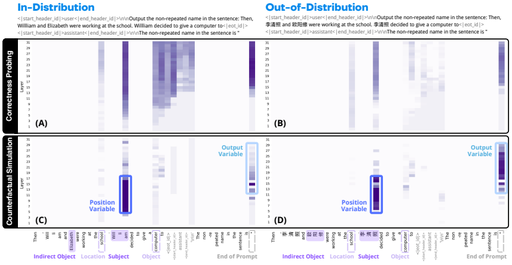
Figure 3 . Robust vs. non-robust features.Many features that are predictive of correctness on in-distribution inputs (purple blocks in panel A), where only very few of them can generalize to out-of-distribution inputs (purple blocksin panel B). These features coincide with features that have causal effects on task predictions, as shown in panel C and D.
원문 · CC BY 4.0 · Jing Huang, Junyi Tao, Thomas Icard, Diyi Yang, Christopher Potts · Internal Causal Mechanisms Robustly Predict Language Model Out-of-Distribution Behaviors · 원문 그림 인용 · 원본 PDF 8쪽에서 그림 영역을 추출했습니다.인과 변수의 국소화와 두 가지 예측 방법
방법은 두 단계로 구성됩니다. 첫 단계에서는 분포 내 데이터에서 고수준 인과 모델의 변수를 신경망 표현 공간에 국소화합니다. 이 논문은 DAS를 사용하며, DAS는 분산 교환 개입으로 직교 정규 기저 Q를 찾아 고수준 변수를 표현 부분공간에 대응시킵니다. 이때 반사실 라벨은 고수준 모델이 정한 값에 따라 정해지고, 교환 개입 정확도(IIA)는 이 대응이 실제로 구현되어 있는지를 측정합니다.
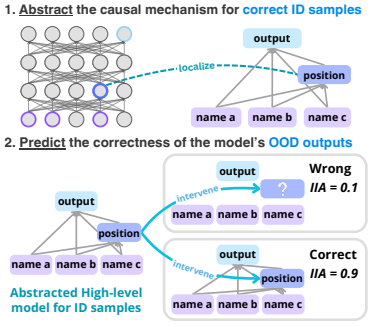
Figure 1 . We propose a two-stage framework to predict correct- ness of model outputs under distribution shifts, illustrated using the counterfactual simulation method on the Indirect Object Iden- tification task (Wang et al., 2023).Stage 1 (Abstract): Identify the abstract causal mechanisms the model uses to solve the task correctly on in-distribution data.Stage 2 (Predict): Predict the model’s output correctness on out-of-distribution inputs by check- ing whether it implements the same mechanisms.Dark blue indicates the key causal variables used for correctness prediction.
원문 · CC BY 4.0 · Jing Huang, Junyi Tao, Thomas Icard, Diyi Yang, Christopher Potts · Internal Causal Mechanisms Robustly Predict Language Model Out-of-Distribution Behaviors · 원문 그림 인용 · 원본 PDF 1쪽에서 그림 영역을 추출했습니다.두 번째 단계에서 제안된 방법은 국소화된 인과 변수를 사용해 테스트 입력의 정답 여부를 예측합니다. 반사실 시뮬레이션은 검증 집합의 기저 입력과 테스트 입력의 인과 변수 값을 교환하여 모델이 반사실 라벨을 맞히는지 확인하고, 그 확률을 정답 예측 점수로 씁니다. value probing은 인과 변수 값을 입력으로 선형 분류기를 학습하고, 실행 시에는 가장 가능성 높은 클래스의 확률을 점수로 씁니다. 두 방법 모두 기존 방법과 달리 어떤 특징이 실제 인과 역할을 하는지에 근거합니다.
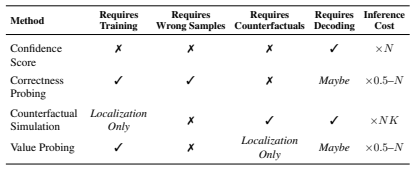
Table 1 . A comparison of methods and their requirements. Re- quires training: whether the method requires learning additional parameters;requires wrong samples: whether supervision from incorrect examples is needed;requires counterfactuals: whether supervision from counterfactual examples is needed;requires de- coding: whether decoding at inference time is needed;inference cost: expected number of forward passes needed, withN decoding steps and K counterfactual samples.Localization onlyindicates the condition is required only for localizing causal variables, but not for correctness prediction;Maybeindicates methods that can apply to both prompt tokens and decoded tokens.
원문 · CC BY 4.0 · Jing Huang, Junyi Tao, Thomas Icard, Diyi Yang, Christopher Potts · Internal Causal Mechanisms Robustly Predict Language Model Out-of-Distribution Behaviors · 원문 그림 인용 · 원본 PDF 6쪽에서 그림 영역을 추출했습니다.분포 내와 분포 이동 설정의 비교
검증은 다섯 과제에서 이루어졌으며, 주요 실험은 Llama-3-8B-Instruct를 사용합니다. 과제는 IOI, PriceTag, RAVEL, MMLU, UnlearnHP로 구성되며, 기호 조작 과제부터 지식 검색과 지시 따르기 과제까지 포함합니다. 분포 내 설정에서는 테스트 세트와 검증 세트를 무작위로 샘플링하고, 정답과 오답 수를 같게 맞춘 균형 이진 분류로 평가합니다. 성능은 AUC-ROC로 측정됩니다.
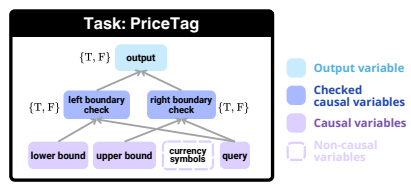
Figure 2 . The identified high-level model for the PriceTag task. See high-level models for all tasks in Figure 5.
원문 · CC BY 4.0 · Jing Huang, Junyi Tao, Thomas Icard, Diyi Yang, Christopher Potts · Internal Causal Mechanisms Robustly Predict Language Model Out-of-Distribution Behaviors · 원문 그림 인용 · 원본 PDF 4쪽에서 그림 영역을 추출했습니다.분포 이동 설정에서는 과제 구조를 유지한 채 패러프레이즈, 번역, 문맥 내 데모 변경, 철자 변형, 산만 요소 추가 등 과제 무관 배경 조건만 바꿉니다. 원문은 모델 정확도가 뚜렷하게 떨어지는 교란만 선택했다고 밝힙니다. 이 설정은 한 모델과 이 다섯 과제에서의 비교이므로, 결과를 다른 모델이나 임의의 분포 이동으로 넓히려면 별도의 검증이 필요합니다.
결과 해석과 적용 범위
분포 내 설정에서 반사실 시뮬레이션은 특히 IOI와 RAVEL에서 가장 좋은 결과를 보입니다. 원인 변수에서 얻은 특징은 마지막 프롬프트 토큰 특징보다 대체로 높은 예측력을 보입니다. value probing은 기존 프로빙보다 대체로 낮은 성능을 보입니다.
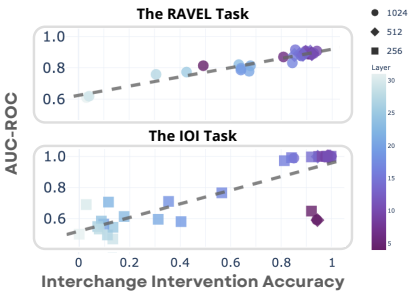
Figure 4 . A positive correlation between interchange interven- tion accuracy and AUC-ROC in in-distribution settings.In- terchange intervention accuracy measures the ability to simulate causal effects, and AUC-ROC measures the ability to predict model correctness. Improving the ability to simulate causal effects gen- erally improves the ability to predict the correctness of model outputs. Each point represents one observation. Different shapes represent different dimensions used to train DAS.
원문 · CC BY 4.0 · Jing Huang, Junyi Tao, Thomas Icard, Diyi Yang, Christopher Potts · Internal Causal Mechanisms Robustly Predict Language Model Out-of-Distribution Behaviors · 원문 그림 인용 · 원본 PDF 9쪽에서 그림 영역을 추출했습니다.분포 이동 설정에서는 내부 인과 특징을 쓰는 방법이 비인과 특징을 쓰는 방법보다 유의하게 우수합니다. 반사실 시뮬레이션은 10개 OOD 과제 중 8개에서 가장 좋은 전체 성능을 보이며, 이전 기준선 대비 평균 AUC-ROC를 13.84% 향상시켰다고 보고됩니다. 신뢰도 점수는 분포 이동 아래에서 예측력이 크게 떨어지고, 온도 선택에 민감하다는 점도 확인됩니다. 이 결과는 이 논문이 검증한 모델과 과제 범위 안에서 읽어야 합니다.
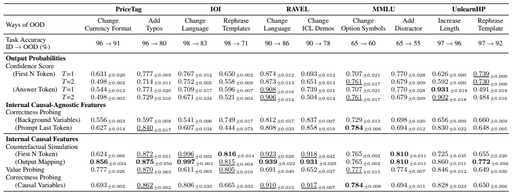
Table 3 . Results of the out-of-distribution setting.Methods using internal causal features are significantly more robust than methods using other features. Causal Simulation performs the best on 8 out of the 10 tasks.
원문 · CC BY 4.0 · Jing Huang, Junyi Tao, Thomas Icard, Diyi Yang, Christopher Potts · Internal Causal Mechanisms Robustly Predict Language Model Out-of-Distribution Behaviors · 원문 그림 인용 · 원본 PDF 7쪽에서 그림 영역을 추출했습니다.한계와 남은 질문
이 논문은 DAS 기반 국소화가 선형 부분공간을 가정한다는 한계를 명시합니다. Transformer 표현은 완전히 선형이거나 완전히 비선형이 아니므로, 비선형으로 인코딩된 개념에서는 선형 부분공간 방법이 어려움을 겪을 수 있습니다. 또한 고수준 인과 모델을 제안하려면 사전 지식이 필요하며, 저자들은 자동 해석 방법과의 결합 가능성과 부분적 이해만으로도 예측력이 나타난다는 점을 함께 논의합니다.
논문 정보
- 저자
- Jing Huang, Junyi Tao, Thomas Icard, Diyi Yang, Christopher Potts
- 학회·저널
- arXiv · 프리프린트
- 최초 공개일
- 2025년 5월 17일
- 등록일
- 2026년 10월 30일
- 수정일
- 2025년 11월 10일
- 버전
- v2
- arXiv
- 2505.11770
- 분류
- cs.LG · cs.AI · cs.CL · stat.ML
- 원문 이용 조건
- CC BY 4.0
- 제공 범위
- 논문 정보, 해설, 허용된 원문 그림
AI 해설은 논문 원문과 별개의 설명이며 오류가 있을 수 있습니다. 원문과 그림은 각 출처의 이용 조건과 따로 표시된 권리를 따릅니다.
초록
Interpretability research now offers a variety of techniques for identifying abstract internal mechanisms in neural networks. Can such techniques be used to predict how models will behave on out-of-distribution examples? In this work, we provide a positive answer to this question. Through a diverse set of language modeling tasks--including symbol manipulation, knowledge retrieval, and instruction following--we show that the most robust features for correctness prediction are those that play a distinctive causal role in the model's behavior. Specifically, we propose two methods that leverage causal mechanisms to predict the correctness of model outputs: counterfactual simulation (checking whether key causal variables are realized) and value probing (using the values of those variables to make predictions). Both achieve high AUC-ROC in distribution and outperform methods that rely on causal-agnostic features in out-of-distribution settings, where predicting model behaviors is more crucial. Our work thus highlights a novel and significant application for internal causal analysis of language models.
원문 인용
Jing Huang, Junyi Tao, Thomas Icard, Diyi Yang, Christopher Potts (2025). Internal Causal Mechanisms Robustly Predict Language Model Out-of-Distribution Behaviors. arXiv:2505.11770v2. https://arxiv.org/abs/2505.11770v2
BibTeX
@misc{huang2025internal,
  title = {{Internal Causal Mechanisms Robustly Predict Language Model Out-of-Distribution Behaviors}},
  author = {Jing Huang and Junyi Tao and Thomas Icard and Diyi Yang and Christopher Potts},
  year = {2025},
  eprint = {2505.11770},
  archivePrefix = {arXiv},
  url = {https://arxiv.org/abs/2505.11770v2}
}