논문 해설
InstructBLIP: Towards General-purpose Vision-Language Models with Instruction Tuning
InstructBLIP: instruction tuning을 활용한 범용 비전-언어 모델을 향하여
- 연구 문제 대규모 언어 모델의 명령어 튜닝을 시각-언어 모델로 확장하여 보지 못한 과제에서도 제로샷 일반화를 얻는 것이 목표입니다.
- 연구 방법 사전학습된 BLIP-2를 초기화로 삼고 명령어 형식 데이터로 Q-Former만 미세조정하며, 명령어 인식 시각 특징 추출과 데이터셋 균형 샘플링을 사용합니다.
- 주요 결과 held-out 제로샷 평가에서 BLIP-2 대비 개선을 보고하며, 명령어 인식 특징과 데이터 균형 샘플링의 절제 결과도 함께 제시합니다.
범용 시각-언어 모델의 과제
대규모 언어 모델은 명령어 튜닝으로 다양한 지시를 따를 수 있게 되었지만, 시각 입력이 추가된 시각-언어 모델에서는 입력 분포와 과제가 훨씬 다양해 같은 접근을 그대로 옮기기 어렵습니다. 기존 연구는 시각-언어 pre-training에는 많이 주목했지만 시각-언어 명령어 튜닝은 충분히 탐구되지 않았습니다. 이 논문은 사전학습된 BLIP-2 모델을 기반으로 26개 공개 데이터셋을 명령어 형식으로 바꾸어 이 공백을 다룹니다. 중요한 변경점은 학습 데이터를 명령어 형식으로 통일하고, 명령어를 시각 특징 추출 단계에까지 넣는 것입니다.
명령어 인식 시각 특징과 데이터 구성
InstructBLIP은 이미지 인코더와 LLM을 동결하고 Q-Former만 미세조정합니다. Q-Former에는 학습 가능한 쿼리 임베딩이 들어가며, 명령어 텍스트가 쿼리와 셀프 어텐션으로 상호작용하여 과제에 맞는 시각 특징을 뽑습니다. 이 특징은 소프트 시각 프롬프트로 동결된 LLM에 전달되고, 명령어와 함께 언어 모델링 손실로 응답을 생성하도록 학습합니다. 학습 데이터는 13개 held-in 데이터셋으로 구성되며, 과제별로 10~15개의 템플릿을 사용합니다. 데이터셋 샘플링 확률은 데이터셋 크기의 제곱근에 비례하도록 정해지고, 일부 데이터셋은 수작업으로 가중치를 조정합니다.
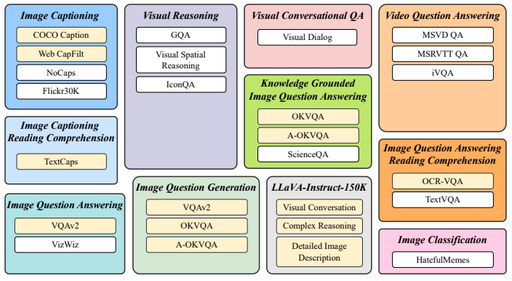
Figure 2 : Tasks and their corresponding datasets used for vision-language instruction tuning. The held-in datasets are indicated by yellow and the held-out datasets by white.
원문 · CC BY 4.0 · Wenliang Dai, Junnan Li, Dongxu Li, Anthony Meng Huat Tiong, Junqi Zhao, Weisheng Wang, Boyang Li, Pascale Fung, Steven Hoi · InstructBLIP: Towards General-purpose Vision-Language Models with Instruction Tuning · 원문 그림 인용 · 원본 PDF 4쪽에서 그림 영역을 추출했습니다.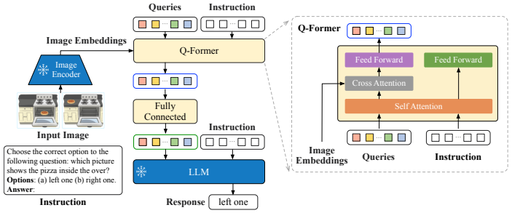
Figure 3 : Model architecture of InstructBLIP. The Q-Former extracts instruction-aware visual features from the output embeddings of the frozen image encoder, and feeds the visual features as soft prompt input to the frozen LLM. We instruction-tune the model with the language modeling loss to generate the response.
원문 · CC BY 4.0 · Wenliang Dai, Junnan Li, Dongxu Li, Anthony Meng Huat Tiong, Junqi Zhao, Weisheng Wang, Boyang Li, Pascale Fung, Steven Hoi · InstructBLIP: Towards General-purpose Vision-Language Models with Instruction Tuning · 원문 그림 인용 · 원본 PDF 5쪽에서 그림 영역을 추출했습니다.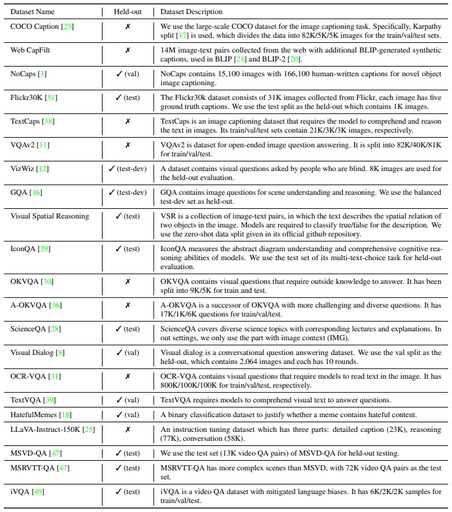
Table 4 : Description of datasets in our held-in instruction tuning and held-out zero-shot evaluations.
원문 · CC BY 4.0 · Wenliang Dai, Junnan Li, Dongxu Li, Anthony Meng Huat Tiong, Junqi Zhao, Weisheng Wang, Boyang Li, Pascale Fung, Steven Hoi · InstructBLIP: Towards General-purpose Vision-Language Models with Instruction Tuning · 원문 그림 인용 · 원본 PDF 16쪽에서 그림 영역을 추출했습니다.제로샷 결과와 절제 실험
제로샷 평가에서 InstructBLIP은 held-out 데이터셋 13개에 대해 BLIP-2와 Flamingo를 비교 대상으로 보고됩니다. 같은 FlanT5XL 백본 비교에서 저자들은 평균 상대 향상이 15.0%라고 보고합니다. 절제 실험에서는 명령어 인식 시각 특징을 제거하면 여러 데이터셋에서 성능이 낮아지고, 데이터 균형 샘플링을 제거하면 학습이 불안정해지는 것으로 설명됩니다. 이 결과는 해당 백본과 설정에서 얻은 것입니다.
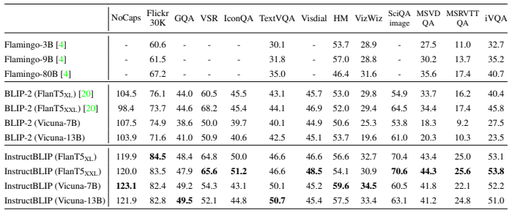
Table 1 : Zero-shot results on the held-out datasets. Here, Visdial, HM and SciQA denote the Visual Dialog, HatefulMemes and ScienceQA datasets, respectively. For ScienceQA, we only evaluate on the set with image context. Following previous works [4, 49, 32], we report the CIDEr score [42] for NoCaps and Flickr30K, iVQA accuracy for iVQA, AUC score for HatefulMemes, and Mean Reciprocal Rank (MRR) for Visual Dialog. For all other datasets, we report the top-1 accuracy (%).
원문 · CC BY 4.0 · Wenliang Dai, Junnan Li, Dongxu Li, Anthony Meng Huat Tiong, Junqi Zhao, Weisheng Wang, Boyang Li, Pascale Fung, Steven Hoi · InstructBLIP: Towards General-purpose Vision-Language Models with Instruction Tuning · 원문 그림 인용 · 원본 PDF 6쪽에서 그림 영역을 추출했습니다.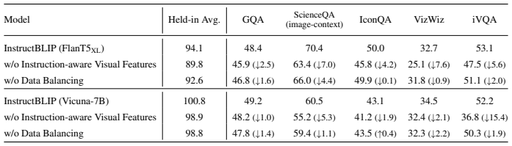
Table 2 : Results of ablation studies that remove the instruction-aware Visual Features (Section 2.3) and the balanced data sampling strategy (Section 2.4). For held-in evaluation, we compute the average score of four datasets, including COCO Caption, OKVQA, A-OKVQA, and TextCaps. For held-out evaluation, we show five datasets from different tasks.
원문 · CC BY 4.0 · Wenliang Dai, Junnan Li, Dongxu Li, Anthony Meng Huat Tiong, Junqi Zhao, Weisheng Wang, Boyang Li, Pascale Fung, Steven Hoi · InstructBLIP: Towards General-purpose Vision-Language Models with Instruction Tuning · 원문 그림 인용 · 원본 PDF 7쪽에서 그림 영역을 추출했습니다.다중작업 학습과 비교
다중작업 학습은 명령어 형식 없이 여러 데이터셋을 함께 학습하는 방법입니다. BLIP-2 FlanT5XL 백본에서 명령어 튜닝과 다중작업 학습을 같은 학습 설정으로 비교하면, held-in 성능은 두 방식이 비슷하지만 unseen held-out 데이터셋에서는 명령어 튜닝이 더 큰 개선을 보입니다. 이 비교는 해당 백본과 설정에 한정되며, 명령어 형식이 일반화 개선의 중요한 요인이라는 해석은 저자들의 해석입니다.
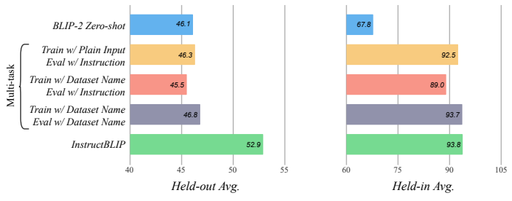
Figure 4 : Comparison of instruction tuning and multitask training based on BLIP-2 FlanT5 XL backbone. For held-in evaluation, we compute the average score across all held-in datasets. For held-out evaluation, we compute the average score across GQA, TextVQA, VSR, HatefulMemes, IconQA, ScienceQA, iVQA, VizWiz.
원문 · CC BY 4.0 · Wenliang Dai, Junnan Li, Dongxu Li, Anthony Meng Huat Tiong, Junqi Zhao, Weisheng Wang, Boyang Li, Pascale Fung, Steven Hoi · InstructBLIP: Towards General-purpose Vision-Language Models with Instruction Tuning · 원문 그림 인용 · 원본 PDF 8쪽에서 그림 영역을 추출했습니다.적용 범위와 한계
InstructBLIP은 동결된 오프더셸프 LLM을 사용하므로 그 모델이 가진 환각이나 편향을 상속할 수 있습니다. 저자들은 특정 응용에 적용하기 전에 안전성과 공정성 평가가 필요하다고 밝힙니다. 또한 fine-tuning 결과는 ScienceQA의 이미지 문맥 부분 등 특정 설정에서 얻은 것입니다.
논문 정보
- 저자
- Wenliang Dai, Junnan Li, Dongxu Li, Anthony Meng Huat Tiong, Junqi Zhao, Weisheng Wang, Boyang Li, Pascale Fung, Steven Hoi
- 학회·저널
- arXiv · 프리프린트
- 최초 공개일
- 2023년 5월 11일
- 등록일
- 2026년 11월 5일
- 수정일
- 2023년 6월 15일
- 버전
- v2
- arXiv
- 2305.06500
- 분류
- cs.CV · cs.LG
- 원문 이용 조건
- CC BY 4.0
- 제공 범위
- 논문 정보, 해설, 허용된 원문 그림
AI 해설은 논문 원문과 별개의 설명이며 오류가 있을 수 있습니다. 원문과 그림은 각 출처의 이용 조건과 따로 표시된 권리를 따릅니다.
초록
Large-scale pre-training and instruction tuning have been successful at creating general-purpose language models with broad competence. However, building general-purpose vision-language models is challenging due to the rich input distributions and task diversity resulting from the additional visual input. Although vision-language pretraining has been widely studied, vision-language instruction tuning remains under-explored. In this paper, we conduct a systematic and comprehensive study on vision-language instruction tuning based on the pretrained BLIP-2 models. We gather 26 publicly available datasets, covering a wide variety of tasks and capabilities, and transform them into instruction tuning format. Additionally, we introduce an instruction-aware Query Transformer, which extracts informative features tailored to the given instruction. Trained on 13 held-in datasets, InstructBLIP attains state-of-the-art zero-shot performance across all 13 held-out datasets, substantially outperforming BLIP-2 and larger Flamingo models. Our models also lead to state-of-the-art performance when finetuned on individual downstream tasks (e.g., 90.7% accuracy on ScienceQA questions with image contexts). Furthermore, we qualitatively demonstrate the advantages of InstructBLIP over concurrent multimodal models. All InstructBLIP models are open-sourced at https://github.com/salesforce/LAVIS/tree/main/projects/instructblip.
원문 인용
Wenliang Dai, Junnan Li, Dongxu Li, Anthony Meng Huat Tiong, Junqi Zhao, Weisheng Wang, Boyang Li, Pascale Fung, Steven Hoi (2023). InstructBLIP: Towards General-purpose Vision-Language Models with Instruction Tuning. arXiv:2305.06500v2. https://arxiv.org/abs/2305.06500v2
BibTeX
@misc{dai2023instructblip,
  title = {{InstructBLIP: Towards General-purpose Vision-Language Models with Instruction Tuning}},
  author = {Wenliang Dai and Junnan Li and Dongxu Li and Anthony Meng Huat Tiong and Junqi Zhao and Weisheng Wang and Boyang Li and Pascale Fung and Steven Hoi},
  year = {2023},
  eprint = {2305.06500},
  archivePrefix = {arXiv},
  url = {https://arxiv.org/abs/2305.06500v2}
}