논문 해설
Bayesian Controller Fusion: Leveraging Control Priors in Deep Reinforcement Learning for Robotics
베이지안 컨트롤러 융합: 로보틱스를 위한 심층 강화학습에서 제어 사전지식 활용
- 연구 문제 로봇 제어에서 심층 강화학습은 샘플 효율과 안전성 때문에 실제 배치가 어렵고, 고전 제어 사전지식은 안전하지만 최적성이 부족합니다. BCF는 이 둘을 불확실성 기반으로 결합하는 문제를 다룹니다.
- 연구 방법 BCF는 정책과 제어 사전지식의 가우시안 행동 분포를 정규화 곱으로 융합하여, 불확실성이 낮은 쪽이 제어를 주도하도록 하는 하이브리드 제어 전략입니다.
- 주요 결과 시뮬레이션에서 PointGoal Navigation은 제어 사전지식 대비 최대 116%, 최대 조작성 도달은 282% 향상을 보고했고, 실제 로봇 배치에서는 정책 단독이 실패한 조건에서도 BCF가 두 궤적을 충돌 없이 완료했습니다.
강화학습과 제어 사전지식이 갈라지는 지점
로봇 제어에서 심층 강화학습은 샘플 효율과 안전성이라는 두 가지 제약에 막혀 있습니다. 실제 로봇에서 무작위에 가까운 탐색은 로봇과 주변 환경에 위험하고, 보상이 드물고 과제가 긴 설정에서는 정책이 해를 찾기까지 많은 상호작용이 필요합니다. 반면 고전 피드백 제어기나 행동 트리 같은 수작업 제어 사전지식은 명시적 해석과 위험 회피적 행동을 가지지만, 모델링과 튜닝 비용 때문에 최적 행동에는 미치지 못하는 경우가 많습니다. 이 논문은 두 방식을 대립시키지 않고, 제어 사전지식을 탐색의 안내자로 쓰면서 학습이 진행될수록 정책이 제어를 넘겨받도록 하는 문제를 다룹니다. 평가 범위는 PointGoal Navigation과 최대 조작성 도달이라는 두 과제의 자유 공간 운동입니다.
정책과 사전지식의 정규화 곱 융합
Bayesian Controller Fusion(BCF)은 RL 정책 π와 제어 사전지식 ψ가 각각 내놓는 가우시안 행동 분포를 normalised product로 결합합니다. 두 분포를 곱해 정규화하면 복합 분포의 평균은 각 분포의 평균을 상대 분포의 분산으로 가중한 값이 됩니다. 식으로 쓰면 \(\mu_\phi=\frac{\mu_\pi\sigma_\psi^2+\mu_\psi\sigma_\pi^2}{\sigma_\psi^2+\sigma_\pi^2}\)이며, 정책의 평균 μπ는 σψ²로, 사전지식의 평균 μψ는 σπ²로 가중됩니다. 따라서 정책의 분산이 커지면 사전지식의 평균이 더 많이 반영되고, 사전지식의 분산이 커지면 정책의 평균이 더 많이 반영됩니다.
복합 분포의 분산은 논문의 식 (14)에 정의되어 있습니다. 학습 중에는 이 복합 분포에서 행동을 샘플링해 탐색을 안내하고, 배치에서도 같은 융합 행동을 사용합니다. 저자들은 이 구조가 가장 신뢰도 높은 제어기가 행동을 주도하는 인간의 이중 과정 의사결정과 비슷하다고 해석합니다.
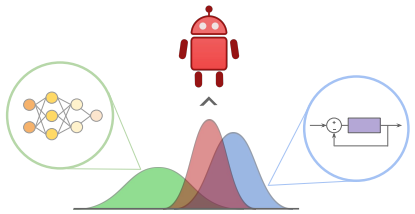
Fig. 1 . Bayesian Controller Fusion: We learn a compositional policy (red) for robotic agents that combines an uncertainty-aware deep RL policy (green) and a classical handcrafted controller (blue). Utilising this compositional policy to govern exploration allows for accelerated learning towards an optimal policy and safe behaviours in unknown states. It additionally allows for the reliable sim-to-real transfer of RL policies.
원문 · CC BY 4.0 · Krishan Rana, Vibhavari Dasagi, Jesse Haviland, Ben Talbot, Michael Milford, Niko Sünderhauf · Bayesian Controller Fusion: Leveraging Control Priors in Deep Reinforcement Learning for Robotics · 원문 그림 인용 · 원본 PDF 1쪽에서 그림 영역을 추출했습니다.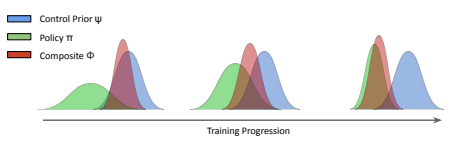
Fig. 3 . Evolution of the composite BCF sampling distribution over the course of training. During the early stages, note the strong bias towards the control prior which provides the exploration guidance.
원문 · CC BY 4.0 · Krishan Rana, Vibhavari Dasagi, Jesse Haviland, Ben Talbot, Michael Milford, Niko Sünderhauf · Bayesian Controller Fusion: Leveraging Control Priors in Deep Reinforcement Learning for Robotics · 원문 그림 인용 · 원본 PDF 5쪽에서 그림 영역을 추출했습니다.앙상블 정책 분포와 Monte Carlo 사전지식 분포
정책 쪽 분포는 SAC 기반 앙상블 M개의 예측을 균등 가중 가우시안 혼합으로 보고, 그 평균 μπ(s)와 분산 σπ²(s)를 계산해 얻습니다. 이 경험적 분산은 정책의 epistemic uncertainty를 근사하여 낯선 상태에서는 넓은 분포, 익숙한 상태에서는 좁은 분포를 만듭니다. 실험에서는 10개의 에이전트를 사용했고 각 에이전트는 무작위로 초기화되어 공유 리플레이 버퍼에서 각자의 배치를 샘플링했습니다. 사전지식 쪽은 결정적 제어기 출력을 그대로 쓰지 않습니다. 센서 모델의 분산에 따라 상태에 잡음을 준 샘플들을 만들고, Monte Carlo (MC) sampling으로 제어기 출력의 평균과 분산을 추정합니다.
제어기가 잡음에 둔감하면 분산이 0에 가까워져 정책이 무력화되므로, 분산은 샘플 분산과 최소 분산 σd² 중 큰 값으로 정해집니다. 사전지식으로는 PointGoal Navigation에 Artificial Potential Fields 제어기를, 도달 과제에 Resolved Rate Motion Control을 사용했습니다. σd는 사용자가 정하는 하이퍼파라미터이며, 이 실험의 PointGoal Navigation과 APF 설정에서는 0.5에서 1 사이의 값이 가장 좋은 학습 성능을 보였습니다. 이 결과는 해당 설정의 민감도 분석이며 다른 과제나 제어기에 그대로 적용되었다고 볼 수 없습니다.
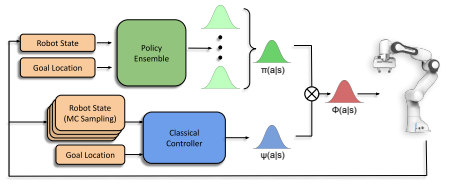
Fig. 4 . BCF hybrid control strategy for safe deployment on real robotic systems. We derive uncertainty-aware action outputs for each controller and compose these outputs to better inform the action selection process.
원문 · CC BY 4.0 · Krishan Rana, Vibhavari Dasagi, Jesse Haviland, Ben Talbot, Michael Milford, Niko Sünderhauf · Bayesian Controller Fusion: Leveraging Control Priors in Deep Reinforcement Learning for Robotics · 원문 그림 인용 · 원본 PDF 6쪽에서 그림 영역을 추출했습니다.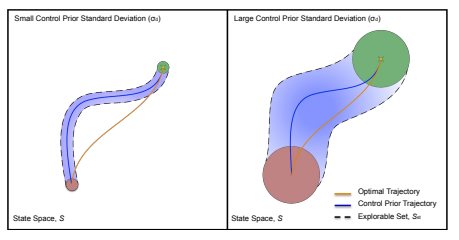
Fig. 5 . Illustration of optimal trajectory vs. control prior trajectory with the explorable set Sst extracted. The chosen standard deviation, σd should reflect the optimality of the controller such that the optimal behaviours can be captured within the distribution.
원문 · CC BY 4.0 · Krishan Rana, Vibhavari Dasagi, Jesse Haviland, Ben Talbot, Michael Milford, Niko Sünderhauf · Bayesian Controller Fusion: Leveraging Control Priors in Deep Reinforcement Learning for Robotics · 원문 그림 인용 · 원본 PDF 7쪽에서 그림 영역을 추출했습니다.시뮬레이션 학습 곡선의 개선 폭
시뮬레이션 학습에서 BCF는 두 과제 모두에서 학습을 가속하고, 제어 사전지식의 성능을 넘어서는 최종 성능을 보고합니다. PointGoal Navigation에서 BCF는 제어 사전지식 대비 최대 116% 향상, 최대 조작성 도달에서는 282% 향상을 기록했다고 보고됩니다. 이 개선률은 각 기법이 달성한 최대 성능 변화를 제어 사전지식 성능의 비율로 계산한 값입니다. 같은 표에서 Residual Reinforcement Learning은 navigation에서 95%, MCF는 109%, KL-Regularised Reinforcement Learning은 21%, CORE-RL은 42%로 나타납니다.
도달 과제에서는 Residual Reinforcement Learning이 110%, MCF가 229%이며, KL-Regularised Reinforcement Learning과 CORE-RL은 측정된 개선이 없고 도달 과제에서 학습에 실패했다고 보고됩니다. 모든 기법은 SAC 기반으로 10개의 랜덤 시드에서 학습되었습니다. BCF의 학습 곡선은 수렴 후 독립된 RL 정책 구성요소를 평가한 값이므로, 사전지식 없이도 학습된 정책 자체의 곡선으로 읽어야 합니다. 저자들은 기존 RLBP 기법의 성능 저하를 제어 사전지식과 현재 정책 행동 사이의 분포 불일치와 Q값 갱신의 불안정성으로 해석합니다.
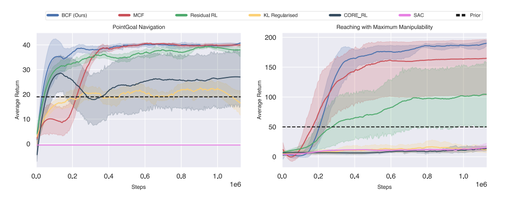
Fig. 7 . Learning curves of BCF and existing RLBP baselines for PointGoal Navigation and Reaching with Maximum Manipulability tasks. Note the faster convergence and lower variance across 10 seeds exhibited by our proposed approach.
원문 · CC BY 4.0 · Krishan Rana, Vibhavari Dasagi, Jesse Haviland, Ben Talbot, Michael Milford, Niko Sünderhauf · Bayesian Controller Fusion: Leveraging Control Priors in Deep Reinforcement Learning for Robotics · 원문 그림 인용 · 원본 PDF 11쪽에서 그림 영역을 추출했습니다.배치 전 시뮬레이션 평가에서 드러난 분포 전환
학습된 정책을 시뮬레이션의 학습 환경과 미관측 환경에서 평가하면, 정책 단독은 학습 환경에서는 좋지만 미관측 환경에서 성능이 떨어집니다. PointGoal Navigation의 SPL은 학습 환경에서 제어 사전지식 0.299, 정책 단독 0.958, BCF 0.958입니다. 미관측 환경에서는 제어 사전지식 0.273, 정책 단독 0.780, BCF 0.909입니다. BCF의 행동 소요 시간은 학습 환경에서 104 ± 11.9 스텝으로 정책 단독과 같은 SPL을 보이면서도 제어 사전지식의 462 ± 78.1 스텝보다 짧습니다. 최대 조작성 도달 평가에서 BCF의 평균 조작성은 학습 환경에서 0.0972 ± 0.00593, 미관측 환경에서 0.0924 ± 0.0161이며 성공률은 두 환경 모두 100%입니다.
정책 단독은 미관측 목표 상태에서 0.0810 ± 0.0296과 80%로 떨어집니다. 이 평가는 저자가 설정한 시뮬레이션 학습 환경과 목표 분포 안팎에서 수행된 결과입니다.
실제 로봇 배치에서의 궤적과 성공률
실제 로봇 실험에서 정책 단독은 두 PointGoal Navigation 궤적 모두에서 충돌 없이 완료하지 못했습니다. 같은 환경에서 BCF는 궤적 1에서 41.2 m, 135 s, 궤적 2에서 30.4 m, 117 s로 완료했고, 제어 사전지식은 42.3 m와 274 s, 35.3 m와 277 s가 걸렸습니다. ROS move_base 제어기는 62.6 m와 263 s, 35.8 m와 258 s였습니다. 시간 기준으로 BCF가 가장 짧았다는 결과이며, 거리는 궤적 1에서는 제어 사전지식보다 짧지만 궤적 2에서는 move_base보다 짧았다는 점까지 함께 봐야 합니다. Maximum Manipulability Reacher의 실제 로봇 평가에서는 BCF의 평균 조작성이 0.0836 ± 0.0156, 최종 조작성이 0.0889 ± 0.0177, 성공률이 98.2%로 보고됩니다.
제어 사전지식의 성공률도 98.2%이므로, 이 과제에서 BCF의 이점은 주로 조작성 향상으로 나타납니다. 정책 단독은 평균 조작성 0.0803과 성공률 78.6%입니다. 실제 평가는 시뮬레이션에서 학습한 정책을 미세조정 없이 배치한 결과입니다.
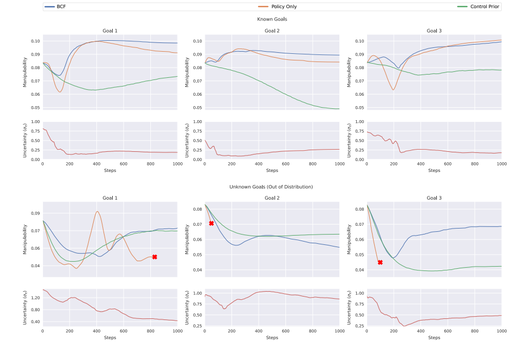
Fig. 14 . Manipulability and uncertainty curves for known and out-of-distribution goals for the reacher task, deployed on a real robot. The red cross indicates a failed trajectory.
원문 · CC BY 4.0 · Krishan Rana, Vibhavari Dasagi, Jesse Haviland, Ben Talbot, Michael Milford, Niko Sünderhauf · Bayesian Controller Fusion: Leveraging Control Priors in Deep Reinforcement Learning for Robotics · 원문 그림 인용 · 원본 PDF 17쪽에서 그림 영역을 추출했습니다.평가 범위와 불확실성 추정의 제약
저자들이 밝힌 첫 번째 한계는 평가 과제가 접촉이 없는 자유 공간 운동에 주로 머물렀다는 점입니다. 접촉이 많은 상호작용 과제에 대한 평가는 아직 이루어지지 않았습니다. 두 번째 한계는 앙상블 기반 불확실성 추정이 학습 초기에 분산을 과소추정하는 경향이 있었다는 점입니다. 모든 네트워크가 0에 가까운 값을 내기 때문인데, 실제로는 몇 번의 기울기 갱신 뒤 앙상블 구성원이 빠르게 다양해졌습니다. 저자들은 Randomized Prior Functions를 사용하면 초기 다양성을 확보할 수 있을 것으로 제안하지만, 이는 향후 검토할 가능성이며 본 논문에서 검증된 결과가 아닙니다. 세 번째 한계는 복합 분포가 각 액추에이터마다 하나의 단일 가우시안으로 축약되어 다중 모드 상황을 표현하기 어렵고, 사전지식도 하나만 사용한다는 점입니다.
저자들은 가우시안 혼합 모델과 계층적 RL을 후속 방향으로 제시합니다.
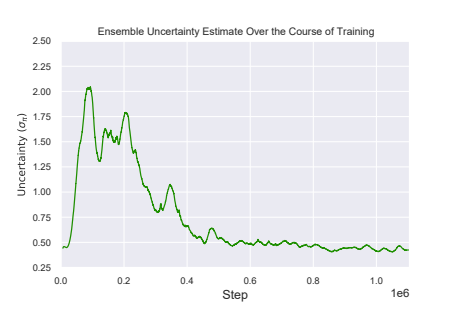
Fig. 15 . Progression of ensemble epistemic uncertainty estimates over the course of training. Note how it estimates relatively low uncertainties at the early stages of training before the ensemble members diverge.
원문 · CC BY 4.0 · Krishan Rana, Vibhavari Dasagi, Jesse Haviland, Ben Talbot, Michael Milford, Niko Sünderhauf · Bayesian Controller Fusion: Leveraging Control Priors in Deep Reinforcement Learning for Robotics · 원문 그림 인용 · 원본 PDF 18쪽에서 그림 영역을 추출했습니다.논문 정보
- 저자
- Krishan Rana, Vibhavari Dasagi, Jesse Haviland, Ben Talbot, Michael Milford, Niko Sünderhauf
- 학회·저널
- arXiv · 프리프린트
- 최초 공개일
- 2021년 7월 21일
- 등록일
- 2026년 11월 6일
- 수정일
- 2023년 4월 3일
- 버전
- v3
- arXiv
- 2107.09822
- 분류
- cs.RO · cs.AI · eess.SY
- 원문 이용 조건
- CC BY 4.0
- 제공 범위
- 논문 정보, 해설, 허용된 원문 그림
AI 해설은 논문 원문과 별개의 설명이며 오류가 있을 수 있습니다. 원문과 그림은 각 출처의 이용 조건과 따로 표시된 권리를 따릅니다.
초록
We present Bayesian Controller Fusion (BCF): a hybrid control strategy that combines the strengths of traditional hand-crafted controllers and model-free deep reinforcement learning (RL). BCF thrives in the robotics domain, where reliable but suboptimal control priors exist for many tasks, but RL from scratch remains unsafe and data-inefficient. By fusing uncertainty-aware distributional outputs from each system, BCF arbitrates control between them, exploiting their respective strengths. We study BCF on two real-world robotics tasks involving navigation in a vast and long-horizon environment, and a complex reaching task that involves manipulability maximisation. For both these domains, simple handcrafted controllers exist that can solve the task at hand in a risk-averse manner but do not necessarily exhibit the optimal solution given limitations in analytical modelling, controller miscalibration and task variation. As exploration is naturally guided by the prior in the early stages of training, BCF accelerates learning, while substantially improving beyond the performance of the control prior, as the policy gains more experience. More importantly, given the risk-aversity of the control prior, BCF ensures safe exploration and deployment, where the control prior naturally dominates the action distribution in states unknown to the policy. We additionally show BCF's applicability to the zero-shot sim-to-real setting and its ability to deal with out-of-distribution states in the real world. BCF is a promising approach towards combining the complementary strengths of deep RL and traditional robotic control, surpassing what either can achieve independently. The code and supplementary video material are made publicly available at https://krishanrana.github.io/bcf.
원문 인용
Krishan Rana, Vibhavari Dasagi, Jesse Haviland, Ben Talbot, Michael Milford, Niko Sünderhauf (2021). Bayesian Controller Fusion: Leveraging Control Priors in Deep Reinforcement Learning for Robotics. arXiv:2107.09822v3. https://arxiv.org/abs/2107.09822v3
BibTeX
@misc{rana2021bayesian,
  title = {{Bayesian Controller Fusion: Leveraging Control Priors in Deep Reinforcement Learning for Robotics}},
  author = {Krishan Rana and Vibhavari Dasagi and Jesse Haviland and Ben Talbot and Michael Milford and Niko Sünderhauf},
  year = {2021},
  eprint = {2107.09822},
  archivePrefix = {arXiv},
  url = {https://arxiv.org/abs/2107.09822v3}
}