논문 해설
Agent-as-a-Judge
- 연구 문제 고정된 문맥만 보는 LLM 판정자는 외부 상태나 사실 증거가 필요한 평가에서 한계를 보입니다.
- 연구 방법 판정 과정에 검사와 결과 사용을 넣고, 다중 에이전트 협업, 도구 통합, 메모리, 계획의 네 축으로 설계 공간을 정리합니다.
- 주요 결과 RM-Bench에서는 TIR-Judge만 비에이전트형 추론 보상 모델을 분명히 넘어섰고, JudgeBench에서는 강한 비에이전트형 모델이 최고 에이전트형 항목과 같거나 약간 높았습니다.
고정 문맥 판정의 한계
LLM-as-a-Judge는 평가 대상과 제공된 문맥만 읽고 점수나 선호, 비평을 냅니다. 에이전트 궤적이나 코드 실행 결과처럼 판정에 필요한 증거가 입력 밖의 환경 상태에 있으면, 이런 수동 판정자는 그 증거를 직접 얻지 못합니다. 또 판정자의 파라미터 지식에 없는 사실 주장도 외부 참조 없이는 확인하기 어렵습니다. 이 논문은 이런 상황에서 판정자가 증거를 찾고 판정 근거를 갱신하는 방식을 Agent-as-a-Judge로 정리합니다.
논문은 이 개념의 범위를 평가 목적의 검사 작업과 그 결과를 판정에 쓰는 절차로 한정합니다. 단순히 여러 페르소나가 같은 점수를 반복하거나 투표만 하는 구성은 이 정의에 들어가지 않습니다.
네 가지 설계 축
논문은 Agent-as-a-Judge의 설계 공간을 다중 에이전트 협업, 도구 통합, 메모리, 계획의 네 축으로 나눕니다. 다중 에이전트 협업은 검사 과제와 판정 권한을 여러 평가자에게 나누고, 토론이나 병렬 검증 후 결과를 합치는 방식입니다. 도구 통합은 실행, 검색, 시각 모델 같은 인터페이스로 판정에 쓸 관찰을 얻습니다.
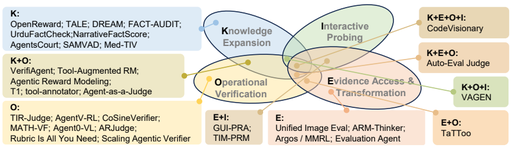
Figure 7 :Functional view of tool use inAgent-as-a-Judge. Four overlapping regions show that judges can chain multiple tool roles within one evaluation.
원문 · CC BY 4.0 · Runyang You, Hongru Cai, Caiqi Zhang, Qiancheng Xu, Meng Liu, Tiezheng Yu, Yongqi Li, Wenjie Li · Agent-as-a-Judge · 원문 그림 인용 · 원본 PDF 8쪽에서 그림 영역을 추출했습니다.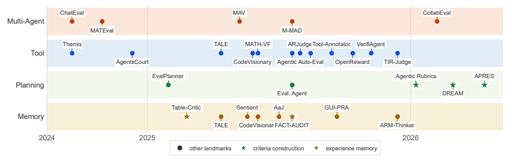
Figure 10 :Representative adoption timeline of the four methodological mechanisms inAgent-as-a-Judge. A method may appear in more than one lane when it instantiates multiple mechanisms. Stars mark two sparse patterns discussed in the text: rubric construction on Planning and experience memory on Memory.
원문 · CC BY 4.0 · Runyang You, Hongru Cai, Caiqi Zhang, Qiancheng Xu, Meng Liu, Tiezheng Yu, Yongqi Li, Wenjie Li · Agent-as-a-Judge · 원문 그림 인용 · 원본 PDF 11쪽에서 그림 영역을 추출했습니다.메모리는 평가 상태를 쓰고, 관리하고, 읽는 순환으로 설명됩니다. 계획은 무엇을 검사할지와 어떤 경로로 증거를 모을지를 명시합니다. 논문은 이 네 축이 서로 조합될 수 있다고 봅니다.
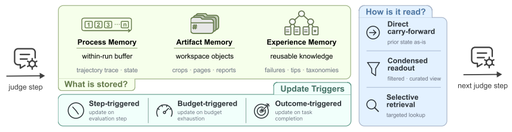
Figure 8 :Memory inAgent-as-a-Judgecan be analyzed as a write–manage–read loop over evaluation state. The stored state may take the form of process memory, artifact memory, or experience memory. Later judgments either receive this state directly, access a filtered or summarized form, or target specific artifacts, failures, or templates through retrieval.
원문 · CC BY 4.0 · Runyang You, Hongru Cai, Caiqi Zhang, Qiancheng Xu, Meng Liu, Tiezheng Yu, Yongqi Li, Wenjie Li · Agent-as-a-Judge · 원문 그림 인용 · 원본 PDF 9쪽에서 그림 영역을 추출했습니다.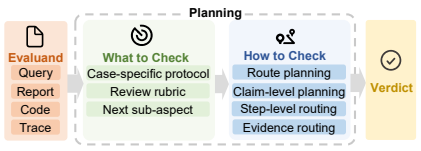
Figure9 :Planning inAgent-as-a-Judgesystems can externalize either what to check or how to gather proof before the verdict.
원문 · CC BY 4.0 · Runyang You, Hongru Cai, Caiqi Zhang, Qiancheng Xu, Meng Liu, Tiezheng Yu, Yongqi Li, Wenjie Li · Agent-as-a-Judge · 원문 그림 인용 · 원본 PDF 10쪽에서 그림 영역을 추출했습니다.보상 모델 벤치마크 비교
논문은 RewardBench, RM-Bench, JudgeBench에서 에이전트형 판정자와 비에이전트형 추론 보상 모델의 공개 점수를 모아 비교했습니다. 논문에 따르면 대부분의 원 논문이 세 벤치마크를 모두 평가하지 않아, 누락된 항목은 공개 소스 코드로 재현했습니다.
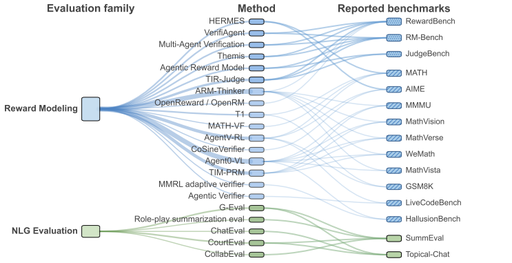
Figure 11 :Evaluation–benchmark coverage map. Links indicate that a method reports results on, or is explicitly evaluated on, a reported benchmark. Right-node fill and pattern encode benchmark artifact type:••• fixed response or judgment sets packaged for direct comparison; /// task problems whose reported results require candidate generation before judging; and green nodes, NLG evaluation datasets.
원문 · CC BY 4.0 · Runyang You, Hongru Cai, Caiqi Zhang, Qiancheng Xu, Meng Liu, Tiezheng Yu, Yongqi Li, Wenjie Li · Agent-as-a-Judge · 원문 그림 인용 · 원본 PDF 12쪽에서 그림 영역을 추출했습니다.RM-Bench에서는 TIR-Judge만 비에이전트형 추론 보상 모델을 분명히 넘어섰습니다. JudgeBench에서는 강한 비에이전트형 모델이 최고 에이전트형 항목과 같거나 약간 높았고, 대부분의 에이전트형 판정자는 그보다 낮았습니다. 이 결과는 고정된 응답 쌍에 대한 선호 및 추론 중심 보상 학습의 효과와도 맞물린다고 저자들은 해석합니다.
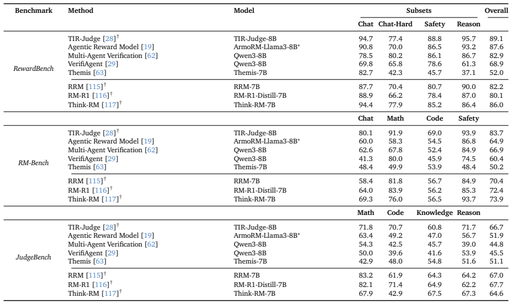
Table 3 :Local reward-model results on shared judge-quality benchmarks.
원문 · CC BY 4.0 · Runyang You, Hongru Cai, Caiqi Zhang, Qiancheng Xu, Meng Liu, Tiezheng Yu, Yongqi Li, Wenjie Li · Agent-as-a-Judge · 원문 그림 인용 · 원본 PDF 14쪽에서 그림 영역을 추출했습니다.고정 벤치마크 비교의 한계
논문은 이런 고정 아티팩트 벤치마크 비교가 테스트 시 선택, 하위 학습, 증거 탐색의 기여를 충분히 분리하지 못한다고 설명합니다. 높은 벤치마크 점수가 테스트 시 선택이나 하위 학습 성능의 향상을 예측하지 못할 수 있다는 점도 함께 제시합니다. 따라서 능동적 증거 탐색의 신뢰성을 보려면 전용 평가가 필요하다고 논문은 주장합니다.
논문 정보
- 저자
- Runyang You, Hongru Cai, Caiqi Zhang, Qiancheng Xu, Meng Liu, Tiezheng Yu, Yongqi Li, Wenjie Li
- 학회·저널
- arXiv · 프리프린트
- 최초 공개일
- 2026년 11월 13일
- 등록일
- 2026년 11월 16일
- 수정일
- 2026년 11월 13일
- 버전
- v1
- arXiv
- 2611.18067
- 분류
- cs.CL
- 원문 이용 조건
- CC BY 4.0
- 제공 범위
- 논문 정보, 해설, 허용된 원문 그림
AI 해설은 논문 원문과 별개의 설명이며 오류가 있을 수 있습니다. 원문과 그림은 각 출처의 이용 조건과 따로 표시된 권리를 따릅니다.
초록
Artificial intelligence has progressed from task-specific systems toward general models spanning perception, generation, reasoning, and autonomous interaction, making reliable evaluation essential for comparison, deployment, and post-training feedback. At scale, modern evaluation pipelines increasingly rely on LLM-as-a-Judge to produce scores, preferences, and critiques; in its fixed-context setting, the judge relies on the supplied evaluand and evaluation materials. Yet a reliable verdict may require evidence beyond the supplied evaluand and context---either because critical environmental states remain unrecorded in the static execution log, or because controversial factual claims require external verification. Passive judges cannot obtain that missing evidence before deciding, especially when evaluating agent trajectories, executable artifacts, or domain-specific reports. Recent work therefore develops active evaluators that seek missing evidence and update their grounds for judgment before deciding. We bring these advances together through Agent-as-a-Judge, focusing on how evaluators construct and control checking processes within the broader LLM-based judging landscape. We define the scope through evaluation-directed checks and the use of their results, covering both structured workflows and observation-driven control. We organize the design space by multi-agent collaboration, tool integration, memory, and planning, and show how these mechanisms supply the checks and evidence on which a verdict rests. We consolidate published scores and reproduce missing entries for key agentic judges; the comparison reveals uneven agentic gains and motivates dedicated agentic evaluation. We conclude by characterizing application demands and open challenges in cost, reliability, safety, and governance that condition trusted deployment of agentic judges at scale.
원문 인용
Runyang You, Hongru Cai, Caiqi Zhang, Qiancheng Xu, Meng Liu, Tiezheng Yu, Yongqi Li, Wenjie Li (2026). Agent-as-a-Judge. arXiv:2611.18067v1. https://arxiv.org/abs/2611.18067v1
BibTeX
@misc{you2026agent,
  title = {{Agent-as-a-Judge}},
  author = {Runyang You and Hongru Cai and Caiqi Zhang and Qiancheng Xu and Meng Liu and Tiezheng Yu and Yongqi Li and Wenjie Li},
  year = {2026},
  eprint = {2611.18067},
  archivePrefix = {arXiv},
  url = {https://arxiv.org/abs/2611.18067v1}
}