논문 해설
A 3D Probabilistic Deep Learning System for Detection and Diagnosis of Lung Cancer Using Low-Dose CT Scans
저선량 CT 영상을 이용한 폐암 탐지 및 진단을 위한 3D 확률적 딥러닝 시스템
- 연구 문제 저선량 CT 폐암 검진의 판독 부담을 줄이면서 알고리즘의 불확실성을 임상에 전달할 수 있는 3D 확률 진단 시스템이 필요합니다.
- 연구 방법 3D 합성곱 신경망으로 CADe 결절 검출과 CADx 환자 진단을 함께 개발하고, MC 드롭아웃과 딥 앙상블로 보정된 확률을 얻습니다.
- 주요 결과 CADe는 LUNA16에서 평균 metric 0.921을, CADx는 Kaggle Stage-2에서 AUC 0.87을 보고했으며 불확실성 기반 참조가 성능을 높였습니다.
저선량 CT 폐암 검진의 문제
저선량 CT는 고위험군의 폐암 검진에 쓰이며, 연간 CT 검진은 연간 흉부 X선 촬영과 비교해 7년 후 폐암 사망률을 적어도 20% 줄일 수 있다고 보고되었습니다. 그러나 방대한 스캔을 정확하고 효율적으로 판독하는 부담이 크며, 알고리즘과 의사 사이에서 알고리즘이 자신의 불확실성을 안정적으로 전달하지 못하면 임상에 적용하기 어렵습니다. 이 논문은 3D 합성곱 신경망으로 CT를 직접 분석해 보정된 확률 점수를 내는 종단간 폐암 진단 시스템을 제안합니다. 시스템은 결절을 찾는 CADe 모듈과 결절 및 환자 단위 악성 여부를 판단하는 CADx 모듈로 구성됩니다.
CADe와 CADx를 함께 개발하는 구조
기존 연구는 CADe나 CADx 중 하나만 최적화하는 경우가 많았습니다. 이 논문은 CADe의 위양성 후보가 CADx 성능에 직접 영향을 준다고 보고, 두 모듈을 함께 개발하고 조정합니다. 입력 CT는 전처리를 거쳐 CADe 분할 네트워크로 들어가고, 후보 결절 목록은 CADx의 순위화 네트워크와 다중 인스턴스 분류 네트워크로 전달됩니다. 실험에서는 CADe 위양성 후보를 줄이는 채점 네트워크를 LUNA16 평가에만 사용하고, CADx는 임계값 0.5에서 생성된 후보를 사용합니다.
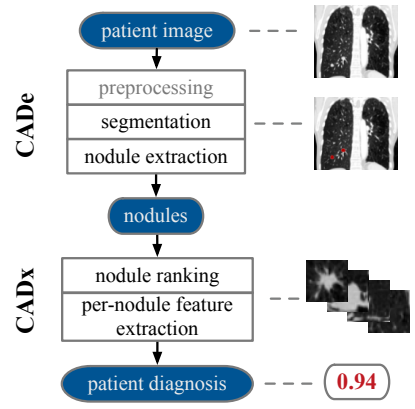
Fig. 1 . Our overall CAD system diagram. Since CADx performance is so reliant on the quality of the nodule candidates generated by the CADe, both were developed simultaneously to achieve the best overall performance.
원문 · CC BY 4.0 · Onur Ozdemir, Rebecca L. Russell, Andrew A. Berlin · A 3D Probabilistic Deep Learning System for Detection and Diagnosis of Lung Cancer Using Low-Dose CT Scans · 원문 그림 인용 · 원본 PDF 3쪽에서 그림 영역을 추출했습니다.CADe 분할과 후보 채점
CADe의 주 분할 네트워크는 V-Net을 기반으로 하는 3D 완전 합성곱 네트워크이며, 인코더-디코더 블록과 건너뛰기 연결을 사용합니다. 블록은 instance normalization과 ReLU를 쓰고 배치 정규화는 쓰지 않습니다. LUNA16 결절 중심과 지름으로 구형 마스크를 만들고 643 블록을 샘플링해 학습하며, 손실은 결절 내부 복셀에 배경보다 두 배 가중치를 주는 교차 엔트로피입니다. 테스트에서는 전체 스캔을 겹치는 블록으로 나누어 분할 결과를 이어 붙이고, 임계값 처리 후 후보 결절을 추출합니다. 후보 채점 네트워크는 323 블록을 입력으로 하며 LUNA16 평가를 위한 위양성 감소 역할을 합니다.
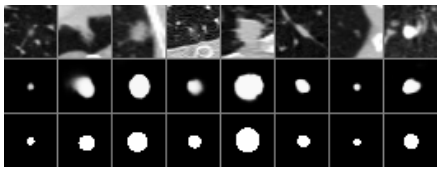
Fig. 3 . Sample nodule segmentations from our CADe segmentation model, sliced through the center of each nodule candidate. First row: Input CT scan images from LIDC-IDRI test data. Second row: Our corresponding segmentation probabilities. Third row: (Spherical) voxelwise labels extracted from the LUNA16 annotations.
원문 · CC BY 4.0 · Onur Ozdemir, Rebecca L. Russell, Andrew A. Berlin · A 3D Probabilistic Deep Learning System for Detection and Diagnosis of Lung Cancer Using Low-Dose CT Scans · 원문 그림 인용 · 원본 PDF 4쪽에서 그림 영역을 추출했습니다.CADx의 순위화와 주의 기반 다중 인스턴스 분류
CADx는 두 개의 3D 합성곱 신경망으로 구성됩니다. 첫 번째 순위화 네트워크는 LIDC-IDRI의 여러 방사선 전문의 악성 점수 평균을 회귀 목표로 학습해 후보를 위험도 기준으로 정렬합니다. 두 번째 분류 네트워크는 정렬된 상위 k개 후보의 특징을 주의 기반 다중 인스턴스 학습으로 결합해 환자 단위 악성 확률을 출력합니다. 최종 모델은 원본 후보와 다운샘플링 후보에서 각각 상위 2개씩, 총 4개 후보를 사용합니다. 이 방식은 후보별 가중치를 합이 1이 되도록 계산하여 환자 확률을 만듭니다.
LUNA16과 Kaggle 평가 결과
CADe는 LUNA16 벤치마크에서 10-fold 교차 검증으로 평가되었습니다. 분할 임계값 0.2에서 민감도 96.5%와 스캔당 평균 위양성 19.7을 보고했으며, 채점 네트워크를 적용한 평균 LUNA16 metric은 0.921입니다. 이 값은 원문이 비교한 최신 공개 결과와 비슷하거나 더 높다고 보고됩니다. CADx는 임계값 0.5에서 생성된 후보를 사용해 Kaggle Stage-2 테스트 세트에서 평균 ROC AUC 0.87을 기록했습니다. 두 결과는 서로 다른 데이터셋과 후보 설정에서 얻은 값이므로 하나의 공통 조건으로 묶지 않습니다.
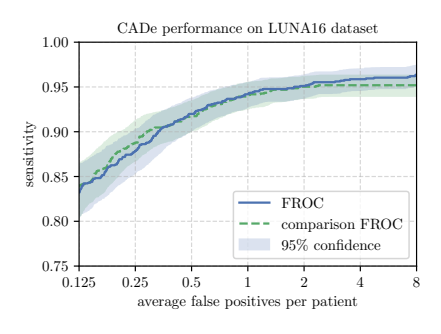
Fig. 6 . The free response operating characteristic (FROC) for our CADe candidate generation and scoring system on the LUNA16 dataset, with patient-bootstrapped 95% confidence interval, and the same results with our comparison model architecture (3D U-Net.)
원문 · CC BY 4.0 · Onur Ozdemir, Rebecca L. Russell, Andrew A. Berlin · A 3D Probabilistic Deep Learning System for Detection and Diagnosis of Lung Cancer Using Low-Dose CT Scans · 원문 그림 인용 · 원본 PDF 7쪽에서 그림 영역을 추출했습니다.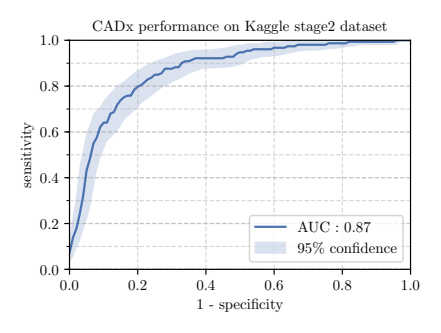
Fig. 8 . The receiver operating characteristic (ROC) curve for our CADx system on the Kaggle Stage-2 test set, trained on both LUNA16 and Kaggle Stage-1 data, with patient-bootstrapped 95% confidence interval.
원문 · CC BY 4.0 · Onur Ozdemir, Rebecca L. Russell, Andrew A. Berlin · A 3D Probabilistic Deep Learning System for Detection and Diagnosis of Lung Cancer Using Low-Dose CT Scans · 원문 그림 인용 · 원본 PDF 8쪽에서 그림 영역을 추출했습니다.CADe 위양성 후보가 CADx에 미치는 영향
CADe 위양성 감소가 CADx에 주는 효과를 확인하기 위해 Kaggle Stage-2 테스트 세트에서 여러 CADe 임계값으로 생성한 후보를 비교했습니다. 원문은 CADx가 위양성 후보에 상대적으로 둔감하며, 위양성 감소 단계가 큰 가치를 더하지 않는다고 보고합니다. 또 1 또는 1/8 FP 평가점으로 CADx를 다시 학습하면 AUROC가 크게 떨어지고 위양성 후보에 대한 강건성도 낮아졌다고 보고합니다. 저자들은 이를 위양성 후보가 CADx 학습 중 내부 CADe 능력을 향상시키는 데 도움을 준 결과로 해석합니다.
불확실성 보정과 확률 기반 참조
모델 불확실성은 Monte Carlo 드롭아웃으로 근사합니다. CADe 채점 네트워크에서는 테스트 시에도 드롭아웃을 적용한 확률이 LUNA16 테스트 데이터에서 보정된 확률을 보였고, 드롭아웃 없이 얻은 확률은 과신하는 경향을 보였습니다. CADx에서는 다섯 개의 학습 및 개발 분할로 학습한 모델을 MC 드롭아웃과 결합한 딥 앙상블을 사용했으며, 이 앙상블 확률이 전체 범위에서 더 안정적으로 보정되었다고 보고합니다. 참조 전략으로는 예측 엔트로피가 높은 항목을 방사선 전문의가 확인하도록 선택했고, 결절 후보 PR AUC는 참조 비율 10% 미만에서도 크게 향상되었습니다. CADx ROC AUC는 최대 0.885까지 올랐으나 참조율이 높아질수록 감소하여 실제 오분류 가능성도 남아 있습니다.
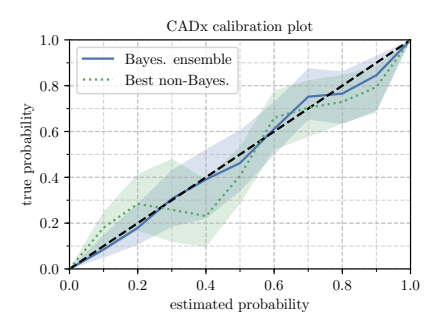
Fig. 10 . Probability calibration curves for the Bayesian ensemble and the best non-Bayesian CADx model, with patient-bootstrapped 95% confidence inter- vals. The estimated malignancy probabilities output by the CADx Bayesian ensemble are well-calibrated when model uncertainty is included.
원문 · CC BY 4.0 · Onur Ozdemir, Rebecca L. Russell, Andrew A. Berlin · A 3D Probabilistic Deep Learning System for Detection and Diagnosis of Lung Cancer Using Low-Dose CT Scans · 원문 그림 인용 · 원본 PDF 9쪽에서 그림 영역을 추출했습니다.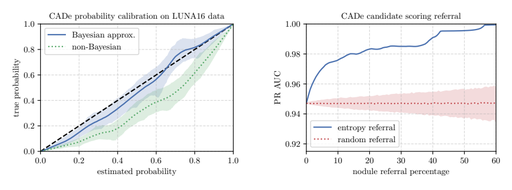
Fig. 11 . The CADe scoring area under the precision-recall curve as a function of referral percentage, for the entropy referral strategy and a random strategy (with 95% confidence interval).
원문 · CC BY 4.0 · Onur Ozdemir, Rebecca L. Russell, Andrew A. Berlin · A 3D Probabilistic Deep Learning System for Detection and Diagnosis of Lung Cancer Using Low-Dose CT Scans · 원문 그림 인용 · 원본 PDF 9쪽에서 그림 영역을 추출했습니다.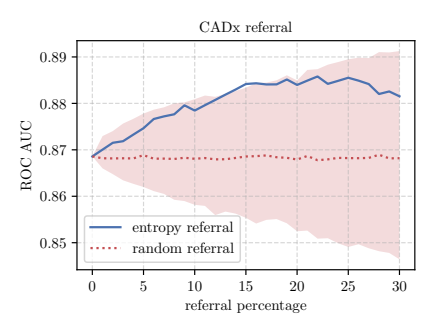
Fig. 12 . The CADx area under the ROC curve as a function of referral percentage, for entropy referral strategy and a random strategy with 95% confidence interval. Note that the confidence interval is wider than the CADe scoring network because the number of patients in the Kaggle test set is smaller than the number of nodules in the LUNA16 dataset.
원문 · CC BY 4.0 · Onur Ozdemir, Rebecca L. Russell, Andrew A. Berlin · A 3D Probabilistic Deep Learning System for Detection and Diagnosis of Lung Cancer Using Low-Dose CT Scans · 원문 그림 인용 · 원본 PDF 10쪽에서 그림 영역을 추출했습니다.데이터 한계와 남은 과제
LUNA16 주석은 30 mm보다 큰 결절을 제외하므로, 학습된 CADe가 큰 결절을 놓칠 수 있습니다. 원문은 이 한계를 줄이기 위해 강한 데이터 증강과 다운샘플링을 사용했지만 해결책이 불완전하다고 밝힙니다. CADe가 악성 병변을 놓치면 CADx는 그 스캔을 악성으로 분류할 수 없어 가장 큰 위음성 원인이 된다고 설명합니다. 또한 Kaggle 스테이지 데이터에 대한 CADx 성능은 해당 데이터셋 조건에서 얻은 결과이므로, 다른 장비나 환자 집단으로 일반화하는 근거는 이 논문에 포함되지 않습니다.
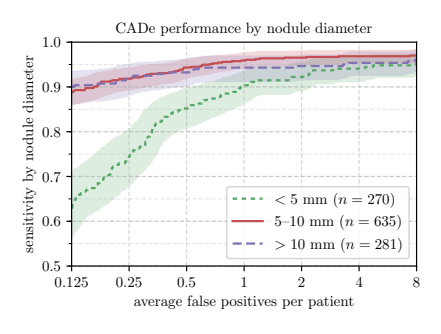
Fig. 7 . CADe FROC on LUNA16 data, breaking down the sensitivity by nodule diameter. CADe sensitivity for the smallest group of nodules (between 3 mm and 5 mm diameter) is significantly worse than the sensitivity for larger nodules (between 5 mm and 30 mm diameter) at lower thresholds that correspond to reduced false positives.
원문 · CC BY 4.0 · Onur Ozdemir, Rebecca L. Russell, Andrew A. Berlin · A 3D Probabilistic Deep Learning System for Detection and Diagnosis of Lung Cancer Using Low-Dose CT Scans · 원문 그림 인용 · 원본 PDF 7쪽에서 그림 영역을 추출했습니다.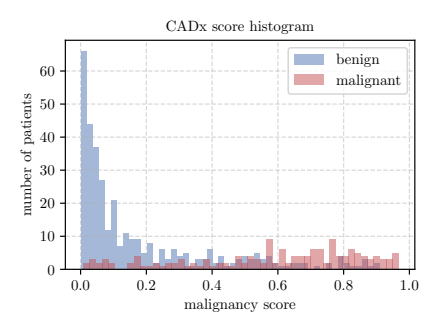
Fig. 13 . Histogram of CADx malignancy probability estimates for benign and malignant patients. Note that the mode around 0 for malignant patients is the reason behind false negatives due to missed nodules by the CADe model.
원문 · CC BY 4.0 · Onur Ozdemir, Rebecca L. Russell, Andrew A. Berlin · A 3D Probabilistic Deep Learning System for Detection and Diagnosis of Lung Cancer Using Low-Dose CT Scans · 원문 그림 인용 · 원본 PDF 10쪽에서 그림 영역을 추출했습니다.논문 정보
- 저자
- Onur Ozdemir, Rebecca L. Russell, Andrew A. Berlin
- 학회·저널
- arXiv · 프리프린트
- 최초 공개일
- 2019년 2월 8일
- 등록일
- 2026년 11월 6일
- 수정일
- 2020년 1월 21일
- 버전
- v3
- arXiv
- 1902.03233
- 분류
- cs.CV · cs.LG
- 원문 이용 조건
- CC BY 4.0
- 제공 범위
- 논문 정보, 해설, 허용된 원문 그림
AI 해설은 논문 원문과 별개의 설명이며 오류가 있을 수 있습니다. 원문과 그림은 각 출처의 이용 조건과 따로 표시된 권리를 따릅니다.
초록
We introduce a new computer aided detection and diagnosis system for lung cancer screening with low-dose CT scans that produces meaningful probability assessments. Our system is based entirely on 3D convolutional neural networks and achieves state-of-the-art performance for both lung nodule detection and malignancy classification tasks on the publicly available LUNA16 and Kaggle Data Science Bowl challenges. While nodule detection systems are typically designed and optimized on their own, we find that it is important to consider the coupling between detection and diagnosis components. Exploiting this coupling allows us to develop an end-to-end system that has higher and more robust performance and eliminates the need for a nodule detection false positive reduction stage. Furthermore, we characterize model uncertainty in our deep learning systems, a first for lung CT analysis, and show that we can use this to provide well-calibrated classification probabilities for both nodule detection and patient malignancy diagnosis. These calibrated probabilities informed by model uncertainty can be used for subsequent risk-based decision making towards diagnostic interventions or disease treatments, as we demonstrate using a probability-based patient referral strategy to further improve our results.
원문 인용
Onur Ozdemir, Rebecca L. Russell, Andrew A. Berlin (2019). A 3D Probabilistic Deep Learning System for Detection and Diagnosis of Lung Cancer Using Low-Dose CT Scans. arXiv:1902.03233v3. https://arxiv.org/abs/1902.03233v3
BibTeX
@misc{ozdemir2019probabilistic,
  title = {{A 3D Probabilistic Deep Learning System for Detection and Diagnosis of Lung Cancer Using Low-Dose CT Scans}},
  author = {Onur Ozdemir and Rebecca L. Russell and Andrew A. Berlin},
  year = {2019},
  eprint = {1902.03233},
  archivePrefix = {arXiv},
  url = {https://arxiv.org/abs/1902.03233v3}
}