논문 해설
Development of a Soft Actor Critic Deep Reinforcement Learning Approach for Harnessing Energy Flexibility in a Large Office Building
대형 사무용 건물의 에너지 유연성 활용을 위한 Soft Actor Critic 심층 강화학습 접근법 개발
- 연구 문제 건물의 냉방 설정점을 제어해 에너지 유연성을 얻으려 할 때, 모델 기반 제어는 건물마다 모델을 만들어야 하므로 대규모 건물 재고에 확장하기 어렵습니다. 이 연구는 SAC 심층 강화학습을 EnergyPlus 기반 대형 사무소 건물 환경에서 검증합니다.
- 연구 방법 SAC 에이전트가 TES를 갖춘 DOE 대형 사무소 모델의 냉방 설정점을 0에서 1로 정규화된 값으로 출력하고, 가격과 기상, 건물 상태를 관측하여 비용과 쾌적성의 보상으로 학습합니다.
- 주요 결과 한 주 테스트에서 RBC 대비 에너지 비용을 9.7% 낮추면서 쾌적 제약을 대체로 지킨 것으로 보고됩니다. 학습 1개 에피소드, 즉 세 달의 학습만으로도 RBC를 앞섰다고 보고되며, 다른 기후로의 전이 성능은 기후에 따라 달라 재학습이 필요한 경우가 있습니다.
건물 냉방 제어에서 모델 없는 강화학습을 검증하는 이유
건물의 냉방 설정점을 조절하면 냉방 부하를 시간대별로 옮겨 전력 수요의 유연성을 얻을 수 있습니다. 그러나 전통적인 모델 기반 제어는 건물마다 별도의 모델을 만들어야 하므로 많은 건물 재고에 확장하기 어렵습니다. 이 연구는 연속 행동 공간을 다룰 수 있는 SAC 심층 강화학습(DRL)을 EnergyPlus 기반 대형 사무소 건물 환경에 적용해, 에너지 비용을 낮추면서 열쾌적성을 유지할 수 있는지 확인합니다. 저자들은 기존 SAC 적용이 사전 계산된 냉방 부하 같은 단순 환경에 머물렀다고 지적하며, 이 점이 본 연구의 검증 범위를 구분하는 기준이 됩니다.
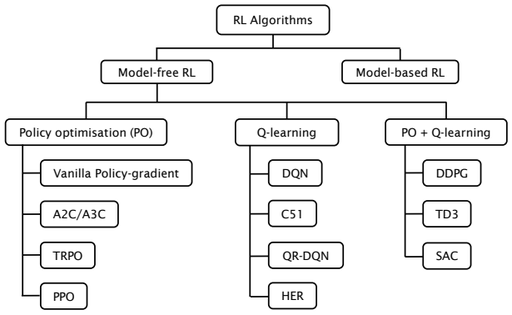
Figure 2 : Class of model-free RL algorithms (adapted from [21])
원문 · CC BY 4.0 · Anjukan Kathirgamanathan, Eleni Mangina, Donal P. Finn · Development of a Soft Actor Critic Deep Reinforcement Learning Approach for Harnessing Energy Flexibility in a Large Office Building · 원문 그림 인용 · 원본 PDF 5쪽에서 그림 영역을 추출했습니다.SAC의 엔트로피 목적과 학습 구조
SAC는 보상만 최대화하는 일반 강화학습과 달리 정책의 엔트로피 항을 보상과 함께 목적에 더합니다. 식 4의 목적은 보상과 알파에 곱한 정책 엔트로피의 합을 최대화하는 형태이며, 알파는 보상과 엔트로피 사이의 상대적 중요도를 조절합니다. 엔트로피가 커지면 정책이 더 많이 탐색하고 나쁜 지역 최적해에 일찍 수렴하는 것을 줄일 수 있다고 설명됩니다. 학습에서는 두 개의 소프트 Q 함수 중 작은 값을 사용해 정책 개선의 양의 편향을 완화하고, 목표 네트워크는 Q 함수 가중치의 지수 이동 평균으로 갱신합니다. 배포 시에는 확률적 샘플 대신 정책 분포의 평균 행동을 사용합니다.
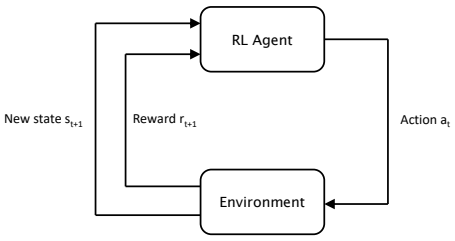
Figure 1 : Agent-environment interaction in reinforcement learning
원문 · CC BY 4.0 · Anjukan Kathirgamanathan, Eleni Mangina, Donal P. Finn · Development of a Soft Actor Critic Deep Reinforcement Learning Approach for Harnessing Energy Flexibility in a Large Office Building · 원문 그림 인용 · 원본 PDF 4쪽에서 그림 영역을 추출했습니다.EnergyPlus와 Python을 잇는 제어 환경
환경은 DOE 대형 사무소 원형 모델을 기반으로 하며, 여기에 TES 탱크를 추가해 냉방 유연성 원천을 더했습니다. 제어 변수는 21도씨에서 28도씨 사이의 냉방 설정점이고, 에이전트는 0에서 1로 정규화된 값을 출력합니다. 학습은 로마 기후에서 수행되며, EnergyPlus와 Python 제어기는 PyEp와 OPC 브리지로 연결되어 공동 시뮬레이션됩니다. 시뮬레이션 간격은 15분으로 설정되었지만, 학습 과정에서는 잦은 설정점 변화가 학습을 방해하여 제어 간격을 1시간으로 늘려야 했다고 보고됩니다. 상태 공간은 Set I, Set II, Set III의 세 구성으로 비교되며, 이 구성 차이가 이후 결과 해석의 기준이 됩니다.
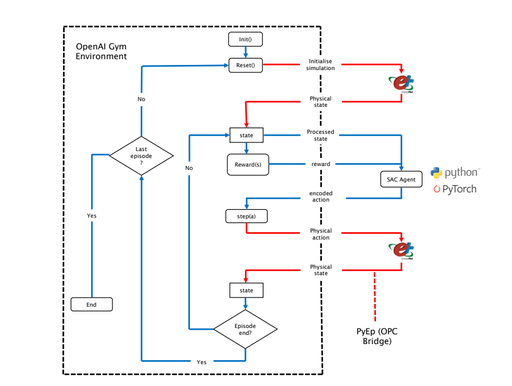
Figure 4 : Architecture of simulation environment for RL control in HVAC systems (modified from [25])
원문 · CC BY 4.0 · Anjukan Kathirgamanathan, Eleni Mangina, Donal P. Finn · Development of a Soft Actor Critic Deep Reinforcement Learning Approach for Harnessing Energy Flexibility in a Large Office Building · 원문 그림 인용 · 원본 PDF 12쪽에서 그림 영역을 추출했습니다.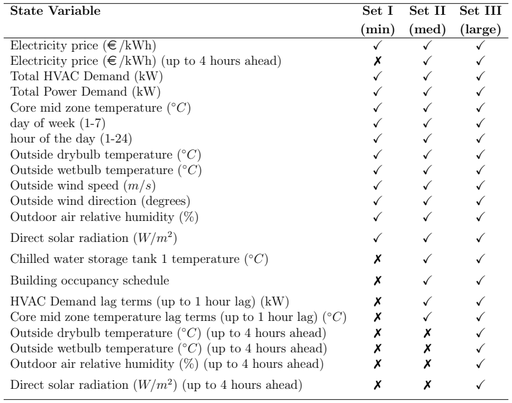
Table 1 : State space configurations used for model-free case (Sets I, II and III)
원문 · CC BY 4.0 · Anjukan Kathirgamanathan, Eleni Mangina, Donal P. Finn · Development of a Soft Actor Critic Deep Reinforcement Learning Approach for Harnessing Energy Flexibility in a Large Office Building · 원문 그림 인용 · 원본 PDF 13쪽에서 그림 영역을 추출했습니다.RBC 대비 비용과 쾌적성의 결과
테스트 주간에서 SAC 에이전트는 RBC보다 구매 에너지를 8.8% 적게 사용했고, 에너지 비용은 9.7% 낮았습니다. 같은 표에서 불쾌감 시간 지표는 78.3% 절감으로 보고되지만, RBC의 기준 불쾌감 시간이 0.60시간으로 매우 낮아 상대 변화율이 크게 나타난 점을 함께 읽어야 합니다. 하이퍼파라미터 민감도 분석에서는 감마 0.99, 알파 0.05 등 여러 조합이 비용과 쾌적성 사이의 파레토 전선을 이루었고, 알파 0.05가 쾌적 제약 준수에 유리한 경향이 보고되었습니다. 그러나 저자들은 명확한 일관 추세는 없다고 설명합니다. 상태 공간 비교에서는 Set II가 비용과 쾌적성을 함께 고려할 때 가장 좋아 권장되었으며, 이 비교는 감마 0.99, 알파 0.05, 람다 100 설정에서 수행되었습니다.
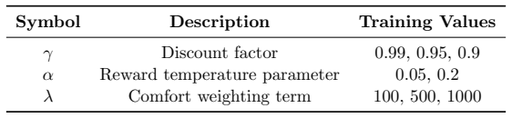
Table 2 : Different hyperparameter configurations implemented in the training phase for SAC DRL applied to ‘Large Office’ building
원문 · CC BY 4.0 · Anjukan Kathirgamanathan, Eleni Mangina, Donal P. Finn · Development of a Soft Actor Critic Deep Reinforcement Learning Approach for Harnessing Energy Flexibility in a Large Office Building · 원문 그림 인용 · 원본 PDF 14쪽에서 그림 영역을 추출했습니다.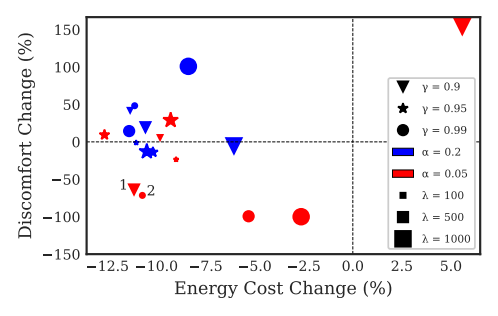
Figure 5 : SAC DRL agent control performance (x-axis: cost and y-axis:discomfort) compared against reference RBC for different combinations of hyperparameters as outlined in Table 2. The shape of the marker represents the discount factor ( γ) of the experiment run, the colour represents the stochastic temperature term (α) and finally the size of the marker represents the comfort weighting term ( λ).
원문 · CC BY 4.0 · Anjukan Kathirgamanathan, Eleni Mangina, Donal P. Finn · Development of a Soft Actor Critic Deep Reinforcement Learning Approach for Harnessing Energy Flexibility in a Large Office Building · 원문 그림 인용 · 원본 PDF 18쪽에서 그림 영역을 추출했습니다.
Table 5 : Comparison of performance of SAC DRL for different state spaces
원문 · CC BY 4.0 · Anjukan Kathirgamanathan, Eleni Mangina, Donal P. Finn · Development of a Soft Actor Critic Deep Reinforcement Learning Approach for Harnessing Energy Flexibility in a Large Office Building · 원문 그림 인용 · 원본 PDF 18쪽에서 그림 영역을 추출했습니다.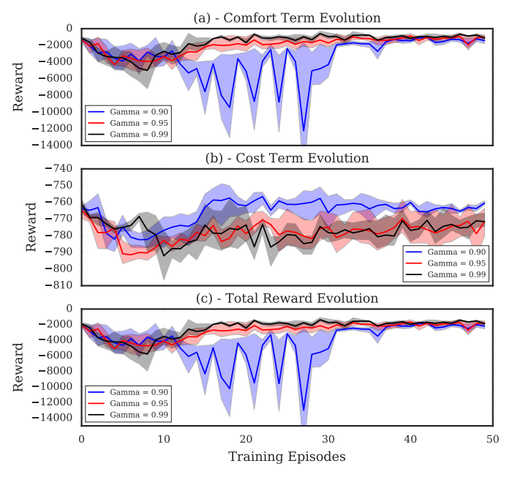
Figure 6 : Function of reward (Equation 5) over training episodes for different discount (how myopic the agent is) factors ( γ = 0.9/0.95/0.99). The solid line represents the mean of the values whereas the filled area represents the bounds for the 25% and 75% quartiles.
원문 · CC BY 4.0 · Anjukan Kathirgamanathan, Eleni Mangina, Donal P. Finn · Development of a Soft Actor Critic Deep Reinforcement Learning Approach for Harnessing Energy Flexibility in a Large Office Building · 원문 그림 인용 · 원본 PDF 19쪽에서 그림 영역을 추출했습니다.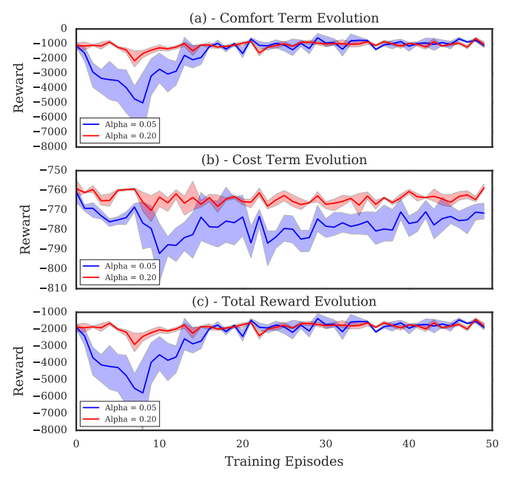
Figure 7 : Function of reward (Equation 5) over training episodes for different temperature (to what level the agent explores the action space) parameters ( α = 0.05/0.2). The solid line represents the mean of the values whereas the filled area represents the bounds for the 25% and 75% quartiles.
원문 · CC BY 4.0 · Anjukan Kathirgamanathan, Eleni Mangina, Donal P. Finn · Development of a Soft Actor Critic Deep Reinforcement Learning Approach for Harnessing Energy Flexibility in a Large Office Building · 원문 그림 인용 · 원본 PDF 20쪽에서 그림 영역을 추출했습니다.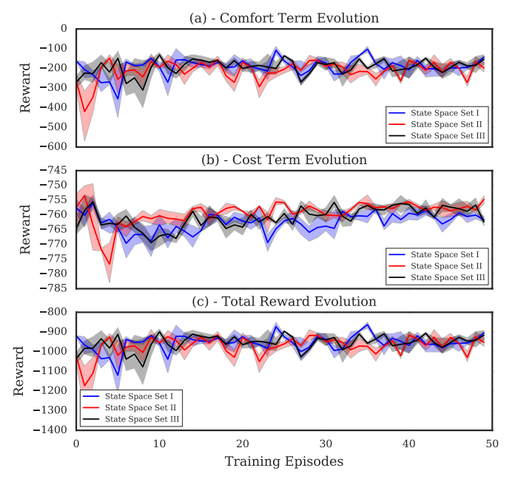
Figure 8 : Function of reward over training episodes for different state spaces (featuring differing number of input variables). The solid line represents the mean of the values whereas the filled area represents the bounds for the 25% and 75% quartiles.
원문 · CC BY 4.0 · Anjukan Kathirgamanathan, Eleni Mangina, Donal P. Finn · Development of a Soft Actor Critic Deep Reinforcement Learning Approach for Harnessing Energy Flexibility in a Large Office Building · 원문 그림 인용 · 원본 PDF 21쪽에서 그림 영역을 추출했습니다.
Table 6 : Comparison of performance of SAC DRL compared to reference RBC control over work week in
원문 · CC BY 4.0 · Anjukan Kathirgamanathan, Eleni Mangina, Donal P. Finn · Development of a Soft Actor Critic Deep Reinforcement Learning Approach for Harnessing Energy Flexibility in a Large Office Building · 원문 그림 인용 · 원본 PDF 21쪽에서 그림 영역을 추출했습니다.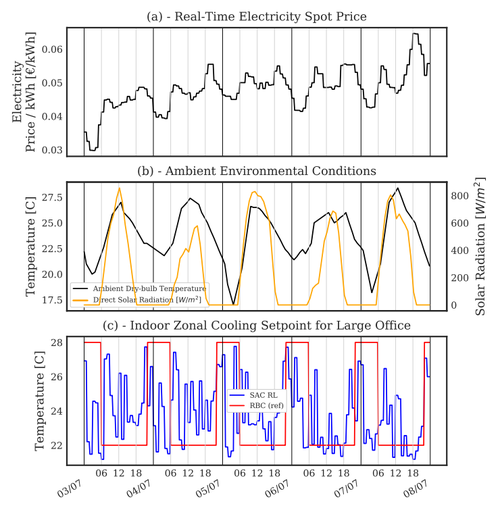
Figure 9 : SAC DRL results (compared to the baseline RBC) over work week in July (03/07-07/07) for test climate of Rome showing (a) real-time electricity spot price, (b) ambient environmental conditions and (c) actuation of control cooling setpoint
원문 · CC BY 4.0 · Anjukan Kathirgamanathan, Eleni Mangina, Donal P. Finn · Development of a Soft Actor Critic Deep Reinforcement Learning Approach for Harnessing Energy Flexibility in a Large Office Building · 원문 그림 인용 · 원본 PDF 22쪽에서 그림 영역을 추출했습니다.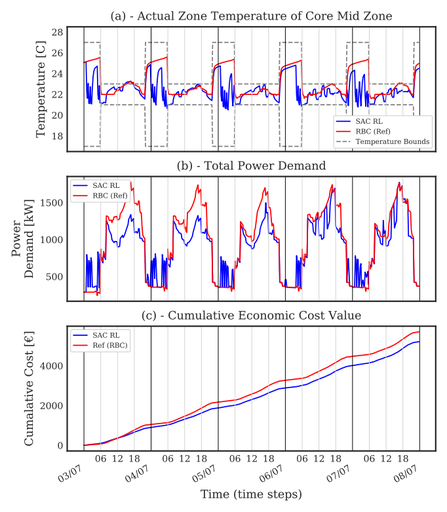
Figure 10 : SAC DRL results (compared to the baseline RBC) over work week in July (03/07-07/07) for test climate of Rome showing (a) actual zonal temperature, (b) building total power demand and (c) cumulative economic cost of control strategy
원문 · CC BY 4.0 · Anjukan Kathirgamanathan, Eleni Mangina, Donal P. Finn · Development of a Soft Actor Critic Deep Reinforcement Learning Approach for Harnessing Energy Flexibility in a Large Office Building · 원문 그림 인용 · 원본 PDF 23쪽에서 그림 영역을 추출했습니다.학습 기간, 계절, 기후 전이의 결과
학습 에피소드를 1개에서 50개까지 바꾸고 갱신 빈도를 4, 96, 672 단계로 비교한 결과, 갱신 빈도가 최소 한 시간에 한 번이어야 1개 에피소드만으로도 비슷한 성능을 낼 수 있다고 보고되었습니다. 1개 에피소드는 4월부터 6월까지의 세 달 시뮬레이션입니다. 이 학습 기간의 에이전트 X는 학습 중에도 RBC 대비 에너지 비용을 0.8%, 구매 에너지를 0.5% 낮추고 불쾌감 시간을 64.6% 줄인 것으로 표 8에 보고됩니다. 여름에 학습한 에이전트를 9월 한 주에 배포한 결과, 본문은 에너지 2.7%와 비용 3.5%의 절감을 적지만 표 9는 구매 에너지 2.3%와 비용 3.4%를 보고합니다. 다른 기후 전이에서는 카이로가 로마와 비슷하거나 더 나은 결과를 보였고, 샨시 중국과 마이애미에서는 비용이 각각 5.5%와 4.1% 낮았습니다.
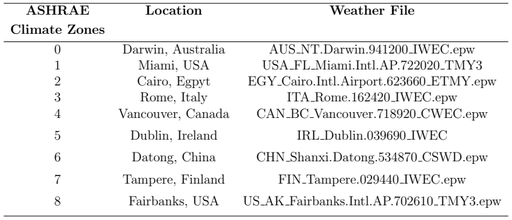
Table 4 : Climate zones and locations used to test adaptability of SAC DRL control
원문 · CC BY 4.0 · Anjukan Kathirgamanathan, Eleni Mangina, Donal P. Finn · Development of a Soft Actor Critic Deep Reinforcement Learning Approach for Harnessing Energy Flexibility in a Large Office Building · 원문 그림 인용 · 원본 PDF 16쪽에서 그림 영역을 추출했습니다.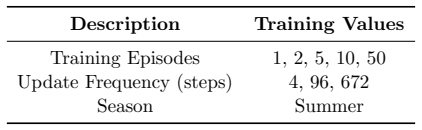
Table 7 : Different hyperparameter configurations implemented in the training phase
원문 · CC BY 4.0 · Anjukan Kathirgamanathan, Eleni Mangina, Donal P. Finn · Development of a Soft Actor Critic Deep Reinforcement Learning Approach for Harnessing Energy Flexibility in a Large Office Building · 원문 그림 인용 · 원본 PDF 24쪽에서 그림 영역을 추출했습니다.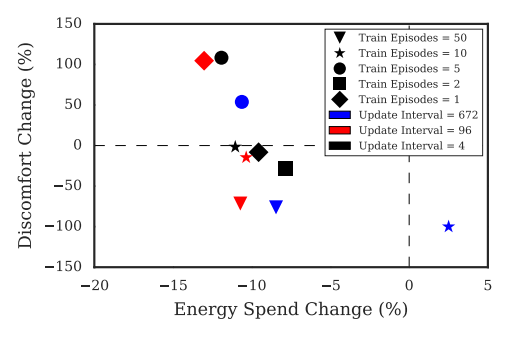
Figure 11 : SAC DRL agent control performance for different number of training episodes and update fre- quency for test work week of 03/07-07/07. The x-axis illustrates the percentage energy cost saving compared to the reference RBC (see Equation 6) and the y-axis illustrates the percentage change in cumulative tem- perature constraint violations compared to the reference RBC (see Equation 7)
원문 · CC BY 4.0 · Anjukan Kathirgamanathan, Eleni Mangina, Donal P. Finn · Development of a Soft Actor Critic Deep Reinforcement Learning Approach for Harnessing Energy Flexibility in a Large Office Building · 원문 그림 인용 · 원본 PDF 25쪽에서 그림 영역을 추출했습니다.
Table 8 : Comparison of performance of SAC DRL compared to reference RBC control during training
원문 · CC BY 4.0 · Anjukan Kathirgamanathan, Eleni Mangina, Donal P. Finn · Development of a Soft Actor Critic Deep Reinforcement Learning Approach for Harnessing Energy Flexibility in a Large Office Building · 원문 그림 인용 · 원본 PDF 25쪽에서 그림 영역을 추출했습니다.
Table 9 : Comparison of performance of SAC DRL compared to reference RBC control for agent trained on
원문 · CC BY 4.0 · Anjukan Kathirgamanathan, Eleni Mangina, Donal P. Finn · Development of a Soft Actor Critic Deep Reinforcement Learning Approach for Harnessing Energy Flexibility in a Large Office Building · 원문 그림 인용 · 원본 PDF 26쪽에서 그림 영역을 추출했습니다.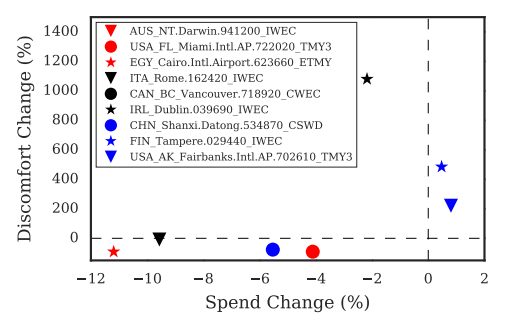
Figure 12 : SAC DRL agent trained on climate of Rome, Italy (ASHRAE climate zone 3) control performance (in terms of energy cost change (see Equation 6) and discomfort degree-hours change (see Equation 7) compared to reference RBC) for deployment on other climates of Table 4
원문 · CC BY 4.0 · Anjukan Kathirgamanathan, Eleni Mangina, Donal P. Finn · Development of a Soft Actor Critic Deep Reinforcement Learning Approach for Harnessing Energy Flexibility in a Large Office Building · 원문 그림 인용 · 원본 PDF 27쪽에서 그림 영역을 추출했습니다.적용 범위와 남은 한계
이 결과는 로마 기후에서 학습하고 7월 한 주에 평가한 대형 사무소 건물 모델에서 얻은 것입니다. 배포 평가가 한 주뿐이었으므로 장기 배포에서의 온라인 적응 성능은 확인되지 않았습니다. 다른 기후 전이에서 다윈과 밴쿠버는 불쾌감 시간이 크게 증가해 재학습이나 하이퍼파라미터 재조정이 필요하다고 보고되었습니다. 또한 야간 사전 냉방 구간에서 설정점의 진동이 관찰되어 장기 작동 피로에 대한 우려가 남아 있습니다. 저층이나 열질량이 작은 다른 동특성의 건물은 이 연구에서 검증되지 않았습니다.
논문 정보
- 저자
- Anjukan Kathirgamanathan, Eleni Mangina, Donal P. Finn
- 학회·저널
- arXiv · 프리프린트
- 최초 공개일
- 2021년 4월 25일
- 등록일
- 2026년 11월 6일
- 수정일
- 2021년 4월 25일
- 버전
- v1
- arXiv
- 2104.12125
- DOI
- 10.1016/j.egyai.2021.100101
- 분류
- cs.LG · eess.SY
- 원문 이용 조건
- CC BY 4.0
- 제공 범위
- 논문 정보, 해설, 허용된 원문 그림
AI 해설은 논문 원문과 별개의 설명이며 오류가 있을 수 있습니다. 원문과 그림은 각 출처의 이용 조건과 따로 표시된 권리를 따릅니다.
초록
This research is concerned with the novel application and investigation of `Soft Actor Critic' (SAC) based Deep Reinforcement Learning (DRL) to control the cooling setpoint (and hence cooling loads) of a large commercial building to harness energy flexibility. The research is motivated by the challenge associated with the development and application of conventional model-based control approaches at scale to the wider building stock. SAC is a model-free DRL technique that is able to handle continuous action spaces and which has seen limited application to real-life or high-fidelity simulation implementations in the context of automated and intelligent control of building energy systems. Such control techniques are seen as one possible solution to supporting the operation of a smart, sustainable and future electrical grid. This research tests the suitability of the SAC DRL technique through training and deployment of the agent on an EnergyPlus based environment of the office building. The SAC DRL was found to learn an optimal control policy that was able to minimise energy costs by 9.7% compared to the default rule-based control (RBC) scheme and was able to improve or maintain thermal comfort limits over a test period of one week. The algorithm was shown to be robust to the different hyperparameters and this optimal control policy was learnt through the use of a minimal state space consisting of readily available variables. The robustness of the algorithm was tested through investigation of the speed of learning and ability to deploy to different seasons and climates. It was found that the SAC DRL requires minimal training sample points and outperforms the RBC after three months of operation and also without disruption to thermal comfort during this period. The agent is transferable to other climates and seasons although further retraining or hyperparameter tuning is recommended.
원문 인용
Anjukan Kathirgamanathan, Eleni Mangina, Donal P. Finn (2021). Development of a Soft Actor Critic Deep Reinforcement Learning Approach for Harnessing Energy Flexibility in a Large Office Building. arXiv:2104.12125v1. https://doi.org/10.1016/j.egyai.2021.100101
BibTeX
@article{kathirgamanathan2021development,
  title = {{Development of a Soft Actor Critic Deep Reinforcement Learning Approach for Harnessing Energy Flexibility in a Large Office Building}},
  author = {Anjukan Kathirgamanathan and Eleni Mangina and Donal P. Finn},
  year = {2021},
  eprint = {2104.12125},
  archivePrefix = {arXiv},
  doi = {10.1016/j.egyai.2021.100101},
  url = {https://arxiv.org/abs/2104.12125v1}
}