논문 해설
Eliciting Research Taste in LLMs through Future Research Direction Choice
미래 연구 방향 선택을 통해 LLM의 연구 취향 끌어내기
- 연구 문제 LLM이 검증 가능한 목표가 없는 열린 연구 방향을 얼마나 작성자와 맞게 고르는지 측정하기 어렵습니다.
- 연구 방법 연구 목표와 가설·결과가 주어진 80개 쌍에서 작성자 방향과 대안을 A/B 두 순서로 제시해 선택을 집계합니다.
연구 취향을 행동으로 측정하려는 이유
LLM이 자율 연구 에이전트로 쓰일수록, 검증 가능한 목표가 없는 열린 연구에서 어떤 방향을 고를지가 중요해집니다. 기존 연구는 인용 수 같은 후행 과학계량 지표를 예측하는 방식으로 연구 취향을 다루었지만, 이 지표는 연구의 질보다 저자와 연구실의 가시성, 학회 명성, 네트워크 효과를 더 많이 반영한다고 알려져 있습니다. 이 논문은 대신 연구 목표와 가설·핵심 결과가 주어졌을 때 다음 연구 방향을 고르는 작은 과제를 설정합니다. 작성자가 추천한 방향과 같은 문맥의 유사 논문에서 가져온 그럴듯한 대안 중 하나를 고르게 하고, 그 선택이 작성자와 맞는지, 순서를 바꿔도 같은지를 봅니다.
80개 쌍 데이터와 순서 통제 평가
데이터는 ML 논문 41편의 LaTeX 원고에서 연구 목표, 가설과 핵심 결과, 미래 연구 방향을 추출하고 방향 문장을 재작성하는 과정으로 만들었습니다. 같은 논문의 작성자 추천 방향과 임베딩 유사도로 고른 상위 5개 논문의 후보 방향을 길이와 구분성, 타당성 기준으로 걸러냈고, 대안이 2개 미만인 논문은 뺐습니다. 최종적으로 19편에서 80개의 쌍이 나왔습니다. 각 쌍은 A/B 순서를 바꿔 두 번 평가합니다. 모델은 temperature 0에서 순서가 있는 프롬프트마다 응답 하나를 냈습니다. 최종 선택 옵션만으로 지표를 계산하며 추론 과정의 타당성은 평가하지 않았습니다.
작성자 정렬과 stable divergence의 정의
두 순서에서 모두 작성자 추천 방향을 고르면 author alignment, 두 순서에서 모두 대안 distractor를 고르면 stable divergence, 순서에 따라 선택이 달라지면 unstable choice로 분류합니다. 이 세 값은 80개 쌍을 분모로 한 비율입니다. 따라서 stable divergence는 작성자 추천과 다른 내용적 선택이 순서에 흔들리지 않은 경우만 셉니다. 저자들은 이 지표가 정답 방향을 판정하는 정확도가 아니라 작성자 선호와의 정렬을 보는 것이라고 봅니다.
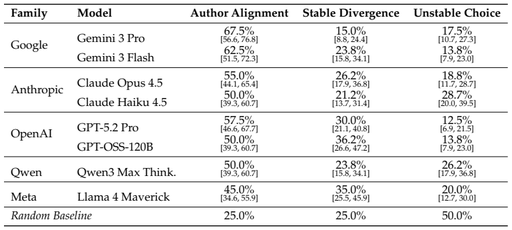
Table 2 : Pairwise future-work selection results (n=80 pairs, 160 ordered queries). Cells report percentages with Wilson 95% confidence intervals in brackets; each outcome uses 80 pairwise comparisons as the denominator.
원문 · CC BY 4.0 · Dhruv Trehan, Paras Chopra · Eliciting Research Taste in LLMs through Future Research Direction Choice · 원문 그림 인용 · 원본 PDF 17쪽에서 그림 영역을 추출했습니다.8개 모델의 정렬과 이탈
모든 모델은 무작위 기준선인 25%를 정렬에서 넘었습니다. stable divergence 사건은 169개였고, 45개 쌍에서 최소 한 모델이, 24개 쌍에서 네 모델 이상이 그 선택을 보였습니다. 이는 특정 모델의 우연이 아니라 여러 모델과 쌍에 걸친 반복으로 읽을 수 있다고 저자들은 해석합니다.
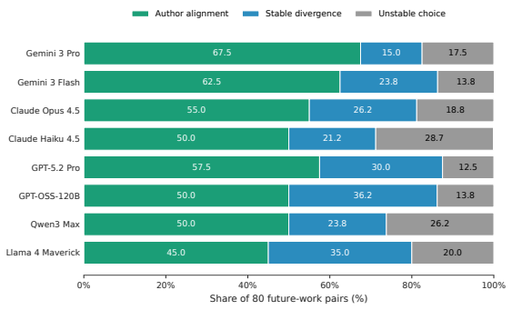
Figure 3 : Outcome shares for future-work selection across evaluated models. All models exceed the 25% random baseline on author alignment and show some substantial stable divergence. Author alignment ranges from 45.0% to 67.5%, and stable divergence from 15.0% to 36.2%. Unstable-choice rates vary from 12.5% to 28.7%, indicating that some models preserve content choices across orderings more consistently than others.
원문 · CC BY 4.0 · Dhruv Trehan, Paras Chopra · Eliciting Research Taste in LLMs through Future Research Direction Choice · 원문 그림 인용 · 원본 PDF 4쪽에서 그림 영역을 추출했습니다.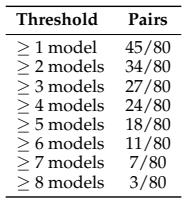
Table 3 : Cumulative stable divergence prevalence across 80 pairwise comparisons at each model-count threshold.
원문 · CC BY 4.0 · Dhruv Trehan, Paras Chopra · Eliciting Research Taste in LLMs through Future Research Direction Choice · 원문 그림 인용 · 원본 PDF 17쪽에서 그림 영역을 추출했습니다.유사도 휴리스틱으로 설명되는지 확인
작성자 추천 옵션이 문맥과 더 유사한 쌍은 80개 중 64개였습니다. 단순 유사도 휴리스틱만 쓰면 작성자 정렬이 80.0%가 되지만, 평가한 모델 중 이 수준에 이른 모델은 없었습니다. 169개의 stable divergence 사건 중 76.9%는 작성자 추천 옵션이 문맥과 더 가까운 쌍에서 나왔습니다. 저자들은 그래서 stable divergence가 단순 유사도 신호만으로 설명되지 않는다고 봅니다. 다만 이 통제는 임베딩 기준 분할에 근거하며, 다른 유사도 정의에서도 같은지는 이 본문에서 확인하지 않았습니다.
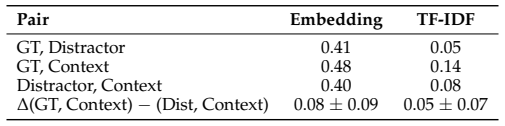
Table 1 : Average semantic (embedding) and lexical (TF-IDF) cosine similarity across 80 unique query pairs.
원문 · CC BY 4.0 · Dhruv Trehan, Paras Chopra · Eliciting Research Taste in LLMs through Future Research Direction Choice · 원문 그림 인용 · 원본 PDF 17쪽에서 그림 영역을 추출했습니다.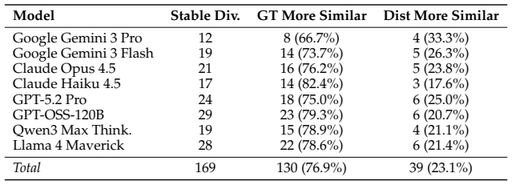
Table 4 : Stable divergence pairs by similarity bucket (embedding). GT More Similar denotes pairs where models preferred the distractor despite GT being more similar to context.
원문 · CC BY 4.0 · Dhruv Trehan, Paras Chopra · Eliciting Research Taste in LLMs through Future Research Direction Choice · 원문 그림 인용 · 원본 PDF 18쪽에서 그림 영역을 추출했습니다.프롬프트 변형에서의 유지 비율
세 변형은 '연구 보조자' 역할을 빼거나, 연구 목표 섹션을 빼거나, 과제 문장을 바꾸는 단일 요소 변경입니다. 네 번째는 연구자가 자신의 프로젝트에서 어떤 방향을 고를지 예측하게 한 작성자 선호 예측 조건입니다. 가중 평균 유지 비율은 66.9%에서 80.5%였습니다. 떨어진 사건은 대개 작성자 방향으로 뒤집히기보다 순서에 따라 흔들리는 불안정 선택으로 바뀌었습니다.

Table 5 : Prompt ablation results across 169 stable divergence events.
원문 · CC BY 4.0 · Dhruv Trehan, Paras Chopra · Eliciting Research Taste in LLMs through Future Research Direction Choice · 원문 그림 인용 · 원본 PDF 18쪽에서 그림 영역을 추출했습니다.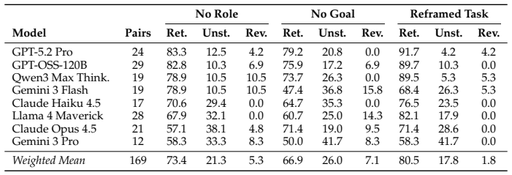
Table 6 : Per-model prompt ablation results. Retained = stable divergence preserved; Unsta- ble = choice became position-dependent; Reversed = flipped to author alignment.
원문 · CC BY 4.0 · Dhruv Trehan, Paras Chopra · Eliciting Research Taste in LLMs through Future Research Direction Choice · 원문 그림 인용 · 원본 PDF 18쪽에서 그림 영역을 추출했습니다.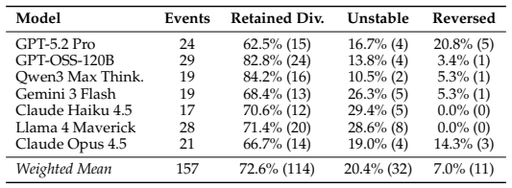
Table 7 : Author-preference prediction check on stable divergence events. Retained di- vergence means the original stable divergence is preserved under the author-preference- prediction framing; unstable means the event is no longer stable across option orderings; reversed means the event flips to author alignment. Parenthesized values are event counts. Gemini 3 Pro is excluded because it was unavailable through our evaluation route at rerun time.
원문 · CC BY 4.0 · Dhruv Trehan, Paras Chopra · Eliciting Research Taste in LLMs through Future Research Direction Choice · 원문 그림 인용 · 원본 PDF 18쪽에서 그림 영역을 추출했습니다.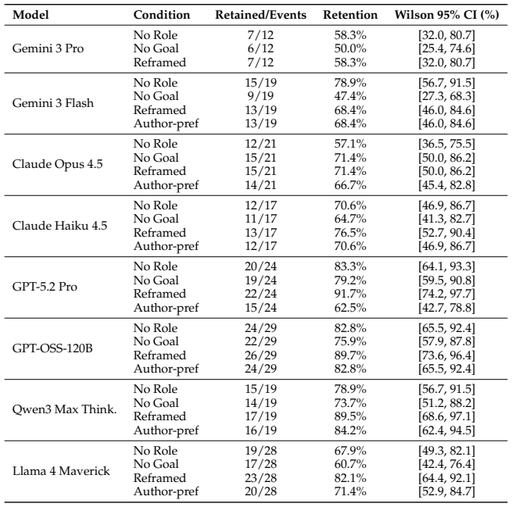
Table 8 : Model-specific retained stable-divergence rates across prompt and author- preference conditions. Wilson 95% confidence intervals are computed over each model’s canonical stable-divergence events. Gemini 3 Pro is not reported for Author-pref because it was unavailable through our evaluation route at rerun time.
원문 · CC BY 4.0 · Dhruv Trehan, Paras Chopra · Eliciting Research Taste in LLMs through Future Research Direction Choice · 원문 그림 인용 · 원본 PDF 19쪽에서 그림 영역을 추출했습니다.파일럿 인간 기준선
10명의 참가자가 23개 쌍에 108개의 응답을 냈습니다. 그중 13건은 기권이었고, 나머지 95개 고정 선택 중 58개(61.1%)가 작성자 추천 방향이었습니다. 참가자는 쌍의 순서를 하나만 보았기 때문에 모델의 순서 통제 지표와 직접 비교하지 않았습니다. 이 결과는 파일럿 규모의 참고치이며, 참가자 수와 쌍 수가 작아 인간 전체의 성향으로 일반화하기 어렵습니다.
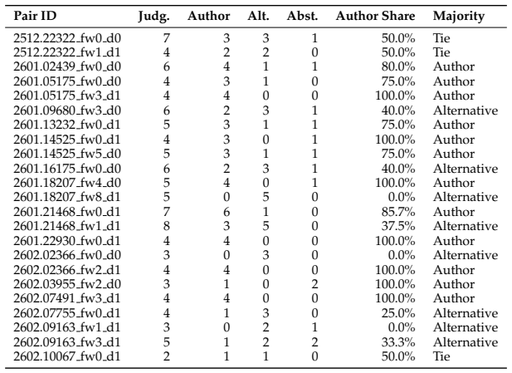
Table 10 : Per-pair human response outcomes for the pilot human baseline. Judgements include fixed choices and abstentions. Author-choice share is computed over fixed choices only, excluding abstentions. Majority denotes whether more participants selected the author- recommended direction or the alternative direction. Equal counts are reported as ties.
원문 · CC BY 4.0 · Dhruv Trehan, Paras Chopra · Eliciting Research Taste in LLMs through Future Research Direction Choice · 원문 그림 인용 · 원본 PDF 21쪽에서 그림 영역을 추출했습니다.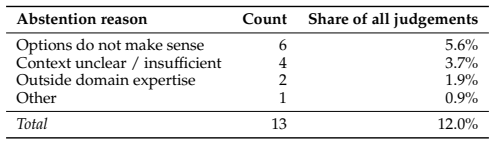
Table 13 : Abstention reasons in the pilot human baseline. Shares use all 108 submitted human judgements as the denominator.
원문 · CC BY 4.0 · Dhruv Trehan, Paras Chopra · Eliciting Research Taste in LLMs through Future Research Direction Choice · 원문 그림 인용 · 원본 PDF 22쪽에서 그림 영역을 추출했습니다.stable divergence의 범주 전환
저자들은 작성자 방향과 대안 방향을 다섯 범주로 분류했습니다. 169개 사건 중 128개(75.7%)는 범주 경계를 넘었고 41개는 같은 범주 안에서 달랐습니다. 가장 많은 세 전환은 인프라에서 방법론으로(55건), 방법론에서 확장성·일반화로(23건), 응용에서 확장성·일반화로(12건)였습니다. 이 전환 분석은 stable divergence 사건만 보기 때문에 각 전환이 얼마나 자주 제시되었는지를 반영하지 않습니다. 따라서 모델의 확정된 선호로 해석하지 않고 불일치의 구조를 묘사한 것으로 읽어야 합니다.
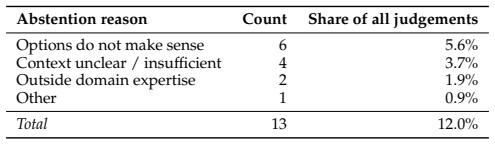
Table 14 : Five-category taxonomy for research direction labelling on both ground truth and distractor directions in the 45 stable divergence pairs. When a future work introduces a stronger model capability that is external to the paper’s main contribution, it is coded as Scaling/Generalization/Robustness rather than Methodological Innovation.
원문 · CC BY 4.0 · Dhruv Trehan, Paras Chopra · Eliciting Research Taste in LLMs through Future Research Direction Choice · 원문 그림 인용 · 원본 PDF 22쪽에서 그림 영역을 추출했습니다.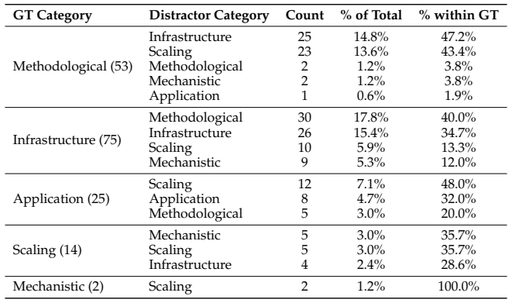
Table 15 : GT-to-distractor category transitions across 169 stable divergence events. The % of Total reflects each transition’s share of all 169 events and the % within GT reflects its share within the corresponding ground-truth category’s divergence events.
원문 · CC BY 4.0 · Dhruv Trehan, Paras Chopra · Eliciting Research Taste in LLMs through Future Research Direction Choice · 원문 그림 인용 · 원본 PDF 22쪽에서 그림 영역을 추출했습니다.구성과 일반화의 한계
정답은 작성자 선호를 반영하며, distractor도 실제 연구 방향이라 객관적으로 더 나쁜 방향이라고 할 수 없습니다. 데이터는 19개 ML 논문에서 왔으므로 다른 과학 분야나 ML 전반으로 일반화할 수 없습니다. 모델 학습 데이터의 cutoff 이후 오염도 완전히 배제하지 못했습니다. 데이터 추출과 재작성, distractor 판정에는 같은 Claude Sonnet 4.5를 썼고, 수작업 품질 검토도 제한적이었습니다.
논문 정보
- 저자
- Dhruv Trehan, Paras Chopra
- 학회·저널
- arXiv · 프리프린트
- 최초 공개일
- 2026년 11월 15일
- 등록일
- 2026년 11월 17일
- 수정일
- 2026년 11월 15일
- 버전
- v1
- arXiv
- 2611.19794
- 분류
- cs.LG · cs.AI · cs.CL
- 원문 이용 조건
- CC BY 4.0
- 제공 범위
- 논문 정보, 해설, 허용된 원문 그림
AI 해설은 논문 원문과 별개의 설명이며 오류가 있을 수 있습니다. 원문과 그림은 각 출처의 이용 조건과 따로 표시된 권리를 따릅니다.
초록
Research taste is increasingly discussed in the context of AI scientists, yet remains little studied or measured in LLMs. This judgment matters especially in open-ended research, where a direction must be chosen before a verifiable objective is available. We operationalize research taste through one task of the scientific workflow: choosing which future research direction to pursue given a research goal and current results. Rather than predicting downstream scientometric metrics or treating author choices as objectively correct, we evaluate models against human-authored future-work directions and report author alignment, stable divergence, and unstable choice as behavioral measures of research-direction preference. We construct an order-controlled evaluation of 80 pairwise comparisons from 19 ML papers published between December 2025 and February 2026 across four subdomains. Each query presents a research goal, hypotheses tested with key results, and two candidate future directions: one author-recommended direction and one plausible distractor sampled from a similar paper. Across eight LLMs, author alignment ranges from 45.0% to 67.5%, while stable divergence ranges from 15.0% to 36.2%. These divergences largely persist under similarity controls, prompt ablations, and an author-preference framing check, and inter-model agreement suggests that some non-author preferences are shared across models. We characterize what models diverge toward using transition-category labels and selected reasoning examples, finding recurring movement toward scaling/generalization and trade-offs between methodological and infrastructure/data extensions. We view this as an early descriptive evaluation for eliciting research taste profiles in LLMs, and as a step toward understanding and steering their research preferences as they take on more autonomous roles in novel open-ended scientific discovery.
원문 인용
Dhruv Trehan, Paras Chopra (2026). Eliciting Research Taste in LLMs through Future Research Direction Choice. arXiv:2611.19794v1. https://arxiv.org/abs/2611.19794v1
BibTeX
@misc{trehan2026eliciting,
  title = {{Eliciting Research Taste in LLMs through Future Research Direction Choice}},
  author = {Dhruv Trehan and Paras Chopra},
  year = {2026},
  eprint = {2611.19794},
  archivePrefix = {arXiv},
  url = {https://arxiv.org/abs/2611.19794v1}
}