논문 해설
Learning through Discernment: when a small language model learns from user feedback on the job, and when it decays
식별을 통한 학습: 작은 언어 모델이 실무에서 사용자 피드백으로 학습하는 경우와 성능이 저하되는 경우
- 연구 문제 정답 결과가 없을 때 소형 모델이 하루 작업의 어떤 시도를 밤에 배울지 정하기 어렵습니다.
- 연구 방법 creature가 낮에 과제를 수행하고 판정자가 고른 시도로 밤마다 LoRA 어댑터를 학습하며, 사용자 반응은 별도의 동결 감각이 읽습니다.
- 주요 결과 WebShop 14일차에서 오라클은 63.2±0.2점, self-judging은 27.0±11.9점을 기록했습니다.
온디바이스 소형 모델은 왜 밤마다 배우기 어려운가
작은 언어 모델이 기기 위에서 하루 작업의 결과로 밤마다 학습하면 성능이 계속 좋아질 수 있습니다. 하지만 정답 결과가 없으면 어떤 시도를 교훈으로 삼을지 정해야 하고, 모델 자신의 판단과 사용자의 반응이 모두 틀릴 수 있습니다. 틀린 교훈은 한 번 학습되면 같은 실패를 반복하게 만듭니다. 이 논문은 이 문제를 수주 동안의 야간 갱신이라는 긴 시간 축에서 다룹니다. 실험 대상은 Qwen3 0.6B와 1.7B 모델에 LoRA 어댑터를 붙인 creature이며, 과제는 WebShop과 τ2-bench입니다.
교훈을 고르는 판정자와 피드백 감각
creature는 낮에 과제를 수행하고 밤에 판정자가 고른 시도로 LoRA 어댑터만 학습합니다. 기반 Qwen3 모델은 고정되어 있으며, 어댑터는 랭크 8로 상위 8개 레이어의 주의 및 피드포워드 투영에 적용됩니다. 판정자는 오라클, 명시된 판정, 모델 자기 판단(self), 사용자 반응을 함께 본 판단(both), 학습 없음(none)으로 비교됩니다. 피드백 감각은 사용자의 요청과 다음 행동, 반응 문장을 읽는 별도의 동결 Qwen3-0.6B이며 행동의 결과는 보지 않습니다. 감각은 v1에서 v3로 발전하며, v3는 먼저 반응이 결과에 대한 명확한 판정인지 묻고 그다음 점수를 매깁니다. 두 단계 게이트를 모두 통과한 반응만 교훈이 됩니다.
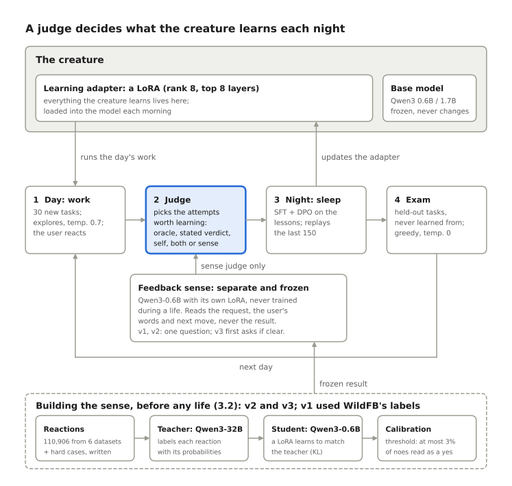
Figure 1 : The creature’s parts (top), its daily cycle (middle), the feedback sense (bottom) and how the sense was built, once, before any life (dashed); the judge, highlighted, is what the experiments vary
원문 · CC BY 4.0 · Kongsilp, Sirisilp · Learning through Discernment: when a small language model learns from user feedback on the job, and when it decays · 원문 그림 인용 · 원본 PDF 5쪽에서 그림 영역을 추출했습니다.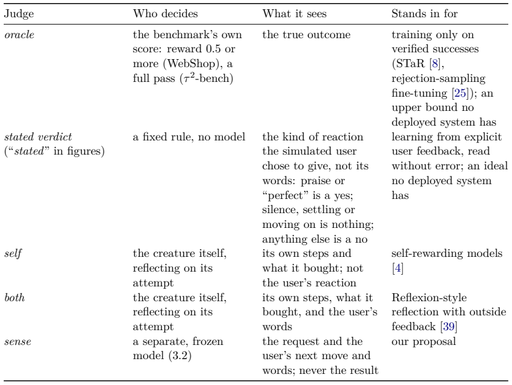
Table 1 : The judges. Only the sense condition uses the feed- back sense.
원문 · CC BY 4.0 · Kongsilp, Sirisilp · Learning through Discernment: when a small language model learns from user feedback on the job, and when it decays · 원문 그림 인용 · 원본 PDF 6쪽에서 그림 영역을 추출했습니다.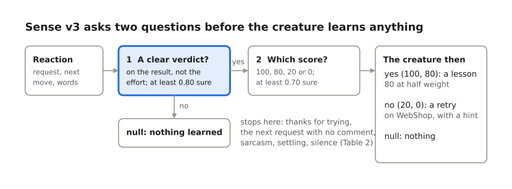
Figure 3 : How sense v3 decides: a reaction must pass both gates before the creature learns from it. v1 and v2 ask only the second question, with one threshold (0.70 and 0.65)
원문 · CC BY 4.0 · Kongsilp, Sirisilp · Learning through Discernment: when a small language model learns from user feedback on the job, and when it decays · 원문 그림 인용 · 원본 PDF 9쪽에서 그림 영역을 추출했습니다.WebShop에서 판정자별 결과
실험 1-A에서 오라클을 판정자로 쓴 생명은 14일차 시험에서 63.2±0.2점을 기록했고, self-judging은 27.0±11.9점이었습니다. self-judging은 처음에는 오라클과 비슷하게 올랐지만 이후 대부분을 잃었습니다. 실험 4에서 v3 감각을 쓴 다섯 생명 중 네 개는 14일차에 53-60점을 유지했지만, 한 생명은 첫 밤의 포기 반응 하나를 교훈으로 삼은 뒤 0점으로 무너졌습니다. 60일차에 네 생명은 9-22점으로 떨어졌고 오라클은 61.8±0.9점이었습니다. 이 감각의 교훈은 실패 비율이 2-10%로 낮았지만 하루 약 2개로 희소했습니다.
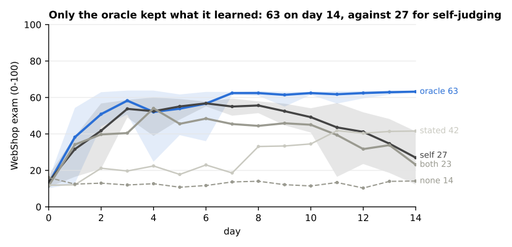
Figure 5 : Experiment 1-A, 5 seeds per judge, daily exams; one self life crashed early and is left out
원문 · CC BY 4.0 · Kongsilp, Sirisilp · Learning through Discernment: when a small language model learns from user feedback on the job, and when it decays · 원문 그림 인용 · 원본 PDF 14쪽에서 그림 영역을 추출했습니다.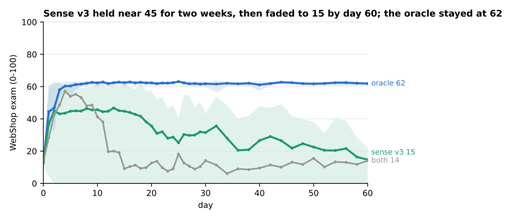
Figure 9 : Experiment 4, 5 seeds per judge, 60 days; exams daily to day 30, then every 2 days
원문 · CC BY 4.0 · Kongsilp, Sirisilp · Learning through Discernment: when a small language model learns from user feedback on the job, and when it decays · 원문 그림 인용 · 원본 PDF 18쪽에서 그림 영역을 추출했습니다.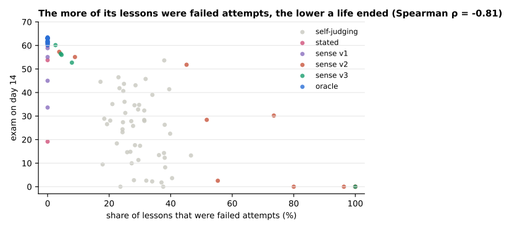
Figure 11 : All 14-day WebShop lives in Experiments 1-4, including 1-C, that learned at least once (97 of 104); lessons counted to day 14; Exp 3b = the sleep variant of Experiment 3
원문 · CC BY 4.0 · Kongsilp, Sirisilp · Learning through Discernment: when a small language model learns from user feedback on the job, and when it decays · 원문 그림 인용 · 원본 PDF 20쪽에서 그림 영역을 추출했습니다.사용자가 결과를 볼 수 없을 때
τ2-bench에서 고객은 자신의 과제가 끝났는지 데이터베이스를 볼 수 없습니다. 1.7B 감각 생명 세 개는 30일차에 전체 시험 과제 완료율이 23%에서 4%로 떨어졌고, 오라클 생명도 1.7B에서 23%에서 13%로 떨어졌습니다. 세 생명씩이라 통계적 차이는 제한적입니다.
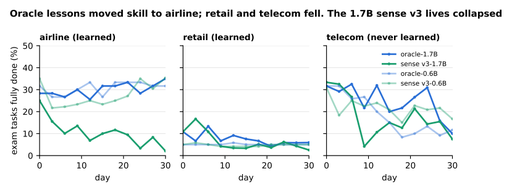
Figure 10 : Experiment 5, 3 seeds per condition; exams on day 0 and every 3 days; broken exam conversations left out
원문 · CC BY 4.0 · Kongsilp, Sirisilp · Learning through Discernment: when a small language model learns from user feedback on the job, and when it decays · 원문 그림 인용 · 원본 PDF 19쪽에서 그림 영역을 추출했습니다.시뮬레이션 사용자와 작은 표본의 한계
모든 사용자는 시뮬레이션입니다. WebShop의 사용자는 저자가 직접 설계했으며, τ2-bench에서는 Gemini 3 Flash가 고객 역할을 했습니다. 실험은 작은 모델과 3-5개 시드 중심이며, 여러 차이는 순위 검정에서만 유의했습니다. 기반 모델 크기를 더 키운 경우와 감각의 쇠퇴 원인은 확인하지 않았습니다.
논문 정보
- 저자
- Kongsilp, Sirisilp
- 학회·저널
- arXiv · 프리프린트
- 최초 공개일
- 2026년 11월 18일
- 등록일
- 2026년 11월 20일
- 수정일
- 2026년 11월 18일
- 버전
- v1
- arXiv
- 2611.23716
- 분류
- cs.LG · cs.AI · cs.CL
- 원문 이용 조건
- CC BY 4.0
- 제공 범위
- 논문 정보, 해설, 허용된 원문 그림
AI 해설은 논문 원문과 별개의 설명이며 오류가 있을 수 있습니다. 원문과 그림은 각 출처의 이용 조건과 따로 표시된 권리를 따릅니다.
초록
Small language models on devices could keep improving by learning, overnight, from their own daily work. Without a true outcome, however, something must decide which attempts are worth learning from, and both the model's own judgment and the user's reaction can be wrong. We study a small model (Qwen3 0.6B and 1.7B) with a LoRA adapter, fine-tuned each night on the attempts a judge accepts, over 127 lives of up to a year on WebShop and $\tau^2$-bench. We compare the true outcome, the user's stated verdict and the model's own judgment with a separate, frozen "feedback sense" that reads the user's reaction, built in three versions. Judging itself, the model improved and then decayed, over a year and whatever its adapter. A sense that took polite give-ups for success collapsed 3 of 5 lives; one built for discernment, which first asks whether the user gave a clear verdict, kept 4 of 5 near the oracle for two weeks, then faded on clean but scarce lessons, to the level of self-judging by day 60. When the user cannot see the outcome ($\tau^2$-bench), the sense read reactions correctly, yet 80% of its lessons were failures the customer had thanked. Across 97 lives, the share of failed attempts among the lessons predicted the outcome (Spearman $\rho$ = -0.81). In our experiments, learning from users held up only where the judge kept failures out and the user could see the outcome; lopsided lessons may also narrow the model.
원문 인용
Kongsilp, Sirisilp (2026). Learning through Discernment: when a small language model learns from user feedback on the job, and when it decays. arXiv:2611.23716v1. https://arxiv.org/abs/2611.23716v1
BibTeX
@misc{sirisilp2026learning,
  title = {{Learning through Discernment: when a small language model learns from user feedback on the job, and when it decays}},
  author = {Kongsilp, Sirisilp},
  year = {2026},
  eprint = {2611.23716},
  archivePrefix = {arXiv},
  url = {https://arxiv.org/abs/2611.23716v1}
}