논문 해설
Are Dense Rewards Worth Their Tokens in GRPO?
GRPO에서 밀집 보상은 그 토큰 비용만큼 가치가 있는가?
- 연구 문제 토큰과 GPU 시간을 맞추지 않은 비교는 dense reward의 이득을 과대평가할 수 있습니다.
- 연구 방법 matched-compute 프로토콜로 생성 토큰과 학습 시간을 같게 맞춰 dense reward와 프롬프트 선택을 비교합니다.
- 주요 결과 Monte-Carlo reward는 토큰 기준에서 14.3 포인트 낮고, 프롬프트 선택은 Qwen3-0.6B와 Qwen2.5-1.5B에서 작은 토큰 기준 이득을 보입니다.
토큰 비용을 빼면 dense reward의 이득이 과대평가됩니다
RLVR에서 GRPO는 한 completion의 모든 토큰에 같은 advantage를 주므로, 중간 단계에 신용을 나누는 dense reward가 제안되어 왔습니다. 그중 Monte-Carlo reward는 부분 풀이에서 continuation을 샘플링해 각 단계의 성공 확률 변화를 계산합니다. 기존의 두 점검, 즉 같은 업데이트 수에서 비교하는 방법과 한 배치의 기울기 검정은 이 reward가 쓰는 생성 토큰과 학습 시간을 반영하지 않습니다. 이 논문은 설정에서 continuation이 전체 생성 토큰의 91%를 차지한다고 보고하며, 그 비용을 포함하지 않은 비교가 결론을 바꿀 수 있는지 묻습니다.
matched-compute 프로토콜의 예산 설계
이 논문은 생성 토큰 예산 B와 학습 GPU 시간을 같은 비교 기준으로 맞추는 matched-compute 프로토콜을 제안합니다. 토큰 예산 B는 continuation과 버려진 group을 포함해 학습 중 생성된 모든 토큰을 셉니다. 한 실행은 B개의 토큰을 생성하면 끝나며, 주 Qwen2.5-1.5B 설정에서 B는 k=4 Monte-Carlo reward가 48 iteration 동안 생성하는 토큰 수로 정해졌습니다. 이때 Monte-Carlo reward는 약 50번, outcome-only GRPO는 584번 업데이트합니다. 학습 시간은 프롬프트 점수화, 생성, credit 계산, 업데이트, weight 동기화를 포함하지만 평가와 로깅은 제외합니다.
같은 seed의 프롬프트 흐름과 평가 샘플을 공유하여 seed마다 쌍을 이루는 차이를 얻습니다.
Monte-Carlo reward는 업데이트 기준에서는 앞서지만 토큰 기준에서는 뒤처집니다
업데이트 수를 같게 맞춘 비교에서 Monte-Carlo reward는 outcome-only GRPO보다 앞섭니다. 저자들은 continuation의 생성 토큰 비용이 업데이트 횟수를 줄여 이 역전을 만든다고 설명합니다. 낮은 continuation 수 k=1, 2, 4를 비교하면 k가 작을수록 격차는 줄지만 사라지지 않습니다. 학습을 더 길게 주어도 네 가지 dense-reward 변형 중 어느 것도 outcome-only GRPO를 유의하게 넘지 못했습니다.
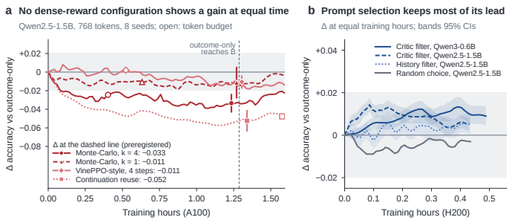
Figure 3 . At equal training time, no tested dense-reward variant showed a gain, and prompt selection keeps most of its lead. (a)A preregistered study ran every configuration beyond the training time that outcome-only GRPO needs to reach the token budget B (dashed line). Curves show each configuration minus outcome-only GRPO at equal training hours (MATH L4–5, mean over seeds); open markers show where each configuration reaches B. Bars give the preregistered contrasts at the dashed line with 95% CIs, and the legend gives their means.(b)The prompt filters, and random choice among the filter’s candidates, minus outcome-only GRPO at equal training hours, up to the time the faster configuration takes to reach the budget (exploratory, H200 GPUs). Bands are95%CIs; the gray bands mark±0.02.
원문 · CC BY 4.0 · Vikash Singh, Weicong Chen, Debargha Ganguly, Yanyan Zhang, Mohsen Hariri, Sreehari Sankar, Wang Yang, Chaoda Song, Alexander Nemecek, Osama Zafar, Yuting Shao, Kai Ye, Biyao Zhang, Xinpeng Li, Shouren Wang, Erman Ayday, Jing Ma, Sanmukh Rao Kuppannagari, Vipin Chaudhary · Are Dense Rewards Worth Their Tokens in GRPO? · 원문 그림 인용 · 원본 PDF 7쪽에서 그림 영역을 추출했습니다.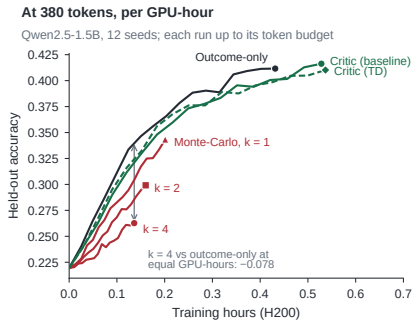
Figure 10 . At 380 tokens, the Monte-Carlo reward trails outcome-only GRPO at its own training time.Exploratory reanalysis of preregistered runs on H200 GPUs: accuracy against training hours for Qwen2.5-1.5B on MATH L4–5 (seeds 5–16, the same for every configuration), each run up to its token bud- get. The Monte-Carlo rewards reach the budget sooner because their continuations take less time per token than training does; the arrow marks the k= 4 reward’s deficit at its own training time (per-seed mean). Figure 3a and Section F run every configuration past outcome-only GRPO’s training time, at768tokens.
원문 · CC BY 4.0 · Vikash Singh, Weicong Chen, Debargha Ganguly, Yanyan Zhang, Mohsen Hariri, Sreehari Sankar, Wang Yang, Chaoda Song, Alexander Nemecek, Osama Zafar, Yuting Shao, Kai Ye, Biyao Zhang, Xinpeng Li, Shouren Wang, Erman Ayday, Jing Ma, Sanmukh Rao Kuppannagari, Vipin Chaudhary · Are Dense Rewards Worth Their Tokens in GRPO? · 원문 그림 인용 · 원본 PDF 40쪽에서 그림 영역을 추출했습니다.기울기 검정은 순서는 맞히지만 크기를 과대평가합니다
효율 지표 (E⟨u,ĥ⟩)^2/E∥u∥^2는 업데이트 방향 u가 기대 정확도 기울기 추정 ĥ와 얼마나 맞는지를 잡음까지 반영해 측정합니다. 토큰당 효율은 업데이트가 소비한 토큰으로 나눈 값입니다. 이 검정은 세 Monte-Carlo reward의 토큰당 순서를 k=1, 2, 4 순으로 학습 결과와 맞춥니다. 이 오차는 검증하려는 이득과 같은 크기입니다. 따라서 검정은 순서의 지표로는 유용하지만 1~2 포인트 수준 이득을 확정하는 증거로 쓰기 어렵습니다.
프롬프트 선택은 Qwen 두 모델에서만 이득을 보입니다
프롬프트 선택은 24개 후보 중 예측 성공률이 1/2에 가장 가까운 6개와 무작위 2개를 학습에 사용합니다. 이 방식은 후보 점수화에 forward pass만 쓰므로 생성 토큰을 추가하지 않습니다. 여섯 모델 중 Qwen3-0.6B에서는 1.7 포인트, Qwen2.5-1.5B에서는 0.8 포인트의 토큰 기준 이득이 나타났습니다. 이 이득은 fresh seed와 1,543개의 미학습 MATH 테스트 문제에서도 재현되었습니다. 같은 후보 중 무작위로 고르는 대조군은 이 이득을 재현하지 못했습니다. 다만 학습 시간을 기준으로 하면 이득은 1.0과 0.5 포인트로 작아지며, 이 값은 탐색적 분석입니다.
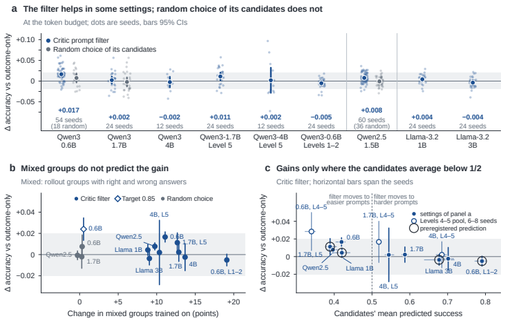
Figure 4 . Where prompt selection helps is predicted by how hard its candidates are, not by how many informative groups it adds. At matched generated tokens:(a)Accuracy at the budget minus outcome-only GRPO on the same seeds, for the critic filter and for random choice of 8 of its 24 candidates (dots: seeds; bold: the filter’s mean). The pool is MATH levels 3–5 unless labeled; Llama models train on the strict verifier.(b)Change in the share of mixed-outcome groups trained on before B against the change in accuracy, both relative to outcome-only GRPO; the diamond is the filter aimed at predicted success 0.85.(c)The critic’s mean predicted success of the candidates against the change in accuracy; the dashed line marks 1/2. Hollow points are the first studies, on a level 4–5 pool, and rings mark the four settings with a preregistered prediction. Bars are95%CIs over seeds; the gray band marks±0.02.
원문 · CC BY 4.0 · Vikash Singh, Weicong Chen, Debargha Ganguly, Yanyan Zhang, Mohsen Hariri, Sreehari Sankar, Wang Yang, Chaoda Song, Alexander Nemecek, Osama Zafar, Yuting Shao, Kai Ye, Biyao Zhang, Xinpeng Li, Shouren Wang, Erman Ayday, Jing Ma, Sanmukh Rao Kuppannagari, Vipin Chaudhary · Are Dense Rewards Worth Their Tokens in GRPO? · 원문 그림 인용 · 원본 PDF 8쪽에서 그림 영역을 추출했습니다.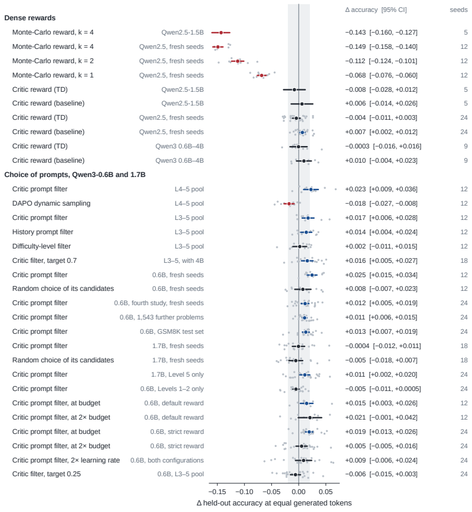
Figure 7 . Every matched-compute comparison, part 1: dense rewards, and the choice of prompts on Qwen3-0.6B and 1.7B. Held-out accuracy at the token budget minus outcome-only GRPO on the same seeds and evaluation draws, on the 200 level 3–5 test problems (level-5 or level 1–2 problems for those pools), except in the rows marked “further test problems” and “GSM8K” (part 2). Gray dots are seeds; bars are 95% paired-t CIs, blue when above zero and red when below; the band marks ±0.02. “Fresh seeds” rows come from studies that repeated an earlier comparison on new seeds. “Default reward” and “strict reward” rows train both configurations for twice the budget with that verifier as the reward. Tables 3 and 4 mark which rows are preregistered primary contrasts.
원문 · CC BY 4.0 · Vikash Singh, Weicong Chen, Debargha Ganguly, Yanyan Zhang, Mohsen Hariri, Sreehari Sankar, Wang Yang, Chaoda Song, Alexander Nemecek, Osama Zafar, Yuting Shao, Kai Ye, Biyao Zhang, Xinpeng Li, Shouren Wang, Erman Ayday, Jing Ma, Sanmukh Rao Kuppannagari, Vipin Chaudhary · Are Dense Rewards Worth Their Tokens in GRPO? · 원문 그림 인용 · 원본 PDF 22쪽에서 그림 영역을 추출했습니다.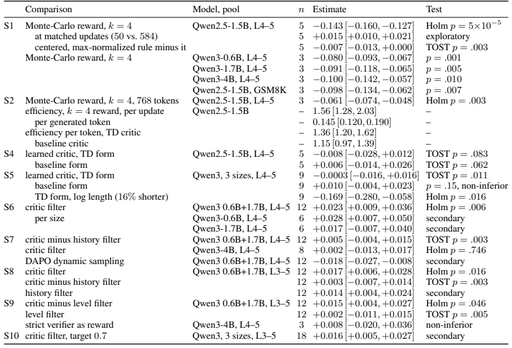
Table 6 . Results of the first matched-compute studiesquoted in Sections 3 and 4. Differences are in held-out accuracy at B against outcome-only GRPO on the same seeds unless stated, with 95% paired-t CIs; efficiencies are ratios to outcome-only GRPO with 95% bootstrap CIs. “Holm” marks a preregistered primary contrast; other rows are secondary or, where marked, exploratory.
원문 · CC BY 4.0 · Vikash Singh, Weicong Chen, Debargha Ganguly, Yanyan Zhang, Mohsen Hariri, Sreehari Sankar, Wang Yang, Chaoda Song, Alexander Nemecek, Osama Zafar, Yuting Shao, Kai Ye, Biyao Zhang, Xinpeng Li, Shouren Wang, Erman Ayday, Jing Ma, Sanmukh Rao Kuppannagari, Vipin Chaudhary · Are Dense Rewards Worth Their Tokens in GRPO? · 원문 그림 인용 · 원본 PDF 25쪽에서 그림 영역을 추출했습니다.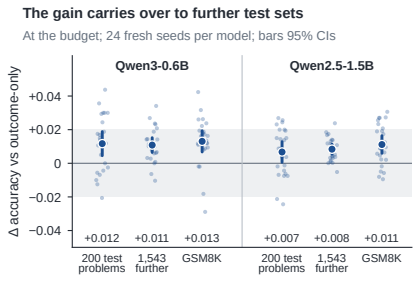
Figure 9 . The prompt filter’s gain carries over to further test sets.Critic filter minus outcome-only GRPO at the token budget, on the same runs: the 200 test problems of every study, the 1,543 numeric-answer MATH test problems of levels 3–5 that no study had evaluated on, and the1,319 GSM8K test problems, on Qwen3- 0.6B (S34) and Qwen2.5-1.5B (S33), 24 fresh seeds each. Dots are seeds, bars 95% paired-t CIs, and the gray band marks ±0.02.
원문 · CC BY 4.0 · Vikash Singh, Weicong Chen, Debargha Ganguly, Yanyan Zhang, Mohsen Hariri, Sreehari Sankar, Wang Yang, Chaoda Song, Alexander Nemecek, Osama Zafar, Yuting Shao, Kai Ye, Biyao Zhang, Xinpeng Li, Shouren Wang, Erman Ayday, Jing Ma, Sanmukh Rao Kuppannagari, Vipin Chaudhary · Are Dense Rewards Worth Their Tokens in GRPO? · 원문 그림 인용 · 원본 PDF 29쪽에서 그림 영역을 추출했습니다.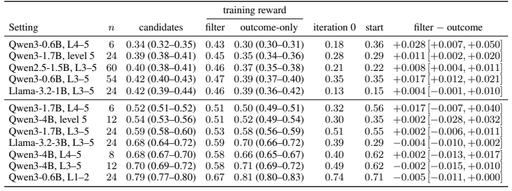
Table 8 . Where the critic filter helps(exploratory). Candidates: the critic’s mean predicted success of the 24 candidates per iteration (seed mean, with the range over seeds). Training reward: mean group reward over the iterations started before B (strict verifier for the Llama models, whose configurations train on it). Iteration 0: training reward of the first iteration, before any update, the same in both configurations (the base model on its first 8 training prompts per seed). Start: outcome-only GRPO’s accuracy on the test set before training. Last column: filter minus outcome-only accuracy atB(95%paired-tCI).
원문 · CC BY 4.0 · Vikash Singh, Weicong Chen, Debargha Ganguly, Yanyan Zhang, Mohsen Hariri, Sreehari Sankar, Wang Yang, Chaoda Song, Alexander Nemecek, Osama Zafar, Yuting Shao, Kai Ye, Biyao Zhang, Xinpeng Li, Shouren Wang, Erman Ayday, Jing Ma, Sanmukh Rao Kuppannagari, Vipin Chaudhary · Are Dense Rewards Worth Their Tokens in GRPO? · 원문 그림 인용 · 원본 PDF 34쪽에서 그림 영역을 추출했습니다.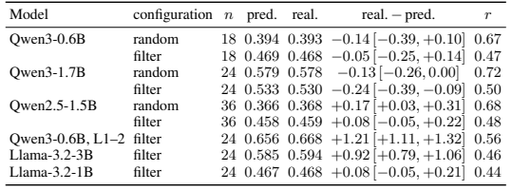
Table 9 . Calibration of the prompt critic(exploratory), on the prompts trained in the iterations before B in which the critic was in use: mean predicted and realized group success, their difference per seed in points (95%CI), and the correlation over groups.
원문 · CC BY 4.0 · Vikash Singh, Weicong Chen, Debargha Ganguly, Yanyan Zhang, Mohsen Hariri, Sreehari Sankar, Wang Yang, Chaoda Song, Alexander Nemecek, Osama Zafar, Yuting Shao, Kai Ye, Biyao Zhang, Xinpeng Li, Shouren Wang, Erman Ayday, Jing Ma, Sanmukh Rao Kuppannagari, Vipin Chaudhary · Are Dense Rewards Worth Their Tokens in GRPO? · 원문 그림 인용 · 원본 PDF 34쪽에서 그림 영역을 추출했습니다.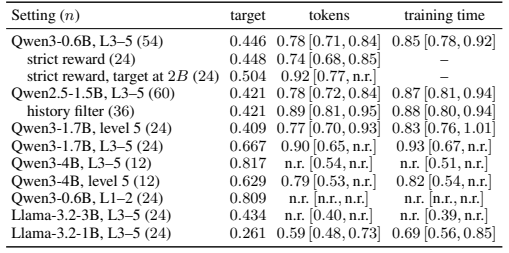
Table 11 . Share of the budget, and of outcome-only GRPO’s training time, that the critic filter needs to reach outcome-only GRPO’s accuracy at B (exploratory; 1 means no saving). The history-filter row uses the critic-free filter of S22 on the same seeds. Training time includes the critic’s scoring and excludes evaluation.
원문 · CC BY 4.0 · Vikash Singh, Weicong Chen, Debargha Ganguly, Yanyan Zhang, Mohsen Hariri, Sreehari Sankar, Wang Yang, Chaoda Song, Alexander Nemecek, Osama Zafar, Yuting Shao, Kai Ye, Biyao Zhang, Xinpeng Li, Shouren Wang, Erman Ayday, Jing Ma, Sanmukh Rao Kuppannagari, Vipin Chaudhary · Are Dense Rewards Worth Their Tokens in GRPO? · 원문 그림 인용 · 원본 PDF 38쪽에서 그림 영역을 추출했습니다.이득은 초기 우위이며 학습률 조정으로 상당 부분 맞출 수 있습니다
프롬프트 선택의 이득은 학습 초기에 크게 나타나고 후반에는 줄어듭니다. 따라서 이 이득은 기준선을 잘 튜닝한 경우와 비교해야 한다는 해석이 가능합니다.
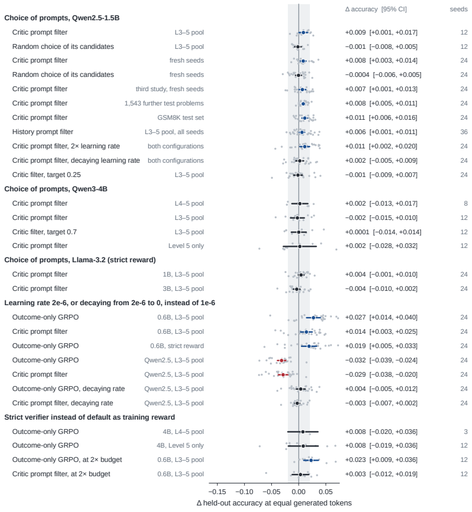
Figure 8 . Every matched-compute comparison, part 2: the choice of prompts on Qwen2.5-1.5B, Qwen3-4B, and the Llama models, the learning rate, and the verifier.As in Figure 7. In the last two blocks, a run at twice the learning rate or with a learning rate decaying linearly from 2×10 −6 to 0 at the budget, or trained on the strict verifier, minus the same configuration at 10−6 or trained on the default verifier.
원문 · CC BY 4.0 · Vikash Singh, Weicong Chen, Debargha Ganguly, Yanyan Zhang, Mohsen Hariri, Sreehari Sankar, Wang Yang, Chaoda Song, Alexander Nemecek, Osama Zafar, Yuting Shao, Kai Ye, Biyao Zhang, Xinpeng Li, Shouren Wang, Erman Ayday, Jing Ma, Sanmukh Rao Kuppannagari, Vipin Chaudhary · Are Dense Rewards Worth Their Tokens in GRPO? · 원문 그림 인용 · 원본 PDF 23쪽에서 그림 영역을 추출했습니다.적용 범위와 한계
주요 공정 비교는 소형 모델과 MATH 풀, 380 또는 768 토큰 completion 길이 등 특정 조건에서 수행되었습니다. 저자들은 Qwen 계열 밖의 모델에서는 프롬프트 선택 이득이 예측대로 나타나지 않았다고 보고하며, 더 큰 규모나 다른 과제, 더 긴 학습 기간으로의 일반화는 확인되지 않았다고 명시합니다. 이 결과는 해당 실험 조건과 예산에서 얻은 것입니다.
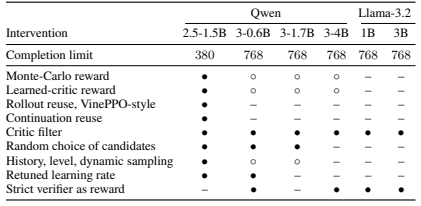
Table 2 . Which interventions were tested at which model. •: preregistered study with 8 or more seeds; ◦: pilot or pooled esti- mate with 3–9 seeds per model; –: not tested. Completion limit in tokens; on Qwen2.5-1.5B, a preregistered study also compared the Monte-Carlo reward and both kinds of reuse at768tokens, to equal training time.
원문 · CC BY 4.0 · Vikash Singh, Weicong Chen, Debargha Ganguly, Yanyan Zhang, Mohsen Hariri, Sreehari Sankar, Wang Yang, Chaoda Song, Alexander Nemecek, Osama Zafar, Yuting Shao, Kai Ye, Biyao Zhang, Xinpeng Li, Shouren Wang, Erman Ayday, Jing Ma, Sanmukh Rao Kuppannagari, Vipin Chaudhary · Are Dense Rewards Worth Their Tokens in GRPO? · 원문 그림 인용 · 원본 PDF 19쪽에서 그림 영역을 추출했습니다.논문 정보
- 저자
- Vikash Singh, Weicong Chen, Debargha Ganguly, Yanyan Zhang, Mohsen Hariri, Sreehari Sankar, Wang Yang, Chaoda Song, Alexander Nemecek, Osama Zafar, Yuting Shao, Kai Ye, Biyao Zhang, Xinpeng Li, Shouren Wang, Erman Ayday, Jing Ma, Sanmukh Rao Kuppannagari, Vipin Chaudhary
- 학회·저널
- arXiv · 프리프린트
- 최초 공개일
- 2026년 11월 10일
- 등록일
- 2026년 11월 11일
- 수정일
- 2026년 11월 10일
- 버전
- v1
- arXiv
- 2611.13560
- 분류
- cs.CL · cs.AI
- 원문 이용 조건
- CC BY 4.0
- 제공 범위
- 논문 정보, 해설, 허용된 원문 그림
AI 해설은 논문 원문과 별개의 설명이며 오류가 있을 수 있습니다. 원문과 그림은 각 출처의 이용 조건과 따로 표시된 권리를 따릅니다.
초록
RLVR trains language models to reason by rewarding correct final answers. A widely used algorithm, group-relative policy optimization (GRPO), gives every token of a solution the same credit, so dense process rewards have been proposed to credit intermediate steps, for example with a Monte-Carlo reward that scores each step by sampling continuations from it. Comparing such a reward with GRPO per training update, or vetting it with a gradient test on a single batch, leaves out what it costs: in our setting, the continuations alone take 91% of all generated tokens. We introduce a matched-compute protocol that gives every training intervention the same budget, measured in generated tokens and training GPU-hours, and tests it in preregistered studies with controls for side effects. Across 1,668 runs on six models, matching compute reverses the ranking. On Qwen2.5-1.5B, the Monte-Carlo reward leads standard GRPO per update, yet ends 14.3 percentage points lower at equal tokens and 7.8 points lower at equal training time, and none of four dense-reward variants outperforms GRPO even with as much training time. A per-token gradient test orders these rewards as training does but overestimates each by one to two points, as much as the gains it is meant to detect. In contrast, training on the prompts whose predicted success is nearest 1/2 improves accuracy at matched compute, by 1.7 points on Qwen3-0.6B and 0.8 on Qwen2.5-1.5B. These gains replicate on fresh seeds and unseen problems, and a simple rule, that the candidate prompts are predicted to fail more often than not, predicted where they appear in five of six preregistered tests. Both gains come early in training, and standard GRPO with twice the initial learning rate comes within half a point of them. We argue that training interventions should be validated at matched compute, which overturns some apparent gains and confirms others.
원문 인용
Vikash Singh, Weicong Chen, Debargha Ganguly, Yanyan Zhang, Mohsen Hariri, Sreehari Sankar, Wang Yang, Chaoda Song, Alexander Nemecek, Osama Zafar, Yuting Shao, Kai Ye, Biyao Zhang, Xinpeng Li, Shouren Wang, Erman Ayday, Jing Ma, Sanmukh Rao Kuppannagari, Vipin Chaudhary (2026). Are Dense Rewards Worth Their Tokens in GRPO?. arXiv:2611.13560v1. https://arxiv.org/abs/2611.13560v1
BibTeX
@misc{singh2026dense,
  title = {{Are Dense Rewards Worth Their Tokens in GRPO?}},
  author = {Vikash Singh and Weicong Chen and Debargha Ganguly and Yanyan Zhang and Mohsen Hariri and Sreehari Sankar and Wang Yang and Chaoda Song and Alexander Nemecek and Osama Zafar and Yuting Shao and Kai Ye and Biyao Zhang and Xinpeng Li and Shouren Wang and Erman Ayday and Jing Ma and Sanmukh Rao Kuppannagari and Vipin Chaudhary},
  year = {2026},
  eprint = {2611.13560},
  archivePrefix = {arXiv},
  url = {https://arxiv.org/abs/2611.13560v1}
}