논문 해설
Neural networks with motivation
동기를 가진 신경망
- 연구 문제 동기 상태가 변하는 환경에서 강화학습 신경망이 행동을 적응적으로 바꿀 수 있는지 살펴봅니다.
- 연구 방법 Q-함수에 동기 벡터를 입력으로 넣고 TD 오차를 역전파하여 신경망을 학습합니다.
- 주요 결과 Four Demands 과제에서 동기 입력 네트워크는 θ에 따라 two-room binge와 migration 전략을 보였고, Transport 과제에서는 테스트 예의 82%에서 최단 경로를 따랐습니다.
동기 변화에 따라 행동을 바꾸는 문제
동물은 배고픔, 갈증, 수면 욕구처럼 시간에 따라 변하는 동기 상태에 맞춰 행동을 바꿉니다. 기존 강화학습 모델은 보상 값이 고정되어 있거나 학습 과정에서 천천히 바뀌는 것을 주로 다루어, 동기 상태가 빠르게 바뀌는 상황을 설명하기 어렵습니다. 이 논문은 Q-learning 신경망에 동기 벡터를 입력으로 넣어, 보상의 지각된 가치가 동기에 따라 달라지는 상황에서 행동이 어떻게 학습되는지 살펴봅니다. 또한 같은 구조를 Pavlovian 조건화 과제에 적용해 VP 뉴런 반응과 비교합니다.
동기 입력을 포함한 Q-함수와 TD 학습
이 모델에서 Q-함수는 상태 s_t와 동기 벡터 µ_t를 함께 인자로 받으며, 미래 지각 보상의 할인된 합으로 정의됩니다. 행동은 Q(s_t, a, µ)를 최대화하도록 선택됩니다. 학습에서는 TD 오차 δ = r̃_t + γ max Q(s_{t+1}, a', µ_{t+1}) − Q(s_t, a_t, µ_t)를 계산하고, 이 오차를 역전파하여 신경망 가중치를 갱신합니다. 동기 값은 상태보다 느리게 변하는 변수로 설정되며, 상태는 행동에 따라 즉시 바뀝니다. 따라서 두 입력은 서로 다른 표현으로 신경망에 주어집니다.
Four Demands 과제에서의 전략 선택
Four Demands 과제는 6x6 격자 환경이 네 개의 방으로 나뉘고, 각 방이 서로 다른 자원과 동기 성분에 대응하는 설정입니다. 에이전트가 어떤 방에 들어가면 해당 동기 성분이 보상으로 소비되고 0으로 재설정되며, 다른 성분은 시간에 따라 1씩 증가하고 최대값 θ에서 포화됩니다. 이 설정에서 원문은 한 방에 머무는 전략, 두 방을 번갈아 가는 전략, 네 방을 순환하는 migration 전략의 평균 보상을 계산합니다. 두 방 전략의 평균 보상은 1이며 migration 전략은 10/3입니다. 다만 θ가 9보다 작으면 migration의 이점이 줄어들고, θ = 1에서는 migration의 보상률이 2/3로 두 방 binge보다 낮습니다.
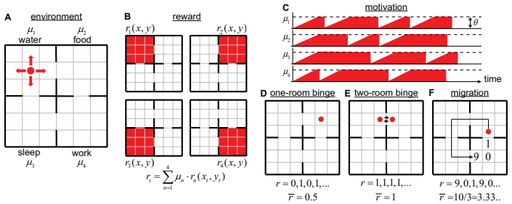
Figure 1 : The Four Demands example. (A) An agent populates a 6x6 environment separated into four rooms. Each room is associated with its own reward and motivation (water, food, sleep, work). (B) The perceived reward is a scalar product between the motivation vector and the reward vector as illustrated. (C) Components of the 4D motivation vector as functions of time. When agent enters a room, its motivation is reset to zero. When the agent is not in the room, the motivation increases by 1 at each time step until saturation at θ. (D-F) Potential strategies in our model: (D) one-room binge, (E) two-room binge, and (F) migration.
원문 · CC BY 4.0 · Sergey A. Shuvaev, Ngoc B. Tran, Marcus Stephenson-Jones, Bo Li, Alexei A. Koulakov · Neural networks with motivation · 원문 그림 인용 · 원본 PDF 3쪽에서 그림 영역을 추출했습니다.동기 입력 유무에 따른 학습 결과 비교
같은 Four Demands 설정에서 동기 입력을 0으로 억제한 네트워크는 대부분 two-room binge 행동을 보였습니다. migration 전략은 최적인 경우가 41회 중 3/4이었지만, 이를 학습한 비동기 에이전트는 41회 중 하나뿐이었습니다. 저자들은 이 결과를 동기 입력이 시간적 신용 할당에 추가적인 단서를 제공하여 학습을 돕는 것으로 해석합니다. 이 해석은 같은 Four Demands 설정과 θ 탐색 범위에서 얻은 관찰에 근거합니다.
Transport 네트워크 과제의 경로 학습
Transport 네트워크 과제에서 에이전트는 도로망의 도시들 가운데 목표 도시 집합을 방문해야 하며, 방문 순서는 중요하지 않지만 전체 경로 길이가 짧아야 합니다. 목표 도시의 동기 성분은 1로 설정되고, 도시에 도달하면 해당 동기가 0으로 재설정됩니다. 보상은 도착한 도시의 동기 값에서 이동 거리를 뺀 값으로 정의됩니다. 이 과제는 10개의 도시와 Delaunay 삼각분할 도로망에서 학습되었고, 50개의 서로 다른 3개 목표 집합으로 평가되었습니다. 평가에서 학습된 네트워크는 테스트 예의 82%에서 최단 경로를 따랐습니다. 나머지 경우의 경로는 최단 경로에 가까웠다고 보고됩니다.
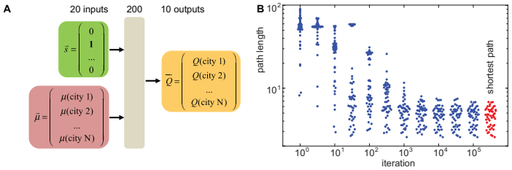
Figure 5 : Training a neural networks to find the shortest route to visit a subset of target cities using the motiva- tion framework. (A) One-layer neural network computing the Q-values. (B) Test performance on 50 sets of 3 random targets (blue). The precomputed shortest path solutions (red). The policy converges on iteration3· 103.
원문 · CC BY 4.0 · Sergey A. Shuvaev, Ngoc B. Tran, Marcus Stephenson-Jones, Bo Li, Alexei A. Koulakov · Neural networks with motivation · 원문 그림 인용 · 원본 PDF 5쪽에서 그림 영역을 추출했습니다.Pavlovian 조건화 과제와 RNN 모델
Pavlovian 과제에서는 소리 신호 뒤에 긍정 또는 부정 보상이 주어지며, 긍정 블록과 부정 블록에서 동물의 기대가 달라집니다. 저자들은 이 시간 구조를 다루기 위해 순환 신경망을 사용합니다. RNN은 trial 안의 시점에 따른 CS 값과 trial 전체에서 일정한 동기 값 µ = ±1을 입력으로 받고, 각 시점의 V-값을 출력합니다. 이 과제에서 TD 오차는 V-값과 보상의 차이로 계산되며, RNN은 부정 블록에서는 낮은 기대에서 시작하고 긍정 블록에서는 그 부호가 반대인 기대를 보였습니다. 이 결과는 학습된 모델이 CS와 동기 블록에 따라 기대를 조정했다는 관찰입니다.
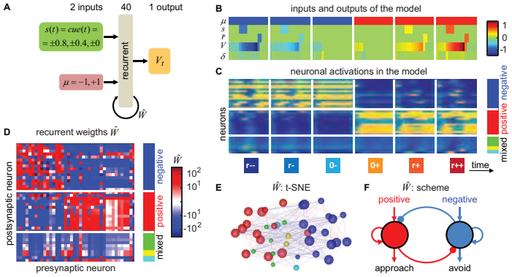
Figure 7 : (A) The architecture of the RNN computing the V-function in the Pavlovian conditioning task. (B) Inputs and outputs of the RNN for each trial type. Inputs: motivation, cue, reward. Outputs: sample V- function. Bottom row: TD error. Trial types (left to right): large negative reward, small negative reward, no negative reward, no positive reward, small positive reward, large positive reward. (C) Sample responses of neurons in the RNN clustered into the negative motivation (blue), positive motivation (red) and neurons of mixed sensitivity (other). (D) Recurrent connectivity matrix. (E) t-SNE representation. (F) Push-pull circuit.
원문 · CC BY 4.0 · Sergey A. Shuvaev, Ngoc B. Tran, Marcus Stephenson-Jones, Bo Li, Alexei A. Koulakov · Neural networks with motivation · 원문 그림 인용 · 원본 PDF 7쪽에서 그림 영역을 추출했습니다.반대로 조율된 두 뉴런 집단과 push-pull 회로
학습된 RNN의 재귀 뉴런 활동을 평균 활동 기반 상관 행렬로 나누고 워터셰드 방식으로 군집화하면, 부정 보상 trial에서 활동하는 집단과 긍정 보상 trial에서 활동하는 집단이 나타납니다. 같은 방향으로 조율된 뉴런끼리는 흥분성으로, 반대로 조율된 뉴런끼리는 억제성으로 연결되는 패턴이 보고됩니다. 이러한 연결은 지연 구간에서 보상 기대를 유지하는 push-pull 회로로 해석됩니다. 저자들은 이 구조가 VP 뉴런의 두 집단과 비슷하다고 보지만, 이는 모델 예측과 기록된 반응 사이의 유사성에 대한 해석입니다.
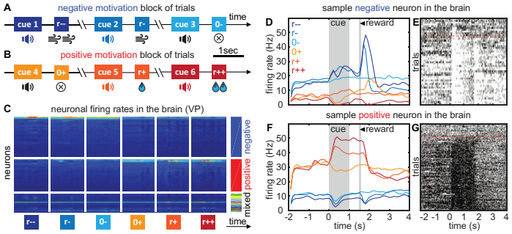
Figure 6 : (A, B) A behavioral task for the recording. Trials were separated into the blocks during which only negative rewards (air puffs) or only positive rewards (water drops) were delivered. (C) Responses of neurons recorded in 3 mice clustered into the negative motivation, positive motivation, and neurons of mixed sensitivity. (D-G) Activity of sample neurons responding to negative (D, E) or positive (F, G) rewards.
원문 · CC BY 4.0 · Sergey A. Shuvaev, Ngoc B. Tran, Marcus Stephenson-Jones, Bo Li, Alexei A. Koulakov · Neural networks with motivation · 원문 그림 인용 · 원본 PDF 6쪽에서 그림 영역을 추출했습니다.적용 범위와 남은 질문
이 연구의 결과는 Four Demands, Transport, Pavlovian 과제에서 얻은 것이며, 각 과제의 설정과 모델 구조에 따른 관찰입니다. Four Demands의 성능 결과는 θ 탐색과 동기 입력 유무를 비교한 설정에 한정됩니다. Transport 결과는 10개 도시, 50개의 테스트 목표 집합, 특정 신경망 구조에 한정됩니다. VP 비교는 3마리 마우스에서 기록한 149개의 과제 관련 단일 뉴런에 근거하며, 신경망 연결의 실제 생물학적 구조를 직접 측정한 것은 아닙니다. 또한 HRL 구현은 이 연구의 범위 밖이라고 밝혀져 있습니다.
논문 정보
- 저자
- Sergey A. Shuvaev, Ngoc B. Tran, Marcus Stephenson-Jones, Bo Li, Alexei A. Koulakov
- 학회·저널
- arXiv · 프리프린트
- 최초 공개일
- 2019년 6월 23일
- 등록일
- 2026년 11월 6일
- 수정일
- 2019년 11월 19일
- 버전
- v2
- arXiv
- 1906.09528
- 분류
- q-bio.NC · cs.LG
- 원문 이용 조건
- CC BY 4.0
- 제공 범위
- 논문 정보, 해설, 허용된 원문 그림
AI 해설은 논문 원문과 별개의 설명이며 오류가 있을 수 있습니다. 원문과 그림은 각 출처의 이용 조건과 따로 표시된 권리를 따릅니다.
초록
How can animals behave effectively in conditions involving different motivational contexts? Here, we propose how reinforcement learning neural networks can learn optimal behavior for dynamically changing motivational salience vectors. First, we show that Q-learning neural networks with motivation can navigate in environment with dynamic rewards. Second, we show that such networks can learn complex behaviors simultaneously directed towards several goals distributed in an environment. Finally, we show that in Pavlovian conditioning task, the responses of the neurons in our model resemble the firing patterns of neurons in the ventral pallidum (VP), a basal ganglia structure involved in motivated behaviors. We show that, similarly to real neurons, recurrent networks with motivation are composed of two oppositely-tuned classes of neurons, responding to positive and negative rewards. Our model generates predictions for the VP connectivity. We conclude that networks with motivation can rapidly adapt their behavior to varying conditions without changes in synaptic strength when expected reward is modulated by motivation. Such networks may also provide a mechanism for how hierarchical reinforcement learning is implemented in the brain.
원문 인용
Sergey A. Shuvaev, Ngoc B. Tran, Marcus Stephenson-Jones, Bo Li, Alexei A. Koulakov (2019). Neural networks with motivation. arXiv:1906.09528v2. https://arxiv.org/abs/1906.09528v2
BibTeX
@misc{shuvaev2019neural,
  title = {{Neural networks with motivation}},
  author = {Sergey A. Shuvaev and Ngoc B. Tran and Marcus Stephenson-Jones and Bo Li and Alexei A. Koulakov},
  year = {2019},
  eprint = {1906.09528},
  archivePrefix = {arXiv},
  url = {https://arxiv.org/abs/1906.09528v2}
}