논문 해설
RoboCat: A Self-Improving Generalist Agent for Robotic Manipulation
RoboCat: 로봇 조작을 위한 자기 개선형 범용 에이전트
- 연구 문제 RoboCat은 이질적인 로봇 경험을 하나의 시각 목표 조건부 트랜스포머에 모아 여러 실제·시뮬레이션 구현체의 조작 작업을 수행하고, 소수의 시연으로 새 작업에 적응하며, 생성 데이터로 자기 개선하는 범용 에이전트를 목표로 합니다.
- 연구 방법 목표 이미지로 작업을 지정하는 Gato 기반 트랜스포머를 VQ-GAN 토큰과 함께 학습하고, 미세조정된 정책이 생성한 데이터를 다음 세대 학습에 재사용합니다.
- 주요 결과 하나의 에이전트가 학습 작업 전체에서 성능을 보이며 단일 작업 VFM 기준선보다 여러 실제 작업에서 우위를 보고합니다. 제한 데이터 모델은 보류 작업에 적응할 수 있으나 0-shot 결과는 작업별로 크게 다릅니다.
여러 로봇과 작업을 하나의 에이전트로 다루는 문제
로봇 학습 연구는 대개 한 번에 하나의 작업을 위한 에이전트를 만드는 데 집중해 왔습니다. 작업 설계와 로봇 경험 생성 비용이 높고, 서로 다른 로봇과 작업에서 얻은 이질적인 데이터를 대규모로 함께 활용하는 일이 어려웠기 때문입니다. RoboCat은 이 문제를 시각 목표 조건부 트랜스포머로 다루면서, 서로 다른 관측·행동 사양을 가진 여러 구현체의 데이터를 하나의 모델에서 학습하는 것을 목표로 합니다. 또한 학습된 모델이 생성한 데이터를 다음 학습 단계에 다시 넣어 자기 개선 루프의 기본 구성요소를 만드는 것을 목표로 합니다.
시각 목표 조건부 트랜스포머와 VQ-GAN 토큰화
RoboCat의 정책은 행동 a_t를 관측 o_t와 목표 이미지 g_t에 조건을 두고 자기회귀적으로 모델링합니다. 관측은 고유수용성 값 x_t와 이미지 I_t로 구성되며, 목표 이미지는 같은 궤적에서 최종 이미지를 사용하는 hindsight goal이나 같은 작업에 성공한 다른 에피소드의 최종 이미지인 semantically-equivalent goal로 정해집니다. 이미지는 사전학습되고 고정된 VQ-GAN 인코더로 8×8 토큰 격자에 이산화되어 입력되며, 이 인코더를 쓰면 이미지를 미리 한 번 토큰화할 수 있어 학습이 빨라집니다. 학습 목적은 행동 토큰 예측 손실에 k=5 시간 단계 뒤의 이미지 토큰을 예측하는 항을 더한 형태입니다.
저자들은 이 미래 이미지 토큰 예측이 픽셀 예측보다 일반화에 유리하다고 보고합니다.
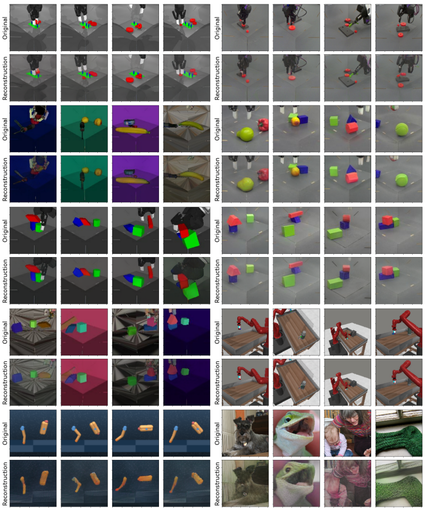
Figure 16 : Reconstructions from our RoboCat VQ-GAN on the training datasets.From right to left, panda sim, sawyer real red-on-blue, sawyer sim (with visual domain randomisation), Meta-World, DM control, and ImageNet.
원문 · CC BY 4.0 · Konstantinos Bousmalis, Giulia Vezzani, Dushyant Rao, Coline Devin, Alex X. Lee, Maria Bauza, Todor Davchev, Yuxiang Zhou, Agrim Gupta, Akhil Raju, Antoine Laurens, Claudio Fantacci, Valentin Dalibard, Martina Zambelli, Murilo Martins, Rugile Pevceviciute, Michiel Blokzijl, Misha Denil, Nathan Batchelor, Thomas Lampe, Emilio Parisotto, Konrad Żołna, Scott Reed, Sergio Gómez Colmenarejo, Jon Scholz, Abbas Abdolmaleki, Oliver Groth, Jean-Baptiste Regli, Oleg Sushkov, Tom Rothörl, José Enrique Chen, Yusuf Aytar, Dave Barker, Joy Ortiz, Martin Riedmiller, Jost Tobias Springenberg, Raia Hadsell, Francesco Nori, Nicolas Heess · RoboCat: A Self-Improving Generalist Agent for Robotic Manipulation · 원문 그림 인용 · 원본 PDF 43쪽에서 그림 영역을 추출했습니다.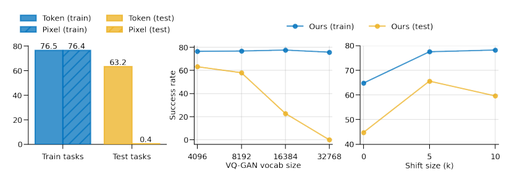
Figure 19 : Tokenisation and obs prediction ablationson the red_on_green generalisation problem. Unless otherwise specified, we use a vocabulary size of 4096 and image prediction with a time step shift ofk = 5 . We compare the success rate (%) for train and test tasks to ablate important design decisions.Left: Predicting future tokens is significantly better than predicting futurepixels. Middle: Increasing VQ-GAN vocabulary size deteriorates test performance. Right: Predicting the next token in the current image (k = 0) is less beneficial than predicting tokens farther in the future. We find predictingk = 5 time steps in the future is optimal.
원문 · CC BY 4.0 · Konstantinos Bousmalis, Giulia Vezzani, Dushyant Rao, Coline Devin, Alex X. Lee, Maria Bauza, Todor Davchev, Yuxiang Zhou, Agrim Gupta, Akhil Raju, Antoine Laurens, Claudio Fantacci, Valentin Dalibard, Martina Zambelli, Murilo Martins, Rugile Pevceviciute, Michiel Blokzijl, Misha Denil, Nathan Batchelor, Thomas Lampe, Emilio Parisotto, Konrad Żołna, Scott Reed, Sergio Gómez Colmenarejo, Jon Scholz, Abbas Abdolmaleki, Oliver Groth, Jean-Baptiste Regli, Oleg Sushkov, Tom Rothörl, José Enrique Chen, Yusuf Aytar, Dave Barker, Joy Ortiz, Martin Riedmiller, Jost Tobias Springenberg, Raia Hadsell, Francesco Nori, Nicolas Heess · RoboCat: A Self-Improving Generalist Agent for Robotic Manipulation · 원문 그림 인용 · 원본 PDF 45쪽에서 그림 영역을 추출했습니다.정책 풀과 자기 개선 절차
자기 개선 절차는 먼저 소수의 사람 시연으로 범용 에이전트를 새 작업에 미세조정합니다. 이 미세조정된 정책을 실제 로봇에서 자율적으로 실행해 많은 궤적을 모읍니다. 실제 로봇에서는 작업 재설정이 어렵기 때문에 policy pool을 사용하여, 한 작업의 종료 상태가 다른 작업의 시작 상태와 겹치도록 묶고 각 에피소드에서 다음에 실행할 정책을 고릅니다. 성공 여부는 학습된 보상 모델로 판정하며, 수집된 궤적과 기존 데이터를 합쳐 다음 세대 에이전트의 학습 데이터셋 D_next를 구성합니다. 원문은 이 절차가 강화학습 루프의 일부를 구현하지만, 데이터 수집과 학습은 분리되어 있고 학습은 고정된 데이터 소스에서 지도학습으로 수행된다고 설명합니다.
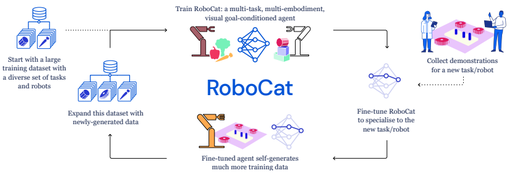
Figure 1 : The self-improvement process. RoboCat is a multi-task, multi-embodiment visual goal-conditioned agent that can iteratively self-improve. A diverse training set is used to train an initial version of this generalist agent, which can be fine-tuned to new tasks with 100–1000 demonstrations and then deployed on real robots to generate much more data for these tasks. The resulting trajectories are then added to the training dataset for the next iteration of RoboCat, increasing the generalist’s repertoire of skills and improving performance across tasks. Our experiments demonstrate one successful iteration of this process.
원문 · CC BY 4.0 · Konstantinos Bousmalis, Giulia Vezzani, Dushyant Rao, Coline Devin, Alex X. Lee, Maria Bauza, Todor Davchev, Yuxiang Zhou, Agrim Gupta, Akhil Raju, Antoine Laurens, Claudio Fantacci, Valentin Dalibard, Martina Zambelli, Murilo Martins, Rugile Pevceviciute, Michiel Blokzijl, Misha Denil, Nathan Batchelor, Thomas Lampe, Emilio Parisotto, Konrad Żołna, Scott Reed, Sergio Gómez Colmenarejo, Jon Scholz, Abbas Abdolmaleki, Oliver Groth, Jean-Baptiste Regli, Oleg Sushkov, Tom Rothörl, José Enrique Chen, Yusuf Aytar, Dave Barker, Joy Ortiz, Martin Riedmiller, Jost Tobias Springenberg, Raia Hadsell, Francesco Nori, Nicolas Heess · RoboCat: A Self-Improving Generalist Agent for Robotic Manipulation · 원문 그림 인용 · 원본 PDF 3쪽에서 그림 영역을 추출했습니다.학습 작업에서의 범용 성능과 기준선 비교
RoboCat은 시뮬레이션과 실제 로봇을 포함한 학습 작업 전체에서 평가되었으며, 성공률은 구현체, 작업군, 객체 집합별로 평균되어 보고됩니다. 한 모델이 여러 구현체와 작업군을 함께 수행할 수 있다는 점이 핵심 결과입니다. 비교 기준선으로는 단일 작업으로 학습된 NFNet-f6와 Swin-L이 사용되었습니다. 두 기준선은 CLIP으로 사전학습되었고, 같은 행동 복제 손실과 같은 성공 에피소드로 학습되었으며, 시뮬레이션의 한 작업에서 59개 후보 중 상위로 선택되었습니다. 실제 로봇의 들기, 삽입, 제거 작업에서는 기준선에 비해 RoboCat의 우위가 더 뚜렷하다고 보고됩니다. 시뮬레이션 쌓기 작업에서는 Panda 스태킹에서 기준선이 경쟁력이 있었습니다.
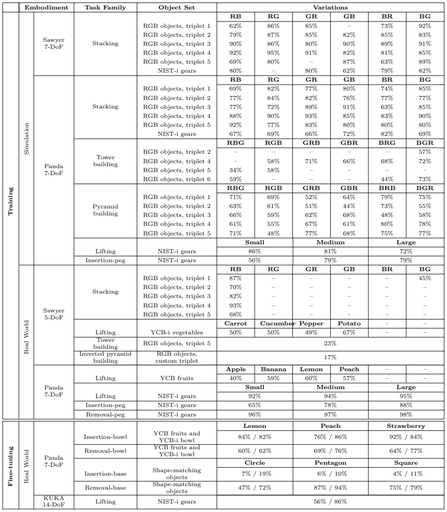
Table 15 : Per-task RoboCat performance on training and fine-tuning tasks. This table expands Table 1 by providing the success rate for each task variant instead of the average per task families. Fine-tuning results are reported for 500 and 1000 demonstrations respectively, separated by a slash.
원문 · CC BY 4.0 · Konstantinos Bousmalis, Giulia Vezzani, Dushyant Rao, Coline Devin, Alex X. Lee, Maria Bauza, Todor Davchev, Yuxiang Zhou, Agrim Gupta, Akhil Raju, Antoine Laurens, Claudio Fantacci, Valentin Dalibard, Martina Zambelli, Murilo Martins, Rugile Pevceviciute, Michiel Blokzijl, Misha Denil, Nathan Batchelor, Thomas Lampe, Emilio Parisotto, Konrad Żołna, Scott Reed, Sergio Gómez Colmenarejo, Jon Scholz, Abbas Abdolmaleki, Oliver Groth, Jean-Baptiste Regli, Oleg Sushkov, Tom Rothörl, José Enrique Chen, Yusuf Aytar, Dave Barker, Joy Ortiz, Martin Riedmiller, Jost Tobias Springenberg, Raia Hadsell, Francesco Nori, Nicolas Heess · RoboCat: A Self-Improving Generalist Agent for Robotic Manipulation · 원문 그림 인용 · 원본 PDF 52쪽에서 그림 영역을 추출했습니다.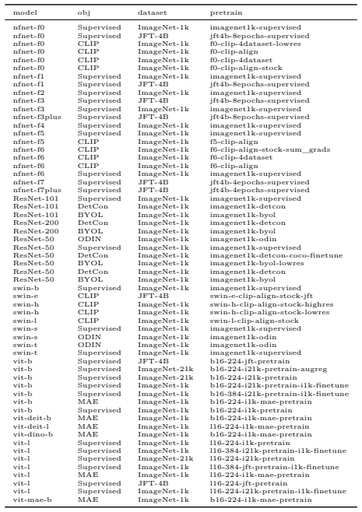
Table 16 :Details of the baseline methods:including the model name, training objectives and pretaining dataset.
원문 · CC BY 4.0 · Konstantinos Bousmalis, Giulia Vezzani, Dushyant Rao, Coline Devin, Alex X. Lee, Maria Bauza, Todor Davchev, Yuxiang Zhou, Agrim Gupta, Akhil Raju, Antoine Laurens, Claudio Fantacci, Valentin Dalibard, Martina Zambelli, Murilo Martins, Rugile Pevceviciute, Michiel Blokzijl, Misha Denil, Nathan Batchelor, Thomas Lampe, Emilio Parisotto, Konrad Żołna, Scott Reed, Sergio Gómez Colmenarejo, Jon Scholz, Abbas Abdolmaleki, Oliver Groth, Jean-Baptiste Regli, Oleg Sushkov, Tom Rothörl, José Enrique Chen, Yusuf Aytar, Dave Barker, Joy Ortiz, Martin Riedmiller, Jost Tobias Springenberg, Raia Hadsell, Francesco Nori, Nicolas Heess · RoboCat: A Self-Improving Generalist Agent for Robotic Manipulation · 원문 그림 인용 · 원본 PDF 58쪽에서 그림 영역을 추출했습니다.새 작업 적응과 RoboCat-lim 일반화
적응 실험은 학습 중 보지 않은 작업에 대해 500개 또는 1000개의 시연으로 미세조정한 결과를 다룹니다. 이 설정에서 미세조정된 RoboCat은 기준선보다 훨씬 적은 시연으로 잘 적응한다고 보고되며, 기준선 VFM 에이전트는 같은 시연 수에서 매우 낮은 성능을 보입니다. 일반화 분석을 위해 저자들은 구조물 쌓기 학습 작업의 부분집합으로만 학습한 RoboCat-lim을 별도로 만들었습니다. RoboCat-lim은 보류된 객체와 작업 변형에 대해 0-shot 및 k-shot으로 평가되었고, 실제 KUKA 14-DoF 들기 작업에서 0-shot 성공률은 0%였으나 fine-tuning 후 69% 성공으로 보고됩니다.
이는 보류 작업에서의 제한된 결과이며 모든 새로운 작업에 대한 일반화로 해석하지 않습니다.
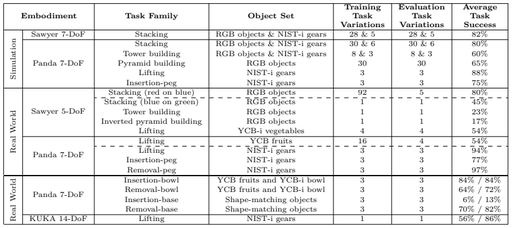
Table 1 : Final RoboCat performance on evaluation tasks.This table lists the tasks used for training and fine-tuning of the final RoboCat agent, and highlights the set of tasks used in the self-improvement process. The success rates are averaged across all the respective evaluation task variations. For fine-tuning experiments, we report success rates when fine-tuning on500 and 1000 demonstrations, respectively. Note that data from the fine-tuning tasks are unseen during generalist training and the fine-tuned agent only uses up to 1000 demonstrations alone for these new tasks.
원문 · CC BY 4.0 · Konstantinos Bousmalis, Giulia Vezzani, Dushyant Rao, Coline Devin, Alex X. Lee, Maria Bauza, Todor Davchev, Yuxiang Zhou, Agrim Gupta, Akhil Raju, Antoine Laurens, Claudio Fantacci, Valentin Dalibard, Martina Zambelli, Murilo Martins, Rugile Pevceviciute, Michiel Blokzijl, Misha Denil, Nathan Batchelor, Thomas Lampe, Emilio Parisotto, Konrad Żołna, Scott Reed, Sergio Gómez Colmenarejo, Jon Scholz, Abbas Abdolmaleki, Oliver Groth, Jean-Baptiste Regli, Oleg Sushkov, Tom Rothörl, José Enrique Chen, Yusuf Aytar, Dave Barker, Joy Ortiz, Martin Riedmiller, Jost Tobias Springenberg, Raia Hadsell, Francesco Nori, Nicolas Heess · RoboCat: A Self-Improving Generalist Agent for Robotic Manipulation · 원문 그림 인용 · 원본 PDF 10쪽에서 그림 영역을 추출했습니다.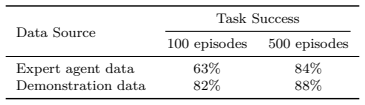
Table 3 : RoboCat-lim fine-tuning using different sources of data.Despite RoboCat-lim only being trained on agent data originally, the model can be fine-tuned with either agent or human demonstration data. The 0-shot success rate for this task is 0%. This task is the held-out real-world perceptual variant of blue-on-green stacking.
원문 · CC BY 4.0 · Konstantinos Bousmalis, Giulia Vezzani, Dushyant Rao, Coline Devin, Alex X. Lee, Maria Bauza, Todor Davchev, Yuxiang Zhou, Agrim Gupta, Akhil Raju, Antoine Laurens, Claudio Fantacci, Valentin Dalibard, Martina Zambelli, Murilo Martins, Rugile Pevceviciute, Michiel Blokzijl, Misha Denil, Nathan Batchelor, Thomas Lampe, Emilio Parisotto, Konrad Żołna, Scott Reed, Sergio Gómez Colmenarejo, Jon Scholz, Abbas Abdolmaleki, Oliver Groth, Jean-Baptiste Regli, Oleg Sushkov, Tom Rothörl, José Enrique Chen, Yusuf Aytar, Dave Barker, Joy Ortiz, Martin Riedmiller, Jost Tobias Springenberg, Raia Hadsell, Francesco Nori, Nicolas Heess · RoboCat: A Self-Improving Generalist Agent for Robotic Manipulation · 원문 그림 인용 · 원본 PDF 15쪽에서 그림 영역을 추출했습니다.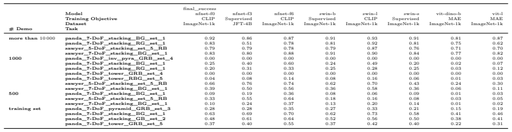
Table 17 :Evaluation of baselines on training and held-out tasks with limited number of demonstrations.
원문 · CC BY 4.0 · Konstantinos Bousmalis, Giulia Vezzani, Dushyant Rao, Coline Devin, Alex X. Lee, Maria Bauza, Todor Davchev, Yuxiang Zhou, Agrim Gupta, Akhil Raju, Antoine Laurens, Claudio Fantacci, Valentin Dalibard, Martina Zambelli, Murilo Martins, Rugile Pevceviciute, Michiel Blokzijl, Misha Denil, Nathan Batchelor, Thomas Lampe, Emilio Parisotto, Konrad Żołna, Scott Reed, Sergio Gómez Colmenarejo, Jon Scholz, Abbas Abdolmaleki, Oliver Groth, Jean-Baptiste Regli, Oleg Sushkov, Tom Rothörl, José Enrique Chen, Yusuf Aytar, Dave Barker, Joy Ortiz, Martin Riedmiller, Jost Tobias Springenberg, Raia Hadsell, Francesco Nori, Nicolas Heess · RoboCat: A Self-Improving Generalist Agent for Robotic Manipulation · 원문 그림 인용 · 원본 PDF 58쪽에서 그림 영역을 추출했습니다.자기 생성 데이터의 효과
자기 개선의 효과는 두 단계로 확인됩니다. 먼저 364M 규모의 작은 모델로 구조물 쌓기 작업과 몇 가지 자기 개선 작업을 대상으로 한 실험에서, 시연 500개만 직접 학습에 넣은 기준 모델보다 자기 생성 데이터를 추가로 본 모델이 네 작업 모두에서 더 나은 결과를 보였다고 보고됩니다. 이후 여러 작업별 fine-tuning 에이전트가 만든 데이터를 합쳐 최종 RoboCat 범용 모델을 학습했으며, 최종 모델의 성능은 데이터를 생성한 에이전트와 비슷하거나 더 나은 경우가 많다고 보고됩니다. 이 결과는 자기 생성 데이터가 다음 세대 에이전트의 학습에 도움이 될 수 있음을 보여 주지만, 현재 실험 범위에서의 관찰로 읽어야 합니다.
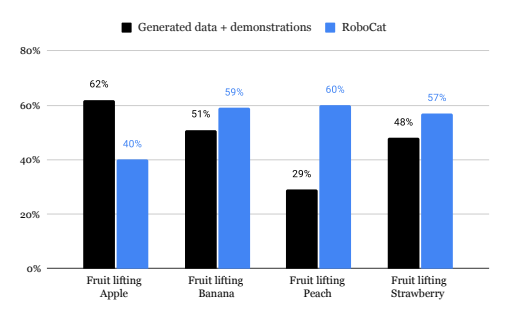
Figure 24 : RoboCat vs training data: Panda 7-DoF YCB lifting tasks (self-improvement, real).This plot compares the performance of RoboCat on the self-improvement tasks with respect to the overall success rate of the training data available for these tasks (self-generated data and successful human teleoperations).
원문 · CC BY 4.0 · Konstantinos Bousmalis, Giulia Vezzani, Dushyant Rao, Coline Devin, Alex X. Lee, Maria Bauza, Todor Davchev, Yuxiang Zhou, Agrim Gupta, Akhil Raju, Antoine Laurens, Claudio Fantacci, Valentin Dalibard, Martina Zambelli, Murilo Martins, Rugile Pevceviciute, Michiel Blokzijl, Misha Denil, Nathan Batchelor, Thomas Lampe, Emilio Parisotto, Konrad Żołna, Scott Reed, Sergio Gómez Colmenarejo, Jon Scholz, Abbas Abdolmaleki, Oliver Groth, Jean-Baptiste Regli, Oleg Sushkov, Tom Rothörl, José Enrique Chen, Yusuf Aytar, Dave Barker, Joy Ortiz, Martin Riedmiller, Jost Tobias Springenberg, Raia Hadsell, Francesco Nori, Nicolas Heess · RoboCat: A Self-Improving Generalist Agent for Robotic Manipulation · 원문 그림 인용 · 원본 PDF 55쪽에서 그림 영역을 추출했습니다.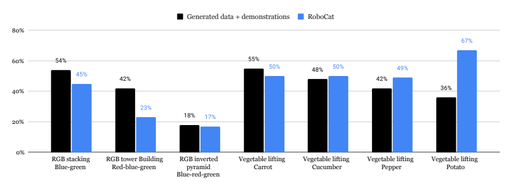
Figure 25 : RoboCat vs training data: Sawyer 5-DoF RGB and YCB tasks (self-improvement, real). This plot compares the performance of RoboCat on the self-improvement tasks with respect to the overall success rate of the training data available for these tasks (self-generated data and successful human teleoperations).
원문 · CC BY 4.0 · Konstantinos Bousmalis, Giulia Vezzani, Dushyant Rao, Coline Devin, Alex X. Lee, Maria Bauza, Todor Davchev, Yuxiang Zhou, Agrim Gupta, Akhil Raju, Antoine Laurens, Claudio Fantacci, Valentin Dalibard, Martina Zambelli, Murilo Martins, Rugile Pevceviciute, Michiel Blokzijl, Misha Denil, Nathan Batchelor, Thomas Lampe, Emilio Parisotto, Konrad Żołna, Scott Reed, Sergio Gómez Colmenarejo, Jon Scholz, Abbas Abdolmaleki, Oliver Groth, Jean-Baptiste Regli, Oleg Sushkov, Tom Rothörl, José Enrique Chen, Yusuf Aytar, Dave Barker, Joy Ortiz, Martin Riedmiller, Jost Tobias Springenberg, Raia Hadsell, Francesco Nori, Nicolas Heess · RoboCat: A Self-Improving Generalist Agent for Robotic Manipulation · 원문 그림 인용 · 원본 PDF 56쪽에서 그림 영역을 추출했습니다.행동 복제 한계와 실험 범위
저자들은 RoboCat이 현재 행동 복제만 사용하며 강화학습을 포함하지 않는다고 밝힙니다. 따라서 보상을 이용한 학습이나 실제 상호작용을 통한 온라인 학습은 향후 과제로 남습니다. 또한 평가는 통제된 실험실 환경에서 수행되었고, 바구니 텍스처 같은 시각적 변화가 큰 환경에 대한 견고성은 확인되지 않았습니다. 모델 불확실성은 단일 모델과 그 절제 실험에 대해 보고되며, 여러 학습 실행을 평가하지 않았다는 점이 명시되어 있습니다. 자기 개선 루프는 사람이 데이터 수집을 시작·중지하고 고정된 모델 버전을 사용하므로, 자율적 학습이 실제 상호작용 중에 일어나는 것은 아닙니다.
논문 정보
- 저자
- Konstantinos Bousmalis, Giulia Vezzani, Dushyant Rao, Coline Devin, Alex X. Lee, Maria Bauza, Todor Davchev, Yuxiang Zhou, Agrim Gupta, Akhil Raju, Antoine Laurens, Claudio Fantacci, Valentin Dalibard, Martina Zambelli, Murilo Martins, Rugile Pevceviciute, Michiel Blokzijl, Misha Denil, Nathan Batchelor, Thomas Lampe, Emilio Parisotto, Konrad Żołna, Scott Reed, Sergio Gómez Colmenarejo, Jon Scholz, Abbas Abdolmaleki, Oliver Groth, Jean-Baptiste Regli, Oleg Sushkov, Tom Rothörl, José Enrique Chen, Yusuf Aytar, Dave Barker, Joy Ortiz, Martin Riedmiller, Jost Tobias Springenberg, Raia Hadsell, Francesco Nori, Nicolas Heess
- 학회·저널
- arXiv · 프리프린트
- 최초 공개일
- 2023년 6월 20일
- 등록일
- 2026년 11월 4일
- 수정일
- 2023년 12월 22일
- 버전
- v2
- arXiv
- 2306.11706
- 분류
- cs.RO · cs.LG
- 원문 이용 조건
- CC BY 4.0
- 제공 범위
- 논문 정보, 해설, 허용된 원문 그림
AI 해설은 논문 원문과 별개의 설명이며 오류가 있을 수 있습니다. 원문과 그림은 각 출처의 이용 조건과 따로 표시된 권리를 따릅니다.
초록
The ability to leverage heterogeneous robotic experience from different robots and tasks to quickly master novel skills and embodiments has the potential to transform robot learning. Inspired by recent advances in foundation models for vision and language, we propose a multi-embodiment, multi-task generalist agent for robotic manipulation. This agent, named RoboCat, is a visual goal-conditioned decision transformer capable of consuming action-labelled visual experience. This data spans a large repertoire of motor control skills from simulated and real robotic arms with varying sets of observations and actions. With RoboCat, we demonstrate the ability to generalise to new tasks and robots, both zero-shot as well as through adaptation using only 100-1000 examples for the target task. We also show how a trained model itself can be used to generate data for subsequent training iterations, thus providing a basic building block for an autonomous improvement loop. We investigate the agent's capabilities, with large-scale evaluations both in simulation and on three different real robot embodiments. We find that as we grow and diversify its training data, RoboCat not only shows signs of cross-task transfer, but also becomes more efficient at adapting to new tasks.
원문 인용
Konstantinos Bousmalis, Giulia Vezzani, Dushyant Rao, Coline Devin, Alex X. Lee, Maria Bauza, Todor Davchev, Yuxiang Zhou, Agrim Gupta, Akhil Raju, Antoine Laurens, Claudio Fantacci, Valentin Dalibard, Martina Zambelli, Murilo Martins, Rugile Pevceviciute, Michiel Blokzijl, Misha Denil, Nathan Batchelor, Thomas Lampe et al. (2023). RoboCat: A Self-Improving Generalist Agent for Robotic Manipulation. arXiv:2306.11706v2. https://arxiv.org/abs/2306.11706v2
BibTeX
@misc{bousmalis2023robocat,
  title = {{RoboCat: A Self-Improving Generalist Agent for Robotic Manipulation}},
  author = {Konstantinos Bousmalis and Giulia Vezzani and Dushyant Rao and Coline Devin and Alex X. Lee and Maria Bauza and Todor Davchev and Yuxiang Zhou and Agrim Gupta and Akhil Raju and Antoine Laurens and Claudio Fantacci and Valentin Dalibard and Martina Zambelli and Murilo Martins and Rugile Pevceviciute and Michiel Blokzijl and Misha Denil and Nathan Batchelor and Thomas Lampe and Emilio Parisotto and Konrad Żołna and Scott Reed and Sergio Gómez Colmenarejo and Jon Scholz and Abbas Abdolmaleki and Oliver Groth and Jean-Baptiste Regli and Oleg Sushkov and Tom Rothörl and José Enrique Chen and Yusuf Aytar and Dave Barker and Joy Ortiz and Martin Riedmiller and Jost Tobias Springenberg and Raia Hadsell and Francesco Nori and Nicolas Heess},
  year = {2023},
  eprint = {2306.11706},
  archivePrefix = {arXiv},
  url = {https://arxiv.org/abs/2306.11706v2}
}