논문 해설
PredRNN: A Recurrent Neural Network for Spatiotemporal Predictive Learning
PredRNN: 시공간 예측 학습을 위한 순환 신경망
- 연구 문제 시공간 예측 학습에서 ConvLSTM은 메모리가 층 사이에서 충분히 결합되지 않고 짧은 시간 변화와 긴 시간 의존성을 한 메모리가 함께 맡는 한계가 있습니다.
- 연구 방법 PredRNN은 공간-시간 메모리를 지그재그로 전달하는 ST-LSTM을 쓰고, 메모리 디커플링 손실과 Reverse Scheduled Sampling으로 두 메모리 역할과 긴 시간 학습을 개선합니다.
- 주요 결과 Moving MNIST 고정 학습 세트 실험에서 ConvLSTM의 MSE 103.3이 PredRNN-V2에서 48.4로 낮아졌습니다. 이 결과는 해당 설정에서 보고된 것입니다.
시공간 예측 학습의 문제와 기존 순환 구조의 한계
시공간 예측 학습은 과거 프레임의 맥락으로부터 미래 프레임을 생성하는 문제입니다. 이 논문은 강수 예측, 교통 흐름, 로봇 조작 같은 응용에서 이 문제가 쓰인다고 소개합니다. 기존 방법으로는 ConvLSTM처럼 합성곱을 사용하는 순환 신경망이 널리 쓰였습니다. 그러나 ConvLSTM에서 메모리 셀 C는 각 층 안에서 시간 방향으로만 갱신되므로, 아래 층과 위 층의 시각적 표현이 메모리에서 충분히 결합되지 않습니다. 또한 출력 은닉 상태가 하나의 메모리 셀과 출력 게이트에 의존하므로, 짧은 시간 변화와 긴 시간 의존성을 한 메모리가 동시에 처리해야 합니다. 저자들은 이 두 한계를 출발점으로 삼고, 훈련 절차에서도 인코더와 예측기 사이의 불일치가 긴 시간 의존성 학습을 방해한다고 지적합니다.
지그재그 메모리 흐름과 ST-LSTM 구조
PredRNN은 메모리 상태가 시간 방향으로만 흐르는 대신, 아래 층에서 위 층으로 올라간 뒤 다음 시점의 최하위 층으로 되돌아오는 지그재그 경로를 사용합니다. 이 공간-시간 메모리 M은 입력 게이트, 망각 게이트, 입력 변조 게이트로 갱신되며, 이전 층의 M을 기준으로 계산됩니다. 최상위 층의 메모리는 다음 시점의 최하위 층으로 전달됩니다. 이 구조는 저수준 정보가 위로 전달되고 고수준 기대가 아래로 되돌아오도록 만듭니다. 이 설계를 구현한 기본 단위가 ST-LSTM입니다. ST-LSTM에서는 시간 방향 메모리 C와 공간-시간 메모리 M을 함께 사용하며, 두 메모리를 연결한 뒤 1×1 합성곱으로 은닉 상태를 만듭니다.
따라서 식 (4)의 M 경로는 기존 ConvLSTM의 Hadamard 곱 기반 게이트 대신 합성곱 연산을 사용합니다.
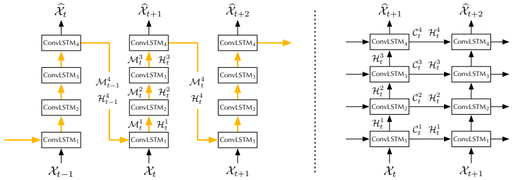
Fig. 1 : Left: the spatiotemporal memory flow architecture that uses ConvLSTM as the building block. The orange arrows show the deep-in-time path of memory state transitions. Right: the original ConvLSTM network proposed by Shi et al. [1].
원문 · CC BY 4.0 · Yunbo Wang, Haixu Wu, Jianjin Zhang, Zhifeng Gao, Jianmin Wang, Philip S. Yu, Mingsheng Long · PredRNN: A Recurrent Neural Network for Spatiotemporal Predictive Learning · 원문 그림 인용 · 원본 PDF 4쪽에서 그림 영역을 추출했습니다.메모리 디커플링 손실
두 메모리 C와 M을 둘 다 사용하더라도, 저자들은 학습 중 두 메모리의 증분이 자연스럽게 분리되지 않는다고 보고합니다. 이를 보완하기 위해 두 메모리의 증분 ΔC와 ΔM에 1×1 합성곱 W_decouple을 적용한 뒤, 채널별 코사인 유사도의 절댓값을 줄이는 디커플링 손실을 추가합니다. 원문 식 (5)는 시간, 층, 채널에 걸쳐 이 값을 합산합니다. 이 손실은 학습 시점에만 사용되며, 추론 시에는 해당 파라미터를 모델에서 제거하므로 모델 크기는 이전 ST-LSTM 버전과 같습니다. 원문은 이 방법이 두 메모리가 서로 다른 시간 규모의 변화를 맡도록 유도한다고 설명하며, t-SNE 시각화에서 학습 후 두 증분이 더 잘 분리된다고 보고합니다.
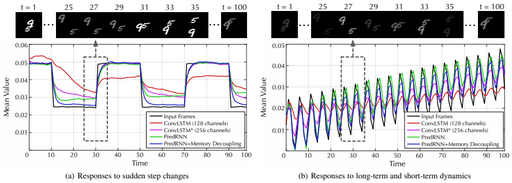
Fig. 11 : Model performance under different types of temporal dynamics, where the models take as inputs the real observations at all timesteps, and the Y axis represents the mean value of predictions averaged over 100 test samples. We show two ground-truth sequences as examples at the top of the figure for a better intuitive understanding of the two types of pixel intensity changes. For each type, we apply the same rate of changes to all test samples. With memory-decoupled ST-LSTMs, our model is shown to (a) respond more rapidly to unexpected, sudden variations, and (b) simultaneously capture temporal dynamics at different timescales.
원문 · CC BY 4.0 · Yunbo Wang, Haixu Wu, Jianjin Zhang, Zhifeng Gao, Jianmin Wang, Philip S. Yu, Mingsheng Long · PredRNN: A Recurrent Neural Network for Spatiotemporal Predictive Learning · 원문 그림 인용 · 원본 PDF 11쪽에서 그림 영역을 추출했습니다.Reverse Scheduled Sampling 훈련 절차
Reverse Scheduled Sampling은 인코딩 단계의 입력 프레임에 적용되는 커리큘럼입니다. 인코딩 단계에서는 실제 관측 X_t를 사용할 확률 ε_k를 학습 반복 k에 따라 ε_s에서 ε_e로 증가시키며, 예측된 프레임을 사용할 확률은 1−ε_k입니다. 예측 단계에는 기존 Scheduled sampling을 적용하여 실제 프레임을 사용할 확률을 줄입니다. 저자들은 인코더가 주로 한 단계 예측을 학습하고 예측기는 관측 없이 긴 시간 의존성을 학습해야 한다는 불일치를 지적합니다. RSS는 이 불일치를 줄이기 위해 인코더의 입력 조건을 점차 바꾸는 방식입니다. 원문은 선형, 지수, 시그모이드 형태의 ε_k를 제시하고, 실험에서는 두 전략 중 두 번째 전략을 지지합니다.
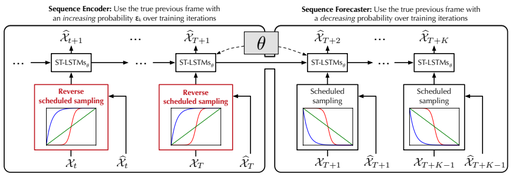
Fig. 5 : In the training phase, we apply the reverse scheduled sampling at the encoding timesteps to force the model to learn long-term dynamics from context frames. This training scheme can be easily combined with the original scheduled sampling strategy, which is used to close the training-inference gap at forecasting timesteps. Both the encoder and the forecaster are parametrized by θ.
원문 · CC BY 4.0 · Yunbo Wang, Haixu Wu, Jianjin Zhang, Zhifeng Gao, Jianmin Wang, Philip S. Yu, Mingsheng Long · PredRNN: A Recurrent Neural Network for Spatiotemporal Predictive Learning · 원문 그림 인용 · 원본 PDF 7쪽에서 그림 영역을 추출했습니다.Moving MNIST에서의 검증 결과
Moving MNIST 고정 학습 세트 실험에서 저자들은 10,000개 샘플로 학습하고 5,000개 시퀀스로 평가했습니다. 입력 10개 프레임으로부터 다음 10개 프레임을 예측하며, MSE, SSIM, LPIPS를 측정했습니다. 이 설정에서 ConvLSTM의 평균 MSE는 103.3이고, 공간-시간 메모리 흐름만 추가한 PredRNN-M-Only는 74.0입니다. ST-LSTM을 사용한 PredRNN은 56.8이며, 메모리 디커플링과 RSS를 함께 적용한 PredRNN-V2는 48.4입니다. 저자들은 PredRNN-V2가 더 큰 ConvLSTM*보다도 효율적이라고 보고합니다. 이 결과는 고정 학습 세트 설정의 결과이며, 동적으로 생성한 학습 데이터에서의 결과는 별도 설정으로 보고됩니다.
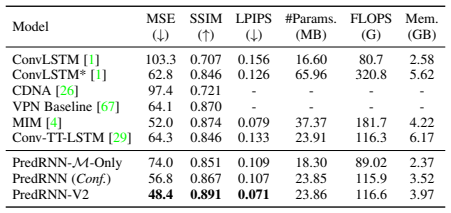
TABLE 2 : Performance on the Moving MNIST test set, averaged over 10 prediction timesteps. All models are trained with a fixed training set of 10,000 sequences. For a fair comparison, we also report the model size and computation efficiency. ConvLSTM* denotes a 4-layer network with a 256-channel hidden state each.
원문 · CC BY 4.0 · Yunbo Wang, Haixu Wu, Jianjin Zhang, Zhifeng Gao, Jianmin Wang, Philip S. Yu, Mingsheng Long · PredRNN: A Recurrent Neural Network for Spatiotemporal Predictive Learning · 원문 그림 인용 · 원본 PDF 8쪽에서 그림 영역을 추출했습니다.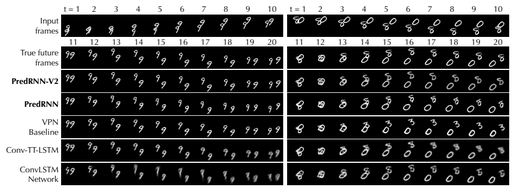
Fig. 8 : Prediction examples on the Moving MNIST test set.
원문 · CC BY 4.0 · Yunbo Wang, Haixu Wu, Jianjin Zhang, Zhifeng Gao, Jianmin Wang, Philip S. Yu, Mingsheng Long · PredRNN: A Recurrent Neural Network for Spatiotemporal Predictive Learning · 원문 그림 인용 · 원본 PDF 9쪽에서 그림 영역을 추출했습니다.레이더 에코와 한계의 범위
레이더 에코 강수 예측에서는 각 시퀀스가 10개 입력 프레임과 10개 출력 프레임으로 구성되며, CSI는 30, 40, 50 dBZ 임계값으로 계산됩니다. 이 설정에서 PredRNN은 MSE 39.1, PredRNN-V2는 MSE 36.4를 보고합니다. 그러나 원문은 레이더 에코의 드문 고강도 영역에서 PredRNN-V2가 희소한 에코의 동역학을 완전히 모델링하지 못한다고 밝힙니다. 따라서 이 결과는 레이더 에코 전체에 대한 완전한 예측 능력을 뜻하지 않으며, 장기 꼬리 분포는 이 논문의 한계로 남습니다.
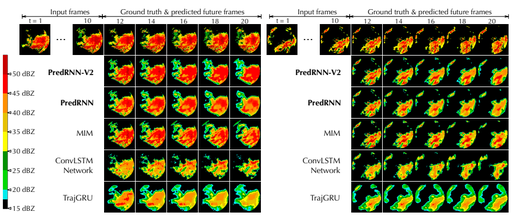
Fig. 14 : Prediction examples on the radar echo test set, in which 10 future frames are generated from the past 10 observations.
원문 · CC BY 4.0 · Yunbo Wang, Haixu Wu, Jianjin Zhang, Zhifeng Gao, Jianmin Wang, Philip S. Yu, Mingsheng Long · PredRNN: A Recurrent Neural Network for Spatiotemporal Predictive Learning · 원문 그림 인용 · 원본 PDF 12쪽에서 그림 영역을 추출했습니다.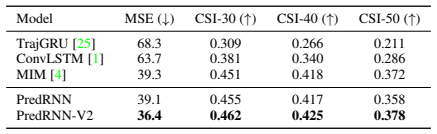
TABLE 8 : Quantitative results on the radar echo dataset.
원문 · CC BY 4.0 · Yunbo Wang, Haixu Wu, Jianjin Zhang, Zhifeng Gao, Jianmin Wang, Philip S. Yu, Mingsheng Long · PredRNN: A Recurrent Neural Network for Spatiotemporal Predictive Learning · 원문 그림 인용 · 원본 PDF 12쪽에서 그림 영역을 추출했습니다.논문 정보
- 저자
- Yunbo Wang, Haixu Wu, Jianjin Zhang, Zhifeng Gao, Jianmin Wang, Philip S. Yu, Mingsheng Long
- 학회·저널
- arXiv · 프리프린트
- 최초 공개일
- 2021년 3월 17일
- 등록일
- 2026년 11월 6일
- 수정일
- 2022년 4월 9일
- 버전
- v4
- arXiv
- 2103.09504
- 분류
- cs.LG · cs.CV
- 원문 이용 조건
- CC BY 4.0
- 제공 범위
- 논문 정보, 해설, 허용된 원문 그림
AI 해설은 논문 원문과 별개의 설명이며 오류가 있을 수 있습니다. 원문과 그림은 각 출처의 이용 조건과 따로 표시된 권리를 따릅니다.
초록
The predictive learning of spatiotemporal sequences aims to generate future images by learning from the historical context, where the visual dynamics are believed to have modular structures that can be learned with compositional subsystems. This paper models these structures by presenting PredRNN, a new recurrent network, in which a pair of memory cells are explicitly decoupled, operate in nearly independent transition manners, and finally form unified representations of the complex environment. Concretely, besides the original memory cell of LSTM, this network is featured by a zigzag memory flow that propagates in both bottom-up and top-down directions across all layers, enabling the learned visual dynamics at different levels of RNNs to communicate. It also leverages a memory decoupling loss to keep the memory cells from learning redundant features. We further propose a new curriculum learning strategy to force PredRNN to learn long-term dynamics from context frames, which can be generalized to most sequence-to-sequence models. We provide detailed ablation studies to verify the effectiveness of each component. Our approach is shown to obtain highly competitive results on five datasets for both action-free and action-conditioned predictive learning scenarios.
원문 인용
Yunbo Wang, Haixu Wu, Jianjin Zhang, Zhifeng Gao, Jianmin Wang, Philip S. Yu, Mingsheng Long (2021). PredRNN: A Recurrent Neural Network for Spatiotemporal Predictive Learning. arXiv:2103.09504v4. https://arxiv.org/abs/2103.09504v4
BibTeX
@misc{wang2021predrnn,
  title = {{PredRNN: A Recurrent Neural Network for Spatiotemporal Predictive Learning}},
  author = {Yunbo Wang and Haixu Wu and Jianjin Zhang and Zhifeng Gao and Jianmin Wang and Philip S. Yu and Mingsheng Long},
  year = {2021},
  eprint = {2103.09504},
  archivePrefix = {arXiv},
  url = {https://arxiv.org/abs/2103.09504v4}
}