논문 해설
Multi-View Causal Discovery without Non-Gaussianity: Identifiability and Algorithms
비가우시안성 없이 다중 관점 인과 발견: 식별 가능성과 알고리즘
- 연구 문제 잡음의 비정규성 가정 없이도 다중뷰 데이터에서 인과 구조를 식별하고 추정할 수 있는지를 다룹니다.
- 연구 방법 뷰들이 공유하는 인과 순서를 2차 통계량 기준으로 재귀적으로 찾고, 이후 뷰별 인과 계수를 일단계 FGLS로 추정합니다.
- 주요 결과 합성 실험에서 제안한 PairwiseLiMVAM과 DirectLiMVAM이 비교 알고리즘보다 낮은 오차를 보였다고 보고되며, MEG 데이터의 중앙값 인과 행렬 안정성은 50회 반복에서 평균 상관 0.67로 측정되었습니다.
다중뷰 데이터에서 인과 구조를 찾는 문제
인과 발견은 관측 변수들 사이의 방향성 있는 영향을 추정하는 문제입니다. 기존 LiNGAM 계열 방법은 잡음이 비정규(non-Gaussian)여야 인과 방향이 식별되므로, 실제 데이터의 잡음이 가우시안에 가까우면 적용이 어렵습니다. 이 논문은 같은 대상을 여러 뷰에서 쌍을 이루어 관측한 다중뷰 데이터에 주목합니다. 뷰 사이의 상관을 식별 정보로 사용하면 잡음 분포에 대한 비정규성 가정을 대신할 수 있는지를 묻습니다.
LiMVAM 모델과 공유 인과 순서
논문은 뷰 i마다 인접 행렬 B_i를 두는 선형 다중뷰 비순환 모델 LiMVAM을 정의합니다. 모든 뷰의 B_i는 같은 인과 순서를 공유하고, 뷰별로는 인과 가중치 T_i만 달라질 수 있습니다. 같은 뷰 안의 잡음 성분은 서로 독립이지만, 서로 다른 뷰의 잡음은 상관될 수 있으며 이 상관이 식별에 사용됩니다.
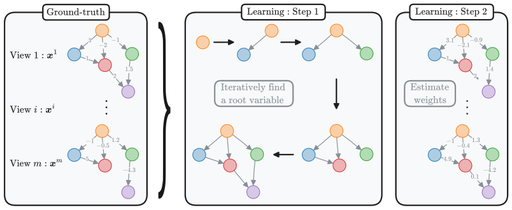
Figure 1 : Left panel: Visual representation of our multi-view LiMV AM model in Eq. 3. Each view of the data is described by a causal graph, nodes represent variables, and disturbances are not illustrated. We see that the causal ordering given by the DAGs is shared over views 1. . . m, but causal weights can differ. Middle and right panels: Main steps of the PairwiseLiMV AM and DirectLiMV AM algorithms. In Step 1, the shared causal ordering is progressively determined. In Step 2, view-specific causal weights are estimated.
원문 · CC BY 4.0 · Ambroise Heurtebise, Omar Chehab, Pierre Ablin, Alexandre Gramfort, Aapo Hyvärinen · Multi-View Causal Discovery without Non-Gaussianity: Identifiability and Algorithms · 원문 그림 인용 · 원본 PDF 4쪽에서 그림 영역을 추출했습니다.재귀 잔차로 인과 순서를 찾는 두 기준
PairwiseLiMVAM은 두 변수의 회귀 잔차로 우도비 기준을 계산하고, DirectLiMVAM은 뷰 전체를 집계한 벡터 사이의 교차공분산 프로베니우스 노름 차이를 기준으로 인과 방향을 고릅니다. 두 방법 모두 방향 점수를 쌓아 루트 변수를 고르고, 그 변수를 회귀로 제거한 잔차에서 같은 과정을 반복하여 공유된 순서를 얻습니다. 이 기준들은 2차 통계량만 사용하며 반복적 최적화를 요구하지 않습니다.
식별 조건과 정리
쌍별 방향 판별은 Assumption 1, 즉 뷰 사이의 상관과 다양성 조건에 의존합니다. 여러 변수로 일반화한 Assumption 2가 성립하면 Theorem 3에 따라 인과 부분 순서와 계수가 식별 가능하며, 통합 그래프에 방향 경로가 충분하다는 Assumption 3이 더해지면 순열 P도 식별됩니다. 이 결과는 주어진 가정 아래의 명제이며, 가정이 성립하지 않는 설정에서 식별을 보장하지 않습니다.
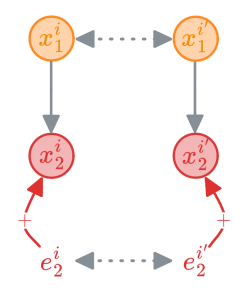
Figure 2 : Example of two views (iandi ′) in the bi- variate case wherex 1 causes
원문 · CC BY 4.0 · Ambroise Heurtebise, Omar Chehab, Pierre Ablin, Alexandre Gramfort, Aapo Hyvärinen · Multi-View Causal Discovery without Non-Gaussianity: Identifiability and Algorithms · 원문 그림 인용 · 원본 PDF 5쪽에서 그림 영역을 추출했습니다.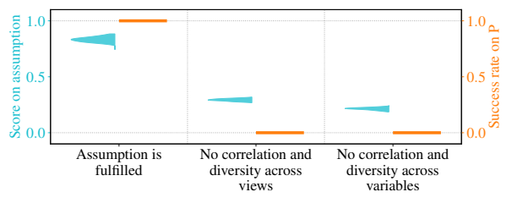
Figure 9 : Proportion of runs in which DirectLiMV AM correctly recovers the causal ordering (orange bars), together with the proposed score evaluating whether Assumption 2 is satisfied (cyan violins). When the assumption holds, the ordering is consistently recovered and the assumption score is high; when the assumption does not hold, the recovery rate and the score are both low.
원문 · CC BY 4.0 · Ambroise Heurtebise, Omar Chehab, Pierre Ablin, Alexandre Gramfort, Aapo Hyvärinen · Multi-View Causal Discovery without Non-Gaussianity: Identifiability and Algorithms · 원문 그림 인용 · 원본 PDF 45쪽에서 그림 영역을 추출했습니다.합성 데이터 비교 결과
합성 실험에서는 표본 수와 잡음 분포를 바꾸며 여섯 알고리즘을 50회 무작위 시드로 비교했습니다. 저자들은 PairwiseLiMVAM과 DirectLiMVAM이 Figure 3 설정에서 다른 비교 알고리즘보다 일관되게 낮은 B_i 오차를 보였다고 보고합니다. 뷰 간 상관이 없는 설정에서도 두 알고리즘을 평가하여 적용 조건을 함께 확인했습니다.
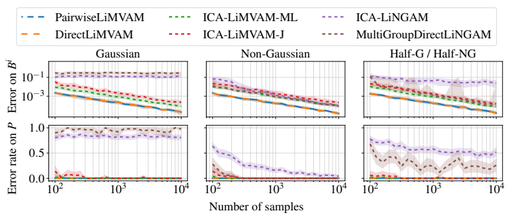
Figure 3 : Separation performance of three recursive residuals algorithms and three ICA-based algorithms. We assume shared disturbances as in Eq. 10. We used 50 different seeds. Lower is better.
원문 · CC BY 4.0 · Ambroise Heurtebise, Omar Chehab, Pierre Ablin, Alexandre Gramfort, Aapo Hyvärinen · Multi-View Causal Discovery without Non-Gaussianity: Identifiability and Algorithms · 원문 그림 인용 · 원본 PDF 10쪽에서 그림 영역을 추출했습니다.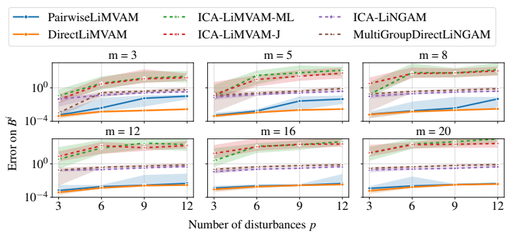
Figure 7 : Separation performance of three pairwise-comparisons-based algorithms — Multi- GroupDirectLiNGAM from Shimizu [34], and DirectLiMV AM and PairwiseLiMV AM which use the criteria in Eq. 5 and Eq. 6, respectively — and three ICA-based algorithms — ICA-LiNGAM, which naively uses Shimizu et al. [36] separately in each view, and our implementation of the two variants of ICA-LiMV AM [6]. We varied the number of views and components. Disturbances are generated using the generalized normal distribution with shape parameterβ∈ {1.5,2,2.5}. The metric used is theℓ 2-distance between true and estimated causal effect matricesB i (lower is better).
원문 · CC BY 4.0 · Ambroise Heurtebise, Omar Chehab, Pierre Ablin, Alexandre Gramfort, Aapo Hyvärinen · Multi-View Causal Discovery without Non-Gaussianity: Identifiability and Algorithms · 원문 그림 인용 · 원본 PDF 43쪽에서 그림 영역을 추출했습니다.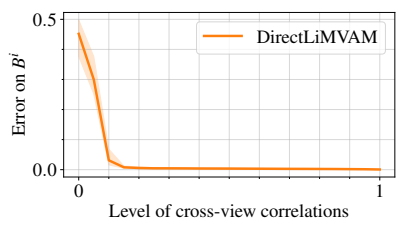
Figure 10 : Performance of DirectLiMV AM under varying levels of cross-view correlation (lower is better). A small amount of cross-view correlation is sufficient for accurate recovery of the adjacency matrices.
원문 · CC BY 4.0 · Ambroise Heurtebise, Omar Chehab, Pierre Ablin, Alexandre Gramfort, Aapo Hyvärinen · Multi-View Causal Discovery without Non-Gaussianity: Identifiability and Algorithms · 원문 그림 인용 · 원본 PDF 46쪽에서 그림 영역을 추출했습니다.MEG 실데이터 적용
MEG 실험은 Cam-CAN 감각운동 과제의 98명 참가자 데이터에 PairwiseLiMVAM을 적용한 사례입니다. 참가자들은 같은 자극을 받으므로 다중뷰 가정과 맞는다고 저자들은 설명합니다. 50회 반복에서 30명씩 무작위로 선택했을 때 중앙값 인과 행렬 간 평균 피어슨 상관은 0.67로 보고됩니다. 이는 특정 데이터와 설정에서의 안정성 측정이며 실제 인과의 확정이 아닙니다.
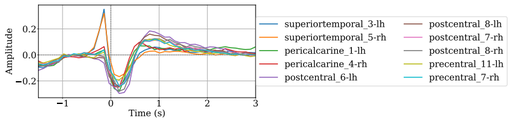
Figure 14 : Example of time series obtained after the preprocessing. We averaged the data across subjects and trials, resulting in 10 time series, one for each brain region.
원문 · CC BY 4.0 · Ambroise Heurtebise, Omar Chehab, Pierre Ablin, Alexandre Gramfort, Aapo Hyvärinen · Multi-View Causal Discovery without Non-Gaussianity: Identifiability and Algorithms · 원문 그림 인용 · 원본 PDF 49쪽에서 그림 영역을 추출했습니다.적용 범위와 한계
이 방법의 식별 결과는 Assumption 2와 Assumption 3, 그리고 공유 인과 순서라는 조건에 기대고 있습니다. 가정이 깨지는 상황에서 식별을 보장하지 않으며, 논문의 실험은 특정 합성 설정과 두 실데이터에 한정됩니다. 따라서 결과를 다른 데이터나 뷰 구조로 일반화하려면 가정의 성립을 별도로 확인해야 합니다.
논문 정보
- 저자
- Ambroise Heurtebise, Omar Chehab, Pierre Ablin, Alexandre Gramfort, Aapo Hyvärinen
- 학회·저널
- arXiv · 프리프린트
- 최초 공개일
- 2025년 2월 27일
- 등록일
- 2026년 10월 29일
- 수정일
- 2026년 10월 22일
- 버전
- v5
- arXiv
- 2502.20115
- 분류
- cs.LG · stat.ML
- 원문 이용 조건
- CC BY 4.0
- 제공 범위
- 논문 정보, 해설, 허용된 원문 그림
AI 해설은 논문 원문과 별개의 설명이며 오류가 있을 수 있습니다. 원문과 그림은 각 출처의 이용 조건과 따로 표시된 권리를 따릅니다.
초록
Causal discovery is a difficult problem that typically relies on strong assumptions on the data-generating model, such as non-Gaussianity. In practice, many modern applications provide multiple related views of the same system, which has rarely been considered for causal discovery. Here, we leverage this multi-view structure to achieve causal discovery with weak assumptions. We propose a multi-view linear Structural Equation Model (SEM) that extends the well-known framework of non-Gaussian disturbances by alternatively leveraging correlation over views. We prove the identifiability of the model for acyclic SEMs. Subsequently, we propose several multi-view causal discovery algorithms, inspired by single-view algorithms (DirectLiNGAM, PairwiseLiNGAM, and ICA-LiNGAM). The new methods are validated through simulations and applications on neuroimaging data, where they enable the estimation of causal graphs between brain regions.
원문 인용
Ambroise Heurtebise, Omar Chehab, Pierre Ablin, Alexandre Gramfort, Aapo Hyvärinen (2025). Multi-View Causal Discovery without Non-Gaussianity: Identifiability and Algorithms. arXiv:2502.20115v5. https://arxiv.org/abs/2502.20115v5
BibTeX
@misc{heurtebise2025multi,
  title = {{Multi-View Causal Discovery without Non-Gaussianity: Identifiability and Algorithms}},
  author = {Ambroise Heurtebise and Omar Chehab and Pierre Ablin and Alexandre Gramfort and Aapo Hyvärinen},
  year = {2025},
  eprint = {2502.20115},
  archivePrefix = {arXiv},
  url = {https://arxiv.org/abs/2502.20115v5}
}