논문 해설
Deep Learning for Survival Analysis: A Review
생존 분석을 위한 딥러닝: 리뷰
- 연구 문제 딥러닝 생존분석 방법은 고차원·비정형 자료에 대응하려는 흐름 속에서 발전했지만, 대부분 우측 중도절단 단일 위험 설정에 머물러 있습니다.
- 연구 방법 Web of Science 검색과 네 가지 제외 기준으로 61개 방법을 선정하고, 추정 방식과 신경망 구조, 지원하는 결과 유형과 특징 측면을 나눠 정리합니다.
- 주요 결과 Cox 기반 방법이 26개로 가장 많고, 많은 방법이 FFNN을 쓰며 경쟁위험·다상태·반복 사건과 시간 의존 효과를 다루는 방법은 상대적으로 적습니다. 다만 자체 보고 벤치마크는 조건이 달라 직접 비교가 어렵습니다.
생존분석과 딥러닝 도입의 배경
생존분석은 사건이 발생하기까지의 시간을 다루며, 중도절단과 절단이 섞인 자료를 편향 없이 추정하는 것이 핵심입니다. 전통적으로는 Kaplan-Meier 추정량과 Cox 비례위험 회귀가 널리 쓰였고, 이후 Random Survival Forest 같은 머신러닝 방법이 예측력을 높였습니다. 1990년대에도 신경망이 생존 자료에 적용되었지만 얕은 구조에 머물렀고, 대부분의 현대 딥러닝 생존 모델은 2010년대 후반 이후 발표되었습니다. 이 논문은 이러한 방법들이 우측 중도절단 단일 위험 같은 일부 과제만 다루는 경우가 많다는 점을 문제로 보고, 딥러닝 기반 생존 방법 61개를 체계적으로 검토합니다.
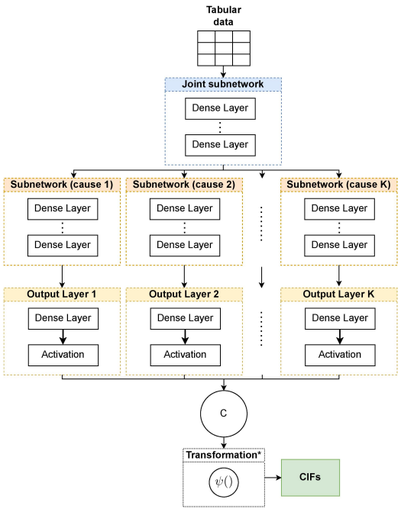
Figure 2 : Schematic neural architecture for competing risks in survival analysis using shared and cause- specific subnetworks. ψ() transforms the model output (e.g., hazard rate) to the final outcome (e.g., cumu- lative incidence functions (CIFs)).
원문 · CC BY 4.0 · Simon Wiegrebe, Philipp Kopper, Raphael Sonabend, Bernd Bischl, Andreas Bender · Deep Learning for Survival Analysis: A Review · 원문 그림 인용 · 원본 PDF 9쪽에서 그림 영역을 추출했습니다.검토 대상 선정과 방법 분류
검토는 Web of Science 검색으로 211편을 찾은 뒤, 새로운 DL 기반 방법인지, 비공개가 아닌 벤치마크 데이터 평가가 있는지, 생존 시간 데이터용 지표를 쓰는지, end-to-end 학습인지의 네 조건으로 걸러 최종 61개 방법을 얻는 절차입니다. 방법들은 추정 방식과 신경망 구조로 나뉩니다. Cox 기반 방법은 log-risk 함수를 신경망으로 매개변수화하고 Cox 부분우도 손실을 최적화하며, 이산 시간 방법은 이산 위험이나 확률질량함수를 신경망으로 추정합니다. DeepSurv는 Cox 회귀의 log-risk를 깊은 FFNN으로 두고 SGD로 최적화하며, Cox-Time은 시간 의존 예측변수를 도입해 시간 의존 효과를 추정하도록 DeepSurv를 확장합니다.
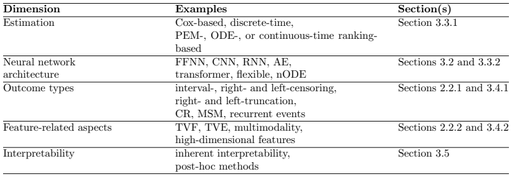
Table 1 : Overview of theoretical and practical dimensions reviewed. PEM: Piecewise Exponential Model; ODE: Ordinary Differential Equation; FFNN: Feed-forward Neural Network; CNN: Convolutional Neural Network; RNN: Recurrent Neural Network; AE: Autoencoder; nODE: neural ODE; CR: Competing Risks; MSM: Multi-state ; TVF: Time-varying Features; TVE: Time-varying Effects.
원문 · CC BY 4.0 · Simon Wiegrebe, Philipp Kopper, Raphael Sonabend, Bernd Bischl, Andreas Bender · Deep Learning for Survival Analysis: A Review · 원문 그림 인용 · 원본 PDF 2쪽에서 그림 영역을 추출했습니다.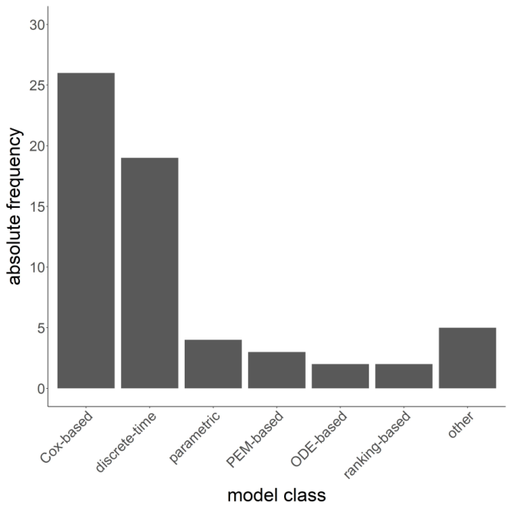
Figure 4 : Absolute frequencies of model classes among all 61 methods reviewed.
원문 · CC BY 4.0 · Simon Wiegrebe, Philipp Kopper, Raphael Sonabend, Bernd Bischl, Andreas Bender · Deep Learning for Survival Analysis: A Review · 원문 그림 인용 · 원본 PDF 11쪽에서 그림 영역을 추출했습니다.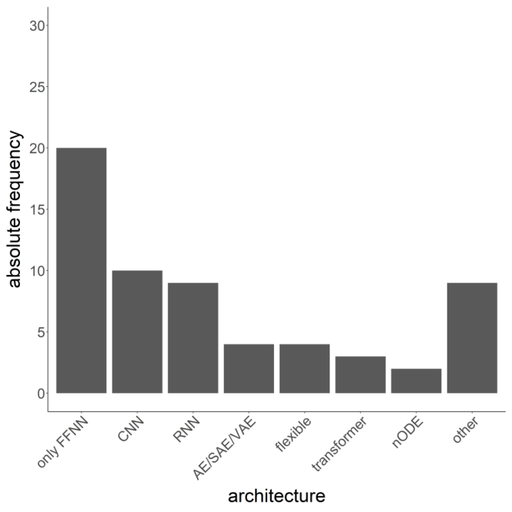
Figure 5 : Absolute frequencies of neural network architectures among all 61 methods reviewed.
원문 · CC BY 4.0 · Simon Wiegrebe, Philipp Kopper, Raphael Sonabend, Bernd Bischl, Andreas Bender · Deep Learning for Survival Analysis: A Review · 원문 그림 인용 · 원본 PDF 16쪽에서 그림 영역을 추출했습니다.비교 가능성의 한계
리뷰 대상 방법들의 벤치마크 결과는 서로 직접 비교하기 어렵다고 원문은 설명합니다. 사용한 데이터셋과 전처리, 결측치 처리가 같지 않고, 리샘플링 전략과 C-index나 Integrated Brier Score 같은 평가 지표의 세부 정의도 명확하지 않거나 서로 다릅니다. 따라서 이 논문은 방법 간 성능 우열을 확정하지 않으며, 중립적 벤치마크 연구가 필요하다고 제시합니다.
남은 과제와 적용 범위
이 논문은 딥러닝 생존 방법의 구조와 자료 측면을 정리했지만, 표본 크기 요구량을 직접 다루는 연구는 아직 거의 없다고 설명합니다. 코드 저장소가 일부 방법에서 공개되지 않았고, 많은 구현이 범용 패키지로 정리되어 있지 않습니다. 또한 여러 방법은 우측 중도절단과 단일 위험 설정에 머물며, 좌측 중도절단과 일부 결과 유형은 드물게 다뤄졌습니다.
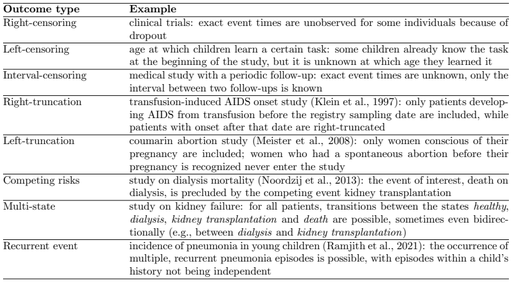
Table 2 : Overview of different outcome types.
원문 · CC BY 4.0 · Simon Wiegrebe, Philipp Kopper, Raphael Sonabend, Bernd Bischl, Andreas Bender · Deep Learning for Survival Analysis: A Review · 원문 그림 인용 · 원본 PDF 4쪽에서 그림 영역을 추출했습니다.논문 정보
- 저자
- Simon Wiegrebe, Philipp Kopper, Raphael Sonabend, Bernd Bischl, Andreas Bender
- 학회·저널
- arXiv · 프리프린트
- 최초 공개일
- 2023년 5월 24일
- 등록일
- 2026년 11월 6일
- 수정일
- 2024년 2월 22일
- 버전
- v4
- arXiv
- 2305.14961
- DOI
- 10.1007/s10462-023-10681-3
- 분류
- stat.ML · cs.LG
- 원문 이용 조건
- CC BY 4.0
- 제공 범위
- 논문 정보, 해설, 허용된 원문 그림
AI 해설은 논문 원문과 별개의 설명이며 오류가 있을 수 있습니다. 원문과 그림은 각 출처의 이용 조건과 따로 표시된 권리를 따릅니다.
초록
The influx of deep learning (DL) techniques into the field of survival analysis in recent years has led to substantial methodological progress; for instance, learning from unstructured or high-dimensional data such as images, text or omics data. In this work, we conduct a comprehensive systematic review of DL-based methods for time-to-event analysis, characterizing them according to both survival- and DL-related attributes. In summary, the reviewed methods often address only a small subset of tasks relevant to time-to-event data - e.g., single-risk right-censored data - and neglect to incorporate more complex settings. Our findings are summarized in an editable, open-source, interactive table: https://survival-org.github.io/DL4Survival. As this research area is advancing rapidly, we encourage community contribution in order to keep this database up to date.
원문 인용
Simon Wiegrebe, Philipp Kopper, Raphael Sonabend, Bernd Bischl, Andreas Bender (2023). Deep Learning for Survival Analysis: A Review. arXiv:2305.14961v4. https://doi.org/10.1007/s10462-023-10681-3
BibTeX
@article{wiegrebe2023deep,
  title = {{Deep Learning for Survival Analysis: A Review}},
  author = {Simon Wiegrebe and Philipp Kopper and Raphael Sonabend and Bernd Bischl and Andreas Bender},
  year = {2023},
  eprint = {2305.14961},
  archivePrefix = {arXiv},
  doi = {10.1007/s10462-023-10681-3},
  url = {https://arxiv.org/abs/2305.14961v4}
}