논문 해설
Pivoting Factorization: A Compact Meta Low-Rank Representation of Sparsity for Efficient Inference in Large Language Models
피벗 분해: 대규모 언어 모델의 효율적 추론을 위한 희소성의 컴팩트한 메타 저랭크 표현
- 연구 문제 저랭크 가지치기는 GPU 호환성은 높지만 같은 밀도의 반구조적 가지치기보다 perplexity 격차가 크다는 문제가 있습니다.
- 연구 방법 PIFA는 저랭크 특이 행렬에서 선형 독립 피벗 행을 고르고 나머지 행을 계수 행렬로 표현하며, M은 밀집 흐름과 저랭크 흐름을 섞은 목표로 오차 누적을 줄입니다.
- 주요 결과 MPIFA는 WikiText2에서 여러 저랭크 기준선보다 낮은 perplexity를 보이고, PIFA 층은 r/d = 0.5에서 메모리 24.2%와 추론 시간 24.6%를 줄입니다.
저랭크 가지치기의 정보 중복 문제
대규모 언어 모델의 메모리와 계산 비용을 줄이기 위해 가중치 행렬을 저랭크 형태로 근사하는 방법이 연구되어 왔습니다. 저랭크 가지치기는 어떤 GPU에서나 텐서 모양을 유지한 채 임의의 밀도로 사용할 수 있다는 장점이 있지만, 같은 밀도의 반구조적 가지치기보다 perplexity가 약 2배 높아지는 성능 격차가 보고되어 있습니다. 원문은 이 격차의 주요 원인으로 두 가지를 듭니다. 첫째는 저랭크 분해가 분해된 가중치 행렬에 정보 중복을 남긴다는 점이고, 둘째는 기존 재구성 방법이 층을 거치며 오차를 누적한다는 점입니다.
이 논문은 첫 번째 문제를 다루기 위해 Pivoting Factorization(PIFA)을 제안합니다. PIFA는 저랭크 표현에서 선형 독립인 행을 피벗 행으로 고르고, 나머지 행을 피벗 행의 선형결합으로 표현하여 추가 손실 없이 파라미터를 줄이는 메타 저랭크 표현입니다.
피벗 행으로 중복을 줄이는 PIFA
PIFA의 입력은 저랭크 분해 U ∈ R^{m×r}와 V^T ∈ R^{r×n}의 곱으로 얻는 특이 행렬 W′ = UV^T입니다. W′의 랭크는 r이므로 선형 독립인 r개의 행, 즉 피벗 행이 존재합니다. 피벗 행의 인덱스는 피벗 기반 QR 또는 LU 분해로 찾습니다.
피벗 행 행렬을 W_p, 나머지 행 행렬을 W_np라고 하면 원문은 W_np = C W_p를 정의합니다. 여기서 C ∈ R^{(m−r)×r}는 계수 행렬입니다. 추론 시에는 입력 X에 W_p를 곱해 피벗 출력을 얻고, C를 곱해 비피벗 출력을 얻은 뒤 원래 행 순서대로 배치합니다. 저장해야 하는 값은 인덱스 I, W_p, C이며, 원문은 이를 r(m+n) − r² + r개의 파라미터로 계산합니다. 원래 저랭크 표현의 r(m+n)에 비해 r² − r만큼 적습니다.
이 절감은 저랭크 인수의 직교 제약이 만드는 자유도 감소를 활용한 것입니다. 원문은 이 구조가 LU 분해의 사다리꼴 비영 파라미터 분포와 달리 직사각형 형태로 정리되어 GPU 저장과 계산에 유리하다고 설명합니다.
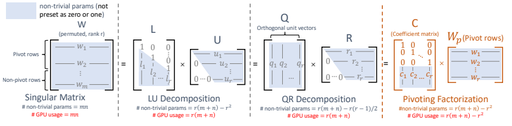
Figure 3 : Pivoting Factorization vs. LU and QR decompositions. Applied to the permuted matrix (pivot rows at the top), Pivoting Factorization avoids the trapezoidal distribution of non-trivial parameters in LU decomposition, instead reorganizing them into a rectangular pattern. This structure optimizes GPU memory usage and reduces computation overhead.
원문 · CC BY 4.0 · Jialin Zhao, Yingtao Zhang, Carlo Vittorio Cannistraci · Pivoting Factorization: A Compact Meta Low-Rank Representation of Sparsity for Efficient Inference in Large Language Models · 원문 그림 인용 · 원본 PDF 5쪽에서 그림 영역을 추출했습니다.오차 누적을 줄이는 온라인 재구성 M
재구성 단계는 SVD-LLM의 truncation-aware 데이터 화이트닝 가지치기로 얻은 U와 V^T를 정제합니다. 기존 SVD-LLM의 재구성은 보정 데이터 X 전체를 GPU 메모리에 올려야 하므로 보정 샘플 수에 제약이 있습니다. 이 논문은 XX^T를 샘플별로 누적하는 온라인 형태로 식을 바꾸어 메모리 사용을 샘플 수와 무관하게 만듭니다.
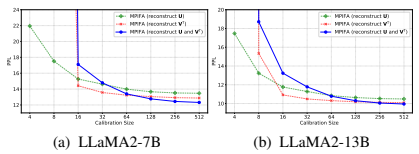
Figure 6 : Impact of calibration sample size. On MPIFA with 0.5 density, reconstructing both U and VT is more sensitive to the number of calibration samples than recon- structing only U.
원문 · CC BY 4.0 · Jialin Zhao, Yingtao Zhang, Carlo Vittorio Cannistraci · Pivoting Factorization: A Compact Meta Low-Rank Representation of Sparsity for Efficient Inference in Large Language Models · 원문 그림 인용 · 원본 PDF 9쪽에서 그림 영역을 추출했습니다.또한 원문은 저랭크 데이터 흐름만 재구성 목표로 쓰면 이전 층의 누적 오차가 전파된다고 지적합니다. 이에 대해 M은 밀집 데이터 흐름 출력 WX_o와 저랭크 데이터 흐름 출력 WX_u를 혼합 비율 λ로 섞은 목표 Y_t = λWX_o + (1−λ)WX_u를 사용합니다. 저자들은 밀집 흐름만 사용하면 보정 데이터에 과적합되기 쉽다고 해석하며, 저랭크 흐름은 이 과적합을 억제하는 정규화 역할을 한다고 설명합니다. 원문은 λ = 0.25를 사용합니다. V^T도 닫힌 형태의 최소제곱 해로 함께 갱신하며, 이 갱신을 위해 부록 A는 직접 최적화와 두 단계 최적화가 같은 해를 준다고 증명합니다.
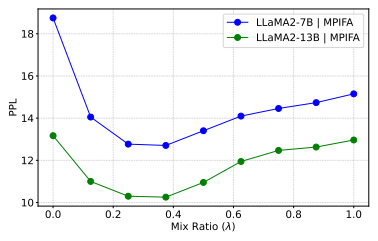
Figure 5 : Impact of mix ratio. With 0.5 density, MPIFA achieves lowest PPL when the mix ratio λ in Equation 7 is around 0.25.
원문 · CC BY 4.0 · Jialin Zhao, Yingtao Zhang, Carlo Vittorio Cannistraci · Pivoting Factorization: A Compact Meta Low-Rank Representation of Sparsity for Efficient Inference in Large Language Models · 원문 그림 인용 · 원본 PDF 8쪽에서 그림 영역을 추출했습니다.MPIFA의 perplexity 검증
MPIFA는 M으로 U와 V^T를 재구성한 뒤 PIFA로 W′ = U_rV^T_r을 압축하는 재학습 없는 저랭크 가지치기 프레임워크입니다. 원문은 WikiText2를 보정과 perplexity 평가에 사용하고, 모든 실험의 시퀀스 길이를 2048 토큰으로 둡니다. 비교 기준은 ASVD, SVD-LLM과 기본 SVD입니다. 밀도 0.4에서 0.9까지 비교하며, 밀도는 원래 모델 대비 남은 파라미터의 비율입니다.
표 2에 따르면 MPIFA는 LLaMA2-7B, LLaMA2-13B, LLaMA2-70B, LLaMA3-8B에서 perplexity gap을 평균 66.4%, 53.8%, 40.7%, 72.7% 줄입니다. 여기서 perplexity gap은 저랭크 가지치기 방법과 원래 모델의 perplexity 차이입니다. LLaMA2-70B에서는 U만 재구성하고 다른 모델은 U와 V^T를 모두 재구성합니다. 이 결과는 WikiText2 perplexity 기준이며, 제로샷 정확도나 다른 데이터셋의 결과로 바로 확장되지 않습니다.
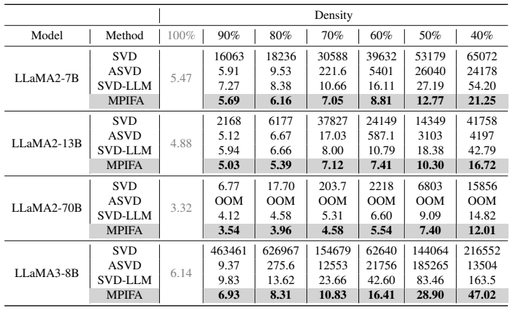
Table 2 : Perplexity (↓) at different parameter density (proportion of remaining parameters relative to the original model) on WikiText2. The best-performing method is highlighted in bold.
원문 · CC BY 4.0 · Jialin Zhao, Yingtao Zhang, Carlo Vittorio Cannistraci · Pivoting Factorization: A Compact Meta Low-Rank Representation of Sparsity for Efficient Inference in Large Language Models · 원문 그림 인용 · 원본 PDF 7쪽에서 그림 영역을 추출했습니다.반구조적 가지치기와의 비교
MPIFA는 반구조적 가지치기와 같은 메모리 절감 조건에서도 비교되었습니다. 원문은 16비트 연산에서 2:4 희소성이 약 44%의 GPU 메모리 절감을 가져온다고 인용하며, 이에 맞춰 MPIFA를 0.55 밀도로 비교합니다. 비교 대상은 Magnitude, Wanda, RIA의 2:4 가지치기이며, 이 조건에서 MPIFANS는 비균일 희소성을 사용합니다.
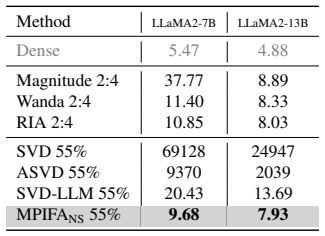
Table 3 : Perplexity (↓) comparison with semi-structured pruning under the same memory reduction on WikiText2. The best performance pruning method is indicated in bold. MPIFANS means MPIFA using non-uniform sparsity.
원문 · CC BY 4.0 · Jialin Zhao, Yingtao Zhang, Carlo Vittorio Cannistraci · Pivoting Factorization: A Compact Meta Low-Rank Representation of Sparsity for Efficient Inference in Large Language Models · 원문 그림 인용 · 원본 PDF 7쪽에서 그림 영역을 추출했습니다.결과는 LLaMA2-7B에서 perplexity gap을 21.7%, LLaMA2-13B에서 3.2% 줄이는 것입니다. 이 차이는 LLaMA2-13B에서 작아, 모델 크기에 따라 이득의 폭이 다름을 보여 줍니다. 또한 fine-tuning 후 표 4에서 MPIFANS 55%는 LLaMA2-7B에서 6.34의 perplexity를 보고합니다.
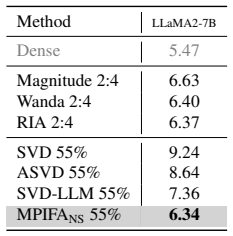
Table 4 : Perplexity (↓) of pruned models after fine-tuning on WikiText2 (LLaMA2-7B). The best-performance prun- ing method is indicated in bold.
원문 · CC BY 4.0 · Jialin Zhao, Yingtao Zhang, Carlo Vittorio Cannistraci · Pivoting Factorization: A Compact Meta Low-Rank Representation of Sparsity for Efficient Inference in Large Language Models · 원문 그림 인용 · 원본 PDF 7쪽에서 그림 영역을 추출했습니다.PIFA 층의 메모리와 추론 속도
PIFA 층은 같은 랭크의 저랭크 층과 비교되었습니다. 그림 7의 조건은 시퀀스 길이 2048, 배치 크기 32, 차원 8192, A6000 GPU입니다. 원문은 r/d = 0.5에서 PIFA 층이 저랭크 층의 메모리를 24.2% 줄이고 추론 시간을 24.6% 줄인다고 보고합니다.
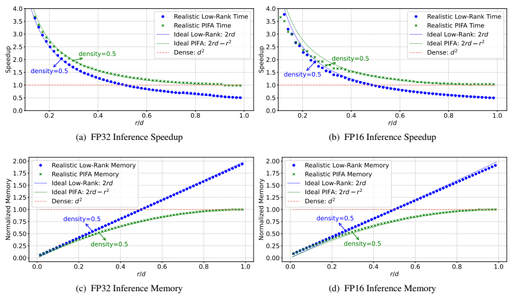
Figure 7 : Efficiency of PIFA layer under various ranks, with sequence length = 2048, batch size = 32, and dimension = 8192 on FP32 and FP16 on A6000 GPU. At 50% density, PIFA achieves47.6% memory savings and 1.95× speedup on FP32. These results guarantee that the overhead of both time and memory of the PIFA layer is quite low.
원문 · CC BY 4.0 · Jialin Zhao, Yingtao Zhang, Carlo Vittorio Cannistraci · Pivoting Factorization: A Compact Meta Low-Rank Representation of Sparsity for Efficient Inference in Large Language Models · 원문 그림 인용 · 원본 PDF 13쪽에서 그림 영역을 추출했습니다.층 단위 비교에서 PIFA 55%는 FP16에서 차원 4096부터 32768까지 2:4 CUTLASS, cuSPARSELt 구현과 비교됩니다. d = 32768에서 PIFA 55%는 A6000에서 2.10배의 속도 향상을 보입니다. 같은 조건에서 2:4 CUTLASS는 0.79배로 밀집 층보다 느립니다. cuSPARSELt는 32768×32768 행렬에서 CUDA 오류를 보고합니다. 이 결과들은 특정 GPU와 층 크기의 측정이며 end-to-end 모델 속도와 같은 결과로 해석되지 않습니다.
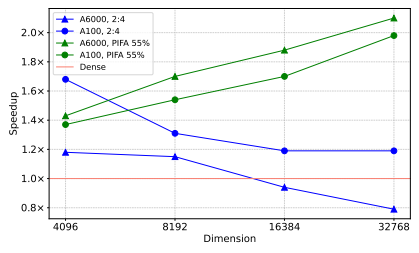
Figure 4 : Layerwise speedup of the PIFA layer and semi- sparse layers across various dimensions, compared to dense linear layers on the same GPU, with a sequence length of 2048 and a batch size of 32, using FP16 (FP32 is not sup- ported by 2:4 sparsity in torch.sparse). PIFA shows increasing speedup as the dimension grows. Detailed values are provided in Table 6.
원문 · CC BY 4.0 · Jialin Zhao, Yingtao Zhang, Carlo Vittorio Cannistraci · Pivoting Factorization: A Compact Meta Low-Rank Representation of Sparsity for Efficient Inference in Large Language Models · 원문 그림 인용 · 원본 PDF 8쪽에서 그림 영역을 추출했습니다.재구성과 PIFA의 구성요소 기여
절제 실험은 SVD-LLM의 가지치기만 사용한 W, 전체 배치 재구성을 더한 W + U, 온라인 재구성 M을 더한 W + M, 그리고 PIFA까지 적용한 W + M + PIFA를 비교합니다. 이 실험은 LLaMA2-7B, LLaMA2-13B, LLaMA2-70B, LLaMA3-8B에서 100%부터 40%까지의 밀도로 수행됩니다.
원문은 전체 배치 재구성 W + U가 가지치기만 한 W보다 perplexity를 악화시키는 경우가 있다고 보고합니다. 반면 W + M은 모든 모델과 밀도에서 W와 W + U보다 낮은 perplexity를 보입니다. PIFA를 추가한 W + M + PIFA는 모든 설정에서 가장 낮은 값을 보입니다. 이 결과는 M이 오차 누적을 줄이고 PIFA가 추가 손실 없이 파라미터를 줄인다는 해석을 지지하지만, 개별 구성요소가 모든 조건에서 개선만 준다는 뜻으로 확장되지 않습니다.
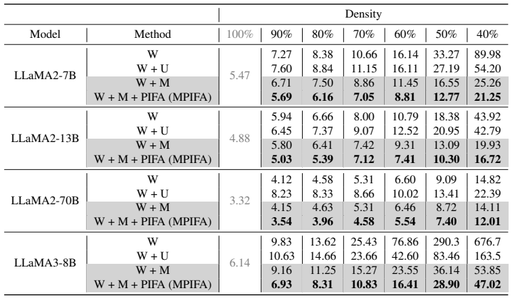
Table 5 : Ablation: Impact of PIFA and M on perplexity (↓) across parameter densities. on WikiText2. W denotes using SVD-LLM’s pruning only; W + U denotes using SVD-LLM’s pruning and full-batch reconstruction; W + M denotes using our Online Error-Accumulation-Minimization Reconstruction, which incorporates SVD-LLM’s pruning as the initial step; W + M + PIFA denotes using Online Error-Accumulation-Minimization Reconstruction followed by PIFA, i.e., MPIFA.
원문 · CC BY 4.0 · Jialin Zhao, Yingtao Zhang, Carlo Vittorio Cannistraci · Pivoting Factorization: A Compact Meta Low-Rank Representation of Sparsity for Efficient Inference in Large Language Models · 원문 그림 인용 · 원본 PDF 9쪽에서 그림 영역을 추출했습니다.적용 범위와 한계
이 방법은 행렬 자체의 랭크를 줄이지 못합니다. 따라서 PIFA는 SVD 같은 저랭크 압축 방법과 함께 적용해야 하며, 독립적인 압축 기법으로 쓰이지 않습니다. 원문은 이 점을 PIFA의 적용 조건으로 명시합니다.
또한 보정 샘플 수에 따라 역행렬의 수치 안정성이 달라집니다. 원문 그림 8은 첫 층의 조건수가 샘플 수가 늘수록 줄어든다고 보고합니다. 부록 B.2의 MPIFANS는 512개의 보정 샘플을 사용하며, 원문에서 비균일 희소성 변형은 모듈 밀도 결정에 추가 탐색을 포함합니다. 반면 학습 효율과 pre-training 적용은 향후 과제로 제시됩니다.
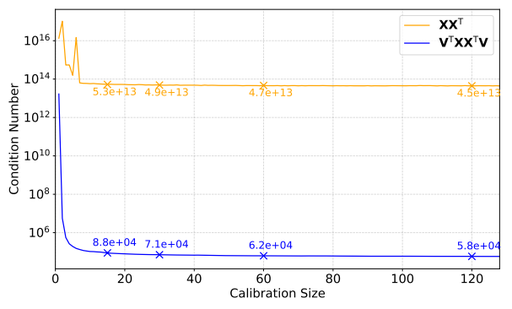
Figure 8 : Condition number. Condition numbers of VTXXTV (Equation 5) and XXT (Equation 8) for the first layer of LLaMA2-7B, whose inverses are used in reconstructing U and VT. Larger calibration sizes reduce condition numbers, enhancing numerical stability and lowering perplexity.
원문 · CC BY 4.0 · Jialin Zhao, Yingtao Zhang, Carlo Vittorio Cannistraci · Pivoting Factorization: A Compact Meta Low-Rank Representation of Sparsity for Efficient Inference in Large Language Models · 원문 그림 인용 · 원본 PDF 14쪽에서 그림 영역을 추출했습니다.논문 정보
- 저자
- Jialin Zhao, Yingtao Zhang, Carlo Vittorio Cannistraci
- 학회·저널
- arXiv · 프리프린트
- 최초 공개일
- 2025년 1월 31일
- 등록일
- 2026년 10월 29일
- 수정일
- 2025년 8월 13일
- 버전
- v3
- arXiv
- 2501.19090
- 분류
- cs.LG
- 원문 이용 조건
- CC BY 4.0
- 제공 범위
- 논문 정보, 해설, 허용된 원문 그림
AI 해설은 논문 원문과 별개의 설명이며 오류가 있을 수 있습니다. 원문과 그림은 각 출처의 이용 조건과 따로 표시된 권리를 따릅니다.
초록
The rapid growth of Large Language Models has driven demand for effective model compression techniques to reduce memory and computation costs. Low-rank pruning has gained attention for its GPU compatibility across all densities. However, low-rank pruning struggles to match the performance of semi-structured pruning, often doubling perplexity at similar densities. In this paper, we propose Pivoting Factorization (PIFA), a novel lossless meta low-rank representation that unsupervisedly learns a compact form of any low-rank representation, effectively eliminating redundant information. PIFA identifies pivot rows (linearly independent rows) and expresses non-pivot rows as linear combinations, achieving 24.2% additional memory savings and 24.6% faster inference over low-rank layers at rank = 50% of dimension. To mitigate the performance degradation caused by low-rank pruning, we introduce a novel, retraining-free reconstruction method that minimizes error accumulation (M). MPIFA, combining M and PIFA into an end-to-end framework, significantly outperforms existing low-rank pruning methods, and achieves performance comparable to semi-structured pruning, while surpassing it in GPU efficiency and compatibility. Our code is available at https://github.com/biomedical-cybernetics/pivoting-factorization.
원문 인용
Jialin Zhao, Yingtao Zhang, Carlo Vittorio Cannistraci (2025). Pivoting Factorization: A Compact Meta Low-Rank Representation of Sparsity for Efficient Inference in Large Language Models. arXiv:2501.19090v3. https://arxiv.org/abs/2501.19090v3
BibTeX
@misc{zhao2025pivoting,
  title = {{Pivoting Factorization: A Compact Meta Low-Rank Representation of Sparsity for Efficient Inference in Large Language Models}},
  author = {Jialin Zhao and Yingtao Zhang and Carlo Vittorio Cannistraci},
  year = {2025},
  eprint = {2501.19090},
  archivePrefix = {arXiv},
  url = {https://arxiv.org/abs/2501.19090v3}
}