논문 해설
Sub-Sequential Physics-Informed Learning with State Space Model
상태 공간 모델을 활용한 서브시퀀셜 물리 정보 학습
- 연구 문제 PINN은 초기 조건의 패턴을 시간 방향으로 전파하지 못하고 과도하게 평활화된 해로 실패하는 경우가 있습니다.
- 연구 방법 PINNMamba는 콜로케이션 점마다 시간 부분열을 만들고, Selective SSM 블록으로 부분열을 인코딩한 뒤 부분열 간 예측을 대조 정렬합니다.
- 주요 결과 convection, reaction, wave 방정식의 주요 비교에서 PINNMamba는 제시된 기준선보다 낮은 rMAE를 보고합니다. 다만 이 결과는 해당 실험 설정에서의 결과입니다.
PINN 실패 모드와 연구 질문
PINN은 신경망 uθ(x, t)을 PDE 잔차 손실로 학습해 PDE의 수치해를 근사합니다. 그러나 원문은 초기 조건에서 정해진 패턴이 시간 방향으로 전파되지 못하고 점차 왜곡되는 실패 모드가 나타난다고 보고합니다. 이 논문은 실패 원인을 두 가지로 봅니다. 하나는 PDE의 연속성과 PINN 학습에서 이산적으로 샘플링된 콜로케이션 점 사이의 Continuous-Discrete Mismatch이고, 다른 하나는 신경망의 simplicity bias로 인해 과도하게 평활화된 해가 손실을 0 근처로 낮추는 현상입니다. 저자들은 이 두 원인을 완화하는 구조로 State Space Model과 부분열 정렬을 결합하는 방향을 제안합니다.
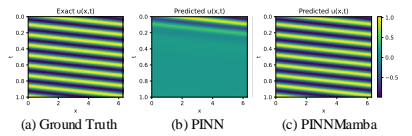
Figure 1 . PINN gradually distorts on convection equation.
원문 · CC BY 4.0 · Chenhui Xu, Dancheng Liu, Yuting Hu, Jiajie Li, Ruiyang Qin, Qingxiao Zheng, Jinjun Xiong · Sub-Sequential Physics-Informed Learning with State Space Model · 원문 그림 인용 · 원본 PDF 1쪽에서 그림 영역을 추출했습니다.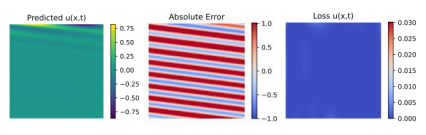
Figure 2 . Failure mode of PINN on convection equation, the over- smooth solution brings the losses down to 0 almost everywhere.
원문 · CC BY 4.0 · Chenhui Xu, Dancheng Liu, Yuting Hu, Jiajie Li, Ruiyang Qin, Qingxiao Zheng, Jinjun Xiong · Sub-Sequential Physics-Informed Learning with State Space Model · 원문 그림 인용 · 원본 PDF 3쪽에서 그림 영역을 추출했습니다.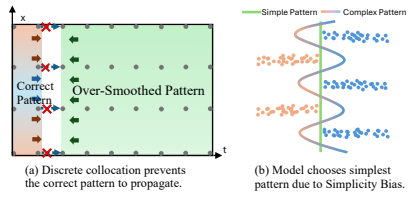
Figure 3 . The correct Pattern determined by the initial conditions faces two resistances in propagation: (a) the difficulty of propa- gating information directly through the gradient among discrete collocation points, and (b) the need to fight against over-smoothed solutions with near-zero loss caused by simplicity bias.
원문 · CC BY 4.0 · Chenhui Xu, Dancheng Liu, Yuting Hu, Jiajie Li, Ruiyang Qin, Qingxiao Zheng, Jinjun Xiong · Sub-Sequential Physics-Informed Learning with State Space Model · 원문 그림 인용 · 원본 PDF 4쪽에서 그림 영역을 추출했습니다.SSM 기반 시간 전파와 부분열 정렬
PINNMamba는 각 콜로케이션 점 (x, t)에 대해 k−1개의 시간 후속 점을 포함한 부분열 X(x, t)를 만듭니다. 부분열의 각 토큰은 MLP 기반 Spatio-Temporal Embedding으로 고차원 표현이 되고, Conv, Selective SSM, Wavelet 활성화를 포함한 PINNMamba 블록을 거쳐 부분열 예측으로 바뀝니다. 부분열의 첫 번째 예측은 해당 콜로케이션 점의 출력으로 쓰이며, 나머지 예측은 같은 점이 여러 부분열에서 만든 값을 정렬하는 데 쓰입니다. 정렬 손실 Lalig는 각 부분열의 예측을 마지막 부분열 예측과 비교해 시간 방향의 패턴 전파를 돕습니다. 저자들은 시간 가변 SSM에서 같은 점이 서로 다른 시간 위치의 부분열에 들어가므로 예측이 자연스럽게 다양해지고, 이 다양한 예측을 대조 정렬로 합의시키면 단순성 편향을 줄일 수 있다고 해석합니다.
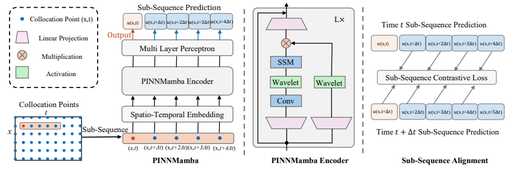
Figure 4 . PINNMamba Overview. PINNMamba takes the sub-sequence as input which is a composite of several consecutive collocation points on the time axis. For each sub-sequence, the prediction of the first collocation point is taken as the output of PINNMamba, while the others are used to align the prediction of different sub-sequences, that can propagate information among time coordinates.
원문 · CC BY 4.0 · Chenhui Xu, Dancheng Liu, Yuting Hu, Jiajie Li, Ruiyang Qin, Qingxiao Zheng, Jinjun Xiong · Sub-Sequential Physics-Informed Learning with State Space Model · 원문 그림 인용 · 원본 PDF 5쪽에서 그림 영역을 추출했습니다.주요 비교 결과와 적용 범위
주요 실험은 convection, reaction, wave 방정식에서 101×101 균일 격자로 콜로케이션 점을 샘플링하고 PINN, QRes, PINNsFormer, KAN과 비교합니다. 모든 모델은 1000 epoch 동안 L-BFGS로 학습되며, PINNMamba의 부분열 길이는 7입니다. 표 1에서 convection 방정식의 rMAE는 PINN 0.8514, PINNsFormer 0.4527, PINNMamba 0.0188로 보고됩니다. 이 값은 해당 설정과 지표에서 얻은 결과이며 다른 과제나 데이터로 일반화된 결과는 아닙니다. 초록은 최신 구조 대비 오차를 최대 86.3%까지 줄인다고 보고하지만, 이 수치의 기준선과 조건은 초록 원문에 기반합니다.
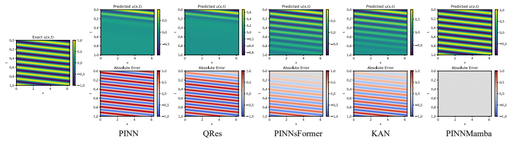
Figure 6 . The ground truth solution, prediction (top), and absolute error (bottom) on convection equations.
원문 · CC BY 4.0 · Chenhui Xu, Dancheng Liu, Yuting Hu, Jiajie Li, Ruiyang Qin, Qingxiao Zheng, Jinjun Xiong · Sub-Sequential Physics-Informed Learning with State Space Model · 원문 그림 인용 · 원본 PDF 7쪽에서 그림 영역을 추출했습니다.
Table 1 . Results for solving convection, reaction, and wave equations.
원문 · CC BY 4.0 · Chenhui Xu, Dancheng Liu, Yuting Hu, Jiajie Li, Ruiyang Qin, Qingxiao Zheng, Jinjun Xiong · Sub-Sequential Physics-Informed Learning with State Space Model · 원문 그림 인용 · 원본 PDF 8쪽에서 그림 영역을 추출했습니다.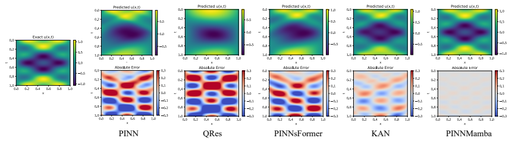
Figure 7 . The ground truth solution, prediction (top), and absolute error (bottom) on wave equations.
원문 · CC BY 4.0 · Chenhui Xu, Dancheng Liu, Yuting Hu, Jiajie Li, Ruiyang Qin, Qingxiao Zheng, Jinjun Xiong · Sub-Sequential Physics-Informed Learning with State Space Model · 원문 그림 인용 · 원본 PDF 8쪽에서 그림 영역을 추출했습니다.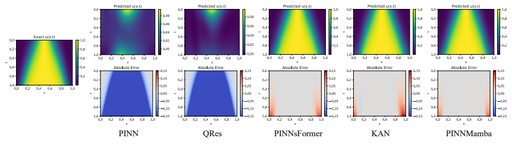
Figure 8 . The ground truth solution, prediction (top), and absolute error (bottom) on reaction equations.
원문 · CC BY 4.0 · Chenhui Xu, Dancheng Liu, Yuting Hu, Jiajie Li, Ruiyang Qin, Qingxiao Zheng, Jinjun Xiong · Sub-Sequential Physics-Informed Learning with State Space Model · 원문 그림 인용 · 원본 PDF 9쪽에서 그림 영역을 추출했습니다.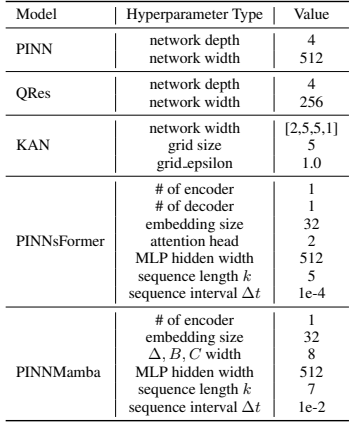
Table 4 . Hyperparameters for main results.
원문 · CC BY 4.0 · Chenhui Xu, Dancheng Liu, Yuting Hu, Jiajie Li, Ruiyang Qin, Qingxiao Zheng, Jinjun Xiong · Sub-Sequential Physics-Informed Learning with State Space Model · 원문 그림 인용 · 원본 PDF 17쪽에서 그림 영역을 추출했습니다.구성요소 절제와 결합 실험
절제 실험은 Sub-sequence alignment 제거, 긴 시퀀스로의 대체, Time-Varying SSM을 선형 시불변 구조로 바꾼 변형, SSM을 MLP로 대체한 변형, Wavelet을 Tanh로 바꾼 변형을 PINNMamba와 비교합니다. convection 방정식에서 PINNMamba의 rMAE 0.0188은 sub-sequence alignment 제거 시 0.1436으로 증가합니다. 이 결과는 정렬 구성요소를 유지하는 효용을 보여 주며, 모든 구성요소가 항상 유익하다는 결론을 뜻하지 않습니다. 또한 RoPINN을 결합하면 본문 기준으로 convection과 wave 방정식에서 PINNMamba의 오차가 약 40% 줄어듭니다.
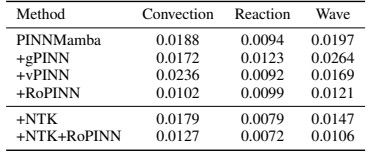
Table 2 . Integrating PINNMamba with advanced training strategies and loss auto-balancing strategy. The rMAE is reported here.
원문 · CC BY 4.0 · Chenhui Xu, Dancheng Liu, Yuting Hu, Jiajie Li, Ruiyang Qin, Qingxiao Zheng, Jinjun Xiong · Sub-Sequential Physics-Informed Learning with State Space Model · 원문 그림 인용 · 원본 PDF 8쪽에서 그림 영역을 추출했습니다.
Table 8 . Results with different activation function in PINNmamba.
원문 · CC BY 4.0 · Chenhui Xu, Dancheng Liu, Yuting Hu, Jiajie Li, Ruiyang Qin, Qingxiao Zheng, Jinjun Xiong · Sub-Sequential Physics-Informed Learning with State Space Model · 원문 그림 인용 · 원본 PDF 18쪽에서 그림 영역을 추출했습니다.계산 비용과 부분열 길이 민감도
계산 비용은 H100 GPU에서 convection 방정식을 학습할 때 측정됩니다. 표 5에서 PINNMamba는 7899 MB 메모리와 1.99 s/it의 학습 시간을 보고하며, PINNsFormer는 8703 MB와 1.82 s/it를 보고합니다. 부분열 길이 민감도 표에서 convection 방정식은 k=5의 rMAE 0.0092가 k=7의 0.0188보다 낮지만, 본문 주요 실험은 k=7을 사용합니다. 이는 과제마다 최적 길이가 다를 수 있음을 보여 주며, 민감도 실험에서 부분열 간격은 1e-2로 고정되어 있습니다.
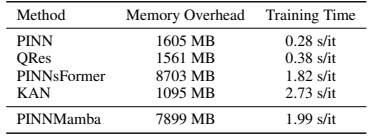
Table 5 . Memory overhead and training time on H100 GPU for solving convection equation.
원문 · CC BY 4.0 · Chenhui Xu, Dancheng Liu, Yuting Hu, Jiajie Li, Ruiyang Qin, Qingxiao Zheng, Jinjun Xiong · Sub-Sequential Physics-Informed Learning with State Space Model · 원문 그림 인용 · 원본 PDF 18쪽에서 그림 영역을 추출했습니다.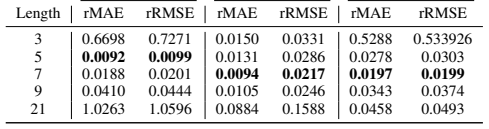
Table 6 . Results with different Sub-Sequence Length of PINNmamba.
원문 · CC BY 4.0 · Chenhui Xu, Dancheng Liu, Yuting Hu, Jiajie Li, Ruiyang Qin, Qingxiao Zheng, Jinjun Xiong · Sub-Sequential Physics-Informed Learning with State Space Model · 원문 그림 인용 · 원본 PDF 18쪽에서 그림 영역을 추출했습니다.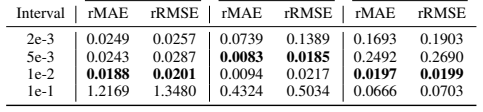
Table 7 . Results with different Sub-Sequence Interval of PINNmamba, k is set to 7.
원문 · CC BY 4.0 · Chenhui Xu, Dancheng Liu, Yuting Hu, Jiajie Li, Ruiyang Qin, Qingxiao Zheng, Jinjun Xiong · Sub-Sequential Physics-Informed Learning with State Space Model · 원문 그림 인용 · 원본 PDF 18쪽에서 그림 영역을 추출했습니다.PINNacle 적용과 한계
복잡한 문제에 대한 일반화를 보기 위해 PINNacle 벤치마크와 2-D Navier-Stokes 방정식에서도 평가합니다. 원문은 PINNacle의 16개 문제 중 PINNMamba를 6개 문제에서만 테스트했다고 밝힙니다. 나머지 문제는 시퀀스 기반 모델이 H100 GPU에서도 메모리 부족을 일으켜 제외되었습니다. 따라서 PINNMamba는 시퀀스 기반 방법의 메모리 제약을 받으며, 이는 저자들이 밝힌 주요 한계입니다. Navier-Stokes 압력 예측에서는 초기 조건 정보가 없어 단일 콜로케이션 점을 정렬에 사용했다고 설명합니다.
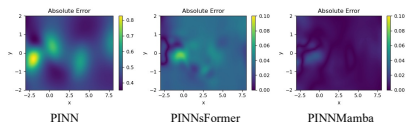
Figure 10 . Absolute Error of pressure prediction of N-S equation
원문 · CC BY 4.0 · Chenhui Xu, Dancheng Liu, Yuting Hu, Jiajie Li, Ruiyang Qin, Qingxiao Zheng, Jinjun Xiong · Sub-Sequential Physics-Informed Learning with State Space Model · 원문 그림 인용 · 원본 PDF 9쪽에서 그림 영역을 추출했습니다.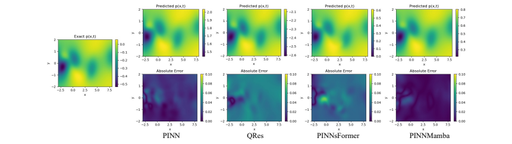
Figure 11 . The ground truth solution, prediction (top), and absolute error (bottom) on Navier-Stokes equations.
원문 · CC BY 4.0 · Chenhui Xu, Dancheng Liu, Yuting Hu, Jiajie Li, Ruiyang Qin, Qingxiao Zheng, Jinjun Xiong · Sub-Sequential Physics-Informed Learning with State Space Model · 원문 그림 인용 · 원본 PDF 19쪽에서 그림 영역을 추출했습니다.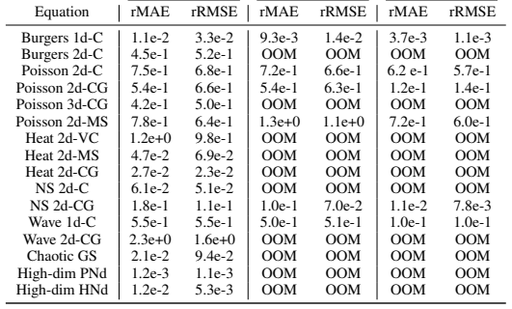
Table 9 . Results on PINNacle. Baseline results are from RoPINN paper (Wu et al., 2024). OOM means Out-of-Memroy.
원문 · CC BY 4.0 · Chenhui Xu, Dancheng Liu, Yuting Hu, Jiajie Li, Ruiyang Qin, Qingxiao Zheng, Jinjun Xiong · Sub-Sequential Physics-Informed Learning with State Space Model · 원문 그림 인용 · 원본 PDF 19쪽에서 그림 영역을 추출했습니다.논문 정보
- 저자
- Chenhui Xu, Dancheng Liu, Yuting Hu, Jiajie Li, Ruiyang Qin, Qingxiao Zheng, Jinjun Xiong
- 학회·저널
- arXiv · 프리프린트
- 최초 공개일
- 2025년 2월 1일
- 등록일
- 2026년 10월 29일
- 수정일
- 2025년 8월 16일
- 버전
- v2
- arXiv
- 2502.00318
- 분류
- cs.LG · math.NA
- 원문 이용 조건
- CC BY 4.0
- 제공 범위
- 논문 정보, 해설, 허용된 원문 그림
AI 해설은 논문 원문과 별개의 설명이며 오류가 있을 수 있습니다. 원문과 그림은 각 출처의 이용 조건과 따로 표시된 권리를 따릅니다.
초록
Physics-Informed Neural Networks (PINNs) are a kind of deep-learning-based numerical solvers for partial differential equations (PDEs). Existing PINNs often suffer from failure modes of being unable to propagate patterns of initial conditions. We discover that these failure modes are caused by the simplicity bias of neural networks and the mismatch between PDE's continuity and PINN's discrete sampling. We reveal that the State Space Model (SSM) can be a continuous-discrete articulation allowing initial condition propagation, and that simplicity bias can be eliminated by aligning a sequence of moderate granularity. Accordingly, we propose PINNMamba, a novel framework that introduces sub-sequence modeling with SSM. Experimental results show that PINNMamba can reduce errors by up to 86.3\% compared with state-of-the-art architecture. Our code is available at https://github.com/miniHuiHui/PINNMamba.
원문 인용
Chenhui Xu, Dancheng Liu, Yuting Hu, Jiajie Li, Ruiyang Qin, Qingxiao Zheng, Jinjun Xiong (2025). Sub-Sequential Physics-Informed Learning with State Space Model. arXiv:2502.00318v2. https://arxiv.org/abs/2502.00318v2
BibTeX
@misc{xu2025sequential,
  title = {{Sub-Sequential Physics-Informed Learning with State Space Model}},
  author = {Chenhui Xu and Dancheng Liu and Yuting Hu and Jiajie Li and Ruiyang Qin and Qingxiao Zheng and Jinjun Xiong},
  year = {2025},
  eprint = {2502.00318},
  archivePrefix = {arXiv},
  url = {https://arxiv.org/abs/2502.00318v2}
}