논문 해설
A survey on efficient vision transformers: algorithms, techniques, and performance benchmarking
효율적인 비전 트랜스포머에 관한 서베이: 알고리즘, 기법, 성능 벤치마킹
- 연구 문제 ViT는 자기어텐션으로 전역 정보를 추출하지만 계산과 메모리 비용이 커서 자원 제약 환경에서 적용하기 어렵습니다.
- 연구 방법 이 논문은 효율적 ViT 전략을 컴팩트 아키텍처, 가지치기, 지식 증류, 양자화로 분류하고 각 전략의 수식과 성능을 정리합니다.
- 주요 결과 분류 비교에서 Castling-MViTv2-T는 Top-1 84.1%와 EER 26.7%를 보고하며, 정확도와 효율의 균형을 보인 사례로 제시됩니다.
ViT의 계산 비용과 효율화 필요성
Vision Transformer(ViT)는 자기어텐션으로 이미지의 전역 정보를 추출하며 합성곱 신경망보다 높은 성능을 보입니다. 그러나 자기어텐션의 시간과 메모리 비용은 패치 수 n에 대해 O(n²)로 증가하고, 소프트맥스 연산도 엣지 기기와 저자원 장치에서 부담이 됩니다. 이 논문은 이러한 제약 아래에서 실시간 컴퓨터 비전 시스템에 적용할 수 있는 효율적인 ViT 전략을 정리하는 것을 목표로 합니다. 기존 서베이가 전반적인 트랜스포머 개요나 효율적인 학습을 다룬 것과 달리, 이 논문은 효율화 전략 자체에 집중합니다.
자기어텐션과 패치 임베딩의 비용 구조
ViT는 입력 이미지를 고정 크기 패치로 나누고, 각 패치를 선형 투영한 뒤 위치 임베딩을 더해 시퀀스를 만듭니다. 이 시퀀스에 자기어텐션을 적용하면 Q, K, V 행렬로부터 softmax(QKᵀ/√dk)·V 형태의 출력이 계산됩니다. QKᵀ 계산과 softmax 가중치에 V를 곱하는 계산이 각각 패치 수 n의 제곱에 비례하므로 전체 비용이 O(n²)가 됩니다. 이 구조적 비용이 컴팩트 아키텍처 설계의 출발점이 됩니다.
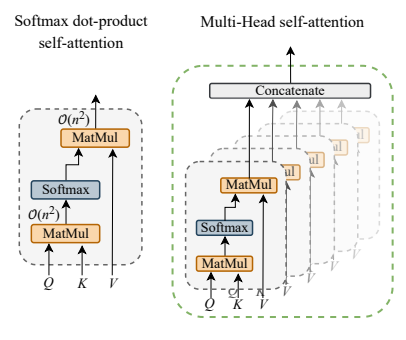
Fig. 1 . Graphical overview of the vanilla self-attention and the multi- head self-attention blocks. The O(n2) in the softmax dot-product self- attention highlights the quadratic cost of each operation.
원문 · CC BY 4.0 · Lorenzo Papa, Paolo Russo, Irene Amerini, Luping Zhou · A survey on efficient vision transformers: algorithms, techniques, and performance benchmarking · 원문 그림 인용 · 원본 PDF 3쪽에서 그림 영역을 추출했습니다.네 가지 효율화 범주
이 논문은 효율적 ViT 전략을 컴팩트 아키텍처, 가지치기, 지식 증류, 양자화의 네 범주로 나눕니다. 컴팩트 아키텍처는 자기어텐션의 비용을 줄이거나 선형화하며, 가지치기는 학습 후 중요도가 낮은 가중치를 0으로 설정해 곱셈 연산을 줄입니다. 지식 증류는 교사 모델의 클래스 확률을 학생 모델이 모방하도록 학습하고, 양자화는 부동소수점 값을 낮은 비트 표현으로 바꿉니다. 각 범주는 서로 다른 연산 또는 표현을 겨냥하므로, 범주별 기여를 구분해 읽어야 합니다.
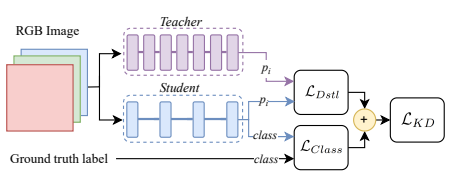
Fig. 2 . Graphical representation of the vanilla KD learning strategy. Please refer to Section 2.3 for the used notation.
원문 · CC BY 4.0 · Lorenzo Papa, Paolo Russo, Irene Amerini, Luping Zhou · A survey on efficient vision transformers: algorithms, techniques, and performance benchmarking · 원문 그림 인용 · 원본 PDF 4쪽에서 그림 영역을 추출했습니다.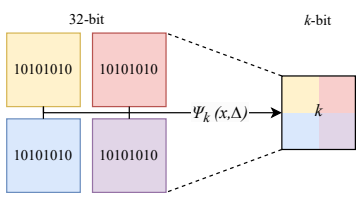
Fig. 3 . Graphical representation of a general quantization procedure; the floating-point 32-bit data is compressed based on the quantization function Ψk(x, ∆) to a k-bit representation.
원문 · CC BY 4.0 · Lorenzo Papa, Paolo Russo, Irene Amerini, Luping Zhou · A survey on efficient vision transformers: algorithms, techniques, and performance benchmarking · 원문 그림 인용 · 원본 PDF 6쪽에서 그림 영역을 추출했습니다.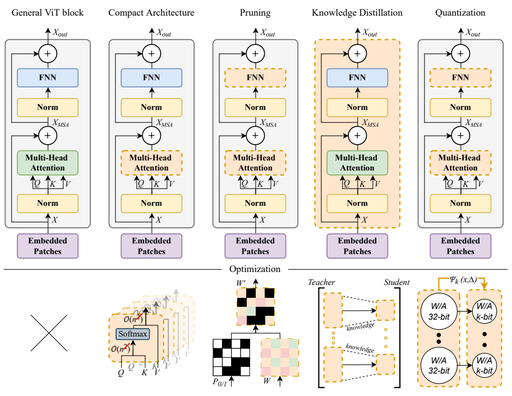
Fig. 4 . Graphical representation of efficient ViT techniques and their optimization effects. The fundamental element on which the VITs are built is shown on top, where the dashed orange block highlights the component on which each optimization technique mainly focuses. A graphical depiction of how the optimizations influence the block of interest is also provided at the bottom of the image. Please refer to Section 2 for the reported variables and their description.
원문 · CC BY 4.0 · Lorenzo Papa, Paolo Russo, Irene Amerini, Luping Zhou · A survey on efficient vision transformers: algorithms, techniques, and performance benchmarking · 원문 그림 인용 · 원본 PDF 7쪽에서 그림 영역을 추출했습니다.EER 지표와 비교 조건
이 논문은 파라미터 수, 비트, FLOPs, 모델 크기처럼 추론 시 장치에 영향을 주는 효율 지표를 기준 모델 대비 정규화해 Efficient Error Rate(EER)를 정의합니다. EER은 각 효율 지표의 비율 Mi/Ri를 평균하여 계산하며, 값이 낮을수록 기준 모델보다 효율적입니다. 원문은 기준 모델로 ViT-B/16을 사용했으며, EER은 분류 과제에서만 측정되었다고 밝힙니다. 따라서 EER 비교는 ImageNet1K 분류 설정 안에서 읽어야 합니다.
ImageNet1K 분류 결과의 해석
ImageNet1K 분류 비교에서 Castling-MViTv2-T는 Top-1 84.1%와 EER 26.7%를 보고합니다. 원문은 이 모델이 MViTv2-L과 비교해 정확도 차이가 1.2%p 수준이면서 EER이 더 낮다고 설명합니다. 이 결과는 원문이 선택한 분류 모델과 기준 설정에서 얻은 것이며, 다른 과제나 하드웨어에서의 효율을 보장하지 않습니다. 저자들은 이 결과를 정확도와 EER의 파레토 균형을 보여 주는 사례로 해석합니다.
적용 범위와 한계
원문은 여러 응용과 과제에서의 일반화, 적대적 공격에 대한 견고성, 평가 지표의 범위를 향후 과제로 제시합니다. 특히 효율 평가 지표가 주로 일반 목적 과제의 지표에 머물러 있으며, 자원 제약 장치 기준의 벤치마크가 필요하다고 설명합니다. 또한 한 범주의 기법만 다루는 연구가 많아 여러 기법을 결합하는 방법에 대한 검토가 필요하다고 지적합니다. 이 논문의 결과는 원문에 보고된 모델, 데이터셋, 기준 설정에 한정해 읽어야 합니다.
논문 정보
- 저자
- Lorenzo Papa, Paolo Russo, Irene Amerini, Luping Zhou
- 학회·저널
- arXiv · 프리프린트
- 최초 공개일
- 2023년 9월 5일
- 등록일
- 2026년 11월 6일
- 수정일
- 2024년 3월 12일
- 버전
- v2
- arXiv
- 2309.02031
- DOI
- 10.1109/tpami.2024.3392941
- 분류
- cs.CV
- 원문 이용 조건
- CC BY 4.0
- 제공 범위
- 논문 정보, 해설, 허용된 원문 그림
AI 해설은 논문 원문과 별개의 설명이며 오류가 있을 수 있습니다. 원문과 그림은 각 출처의 이용 조건과 따로 표시된 권리를 따릅니다.
초록
Vision Transformer (ViT) architectures are becoming increasingly popular and widely employed to tackle computer vision applications. Their main feature is the capacity to extract global information through the self-attention mechanism, outperforming earlier convolutional neural networks. However, ViT deployment and performance have grown steadily with their size, number of trainable parameters, and operations. Furthermore, self-attention's computational and memory cost quadratically increases with the image resolution. Generally speaking, it is challenging to employ these architectures in real-world applications due to many hardware and environmental restrictions, such as processing and computational capabilities. Therefore, this survey investigates the most efficient methodologies to ensure sub-optimal estimation performances. More in detail, four efficient categories will be analyzed: compact architecture, pruning, knowledge distillation, and quantization strategies. Moreover, a new metric called Efficient Error Rate has been introduced in order to normalize and compare models' features that affect hardware devices at inference time, such as the number of parameters, bits, FLOPs, and model size. Summarizing, this paper firstly mathematically defines the strategies used to make Vision Transformer efficient, describes and discusses state-of-the-art methodologies, and analyzes their performances over different application scenarios. Toward the end of this paper, we also discuss open challenges and promising research directions.
원문 인용
Lorenzo Papa, Paolo Russo, Irene Amerini, Luping Zhou (2023). A survey on efficient vision transformers: algorithms, techniques, and performance benchmarking. arXiv:2309.02031v2. https://doi.org/10.1109/tpami.2024.3392941
BibTeX
@article{papa2023survey,
  title = {{A survey on efficient vision transformers: algorithms, techniques, and performance benchmarking}},
  author = {Lorenzo Papa and Paolo Russo and Irene Amerini and Luping Zhou},
  year = {2023},
  eprint = {2309.02031},
  archivePrefix = {arXiv},
  doi = {10.1109/tpami.2024.3392941},
  url = {https://arxiv.org/abs/2309.02031v2}
}