논문 해설
Thoughtbubbles: an Unsupervised Method for Parallel Thinking in Latent Space
Thoughtbubbles: 잠재 공간에서의 병렬 사고를 위한 비지도 방법
- 연구 문제 pre-training 중 언어 모델링 손실만으로 잠재 공간에서 병렬 적응 계산을 할당할 수 있는지를 다룹니다.
- 연구 방법 잔차 스트림을 누적 점수로 포크하거나 제거하고, 점수로 어텐션과 잔차 갱신을 감쇠한 뒤 같은 토큰의 스트림을 가중 평균하는 방식입니다.
- 주요 결과 1.9B 규모에서 20B 토큰 학습 결과가 40B 토큰 기준선의 제로샷 평가와 GSM8K에 대응하거나 앞서며, 150M에서 772M 규모에서도 perplexity 비교 우위를 보고합니다.
연구 문제: 추론 시 계산을 잠재 공간에서 늘리기
Transformer는 고정된 계산 예산과 작업 메모리를 가지므로 다단계 문제를 푸는 데 한계가 있습니다. 이를 보완하려고 chain-of-thought처럼 자연어 중간 토큰을 생성하는 방법이 쓰였지만, 이 방법은 pre-training 중에는 적용하기 어렵고 직렬로 생성되는 자연어 추론에 의존합니다. 이 논문은 pre-training 중 언어 모델링 손실만으로 잠재 공간에서 병렬 적응 계산을 할당할 수 있는지를 묻습니다.
포크와 누적 점수로 잔차 스트림을 조절하는 방식
Thoughtbubbles는 각 잔차 스트림에 0과 1 사이의 누적 점수를 부여하고, 포크 레이어에서 유지 점수와 포크 점수를 이전 누적 점수와 곱해 전파합니다. 이후 top-k 판단으로 점수가 높은 잔차 스트림을 유지하거나 복제하며, 입력 토큰의 원래 가장 오른쪽 스트림은 유지 점수가 1로 고정됩니다. 포크 레이어는 3, 7, 11번째 층에 배치됩니다.
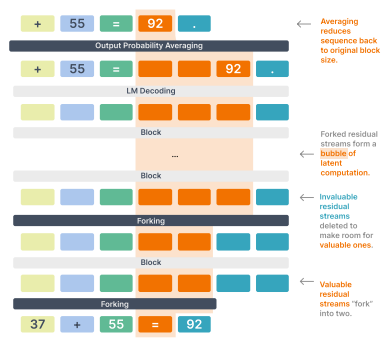
Figure 1 .Overview of our method: input tokens fork to form a bubble of latent computation (orange), which is then contracted to produce the final token. Some extraneous tokens may fork (dark blue), but then be pruned.
원문 · CC BY 4.0 · Liu, Houjun, Murty, Shikhar, Manning, Christopher D., Csordás, Róbert · Thoughtbubbles: an Unsupervised Method for Parallel Thinking in Latent Space · 원문 그림 인용 · 원본 PDF 1쪽에서 그림 영역을 추출했습니다.누적 점수는 어텐션 계산과 잔차 갱신을 감쇠하는 데에도 쓰입니다. 점수가 낮아 삭제될 스트림에 모델이 의존하지 않도록 학습을 유도하는 장치입니다. 최종 출력은 같은 입력 토큰의 여러 스트림을 디코딩한 뒤 누적 점수로 가중 평균하여 만듭니다. 1.9B 모델에서는 잔차를 먼저 평균하는 근사를 사용합니다.
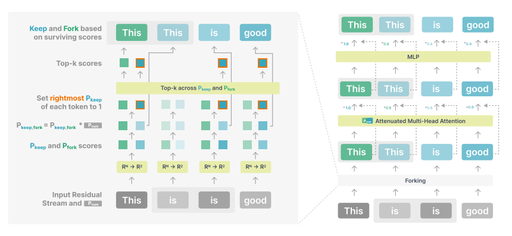
Figure 2 .Forking procedure. Token “is” has two forks, one of which will get deleted; the token “this” creates a new fork; we show a score-attenuated transformer block after a forking operation.
원문 · CC BY 4.0 · Liu, Houjun, Murty, Shikhar, Manning, Christopher D., Csordás, Róbert · Thoughtbubbles: an Unsupervised Method for Parallel Thinking in Latent Space · 원문 그림 인용 · 원본 PDF 3쪽에서 그림 영역을 추출했습니다.
Table 6 .Performance of an ablation where we keep the rightmost token instead of logit average for output token merging.
원문 · CC BY 4.0 · Liu, Houjun, Murty, Shikhar, Manning, Christopher D., Csordás, Róbert · Thoughtbubbles: an Unsupervised Method for Parallel Thinking in Latent Space · 원문 그림 인용 · 원본 PDF 13쪽에서 그림 영역을 추출했습니다.추론 시 포크 예산과 위치 인코딩
추론 시 포크 예산 κ를 학습 때 값으로 고정하는 방식과, 학습 때의 블록 크기 대비 비율을 유지하여 입력 길이에 비례하게 설정하는 방식이 있습니다. 저자들은 자기회귀 생성에서 고정 블록 크기를 쓰면 짧은 입력에서 포크가 과도하게 허용되어 분포 이동이 생긴다고 설명하며, 그래서 동적 포크와 토큰마다 갱신되는 rolling top-k를 사용합니다. 위치 인코딩에서는 한 토큰의 포크 수에 비례해 RoPE의 부분 회전을 적용합니다.
기준선과 평가 설정
주요 실험은 1.9B 규모에서 GPT-2 유사 표준 Transformer와 비교합니다. Thoughtbubbles는 20B 토큰 pre-training 결과이고 기준선은 40B 토큰 pre-training 결과이며, 제로샷 평가는 perplexity, LAMBADA, HellaSwag, BLiMP, AI2-ARC, PIQA로 구성됩니다. GSM8K는 중간 학습 후 제로샷 chain-of-thought 설정으로 평가되고 pass@1을 보고합니다. 150M에서 772M 규모 실험은 OpenWebText와 peS2o에서 2.5B 토큰 pre-training으로 수행되며, 파라미터 일치 기준선과 입력 잔차를 복사하는 Copy-3, Copy-5 기준선을 함께 둡니다.
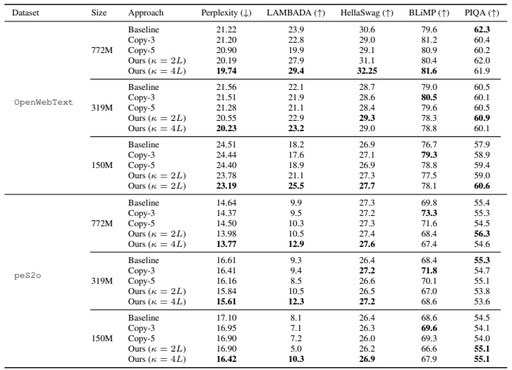
Table 2 .Zero-shot evaluation results across all model scales after pretraining on 2.5 billion tokens. Each setting is parameter-matched; baseline is a standard GPT-2-like model; copy-3 and copy-5 are models where the input residuals are copied multiple times and can attend to each other; ours is thethoughtbubblestransformer, with forking budget set to 2x(κ= 2L)and 4x(κ= 4L)the input block size.
원문 · CC BY 4.0 · Liu, Houjun, Murty, Shikhar, Manning, Christopher D., Csordás, Róbert · Thoughtbubbles: an Unsupervised Method for Parallel Thinking in Latent Space · 원문 그림 인용 · 원본 PDF 7쪽에서 그림 영역을 추출했습니다.주요 비교 결과와 적용 범위
1.9B 규모에서 Thoughtbubbles는 20B 토큰만 학습했을 때 Table 1의 모든 제로샷 평가와 GSM8K pass@1에서 40B 토큰 기준선과 같거나 더 나은 값을 보고합니다. 다만 이는 20B 토큰 대 40B 토큰이라는 조건에서의 결과입니다. 150M에서 772M 규모에서는 Thoughtbubbles가 perplexity에서 기준선과 Copy 기준선보다 낮은 값을 보고하며, 319M 규모 Thoughtbubbles가 OpenWebText perplexity에서 772M 기준선보다 낮다는 점도 제시됩니다. BLiMP에서는 파라미터 일치 기준선에는 앞서지만 계산량 일치 기준선에는 앞서지 않습니다.
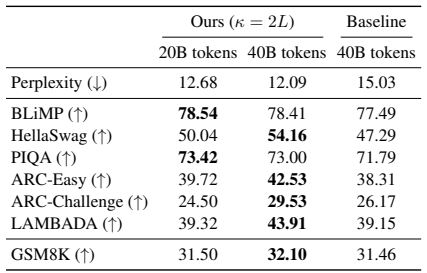
Table 1 .Zero-shot evaluation results across all model scales after pretraining on 20 and 40 billion tokens. Each setting is parameter- matched at 1.9B parameters. Baseline is a standard GPT-2-like model; ours is thethoughtbubblestransformer, with forking bud- get set to 2x (κ= 2L) the input block size. Measuring 20B tokens of pretraining of our approach against 40B tokens of baseline gives a generoustemporal,dataandcomputationlower bound.
원문 · CC BY 4.0 · Liu, Houjun, Murty, Shikhar, Manning, Christopher D., Csordás, Róbert · Thoughtbubbles: an Unsupervised Method for Parallel Thinking in Latent Space · 원문 그림 인용 · 원본 PDF 6쪽에서 그림 영역을 추출했습니다.포크 위치와 절제 실험
포크 수는 최종 층에서 4개 토큰 창의 평균 사후 엔트로피와 함께 증가하지만, 가장 높은 불확실성 영역에서는 할당이 줄어 오목한 포물선 관계를 보입니다. 저자들은 이를 정보가 높은 중간 불확실성에서 추가 계산이 더 유용하다고 해석합니다. 어텐션 마스킹 절제에서는 150M 모델의 검증 손실이 3.17에서 3.90으로 나빠졌으며, 이는 누적 점수가 계산에 영향을 주지 않으면 top-k 결정이 무작위에 가까워진다는 저자 해석과 함께 제시됩니다. 과도한 포크 절제는 772M 모델을 25,000 스텝 동안 학습한 단일 조건에서 perplexity 29.84와 28.02를 비교하며, 확장 포크는 소폭의 이점만 보고합니다.

Table 7 .Ablation: removing attention masking significantly degrades performance.
원문 · CC BY 4.0 · Liu, Houjun, Murty, Shikhar, Manning, Christopher D., Csordás, Róbert · Thoughtbubbles: an Unsupervised Method for Parallel Thinking in Latent Space · 원문 그림 인용 · 원본 PDF 13쪽에서 그림 영역을 추출했습니다.한계와 남은 질문
이 결과는 Thoughtbubbles가 특정 규모, 특정 데이터셋, 저자가 설정한 예산 조건에서 얻은 것입니다. BLiMP에서 계산량 일치 기준선에 앞서지 않는다는 점은 동적 병렬 계산이 구문 과제에 항상 도움이 되지는 않을 수 있음을 보여줍니다. 실행 시간은 단일 H100과 blocking CUDA 호출, 8개 시퀀스 배치라는 조건의 측정이며, 기준선과 2L 설정의 시간을 함께 제시하지만 이 값을 모든 하드웨어로 일반화할 수 없습니다. 또한 긴 깊이의 포크는 조건에 따라 제한된 이점만 보고되므로, 저자들이 제안한 노이즈 기반 완화의 효과는 본 실험의 범위 밖의 질문으로 남습니다.
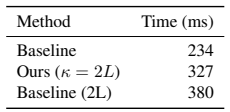
Table 5 .Wall-clock performance on a single Nvidia H100, with blocking CUDA kernel launch operations, for our approach at 1.9B scale and on a batch of8sequences;L= 512is the block size used.
원문 · CC BY 4.0 · Liu, Houjun, Murty, Shikhar, Manning, Christopher D., Csordás, Róbert · Thoughtbubbles: an Unsupervised Method for Parallel Thinking in Latent Space · 원문 그림 인용 · 원본 PDF 13쪽에서 그림 영역을 추출했습니다.논문 정보
- 저자
- Liu, Houjun, Murty, Shikhar, Manning, Christopher D., Csordás, Róbert
- 학회·저널
- arXiv · 프리프린트
- 최초 공개일
- 2025년 9월 30일
- 등록일
- 2026년 10월 30일
- 수정일
- 2026년 1월 30일
- 버전
- v2
- arXiv
- 2510.00219
- 원문 이용 조건
- CC BY 4.0
- 제공 범위
- 논문 정보, 해설, 허용된 원문 그림
AI 해설은 논문 원문과 별개의 설명이며 오류가 있을 수 있습니다. 원문과 그림은 각 출처의 이용 조건과 따로 표시된 권리를 따릅니다.
초록
Current approaches for scaling inference-time compute in transformers train them to emit explicit chain-of-thought tokens before producing an answer. While these methods are powerful, they are limited because they cannot be applied during pretraining and rely solely on serially-generated, natural-language verbalization. In this work, we propose Thoughtbubbles, a transformer variant that natively performs parallel adaptive computation in latent space by learning to fork or delete residual streams. Thus, tokens requiring more computation can form a "bubble" of cloned residuals in the middle of the network. Crucially, this behavior is learned during pretraining with only language modeling loss. Using half of the training budget, Thoughtbubbles outperforms the perplexity and zero-shot evals of both standard decoder LMs and those using non-adaptive parallel computation approaches. These results hold across model sizes from 150M to 1.9B. Thoughtbubbles achieves competitive GSM8K results using half of the baseline's token budget. The implicit nature of our method enables models to begin learning adaptive computation at pretraining time, paving the way to unified train-time and test-time scaling behaviors.
원문 인용
Liu, Houjun, Murty, Shikhar, Manning, Christopher D., Csordás, Róbert (2025). Thoughtbubbles: an Unsupervised Method for Parallel Thinking in Latent Space. arXiv:2510.00219v2. https://arxiv.org/abs/2510.00219v2
BibTeX
@misc{houjun2025thoughtbubbles,
  title = {{Thoughtbubbles: an Unsupervised Method for Parallel Thinking in Latent Space}},
  author = {Liu, Houjun and Murty, Shikhar and Manning, Christopher D. and Csordás, Róbert},
  year = {2025},
  eprint = {2510.00219},
  archivePrefix = {arXiv},
  url = {https://arxiv.org/abs/2510.00219v2}
}