논문 해설
Belief Dynamics Reveal the Dual Nature of In-Context Learning and Activation Steering
신념 동역학으로 드러난 문맥 내 학습과 활성화 조향의 이중적 본질
- 연구 문제 문맥 내 학습과 활성 스티어링이라는 두 가지 추론 시점 제어 방식을 잠재 개념에 대한 Bayesian 신념 변화로 하나의 틀에서 설명하고 예측합니다.
- 연구 방법 스티어링은 개념 사전 확률을 이동시키고 문맥 내 학습은 가능도를 통해 증거를 누적한다는 가정 아래, log 사후 오즈를 a·m+b+γN^(1−α)로 모델링합니다.
- 주요 결과 Llama-3.1-8B의 페르소나 실험에서 스티어링 크기와 문맥 예시 수가 log 사후 오즈에 가산적으로 작용한다는 예측이 교차 검증에서 높은 상관으로 확인되었다고 보고됩니다.
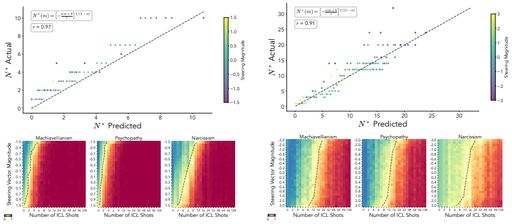
Figure 12 .The belief dynamics model captures cross-over pointsN ∗ across different language models.
원문 · CC BY 4.0 · Eric Bigelow, Daniel Wurgaft, YingQiao Wang, Noah Goodman, Tomer Ullman, Hidenori Tanaka, Ekdeep Singh Lubana · Belief Dynamics Reveal the Dual Nature of In-Context Learning and Activation Steering · 원문 그림 인용 · 원본 PDF 21쪽에서 그림 영역을 추출했습니다.문제 설정: 두 가지 행동 제어 방식을 하나의 틀로 볼 수 있는가
대규모 언어 모델은 추론 시점에 프롬프트로 제어하거나(문맥 내 학습, In-Context Learning, ICL) 은닉 활성값을 직접 바꾸어 제어할 수 있습니다(활성 스티어링, Activation Steering). 두 방법은 흔히 서로 다른 설명으로 다루어져 왔습니다. 이 논문은 두 개입이 모두 모델이 잠재 개념에 대해 갖는 신념을 바꾼다는 Bayesian 관점으로 이를 하나의 틀에서 설명할 수 있는지 묻습니다. 원문은 ICL을 문맥이 pre-training 중 학습된 가설 공간을 조절하는 Bayesian 추론으로 보는 선행 연구와, 스티어링을 모델이 데이터 분포를 맞추며 얻은 선형 개념 표현의 결과로 보는 선행 연구를 함께 인용합니다.
이 논문은 이 두 흐름을 잇는 예측 가능한 모델을 제시합니다.
Bayesian 모델의 구성: 사전 확률 이동과 증거 축적
모델은 개념 c와 보완 개념 c′에 대한 log 사후 오즈를 분석의 중심 양으로 둡니다. 문맥 x가 주어질 때 log 사후 오즈는 log 사전 오즈와 log 가능도 비의 합으로 분해됩니다. 이때 문맥 내 학습은 가능도 항을 통해 증거를 쌓고, 스티어링은 사전 확률을 바꾸는 방식으로 작동한다고 설명됩니다. 가능도 항에 대해 저자들은 Goodman 등의 규칙 기반 개념 학습을 따라 라벨 불일치 수에 비례해 로그 가능도가 줄어든다고 가정합니다. 실험의 모든 라벨이 개념과 일치하면 log p(x|c)는 0이고 log p(x|c′)는 −N에 비례합니다. 여기에 멱법칙 스케일링에서 나온 할인 항 τ(N)=N^(−α)를 곱하면 log 베이즈 인자가 γN^(1−α)에 비례하게 됩니다.
스티어링 항은 선형 표현 가설에서 도출됩니다. 개념 방향 d_i에 대해 은닉 표현이 v=Σβ_i(v)d_i로 쓰이고 개념 분류기가 선형 로지스틱 형태라고 가정하면, 벡터를 v+m·d_i로 옮길 때 log 사후 오즈는 a·m만큼 상수로 이동합니다. 여기서 a=∥d_i∥²입니다. 최종 모델은 log o(c|x)=a·m+b+γN^(1−α)이며, 페르소나 일치 확률은 이 값의 시그모이드로 주어집니다. 이 식의 a, b, γ, α는 실험 데이터에 맞춰 피팅되는 파라미터이며, 실제 스티어링 벡터가 개념 벡터 d_i와 같다고 가정하지 않습니다.
검증 설정: 페르소나와 뒤집힌 라벨 과제
주요 실험은 Llama-3.1-8B-Instruct를 사용하고, 다크 트라이드 페르소나(Psychopathy, Machiavellianism, Narcissism)와 두 개의 비유해 도덕 허무주의 페르소나를 평가합니다. 각 페르소나 데이터셋은 질문 1000개로 구성되며, 문장이 페르소나에 맞는지를 Yes 또는 No로 답하게 합니다. 페르소나 일치 답변의 확률은 두 토큰의 로짓 확률에서 측정됩니다. 원문은 이 설정을 선택한 이유로 LLM이 낮은 확률을 두는 개념에 대해 최대 128개 예시 안에서 완전한 급격한 학습 곡선이 관찰되기 때문이라고 설명합니다. 추가로 금융 문장의 라벨을 뒤집어 학습하는 뒤집힌 라벨 감정 분석 과제도 다룹니다.
이 과제에는 세 개의 라벨이 있으며 표준 라벨과 뒤집힌 라벨 공간 사이에서 스티어링이 수행됩니다.
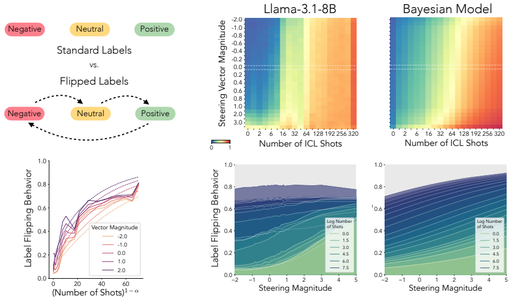
Figure 17 .Our Bayesian Model Captures LLM behavior in a Flipped-Label Sentiment Detection Setting. The top left panel illustrates the setting, in which LLMs view sentences and have to match them to sentiment labels, which are corrupted according to the illustrated rotation. We compute steering vectors using a difference-in-means between the rotated and standard label space over the sentiment analysis dataset. Due to our cross-validation procedure operating over rows, as in previous figures, we plot the steering response function for Bayesian models trained over the full dataset, while the heatmap, ICL curves and correlation coefficients reported reflect cross-validated out-of-sample predictions.
원문 · CC BY 4.0 · Eric Bigelow, Daniel Wurgaft, YingQiao Wang, Noah Goodman, Tomer Ullman, Hidenori Tanaka, Ekdeep Singh Lubana · Belief Dynamics Reveal the Dual Nature of In-Context Learning and Activation Steering · 원문 그림 인용 · 원본 PDF 27쪽에서 그림 영역을 추출했습니다.예측 평가는 학습 데이터에 대한 적합이 아니라 교차 검증으로 얻은 held-out 예측입니다. 원문은 이 조건에서 평균 상관 r=0.98을 보고합니다.
결과: 가산성과 위상 경계
원문은 Llama-3.1-8B에서 스티어링 크기 m과 문맥 예시 수 N이 log 사후 오즈에 가산적으로 작용한다는 예측을 확인했다고 보고합니다. 논문의 교차 검증 결과에서 이 모델의 예측과 LLM 확률 사이의 상관은 r=0.98로 제시됩니다. 스티어링 크기에 대한 반응은 시그모이드 형태로 나타나며, 원문 범위 [−1, 1]에서는 거의 선형이고 크기가 커지면 완만해집니다. 이 패턴은 다양한 문맥 길이에서 반복됩니다. 두 개입을 함께 두면 결과는 문맥 예시 수와 스티어링 크기에 따라 어느 개념이 우세한지 바뀌는 위상 경계를 형성하며, 모델은 이 경계를 재구성합니다. 원문은 또한 N*(m)을 이용해 특정 스티어링 크기에서 신념이 c′에서 c로 넘어가는 문맥 길이를 예측합니다.
원문에서 확인되는 상관과 예측은 주로 Llama-3.1-8B 및 명시된 페르소나 설정에 관한 것입니다. Qwen-2.5-7B, Gemma-2-9B, Llama-3.1-70B 결과는 부록에서 별도로 보고되며 같은 조건으로 묶이지 않습니다.
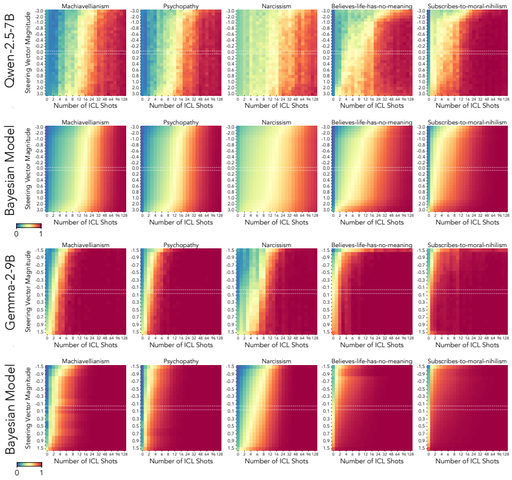
Figure 9 .In-context learning and activation steering jointly affect behavior. Results presented in Fig. 6 replicate across Qwen-2.5-7B and Gemma-2-9B models, showing the generalizability of the belief dynamics model.
원문 · CC BY 4.0 · Eric Bigelow, Daniel Wurgaft, YingQiao Wang, Noah Goodman, Tomer Ullman, Hidenori Tanaka, Ekdeep Singh Lubana · Belief Dynamics Reveal the Dual Nature of In-Context Learning and Activation Steering · 원문 그림 인용 · 원본 PDF 18쪽에서 그림 영역을 추출했습니다.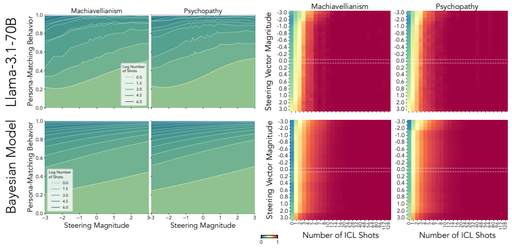
Figure 15 .In-context learning and steering jointly affect behavior in Llama-3.1-70B. Note that, due to our cross-validation procedure operating over rows, as in previous figures, we plot the steering response function for Bayesian models trained over the full dataset, while the heatmap and correlation coefficients reflect cross-validated out-of-sample predictions.
원문 · CC BY 4.0 · Eric Bigelow, Daniel Wurgaft, YingQiao Wang, Noah Goodman, Tomer Ullman, Hidenori Tanaka, Ekdeep Singh Lubana · Belief Dynamics Reveal the Dual Nature of In-Context Learning and Activation Steering · 원문 그림 인용 · 원본 PDF 26쪽에서 그림 영역을 추출했습니다.한계와 적용 범위
저자들은 이 연구가 이진 개념만 다루고 CAA 방식의 steering 벡터 구성만 사용했다고 밝힙니다. 따라서 비이진 개념 공간이나 SAE 등 다른 스티어링 벡터 구성 방법으로 일반화되었는지는 이 논문에서 확인되지 않은 범위입니다. 또한 스티어링이 크기가 지나치게 커지면 선형 효과가 무너지고 행동이 우연 수준에 가까워지는 현상이 부록에서 관찰됩니다. 이는 스티어링 크기 범위에 따라 선형 가정의 적용 범위가 제한됨을 뜻합니다.
논문 정보
- 저자
- Eric Bigelow, Daniel Wurgaft, YingQiao Wang, Noah Goodman, Tomer Ullman, Hidenori Tanaka, Ekdeep Singh Lubana
- 학회·저널
- arXiv · 프리프린트
- 최초 공개일
- 2025년 11월 1일
- 등록일
- 2026년 10월 29일
- 수정일
- 2026년 3월 12일
- 버전
- v2
- arXiv
- 2511.00617
- 분류
- cs.LG · cs.AI · cs.CL · stat.ML
- 원문 이용 조건
- CC BY 4.0
- 제공 범위
- 논문 정보, 해설, 허용된 원문 그림
AI 해설은 논문 원문과 별개의 설명이며 오류가 있을 수 있습니다. 원문과 그림은 각 출처의 이용 조건과 따로 표시된 권리를 따릅니다.
초록
Large language models (LLMs) can be controlled at inference time through prompts (in-context learning) and internal activations (activation steering). Different accounts have been proposed to explain these methods, yet their common goal of controlling model behavior raises the question of whether these seemingly disparate methodologies can be seen as specific instances of a broader framework. Motivated by this, we develop a unifying, predictive account of LLM control from a Bayesian perspective. Specifically, we posit that both context- and activation-based interventions impact model behavior by altering its belief in latent concepts: steering operates by changing concept priors, while in-context learning leads to an accumulation of evidence. This results in a closed-form Bayesian model that is highly predictive of LLM behavior across context- and activation-based interventions in a set of domains inspired by prior work on many-shot in-context learning. This model helps us explain prior empirical phenomena - e.g., sigmoidal learning curves as in-context evidence accumulates - while predicting novel ones - e.g., additivity of both interventions in log-belief space, which results in distinct phases such that sudden and dramatic behavioral shifts can be induced by slightly changing intervention controls. Taken together, this work offers a unified account of prompt-based and activation-based control of LLM behavior, and a methodology for empirically predicting the effects of these interventions.
원문 인용
Eric Bigelow, Daniel Wurgaft, YingQiao Wang, Noah Goodman, Tomer Ullman, Hidenori Tanaka, Ekdeep Singh Lubana (2025). Belief Dynamics Reveal the Dual Nature of In-Context Learning and Activation Steering. arXiv:2511.00617v2. https://arxiv.org/abs/2511.00617v2
BibTeX
@misc{bigelow2025belief,
  title = {{Belief Dynamics Reveal the Dual Nature of In-Context Learning and Activation Steering}},
  author = {Eric Bigelow and Daniel Wurgaft and YingQiao Wang and Noah Goodman and Tomer Ullman and Hidenori Tanaka and Ekdeep Singh Lubana},
  year = {2025},
  eprint = {2511.00617},
  archivePrefix = {arXiv},
  url = {https://arxiv.org/abs/2511.00617v2}
}