논문 해설
Deep Learning-based Patient Re-identification Is able to Exploit the Biometric Nature of Medical Chest X-ray Data
딥러닝 기반 환자 재식별은 의료용 흉부 X선 데이터의 생체 특성을 활용할 수 있다
- 연구 문제 공개 흉부 X선 데이터에서 딥러닝 모델이 같은 환자를 식별할 수 있는지를 검증합니다.
- 연구 방법 파라미터를 공유하는 SNN으로 두 영상의 같은 환자 여부를 검증하고, 임베딩 검색으로 같은 환자를 재식별합니다.
- 주요 결과 ChestX-ray14에서 검증 AUC 0.9940과 재식별 mAP@R 0.9748을 보고하며, 외부 데이터셋에서도 높은 검증 AUC를 보고합니다.
연구 문제와 공개 데이터의 위험
흉부 X선 데이터는 임상 정보와 함께 환자 식별을 어렵게 하는 익명화 과정을 거쳐 공개되는 경우가 많습니다. 그러나 이 논문은 잘 학습된 딥러닝 모델이 흉부 X선 영상 자체에서 환자 정체를 복원할 수 있는지를 묻습니다. 연구에서는 공개 데이터셋인 ChestX-ray14를 사용하며, 이 데이터셋은 112,120장의 정면 흉부 X선 영상과 30,805명의 환자로 구성됩니다. 같은 환자의 후속 촬영 영상이 여러 장 존재하므로, 같은 환자 여부를 판별하는 문제가 실제 재식별 위험으로 이어질 수 있습니다.
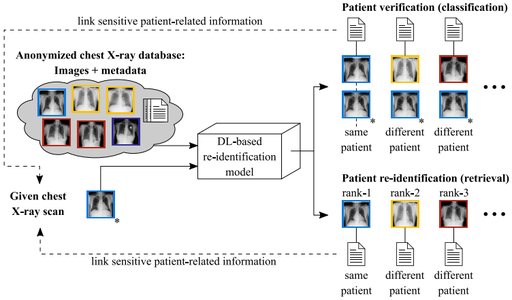
Figure 1 . General problem scenario: Comparing a given chest radiograph to publicly available dataset images by means of DL techniques would either result in discrete labels indicating whether or not the dataset images belong to the same patient as the given radiograph (verification scenario) or yield a ranked list of the most similar radiographs related to the given scan (retrieval scenario). Images belonging to the same patient are highlighted with the same color. The given radiograph is marked with an asterisk. The shown cases would enable a potential attacker to link sensitive patient-related information contained in the dataset to the image of interest.
원문 · CC BY 4.0 · Kai Packhäuser, Sebastian Gündel, Nicolas Münster, Christopher Syben, Vincent Christlein, Andreas Maier · Deep Learning-based Patient Re-identification Is able to Exploit the Biometric Nature of Medical Chest X-ray Data · 원문 그림 인용 · 원본 PDF 2쪽에서 그림 영역을 추출했습니다.환자 검증을 위한 SNN 구조와 학습
환자 검증 모델은 두 입력 영상을 파라미터를 공유하는 두 분기로 처리하는 SNN입니다. 각 분기는 사전 학습된 ResNet-50을 사용하며, 분류층을 128차원 특징 표현을 내는 층으로 바꿉니다. 두 분기의 특징 표현에서 얻은 절대 차이에 완전연결층과 시그모이드를 적용해 0에서 1 사이의 점수를 출력합니다. 학습은 이진 교차 엔트로피 손실을 사용하고, 미니배치 확률적 경사 하강법과 adaptive moment estimation을 함께 사용합니다. 이 검증 실험의 학습 범위는 파라미터가 공유되는 백본과 병합 이후 추가된 출력 계층을 포함하며, 원문이 고정한 범위 밖의 설정을 추가하지 않습니다.
재식별을 위한 임베딩 학습과 검색 지표
재식별 모델은 검증 모델에서 병합 층 이후의 구성 요소를 제거하고, ResNet-50의 풀링 구조를 수정해 128차원 임베딩을 얻습니다. 학습에는 대조 손실을 사용하며, 여유 값 m은 1로 설정되고 음성 쌍은 거리가 m보다 작을 때만 손실에 기여합니다. 온라인 방식은 배치 안에서 쌍을 구성하고, 교차 배치 메모리로 이전 배치의 임베딩을 함께 사용합니다. 검색 평가는 질의 영상과 다른 영상의 유클리드 거리로 순위 목록을 만들고, mAP@R과 Precision@1로 측정합니다. 이 두 지표는 같은 순위 목록의 서로 다른 측면을 보여 줍니다.
환자 검증 결과와 학습 데이터 규모의 영향
환자 검증 실험에서 학습 쌍 수를 늘리면 AUC가 개선되었습니다. 100,000쌍으로 학습한 모델은 AUC 0.8610이었고, 800,000쌍으로 학습한 모델은 FTS 방식에서 AUC 0.9896을 보였습니다. 무작위 음성 쌍을 에폭마다 새로 구성한 RNP 방식은 같은 800,000쌍 설정에서 AUC 0.9940과 정확도 95.55%를 기록했습니다. 이 수치는 ChestX-ray14의 검증·테스트 구성에서 얻은 결과이며, 다른 데이터셋의 결과로 옮길 수 없습니다.

Table 1 . Overview of the obtained verification results for our experiments using varying training set sizes Ns at different learning rates η. Moreover, different data handling techniques were used (FTS: Fixed training set; RNP: Randomized negative pairs). For each experiment, the training sets were balanced with respect to the amount of positive and negative image pairs. In this table, we present the area under the curve (AUC) (together with the lower and upper bounds of the 95 % confidence intervals from 10,000 bootstrap runs), the accuracy, the specificity, the recall, the precision, and the F1-score. Bold text emphasizes the overall highest AUC value.
원문 · CC BY 4.0 · Kai Packhäuser, Sebastian Gündel, Nicolas Münster, Christopher Syben, Vincent Christlein, Andreas Maier · Deep Learning-based Patient Re-identification Is able to Exploit the Biometric Nature of Medical Chest X-ray Data · 원문 그림 인용 · 원본 PDF 3쪽에서 그림 영역을 추출했습니다.재식별 검색 결과와 영상 해상도의 영향
재식별 실험에서 원본 크기 1024×1024 입력의 mAP@R은 0.9748이고 Precision@1은 0.9963이었습니다. 입력 해상도를 800×800과 512×512로 낮추면 mAP@R이 완만하게 낮아졌지만 Precision@1은 높은 값을 유지했습니다. 224×224에서는 mAP@R이 0.7730으로 크게 낮아졌고 Precision@1은 0.9756이었습니다. 따라서 상위 1위 정확도와 순위 전체의 품질은 같은 방향으로만 움직이지 않습니다.
외부 데이터셋 일반화와 적용 범위
외부 평가에서는 CheXpert와 COVID-19 Image Data Collection을 학습에 사용하지 않고 평가했습니다. 검증 AUC는 CheXpert에서 0.9870, COVID-19 Image Data Collection에서 0.9763으로 보고됩니다. COVID-19 Image Data Collection은 정면 영상만 사용했고 측면 영상과 CT 영상은 제외했습니다. 이 결과는 해당 데이터셋과 평가 조건에서 얻은 것이며, 모든 흉부 X선 데이터에 대한 보편적 성능으로 읽을 수 없습니다.

Table 2 . Comparison of the verification performance on two different subsets of the ChestX-ray14 dataset that either contain foreign material or not (first two rows). Furthermore, we show the verification results for the CheXpert dataset and the COVID-19 Image Data Collection (last two rows). We present the AUC (together with the lower and upper bounds of the 95 % confidence intervals from 10,000 bootstrap runs), the accuracy, the specificity, the recall, the precision, and the F1-score.
원문 · CC BY 4.0 · Kai Packhäuser, Sebastian Gündel, Nicolas Münster, Christopher Syben, Vincent Christlein, Andreas Maier · Deep Learning-based Patient Re-identification Is able to Exploit the Biometric Nature of Medical Chest X-ray Data · 원문 그림 인용 · 원본 PDF 5쪽에서 그림 영역을 추출했습니다.해석의 한계와 이 결과의 적용 범위
이 연구의 결과는 경험적으로 얻은 것이며, 실제 확실성을 측정한 값을 반드시 반영하지는 않습니다. 또한 재식별 가능성은 공격자가 이미 알고 있는 환자의 영상을 확보하고 있다는 전제에서 논의됩니다. 저자들은 이러한 결과를 익명화 기준을 재검토해야 한다는 근거로 해석합니다. 차분 프라이버시나 연합 학습 같은 대안은 논문에서 해결책으로 논의되지만, 이 실험으로 그 효과를 검증한 것은 아닙니다.
논문 정보
- 저자
- Kai Packhäuser, Sebastian Gündel, Nicolas Münster, Christopher Syben, Vincent Christlein, Andreas Maier
- 학회·저널
- arXiv · 프리프린트
- 최초 공개일
- 2021년 3월 15일
- 등록일
- 2026년 11월 6일
- 수정일
- 2022년 9월 2일
- 버전
- v4
- arXiv
- 2103.08562
- DOI
- 10.1038/s41598-022-19045-3
- 분류
- cs.CV · cs.AI · cs.LG · eess.IV
- 원문 이용 조건
- CC BY 4.0
- 제공 범위
- 논문 정보, 해설, 허용된 원문 그림
AI 해설은 논문 원문과 별개의 설명이며 오류가 있을 수 있습니다. 원문과 그림은 각 출처의 이용 조건과 따로 표시된 권리를 따릅니다.
초록
With the rise and ever-increasing potential of deep learning techniques in recent years, publicly available medical datasets became a key factor to enable reproducible development of diagnostic algorithms in the medical domain. Medical data contains sensitive patient-related information and is therefore usually anonymized by removing patient identifiers, e.g., patient names before publication. To the best of our knowledge, we are the first to show that a well-trained deep learning system is able to recover the patient identity from chest X-ray data. We demonstrate this using the publicly available large-scale ChestX-ray14 dataset, a collection of 112,120 frontal-view chest X-ray images from 30,805 unique patients. Our verification system is able to identify whether two frontal chest X-ray images are from the same person with an AUC of 0.9940 and a classification accuracy of 95.55%. We further highlight that the proposed system is able to reveal the same person even ten and more years after the initial scan. When pursuing a retrieval approach, we observe an mAP@R of 0.9748 and a precision@1 of 0.9963. Furthermore, we achieve an AUC of up to 0.9870 and a precision@1 of up to 0.9444 when evaluating our trained networks on external datasets such as CheXpert and the COVID-19 Image Data Collection. Based on this high identification rate, a potential attacker may leak patient-related information and additionally cross-reference images to obtain more information. Thus, there is a great risk of sensitive content falling into unauthorized hands or being disseminated against the will of the concerned patients. Especially during the COVID-19 pandemic, numerous chest X-ray datasets have been published to advance research. Therefore, such data may be vulnerable to potential attacks by deep learning-based re-identification algorithms.
원문 인용
Kai Packhäuser, Sebastian Gündel, Nicolas Münster, Christopher Syben, Vincent Christlein, Andreas Maier (2021). Deep Learning-based Patient Re-identification Is able to Exploit the Biometric Nature of Medical Chest X-ray Data. arXiv:2103.08562v4. https://doi.org/10.1038/s41598-022-19045-3
BibTeX
@article{packhuser2021deep,
  title = {{Deep Learning-based Patient Re-identification Is able to Exploit the Biometric Nature of Medical Chest X-ray Data}},
  author = {Kai Packhäuser and Sebastian Gündel and Nicolas Münster and Christopher Syben and Vincent Christlein and Andreas Maier},
  year = {2021},
  eprint = {2103.08562},
  archivePrefix = {arXiv},
  doi = {10.1038/s41598-022-19045-3},
  url = {https://arxiv.org/abs/2103.08562v4}
}