논문 해설
Kimera: from SLAM to Spatial Perception with 3D Dynamic Scene Graphs
Kimera: SLAM에서 3D 동적 장면 그래프 기반 공간 인식으로
- 연구 문제 로봇의 내부 표현이 기하 원소나 객체 집합에 머물러 사람 수준의 다중 추상화 공간 이해를 담지 못하는 문제를 다룹니다.
- 연구 방법 기하와 의미를 층상 그래프로 담는 3D Dynamic Scene Graph를 제안하고, 시각-관성 데이터로부터 이를 자동으로 구축하는 Kimera를 구현합니다.
- 주요 결과 EuRoC와 uHumans2에서 Kimera 모듈의 궤적 오차와 재구성 결과를 보고하며, 계층 경로 계획이 ESDF 기반 계획보다 계산 시간을 줄인다고 보고합니다.
로봇 표현의 간극과 DSG의 필요성
로봇의 내부 표현은 점, 선, 평면, 복셀 같은 기하 원소나 객체 집합에 머무는 경우가 많아, 사람이 가진 방, 건물, 사람과 같은 다중 추상화 수준의 이해를 충분히 담지 못합니다. 이 논문은 이 간극을 줄이기 위해 기하와 의미를 함께 담는 3D Dynamic Scene Graph(DSG)를 제안합니다. DSG는 노드가 서로 다른 추상화 수준의 공간 개념을 나타내는 층상 그래프이며, 간선은 노드 사이의 시공간 관계를 표현합니다. 기존 scene graph 연구는 객체만 다루거나 계층을 빠뜨리고, 동적 개체를 모델링하지 않는다는 한계가 있었으며, 이 논문은 그 한계를 함께 다룹니다.
DSG의 층 구조와 Kimera의 자동 구축
DSG는 메트릭-의미 메시, 객체와 에이전트, 장소와 구조, 방, 건물의 다섯 층으로 구성된 예시를 제시합니다. Kimera는 스테레오 또는 RGB-D 영상과 IMU 측정값을 입력받아 이 DSG를 출력하는 Spatial Perception Engine입니다. 첫 층인 메트릭-의미 메시는 Kimera-Core가 실시간으로 만들고, 이후 층은 Kimera-DSG 모듈이 메시로부터 구축합니다. 저자들은 이 구성을 시각-관성 데이터에서 DSG를 자동으로 만든 첫 사례로 제시합니다.
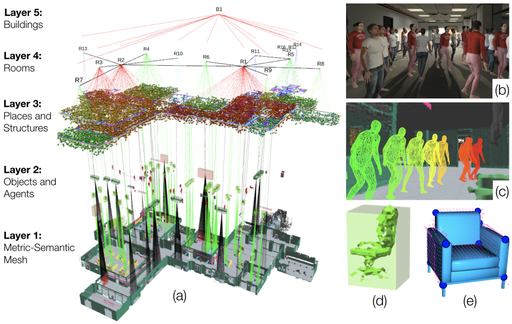
Figure 1 . (a) A 3D Dynamic Scene Graph (DSG) is a layered and hierarchical representation that abstracts a dense 3D model (e.g., a metric-semantic mesh) into higher-level spatial concepts (e.g., objects, agents, places, rooms) and models their spatio-temporal relations (e.g., “agent A is in room B at timet”). Kimera is the first Spatial Perception Engine that reconstructs a DSG from visual-inertial data, and (a) segments places, structures (e.g., walls), and rooms, (b) is robust to extremely crowded environments, (c) tracks dense mesh models of human agents in real time, (d) estimates centroids and bounding boxes of objects of unknown shape, (e) estimates the 3D pose of objects for which a CAD model is given.
원문 · CC BY 4.0 · Antoni Rosinol, Andrew Violette, Marcus Abate, Nathan Hughes, Yun Chang, Jingnan Shi, Arjun Gupta, Luca Carlone · Kimera: from SLAM to Spatial Perception with 3D Dynamic Scene Graphs · 원문 그림 인용 · 원본 PDF 4쪽에서 그림 영역을 추출했습니다.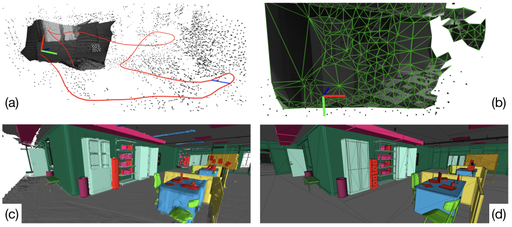
Figure 4 . Kimera-Core is an open-source library for real-time metric-semantic SLAM. It provides (a) visual-inertial state estimates at IMU rate (Kimera-VIO), and a globally consistent and outlier-robust trajectory estimate (Kimera-RPGO), computes (b) a low-latency local mesh of the scene (Kimera-Mesher), and builds (c) a semantically annotated 3D mesh (Kimera-Semantics), which can be optimized for global consistency (Kimera-PGMO) and accurately reflects the ground truth model (d).
원문 · CC BY 4.0 · Antoni Rosinol, Andrew Violette, Marcus Abate, Nathan Hughes, Yun Chang, Jingnan Shi, Arjun Gupta, Luca Carlone · Kimera: from SLAM to Spatial Perception with 3D Dynamic Scene Graphs · 원문 그림 인용 · 원본 PDF 6쪽에서 그림 영역을 추출했습니다.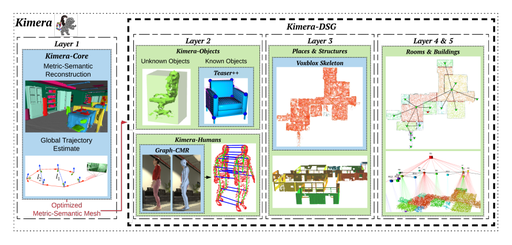
Figure 6 . Kimera’s architecture, with Kimera-Core and Kimera-DSG as sub-modules. Kimera-Core generates a globally consistent 3D metric-semantic mesh (Figure 5) that represents the first layer of the DSG and is further used by Kimera-DSG to build the subsequent layers. Kimera-DSG further comprises three key modules: Kimera-Objects, Kimera-Humans, and Kimera-BuildingParser (which generates layers 3 to 5).
원문 · CC BY 4.0 · Antoni Rosinol, Andrew Violette, Marcus Abate, Nathan Hughes, Yun Chang, Jingnan Shi, Arjun Gupta, Luca Carlone · Kimera: from SLAM to Spatial Perception with 3D Dynamic Scene Graphs · 원문 그림 인용 · 원본 PDF 7쪽에서 그림 영역을 추출했습니다.루프 클로저와 메시 변형
Kimera-Semantics가 만든 메시는 VIO 자세를 사용하므로 시간이 지나며 드리프트가 생깁니다. Kimera-PGMO는 루프 클로저로 궤적과 메시를 함께 보정합니다. 메시는 재구성하지 않고 변형 그래프를 통해 변형되며, 로봇 포즈 그래프와 단순화된 메시 정점을 하나의 변형 그래프에 묶어 단일 최적화로 궤적과 환경을 동시에 갱신합니다. 이 최적화는 포즈 그래프 최적화와 같은 형태로 재구성되어 GTSAM에서 풀립니다. Kimera-RPGO는 같은 PCM 기반 이상치 기각을 쓰되 메시를 최적화하지 않고 궤적만 최적화하므로, Kimera-PGMO는 이를 더 넓게 일반화한 방법으로 설명됩니다.
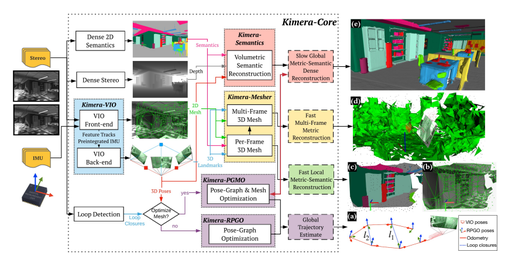
Figure 5 . Kimera-Core’s architecture. Kimera-Core uses stereo images (or RGB-D) and IMU data as input (shown on the left) and outputs (a) pose estimates and (b-e) multiple metric-semantic reconstructions. Kimera-Core has four key modules: Kimera-VIO, Kimera-PGMO (alternatively, Kimera-RPGO), Kimera-Mesher, and Kimera-Semantics.
원문 · CC BY 4.0 · Antoni Rosinol, Andrew Violette, Marcus Abate, Nathan Hughes, Yun Chang, Jingnan Shi, Arjun Gupta, Luca Carlone · Kimera: from SLAM to Spatial Perception with 3D Dynamic Scene Graphs · 원문 그림 인용 · 원본 PDF 6쪽에서 그림 영역을 추출했습니다.자세 추정과 루프 클로저 평가
EuRoC에서 Kimera-VIO와 Kimera-RPGO는 기존 VIO 및 루프 클로저 파이프라인과 비교되며, 절대 궤적 오차는 SE(3) 정렬 뒤 RMSE로 보고됩니다. 루프 클로저 임계값을 바꾼 실험에서 PCM을 쓰지 않은 PGO는 값이 1.59에서 0.45 사이로 크게 달라졌지만, PCM을 쓴 Kimera-RPGO는 임계값 전 범위에서 0.05로 유지되었습니다. 이는 PCM이 임계값 선택에 대한 민감도를 줄인다는 관찰로 읽어야 하며, 다른 데이터셋으로 일반화된 결론은 아닙니다. uHumans2의 Neighborhood와 Subway 장면에서는 누적 ATE가 커서 Kimera-PGMO가 Kimera-RPGO보다 낮은 오차를 보였지만, EuRoC에서는 DVIO가 이미 정확하여 개선 폭이 작았습니다.
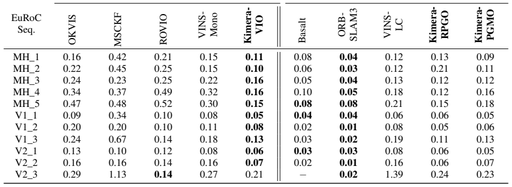
Table 1 . RMSE [m] for the absolute translation error (ATE) of state-of-the-art VIO pipelines (reported from (Delmerico and Scaramuzza 2018), and the results from the respective papers) compared to Kimera, on the EuRoC dataset. In bold the best result for each category: fixed-lag smoothing, and PGO with loop closure. − indicates missing data.
원문 · CC BY 4.0 · Antoni Rosinol, Andrew Violette, Marcus Abate, Nathan Hughes, Yun Chang, Jingnan Shi, Arjun Gupta, Luca Carlone · Kimera: from SLAM to Spatial Perception with 3D Dynamic Scene Graphs · 원문 그림 인용 · 원본 PDF 16쪽에서 그림 영역을 추출했습니다.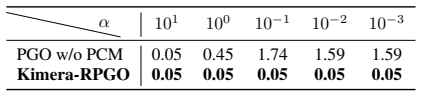
Table 2 . RMSE ATE [m] vs. loop closure thresholdα, on the V1_01 EuRoC dataset.
원문 · CC BY 4.0 · Antoni Rosinol, Andrew Violette, Marcus Abate, Nathan Hughes, Yun Chang, Jingnan Shi, Arjun Gupta, Luca Carlone · Kimera: from SLAM to Spatial Perception with 3D Dynamic Scene Graphs · 원문 그림 인용 · 원본 PDF 16쪽에서 그림 영역을 추출했습니다.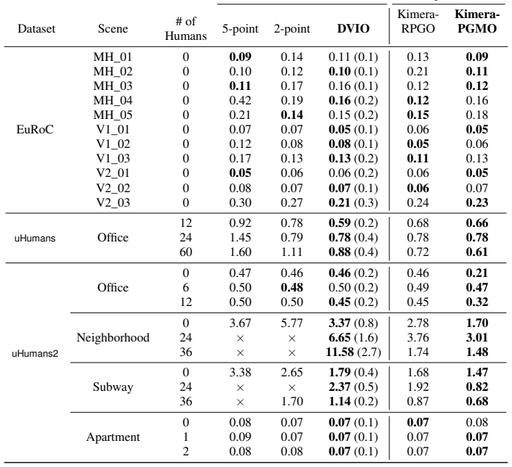
Table 4 . RMSE for the absolute translation error in meters when using 5-point, 2-point, and DVIO poses, as well as Kimera-RPGO and Kimera-PGMO’s optimized trajectory. We show the drift in % for DVIO to account for the length of the different trajectories.
원문 · CC BY 4.0 · Antoni Rosinol, Andrew Violette, Marcus Abate, Nathan Hughes, Yun Chang, Jingnan Shi, Arjun Gupta, Luca Carlone · Kimera: from SLAM to Spatial Perception with 3D Dynamic Scene Graphs · 원문 그림 인용 · 원본 PDF 18쪽에서 그림 영역을 추출했습니다.메트릭-의미 재구성과 시간 비용
Kimera-Semantics는 깊이 맵과 2D 의미 라벨을 사용해 볼륨 TSDF에 광선 묶음 단위로 확률을 누적하고, 최종 메시를 추출합니다. 시뮬레이션 실험에서 실제 깊이와 실제 자세를 쓰면 mIoU는 80.10%, 조밀 스테레오와 VIO를 쓰면 57.23%로 떨어졌으며, 저자들은 이 큰 하락을 텍스처가 없는 벽의 조밀 스테레오 오차 때문으로 해석합니다. 시간 측면에서는 Kimera-Semantics의 메시 업데이트가 EuRoC에서 평균 약 0.1s가 걸리고, Kimera-Mesher는 이보다 두 자릿수 짧은 시간에 빠른 다중 프레임 메시를 만든다고 보고됩니다. 이 빠른 메시는 EuRoC 전 실험 기준으로 정확도가 낮다는 장단점이 함께 있습니다.
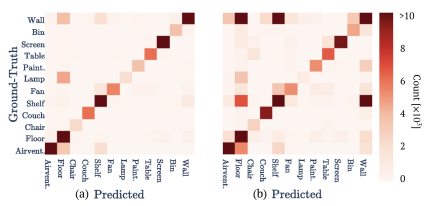
Figure 17 . Confusion matrices for Kimera-Semantics using bundled raycasting and (a) ground truth stereo depth or (b) dense stereo (H. Hirschmüller 2008). Both experiments use ground-truth 2D semantics. Values are saturated to 104 for visualization purposes.
원문 · CC BY 4.0 · Antoni Rosinol, Andrew Violette, Marcus Abate, Nathan Hughes, Yun Chang, Jingnan Shi, Arjun Gupta, Luca Carlone · Kimera: from SLAM to Spatial Perception with 3D Dynamic Scene Graphs · 원문 그림 인용 · 원본 PDF 17쪽에서 그림 영역을 추출했습니다.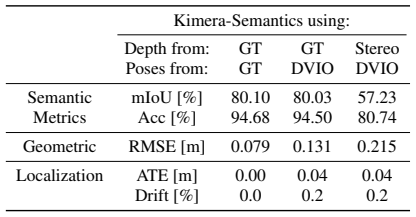
Table 6 . Evaluation of Kimera-Semantics using the simulated dataset from Rosinol et al. (2020a), which has no humans, using a combination of ground-truth (GT) and dense stereo (Stereo) depth maps, as well as ground-truth (GT) and DVIO (DVIO) poses.
원문 · CC BY 4.0 · Antoni Rosinol, Andrew Violette, Marcus Abate, Nathan Hughes, Yun Chang, Jingnan Shi, Arjun Gupta, Luca Carlone · Kimera: from SLAM to Spatial Perception with 3D Dynamic Scene Graphs · 원문 그림 인용 · 원본 PDF 19쪽에서 그림 영역을 추출했습니다.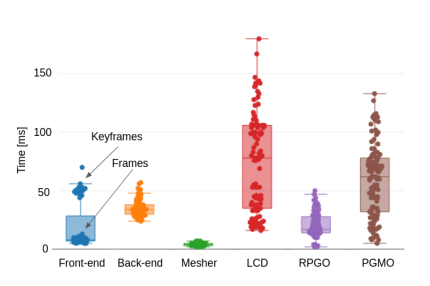
Figure 19 . Runtime breakdown for Kimera-VIO, Kimera-Mesher, loop-closure detection (LCD), Kimera-RPGO, and Kimera-PGMO. Note that the timing for Kimera-RPGO and Kimera-PGMO will increase with the size of the pose graph and the mesh. The timing here is collected on the EuRoC V1_01 dataset. The complete run of the dataset consists of 728 poses and 71 loop closures, and the final mesh has 324474 vertices.
원문 · CC BY 4.0 · Antoni Rosinol, Andrew Violette, Marcus Abate, Nathan Hughes, Yun Chang, Jingnan Shi, Arjun Gupta, Luca Carlone · Kimera: from SLAM to Spatial Perception with 3D Dynamic Scene Graphs · 원문 그림 인용 · 원본 PDF 21쪽에서 그림 영역을 추출했습니다.동적 장면과 객체·사람 노드
Kimera-Humans는 GraphCMR로 SMPL 메시를 추정하고, 사람마다 포즈 그래프를 유지하며 동일 인물을 연결합니다. 동적 마스킹은 사람으로 분류된 픽셀에서 자유 공간 정보만 써서 사람이 메시에 남기는 잔상을 줄입니다. 객체 노드는 형상 미지 객체에 바운딩 박스를, 형상 기지 객체에는 TEASER++로 CAD 모델을 정합합니다. 이 결과들은 uHumans와 uHumans2의 시뮬레이션 장면에서 얻은 것이며, 실제 데이터의 사람 추적이나 객체 정합에 그대로 적용된다고 볼 수는 없습니다.
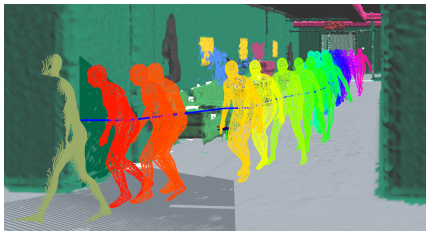
Figure 10 . Human Pose-Graph: Optimized pose-graph (blue line) for a single human. The detected human shape is shown as a 3D mesh, color-coded from the most recent detection in red to the oldest one in pink.
원문 · CC BY 4.0 · Antoni Rosinol, Andrew Violette, Marcus Abate, Nathan Hughes, Yun Chang, Jingnan Shi, Arjun Gupta, Luca Carlone · Kimera: from SLAM to Spatial Perception with 3D Dynamic Scene Graphs · 원문 그림 인용 · 원본 PDF 12쪽에서 그림 영역을 추출했습니다.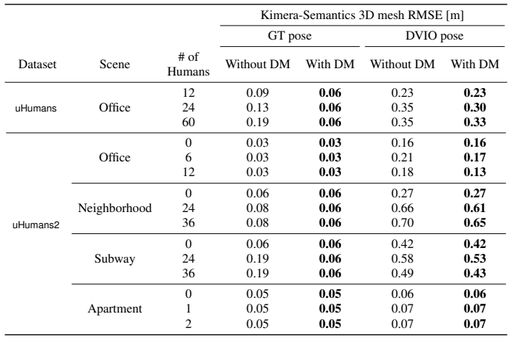
Table 5 . 3D Mesh RMSE in meters with and without Dynamic Masking (DM) for Kimera-Semantics when using ground-truth pose (GT pose) and DVIO’s estimated pose (DVIO pose) in theuHumans and uHumans2 datasets. The third column shows the number of humans in each scene (# of Humans).
원문 · CC BY 4.0 · Antoni Rosinol, Andrew Violette, Marcus Abate, Nathan Hughes, Yun Chang, Jingnan Shi, Arjun Gupta, Luca Carlone · Kimera: from SLAM to Spatial Perception with 3D Dynamic Scene Graphs · 원문 그림 인용 · 원본 PDF 18쪽에서 그림 영역을 추출했습니다.장소와 방 분할 및 계층 경로 계획
Kimera-BuildingParser는 ESDF의 2D 단면을 잘라 방 구조를 분할하고, 장소 노드를 방으로 라벨링합니다. Office와 Subway에서는 방 분할 정밀도와 재현율이 높게 보고되었지만, Apartment와 AeroAstro에서는 과분할이 나타났습니다. 계층 경로 계획은 건물, 방, 장소 순서로 A*를 적용해 ESDF 기반 계획보다 몇 자릿수 빠른 시간을 보고합니다. 다만 과분할로 방이 여러 개가 되면 경로 계획의 중간 단계가 늘어나며, 이 경우에도 실행 시간은 밀리초 단위로 남는다고 저자들이 해석합니다.
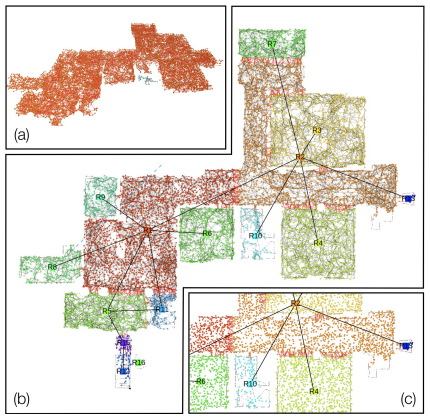
Figure 2 . Places and their connectivity shown as a graph. (a) Skeleton (places and topology) produced by (Oleynikova et al. 2018) (side view); (b) Room parsing produced by our approach (top-down view); (c) Zoomed-in view; red edges connect different rooms.
원문 · CC BY 4.0 · Antoni Rosinol, Andrew Violette, Marcus Abate, Nathan Hughes, Yun Chang, Jingnan Shi, Arjun Gupta, Luca Carlone · Kimera: from SLAM to Spatial Perception with 3D Dynamic Scene Graphs · 원문 그림 인용 · 원본 PDF 4쪽에서 그림 영역을 추출했습니다.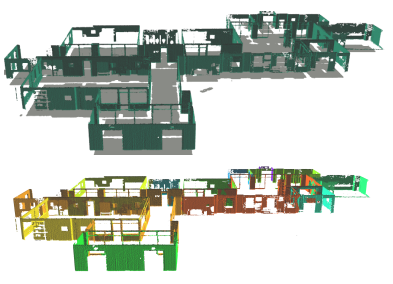
Figure 3 . Structures: exploded view of walls and floor (top). Segmented walls according to the room id (bottom).
원문 · CC BY 4.0 · Antoni Rosinol, Andrew Violette, Marcus Abate, Nathan Hughes, Yun Chang, Jingnan Shi, Arjun Gupta, Luca Carlone · Kimera: from SLAM to Spatial Perception with 3D Dynamic Scene Graphs · 원문 그림 인용 · 원본 PDF 5쪽에서 그림 영역을 추출했습니다.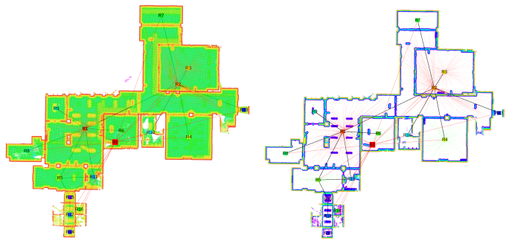
Figure 11 . (Left) 2D slice of 3D ESDF . The euclidean distance is color coded from red (0m) to green (0.5m). (Right) Truncated (≤ 0.10m) 2D ESDF , revealing the room’s contours. Overlaid in both figures are the estimated room layout (square nodes) and their connectivity (black edges).
원문 · CC BY 4.0 · Antoni Rosinol, Andrew Violette, Marcus Abate, Nathan Hughes, Yun Chang, Jingnan Shi, Arjun Gupta, Luca Carlone · Kimera: from SLAM to Spatial Perception with 3D Dynamic Scene Graphs · 원문 그림 인용 · 원본 PDF 13쪽에서 그림 영역을 추출했습니다.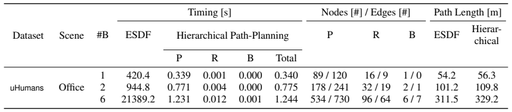
Table 9 . Hierarchical semantic path-planning using A* at different levels of abstraction. Planning at the level of buildings (B), rooms (R), and then places (P), in a hierarchical fashion, is several orders of magnitude faster than planning at the volumetric level (ESDF). We ‘copy-paste’ the 3D DSG of the office scene from uHumans to form a neighborhood of offices in a grid-like pattern where each office is a building; hence creating a scenario of a much larger scale. We also show the number of nodes and edges in the path, as well as the length of the estimated trajectories for comparison.
원문 · CC BY 4.0 · Antoni Rosinol, Andrew Violette, Marcus Abate, Nathan Hughes, Yun Chang, Jingnan Shi, Arjun Gupta, Luca Carlone · Kimera: from SLAM to Spatial Perception with 3D Dynamic Scene Graphs · 원문 그림 인용 · 원본 PDF 24쪽에서 그림 영역을 추출했습니다.한계와 적용 범위
이 논문의 주요 평가는 EuRoC, uHumans, uHumans2와 몇 개의 실제 수집 데이터에 한정되며, 실제 장면 중 일부는 과분할, 잡음, 불완전한 메시 같은 문제를 보였습니다. DSG 전체는 현재 구현에서 몇 분 단위로 계산되어 실시간 구축은 아직 과제로 남아 있습니다. 또한 객체·구조·방 층은 실행 종료 뒤 생성되어 완전한 실시간 DSG가 아니라는 점에 유의해야 합니다.
논문 정보
- 저자
- Antoni Rosinol, Andrew Violette, Marcus Abate, Nathan Hughes, Yun Chang, Jingnan Shi, Arjun Gupta, Luca Carlone
- 학회·저널
- arXiv · 프리프린트
- 최초 공개일
- 2021년 1월 18일
- 등록일
- 2026년 11월 6일
- 수정일
- 2021년 10월 20일
- 버전
- v3
- arXiv
- 2101.06894
- 분류
- cs.RO · cs.CV
- 원문 이용 조건
- CC BY 4.0
- 제공 범위
- 논문 정보, 해설, 허용된 원문 그림
AI 해설은 논문 원문과 별개의 설명이며 오류가 있을 수 있습니다. 원문과 그림은 각 출처의 이용 조건과 따로 표시된 권리를 따릅니다.
초록
Humans are able to form a complex mental model of the environment they move in. This mental model captures geometric and semantic aspects of the scene, describes the environment at multiple levels of abstractions (e.g., objects, rooms, buildings), includes static and dynamic entities and their relations (e.g., a person is in a room at a given time). In contrast, current robots' internal representations still provide a partial and fragmented understanding of the environment, either in the form of a sparse or dense set of geometric primitives (e.g., points, lines, planes, voxels) or as a collection of objects. This paper attempts to reduce the gap between robot and human perception by introducing a novel representation, a 3D Dynamic Scene Graph(DSG), that seamlessly captures metric and semantic aspects of a dynamic environment. A DSG is a layered graph where nodes represent spatial concepts at different levels of abstraction, and edges represent spatio-temporal relations among nodes. Our second contribution is Kimera, the first fully automatic method to build a DSG from visual-inertial data. Kimera includes state-of-the-art techniques for visual-inertial SLAM, metric-semantic 3D reconstruction, object localization, human pose and shape estimation, and scene parsing. Our third contribution is a comprehensive evaluation of Kimera in real-life datasets and photo-realistic simulations, including a newly released dataset, uHumans2, which simulates a collection of crowded indoor and outdoor scenes. Our evaluation shows that Kimera achieves state-of-the-art performance in visual-inertial SLAM, estimates an accurate 3D metric-semantic mesh model in real-time, and builds a DSG of a complex indoor environment with tens of objects and humans in minutes. Our final contribution shows how to use a DSG for real-time hierarchical semantic path-planning. The core modules in Kimera are open-source.
원문 인용
Antoni Rosinol, Andrew Violette, Marcus Abate, Nathan Hughes, Yun Chang, Jingnan Shi, Arjun Gupta, Luca Carlone (2021). Kimera: from SLAM to Spatial Perception with 3D Dynamic Scene Graphs. arXiv:2101.06894v3. https://arxiv.org/abs/2101.06894v3
BibTeX
@misc{rosinol2021kimera,
  title = {{Kimera: from SLAM to Spatial Perception with 3D Dynamic Scene Graphs}},
  author = {Antoni Rosinol and Andrew Violette and Marcus Abate and Nathan Hughes and Yun Chang and Jingnan Shi and Arjun Gupta and Luca Carlone},
  year = {2021},
  eprint = {2101.06894},
  archivePrefix = {arXiv},
  url = {https://arxiv.org/abs/2101.06894v3}
}