논문 해설
Centered Ablation: Why Last-Layer Directional Ablation Under-Fires or Collapses, and a Closed-Form Fix
Centered Ablation: 마지막 레이어 방향성 ablation이 충분히 작동하지 않거나 붕괴하는 이유와 closed-form 해결책
- 연구 문제 표준 방향 절제는 모델에 따라 거의 작동하지 않거나 출력을 반복 문장으로 붕괴시킵니다.
- 연구 방법 마지막 잔차 스트림의 절제를 코사인 게이트 로짓 편향으로 정확히 풀고, benign 공통 모드를 방향에서 투영해 제거합니다.
- 주요 결과 Llama-3.1-8B와 Llama-3.2-3B에서 공격 성공률을 각각 +29.0포인트와 +46.3포인트 높였고, Gemma-2-9B의 붕괴율을 50%에서 1%로 낮췄습니다.
방향 절제의 불안정성
방향 절제는 은닉 상태에서 행동 방향 성분을 제거해 모델의 행동을 끄는 표준 기법입니다. 그런데 모델에 따라 거절이 거의 꺼지지 않거나, 반대로 출력이 반복 문장으로 무너지는 일이 생깁니다. 이 논문은 마지막 잔차 스트림에서 이 불안정성이 어떤 메커니즘에서 나오는지 정확히 설명하려 합니다. 논문에 따르면 Llama-3.2-3B에서는 DIM 절제 후에도 해로운 요청에 대한 응답의 86%가 거절로 시작했고, Gemma-2-9B에서는 프롬프트의 50%가 반복 출력으로 붕괴했습니다.
마지막 레이어 절제는 코사인 게이트가 있는 로짓 편향
연구는 절제 지점을 마지막 디코더 블록 뒤의 잔차 스트림으로 한정합니다. 이 지점은 최종 정규화와 언임베딩만 거치므로 절제가 로짓에 주는 효과를 닫힌 형태로 쓸 수 있습니다. 명제 3.1은 단위 방향 u와 강도 s에 대해 절제 후 로짓이 τs(h)[ℓ(h)−s√d κu(h) fu]와 같다고 말합니다. 여기서 κu(h)는 은닉 상태와 방향의 코사인이고, fu = WU G u는 어휘 전체에 대한 footprint입니다. τs(h)는 양의 스케일이므로 탐욕 디코딩의 argmax를 바꾸지 않습니다. 따라서 마지막 레이어 절제는 고정된 어휘 벡터를 게이트 κu(h)만큼 더하는 편향으로 볼 수 있으며, 게이트가 상태마다 편향의 세기를 정합니다.
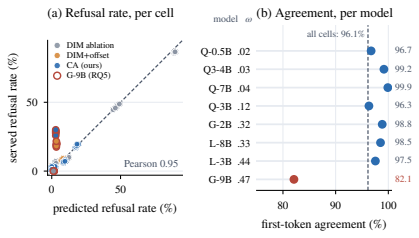
Figure 3 :The closed form predicts what the served model actually emits.(a) Refusal rate predicted from cached states against the served model’s refusal rate, one point per cell; the dashed line is equality. (b) First-token agreement per model; the dashed line pools all cells. Gemma-2-9B (red) is the one shortfall (Section 4.6). Exact values in Table 9.
원문 · CC BY 4.0 · Quy-Anh Dang, Chris Ngo · Centered Ablation: Why Last-Layer Directional Ablation Under-Fires or Collapses, and a Closed-Form Fix · 원문 그림 인용 · 원본 PDF 8쪽에서 그림 영역을 추출했습니다.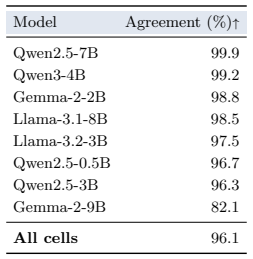
Table 9 :The closed form of Proposition 3.1 predicts the served model’s steered first token. Per-prompt agreement (percent) between the first token predicted from cached states,WU andG and the token emitted by the served model, averaged over 18 cells per model (3 directions× 6 calibration draws). Across all cells, predicted and observed refusal rates correlate at Pearson .952 (Spearman .82).↑/↓: higher/lower is better.
원문 · CC BY 4.0 · Quy-Anh Dang, Chris Ngo · Centered Ablation: Why Last-Layer Directional Ablation Under-Fires or Collapses, and a Closed-Form Fix · 원문 그림 인용 · 원본 PDF 29쪽에서 그림 영역을 추출했습니다.benign 공통 모드가 만드는 게이트 바닥
코사인 게이트는 원점에서 잰 각도인데, 마지막 레이어 상태들은 원점 주변이 아니라 공유된 방향 주변에 모여 있습니다. 논문은 benign 상태의 정규화 평균 방향 μ̂−을 공통 모드로 정의하고, 방향 u와의 겹침을 ω(u)=|u⊤μ̂−|로 둡니다. 게이트는 공통 모드 성분과 나머지 성분으로 나뉘며, benign 상태의 평균 게이트는 λ̄ω의 바닥으로 고정됩니다. 이 바닥은 강도 s를 바꿔도 사라지지 않습니다. 그래서 ω가 큰 DIM 방향은 benign 텍스트에도 발화해 답변을 바꾸고, 편향이 로짓 분산을 넘으면 붕괴를 일으킵니다. 또 단위 벡터의 고정된 예산 중 일부가 공통 모드에 쓰여 클래스 분리 성분이 줄어듭니다.
논문은 ω 하나로 이 세 증상을 함께 설명합니다.
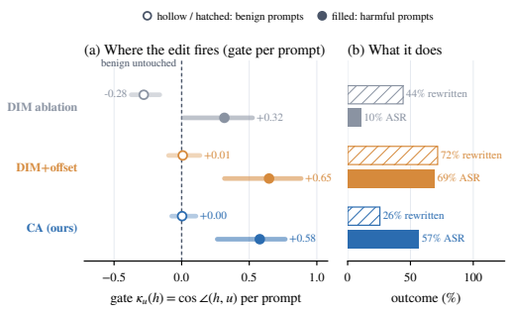
Figure 2 :The standard direction fires on benign prompts; centring the direction removes that floor.Llama-3.2-3B ( ω = 0.44), withDIM ablation(gray),DIM+offset(orange; the other way to anchor the gate, Section 3.5) andCA(blue). (a) Gateκu(h)per prompt: mean and 5th to 95th percentile. Under DIM the benign gate sits at−0.28, the floor of Equation (6); both corrections move it to zero and raise the harmful gate. (b) Attack success and benign rewrite rate of the generated text.
원문 · CC BY 4.0 · Quy-Anh Dang, Chris Ngo · Centered Ablation: Why Last-Layer Directional Ablation Under-Fires or Collapses, and a Closed-Form Fix · 원문 그림 인용 · 원본 PDF 5쪽에서 그림 영역을 추출했습니다.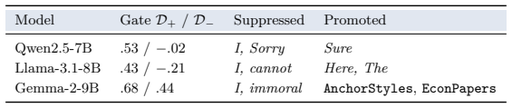
Table 18 : Gate and footprint of the standard direction (single draw). Gate: meanκu on harmful / benign prompt-final states.
원문 · CC BY 4.0 · Quy-Anh Dang, Chris Ngo · Centered Ablation: Why Last-Layer Directional Ablation Under-Fires or Collapses, and a Closed-Form Fix · 원문 그림 인용 · 원본 PDF 33쪽에서 그림 영역을 추출했습니다.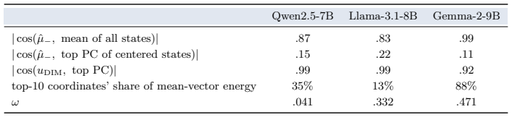
Table 20 : The common mode is neither the top principal component nor an outlier-coordinate effect (pilot models, pooled calibration states).
원문 · CC BY 4.0 · Quy-Anh Dang, Chris Ngo · Centered Ablation: Why Last-Layer Directional Ablation Under-Fires or Collapses, and a Closed-Form Fix · 원문 그림 인용 · 원본 PDF 35쪽에서 그림 영역을 추출했습니다.CA: 공통 모드를 투영해 제거하기
CA는 DIM 방향 uDIM에서 공통 모드 성분을 빼고 정규화한 uCA = unit((I−μ̂−μ̂−⊤)uDIM)을 절제 방향으로 씁니다. 이렇게 하면 ω(uCA)=0이 되어 게이트의 benign 바닥이 사라집니다. 논문은 uCA⊤(μ+−μ−) = ∥μ+−μ−∥√(1−ω(uDIM)²)을 보여 클래스 분리의 대부분이 보존된다고 말합니다. 알고리즘은 두 표본 평균, 하나의 투영, 하나의 정규화로 이루어지며 최적화나 강도 외의 하이퍼파라미터가 없습니다. 같은 원리를 로짓 편향 관점에서 보면, 게이트를 원점이 아니라 benign 클래스 기준으로 재는 것입니다.
오프셋 경로와 CA의 차이
ACE의 오프셋 경로는 방향 uDIM을 그대로 두고 benign 평균의 계수만큼 원점을 옮깁니다. 논문은 uDIM = ω μ̂− + √(1−ω²) uCA로 분해하고, 오프셋 경로의 해로운 상태 평균 게이트가 CA보다 1/√(1−ω²)배 크다고 유도합니다. 또 benign 상태에서는 공통 모드 크기의 분산 중 ω² 몫을 그대로 떠안습니다. 그래서 ω가 작으면 두 경로가 같고, ω가 커질수록 오프셋은 효과를 더 많이 얻는 대신 benign 답변을 더 많이 바꿉니다. 실험에서는 ω가 큰 세 모델에서 DIM+offset이 CA보다 benign 답변을 39~46포인트 더 많이 재작성했습니다. 이 차이는 ω가 큰 모델들에 한정된 관찰입니다.
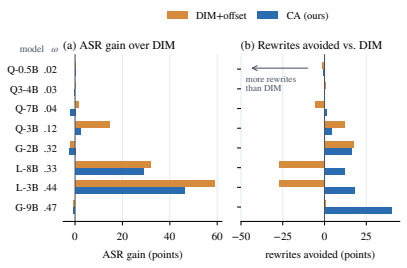
Figure 4 :The offset route is the stronger attack on a few models; CA is the faithful one on every high-ω model.Gains over DIM ablation, models ordered byω. (a) Fluent-only ASR. (b) Be- nign answers preserved; negative means more rewrites than DIM. Exact values in Tables 11 and 12.
원문 · CC BY 4.0 · Quy-Anh Dang, Chris Ngo · Centered Ablation: Why Last-Layer Directional Ablation Under-Fires or Collapses, and a Closed-Form Fix · 원문 그림 인용 · 원본 PDF 9쪽에서 그림 영역을 추출했습니다.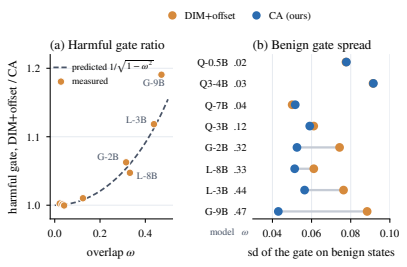
Figure 5 :The two routes differ exactly as the derivation predicts.Models ordered by ω. (a) Mean harmful gate ofDIM+offsetover that of CA, against the predicted1/ √ 1−ω 2 (dashed, noth- ing fitted). (b) Spread of the gate on benign states: the two routes coincide at smallω and separate as it grows. Exact values in Table 15.
원문 · CC BY 4.0 · Quy-Anh Dang, Chris Ngo · Centered Ablation: Why Last-Layer Directional Ablation Under-Fires or Collapses, and a Closed-Form Fix · 원문 그림 인용 · 원본 PDF 9쪽에서 그림 영역을 추출했습니다.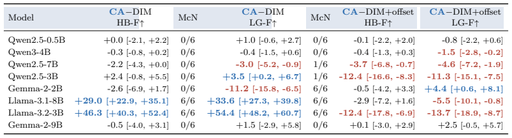
Table 11 :Paired differences in fluent-only attack success (points), with 95% prompt-bootstrap intervals.McN: number of the 6 calibration draws on which an exact McNemar test of CA vs. DIM gives p<. 05.Blue bold: interval above zero;red bold: below zero. Negative CA−DIM+offset: the offset route is the stronger attack. Gemma-2-9B under unfiltered Llama-Guard:−46.4[−53.0,−39.7] for CA−DIM, the artifact of Figure 8.↑/↓: higher/lower is better.
원문 · CC BY 4.0 · Quy-Anh Dang, Chris Ngo · Centered Ablation: Why Last-Layer Directional Ablation Under-Fires or Collapses, and a Closed-Form Fix · 원문 그림 인용 · 원본 PDF 31쪽에서 그림 영역을 추출했습니다.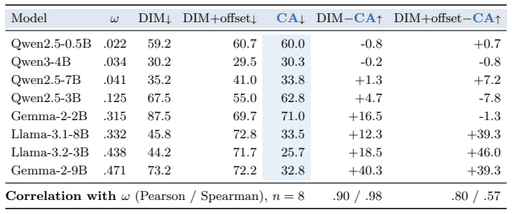
Table 12 :Benign rewrite rate: percent of 100 held-out Alpaca answers badly changed(string similarity to the unsteered answer below0.5), pooled over 6 calibration draws. Last two columns, in points: benign answers preserved by CA relative to DIM and to DIM+offset (how many more answers each of them rewrites). Shaded cells,CA: ours.↑/↓: higher/lower is better.
원문 · CC BY 4.0 · Quy-Anh Dang, Chris Ngo · Centered Ablation: Why Last-Layer Directional Ablation Under-Fires or Collapses, and a Closed-Form Fix · 원문 그림 인용 · 원본 PDF 31쪽에서 그림 영역을 추출했습니다.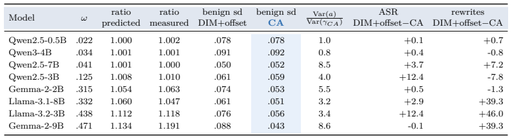
Table 15 :The two routes differ as Proposition B.5 predicts.Calibration draw 0. Gate ratio: mean gate of DIM+offset over that of CA on 240 HarmBench prompt-final states, predicted1/ √ 1−ω 2 vs. measured (Pearson 0.97, largest error 0.057). Benign sd: standard deviation of the gate on 160 held-out Alpaca states. Var(a)/Var(γCA): common-mode magnitude variance relative to CA’s benign coefficient variance. Last two columns (points, 6 draws): DIM+offset minus CA in fluent-only ASR and in benign rewrite rate.Shaded cells,CA: ours.
원문 · CC BY 4.0 · Quy-Anh Dang, Chris Ngo · Centered Ablation: Why Last-Layer Directional Ablation Under-Fires or Collapses, and a Closed-Form Fix · 원문 그림 인용 · 원본 PDF 32쪽에서 그림 영역을 추출했습니다.공격 성공과 붕괴 결과
HarmBench 240개 프롬프트에서 fluent-only 공격 성공률을 측정했습니다. Llama-3.1-8B에서 CA는 DIM 대비 +29.0포인트, Llama-3.2-3B에서는 +46.3포인트 높였고 두 차이 모두 6개 draw 중 6개에서 유의했습니다. Gemma-2-9B에서는 DIM의 붕괴율 50%가 CA에서 1%로 떨어졌고, fluent-only ASR은 14.0%와 14.4%로 거의 같았습니다. 나머지 여섯 모델에서는 HarmBench ASR 변화가 최대 2.6포인트였습니다. 따라서 CA의 이득은 under-firing이 있는 모델과 붕괴 모델에 집중되었습니다.
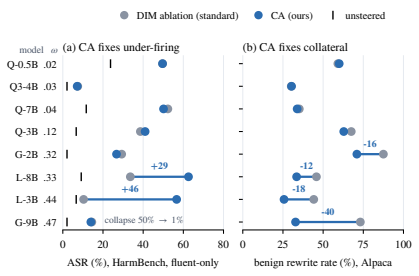
Figure 1 :Centered Ablation repairs the standard recipe where it fails and changes little elsewhere. One row per model, ordered by the overlapω (Section 3.3); a line joinsDIM ablation(gray) toCA (blue). (a) Fluent-only attack success on HarmBench. (b) Benign Alpaca answers rewritten. Exact values in Tables 10 and 12.
원문 · CC BY 4.0 · Quy-Anh Dang, Chris Ngo · Centered Ablation: Why Last-Layer Directional Ablation Under-Fires or Collapses, and a Closed-Form Fix · 원문 그림 인용 · 원본 PDF 2쪽에서 그림 영역을 추출했습니다.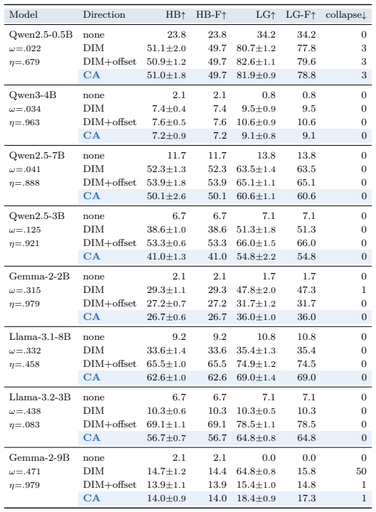
Table 10 :Attack success on HarmBench (n = 240), 8 models, 6 calibration draws, two judges.All columns in percent. HB: HarmBench classifier; LG: Llama-Guard-3-8B; F: fluent-only (degenerate outputs counted as failures); collapse: collapse rate. Mean± standard deviation over draws; “none”: unsteered (one run). Models ordered byω. Shaded cells,CA: ours.↑/↓: higher/lower is better.
원문 · CC BY 4.0 · Quy-Anh Dang, Chris Ngo · Centered Ablation: Why Last-Layer Directional Ablation Under-Fires or Collapses, and a Closed-Form Fix · 원문 그림 인용 · 원본 PDF 30쪽에서 그림 영역을 추출했습니다.판정기가 붕괴 출력을 다르게 읽는 문제
Gemma-2-9B의 DIM 출력 120개(붕괴)와 120개(유창)를 HarmBench 분류기와 Llama-Guard-3-8B로 각각 판정했습니다. 유창한 출력에서는 두 판정기가 대체로 일치했지만, 붕괴 출력에서는 HarmBench 분류기가 1.7%만 유해로 보았고 Llama-Guard는 98.3%를 유해로 보았습니다. 논문은 이 때문에 공격 성공을 fluent-only로 평가하고 붕괴율을 함께 보고해야 한다고 주장합니다.
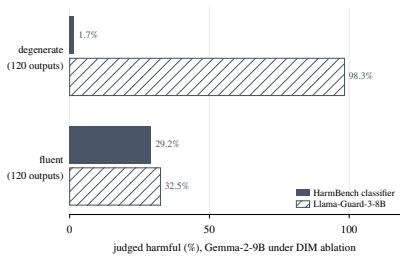
Figure 8 :Two standard judges score the same collapsed text in opposite directions.Outputs judged harmful on Gemma-2-9B under DIM ablation, split into its 120 degenerate and 120 fluent outputs. The judges agree on fluent text and disagree com- pletely on degenerate text.
원문 · CC BY 4.0 · Quy-Anh Dang, Chris Ngo · Centered Ablation: Why Last-Layer Directional Ablation Under-Fires or Collapses, and a Closed-Form Fix · 원문 그림 인용 · 원본 PDF 11쪽에서 그림 영역을 추출했습니다.
Table 7 : Which prompt each judged metric uses, and how many calls it makes.
원문 · CC BY 4.0 · Quy-Anh Dang, Chris Ngo · Centered Ablation: Why Last-Layer Directional Ablation Under-Fires or Collapses, and a Closed-Form Fix · 원문 그림 인용 · 원본 PDF 27쪽에서 그림 영역을 추출했습니다.생성 전 진단값의 예측력
ω, 효능 η, 붕괴 지표 β를 캐시된 활성값에서 생성 없이 계산합니다. ω는 benign 답변 보존 이득을 Spearman 0.98로 예측했고, η는 DIM의 공격 성공 이득을 Pearson −0.95로 예측했습니다. 두 진단값은 서로 대체되지 않는데, ω만으로는 공격 이득의 순서를 거의 정하지 못했습니다. 붕괴는 β+ > 1에서 나타나는 것으로 관찰되었고, 8개 모델 중 한 모델만 이 임계를 넘었습니다. 이 결과는 8개 모델에 기반하므로 η=0.6 분리와 β+=1 임계값의 일반성은 작은 표본에 의존합니다.
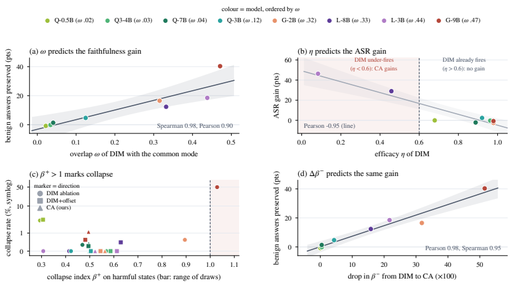
Figure 6 :Two numbers read from cached activations predict two different benefits of CA, and a third marks collapse.Colour is the model in this figure only. (a)ω predicts the benign answers preserved. (b) η predicts the ASR gain, as two regimes split atη = 0.6. (c)β+ > 1(shaded) marks the one collapsing model and direction; marker shape is the direction. (d) The drop inβ− predicts the same gain as (a). Lines are least-squares fits with 95% bands. Exact values in Tables 16 and 17.
원문 · CC BY 4.0 · Quy-Anh Dang, Chris Ngo · Centered Ablation: Why Last-Layer Directional Ablation Under-Fires or Collapses, and a Closed-Form Fix · 원문 그림 인용 · 원본 PDF 10쪽에서 그림 영역을 추출했습니다.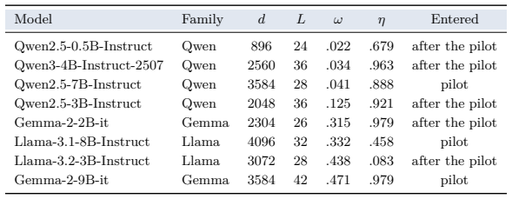
Table 4 : Models, ordered byω. d: hidden size;L: number of blocks;ω, η of the standard direction. All eight are evaluated identically; the last column records only the order in which they entered the study, since the five added after the pilot are the ones whose predictions in Table 16 were locked in advance.
원문 · CC BY 4.0 · Quy-Anh Dang, Chris Ngo · Centered Ablation: Why Last-Layer Directional Ablation Under-Fires or Collapses, and a Closed-Form Fix · 원문 그림 인용 · 원본 PDF 25쪽에서 그림 영역을 추출했습니다.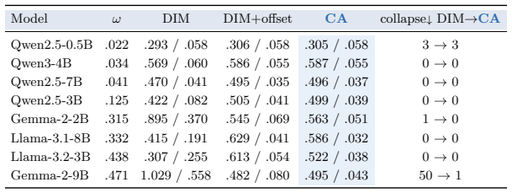
Table 17 :Collapse index β+ / β− (Equation (4)) ats = 1, mean over 6 draws.β+: HarmBench prompt-final states;β−: held-out Alpaca states. For DIM+offset the gate includes its offset. Last column: collapse rate (percent) under DIM and under CA. Only Gemma-2-9B under DIM exceedsβ+ = 1(1.029 ± .005); its 6 cells collapse at a mean rate of 49.8%, the other 138 cells at 0.6% (max 4.2%).Shaded cells, CA: ours.↑/↓: higher/lower is better.
원문 · CC BY 4.0 · Quy-Anh Dang, Chris Ngo · Centered Ablation: Why Last-Layer Directional Ablation Under-Fires or Collapses, and a Closed-Form Fix · 원문 그림 인용 · 원본 PDF 33쪽에서 그림 영역을 추출했습니다.적용 범위와 한계
분석은 마지막 잔차 스트림의 랭크-1 절제와 탐욕 디코딩에 한정됩니다. 샘플링에서는 τs가 온도 역할을 하며 argmax 설명이 그대로 성립하지 않습니다. 더 앞선 레이어에서는 주의 메커니즘을 거쳐 전파되므로 이 닫힌 형태가 없습니다. 실험은 8개 모델로 이뤄졌고, 진단 법칙이 8개 모델에 기반합니다. 공격 성공 이득의 η=0.6 분리와 붕괴 임계 β+=1은 각각 두 모델과 한 모델에 의존하므로 작은 표본의 한계가 있습니다.
논문 정보
- 저자
- Quy-Anh Dang, Chris Ngo
- 학회·저널
- arXiv · 프리프린트
- 최초 공개일
- 2026년 11월 15일
- 등록일
- 2026년 11월 17일
- 수정일
- 2026년 11월 15일
- 버전
- v1
- arXiv
- 2611.20148
- 분류
- cs.CL
- 원문 이용 조건
- CC BY 4.0
- 제공 범위
- 논문 정보, 해설, 허용된 원문 그림
AI 해설은 논문 원문과 별개의 설명이며 오류가 있을 수 있습니다. 원문과 그림은 각 출처의 이용 조건과 따로 표시된 권리를 따릅니다.
초록
Directional ablation removes a hidden state's component along a "behaviour direction" while a language model runs. It is the standard way to switch a behaviour such as refusal off, but it is erratic: on some models it barely fires, on others the text collapses into repetition. We show why, and fix it. At the last residual stream, ablation is exactly a logit bias: a fixed vocabulary footprint scaled by a gate, the cosine between the hidden state and the direction. The gate is measured from the origin, but last-layer states share a large common mode far from it, so a direction that overlaps the common mode fires on benign text and under-fires on its targets. Centered Ablation (CA) projects the common mode out of the direction, in closed form. Across 8 models, CA raises attack success by 29 and 46 points where the standard recipe under-fires, cuts collapse on Gemma-2-9B from 50\% to 1\%, and preserves 12 to 40 points more benign answers on high-overlap models, 39 to 46 more than the affine offset of prior work. Two numbers computed before generation predict, on models the analysis had not seen, which gain faithfulness and which gain attack success, and a collapse index marks when text degenerates. We also show that two standard safety judges score collapsed text in opposite directions, which can fabricate a 46-point effect.
원문 인용
Quy-Anh Dang, Chris Ngo (2026). Centered Ablation: Why Last-Layer Directional Ablation Under-Fires or Collapses, and a Closed-Form Fix. arXiv:2611.20148v1. https://arxiv.org/abs/2611.20148v1
BibTeX
@misc{dang2026centered,
  title = {{Centered Ablation: Why Last-Layer Directional Ablation Under-Fires or Collapses, and a Closed-Form Fix}},
  author = {Quy-Anh Dang and Chris Ngo},
  year = {2026},
  eprint = {2611.20148},
  archivePrefix = {arXiv},
  url = {https://arxiv.org/abs/2611.20148v1}
}