논문 해설
MathaMAGICal: Validating Trajectory Data Attribution During Capability Acquisition
MathaMAGICal: 능력 습득 과정에서 궤적 데이터 어트리뷰션 검증
- 연구 문제 MAGIC 같은 궤적 어트리뷰션 점수가 실제 데이터 제거 시 재학습 결과를 예측하는지는 재학습으로만 확인할 수 있어 검증 조건이 불분명합니다.
- 연구 방법 학습 실행 전체를 미분하는 대신 체크포인트에서 100스텝 윈도우만 미분해 MAGIC 점수를 계산하고, 블록 부분집합 재학습으로 LDS를 측정합니다.
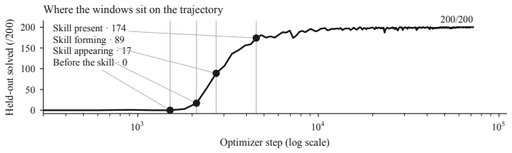
Figure 3 : Held-out accuracy of 152M web+math. Each window attributes 100 steps from its marked checkpoint; the model reaches200/200by a third of training and holds it.
원문 · CC BY 4.0 · Jason Lee, Dikshanta Pokhrel, Phonn Nay Khant, Victor Lee, Moritz Weckbecker, Sebastian Lapuschkin, Wojciech Samek, Mark Riedl, Glenn Matlin · MathaMAGICal: Validating Trajectory Data Attribution During Capability Acquisition · 원문 그림 인용 · 원본 PDF 3쪽에서 그림 영역을 추출했습니다.궤적 어트리뷰션을 재학습으로 검증해야 하는 이유
학습 데이터 한 블록을 빼면 held-out 손실이 어떻게 변할지 묻는 것이 이 논문의 출발점입니다. MAGIC은 학습 경로를 따라 실행된 옵티마이저 업데이트를 미분해 이 변화를 1차 근사로 계산합니다. 그러나 이 점수가 실제로 재학습 결과와 맞는지는 재학습으로만 확인할 수 있습니다. 논문은 86M과 152M의 GPT-2 형식 모델을 웹 텍스트와 네 가지 합성 산술 패밀리 혼합으로 처음부터 학습하며, 점수 타당성이 어떤 학습 구간과 조건에서 유지되는지 묻습니다.
짧은 체크포인트 윈도우와 전체 실행 unrolling
전체 실행 방식은 처음부터 끝까지 메타그래디언트를 역방향으로 전달합니다. 짧은 윈도우 방식은 저장된 체크포인트에서 100 스텝만 이어 학습하고, 그 구간의 스텝만 bergson으로 미분해 블록별 점수를 얻습니다. 점수는 512토큰 블록마다 하나씩 주어지며, 양의 점수는 제거 시 held-out 손실이 낮아지는 해로운 블록을 뜻합니다.
재학습 검증과 LDS 측정
검증 절차는 블록 부분집합을 제거하고 같은 체크포인트에서 다시 학습한 뒤, 예측 점수 합과 관찰된 손실 변화의 순위 상관을 계산하는 것입니다. 이 순위 상관이 선형 데이터모델링 점수(LDS)이며 1은 완전한 순위 일치, 0은 우연 수준입니다. 152M 주 실험에서는 블록의 1%를 제거한 48개 부분집합과 질의 8개를 사용했습니다. 86M 전체 실행의 클리핑 버전은 LDS가 0.217과 0.168로, 비유한 점수를 없앤 것만으로는 재학습 예측이 보장되지 않음을 보였습니다.
152M 짧은 윈도우의 검증 결과
152M web+math 모델은 전체 학습의 약 1/3 지점에서 held-out 정확도 200/200에 도달했습니다. 네 개의 100스텝 윈도우는 기술 이전 단계, 기술 출현, 형성, 존재 시점에서 측정되었고 중앙값 LDS는 모두 0.86 이상, 세 곳에서 0.99 이상이었습니다. 같은 재학습 부분집합에서 단일 체크포인트 gradient-dot 베이스라인은 거의 0에 가까운 LDS를 보여, unrolled MAGIC의 0.57–0.99와 차이가 컸습니다.
블록 순위와 패밀리 수준 민감도의 전이
개별 블록 순위는 같은 실행 안에서는 재학습을 예측했지만, 시드·배치 크기·옵티마이저를 바꾼 동일 블록에서는 Spearman 상관이 −0.01에서 +0.09 사이로 떨어졌습니다. 반면 워크드 예시와 프리미티브 팩트는 가장 도움이 되는 5% 꼬리와 가장 해로운 5% 꼬리 모두에서 코퍼스 비율의 2.1–2.6배로 나타났습니다. 저자들은 이를 큰 분산에서 나온 양방향 국소 민감도로 해석하며, 평균적 유익성과는 구분합니다.
다중 에포크 패밀리 삭제와 적용 범위
패밀리를 통째로 삭제하고 여러 에포크 재학습한 결과, 워크드 예시 삭제는 정확도를 0/200으로 떨어뜨렸고 프리미티브 팩트 삭제는 126/200을 기록했습니다. 또 웹 텍스트 제거는 산술 비율을 50.0%에서 57.1%로 바꾸어 15.0문제의 이득과 교란됩니다. 대부분의 윈도우 구성은 시드 하나를 사용하므로 교차 실행 주장은 패밀리 수준으로 제한됩니다.
논문 정보
- 저자
- Jason Lee, Dikshanta Pokhrel, Phonn Nay Khant, Victor Lee, Moritz Weckbecker, Sebastian Lapuschkin, Wojciech Samek, Mark Riedl, Glenn Matlin
- 학회·저널
- arXiv · 프리프린트
- 최초 공개일
- 2026년 11월 15일
- 등록일
- 2026년 11월 17일
- 수정일
- 2026년 11월 15일
- 버전
- v1
- arXiv
- 2611.19692
- 분류
- cs.LG · cs.AI · cs.CL
- 원문 이용 조건
- CC BY 4.0
- 제공 범위
- 논문 정보, 해설, 허용된 원문 그림
AI 해설은 논문 원문과 별개의 설명이며 오류가 있을 수 있습니다. 원문과 그림은 각 출처의 이용 조건과 따로 표시된 권리를 따릅니다.
초록
Influence-function-based methods like MAGIC provide exact first-order scores for trajectory data attribution, yet only retraining indicates whether those scores accurately predict data removal. We evaluate MAGIC on $86$M- and $152$M-parameter GPT-2-style models learning multistep arithmetic from scratch on filtered web text and four synthetic math families. Full-run attribution at $86$M suffers from numerical overflow, and even with metagradient clipping, scores correlate near chance with retraining (linear datamodeling score, LDS, $0.17$--$0.22$). In contrast, short checkpoint windows yield stable, accurate predictions at both scales (LDS $0.86$--$0.99$ across four $100$-step windows at $152$M), whereas a single-checkpoint gradient-dot baseline shows near-zero correlation. Rankings of individual training blocks predict retraining only within that single run and do not transfer across seeds or hyperparameters ($ρ\le 0.09$), whereas format-level patterns replicate across runs. Two data families, worked examples and primitive facts, occupy $2.1$--$2.6\times$ their corpus share in both the helpful and harmful $5\%$ score tails, reflecting strong bidirectional local sensitivity distinct from net benefit under multi-epoch family deletion. These results show that trajectory attribution is reliable within short, validated windows and yields family-level insights that generalize across runs.
원문 인용
Jason Lee, Dikshanta Pokhrel, Phonn Nay Khant, Victor Lee, Moritz Weckbecker, Sebastian Lapuschkin, Wojciech Samek, Mark Riedl, Glenn Matlin (2026). MathaMAGICal: Validating Trajectory Data Attribution During Capability Acquisition. arXiv:2611.19692v1. https://arxiv.org/abs/2611.19692v1
BibTeX
@misc{lee2026mathamagical,
  title = {{MathaMAGICal: Validating Trajectory Data Attribution During Capability Acquisition}},
  author = {Jason Lee and Dikshanta Pokhrel and Phonn Nay Khant and Victor Lee and Moritz Weckbecker and Sebastian Lapuschkin and Wojciech Samek and Mark Riedl and Glenn Matlin},
  year = {2026},
  eprint = {2611.19692},
  archivePrefix = {arXiv},
  url = {https://arxiv.org/abs/2611.19692v1}
}