논문 해설
Proximity Perception in Human-Centered Robotics: A Survey on Sensing Systems and Applications
인간 중심 로보틱스에서의 근접 인지: 센싱 시스템과 응용에 관한 서베이
- 연구 문제 근접 센서는 접촉 전 물체를 감지해 시각과 촉각의 공백을 메우는 감각으로, 인간 중심 로봇의 안전과 파지에 쓰입니다.
- 연구 방법 논문은 근접 센서 응용을 AT-I와 AT-II로, 행동을 반응형과 인지형으로 나누고 감지 원리별 특성을 정리합니다.
- 주요 결과 정전용량·광학·레이더·초음파 등 원리별 특성과 한계, 반응형 예비 형상화와 안전 분리 거리 식이 주요 내용으로 제시됩니다.
근접 감지가 필요한 이유
인간 중심 로봇은 카메라가 가려지는 상황과 접촉 이전의 상호작용을 함께 다뤄야 합니다. 원문은 근접 센서를 비접촉으로 물체를 감지하고, 시각과 촉각 사이의 감지 공백을 메우는 감각으로 설명합니다. 접촉 후에만 감지하는 촉각 피부는 로봇 속도를 크게 낮춰야 하므로, 접촉 이전 단계의 감지가 필요하다는 점이 문제의 출발점입니다. 이 서베이는 이러한 센서의 응용을 AT-I와 AT-II로 나누고, 감지 원리와 행동 복잡도를 기준으로 정리합니다.
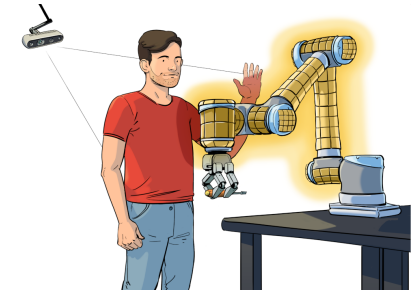
Fig. 1 . A robot skin with proximity sensing capability can be deployed in scenarios with intense human-robot interaction and collaboration. The skin helps closing the gap between vision-based perception and tactile/force perception.
원문 · CC BY 4.0 · Stefan Escaida Navarro, Stephan Mühlbacher-Karrer, Hosam Alagi, Hubert Zangl, Keisuke Koyama, Björn Hein, Christian Duriez, Joshua R. Smith · Proximity Perception in Human-Centered Robotics: A Survey on Sensing Systems and Applications · 원문 그림 인용 · 원본 PDF 1쪽에서 그림 영역을 추출했습니다.응용과 행동의 분류
논문은 근접 센서 응용을 매니퓰레이터 링크를 덮는 안전·상호작용 응용(AT-I)과 그리퍼나 손에 센서를 두어 파지와 탐색을 지원하는 응용(AT-II)으로 구분합니다. 행동은 반응형 또는 반사형 행동(BT-I)과 인지형 또는 모델 기반 행동(BT-II)으로 나뉩니다. 저자들은 이 범주화가 여러 연구를 한 틀에서 비교하기 위한 기준이라고 제시합니다.
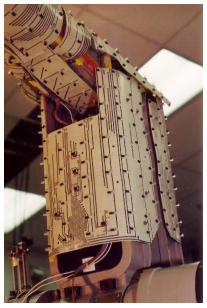
Fig. 9 . Using flexible circuit boards, Lumelsky and Cheung show the real- ization of a proximity skin covering whole manipulator arm as discussed for instance in [53].Sensor type: O-RLI (Photo courtesy of www.edcheung.com)
원문 · CC BY 4.0 · Stefan Escaida Navarro, Stephan Mühlbacher-Karrer, Hosam Alagi, Hubert Zangl, Keisuke Koyama, Björn Hein, Christian Duriez, Joshua R. Smith · Proximity Perception in Human-Centered Robotics: A Survey on Sensing Systems and Applications · 원문 그림 인용 · 원본 PDF 7쪽에서 그림 영역을 추출했습니다.감지 원리별 특성
정전용량 감지는 전극으로 전기장을 만들고 물체가 그 장에 주는 변화를 측정합니다. 단일 종단 모드(C-SE)는 전극과 먼 접지 사이의 정전용량을, 상호 정전용량 모드(C-M)는 전극 사이의 정전용량을 사용합니다. 광학 감지는 반사광 강도(O-RLI), 비행시간(O-ToF), 삼각측량(O-Tri), 차단 빔(O-BB)으로 나뉘며, 투명하거나 반짝이는 물체에서는 한계가 있어 다중 모달 감지가 필요하다고 원문은 서술합니다. 레이더는 FMCW 방식으로 거리와 속도를 함께 측정하며, 초음파는 근접 응용에서 사각지대 때문에 제약이 있습니다.
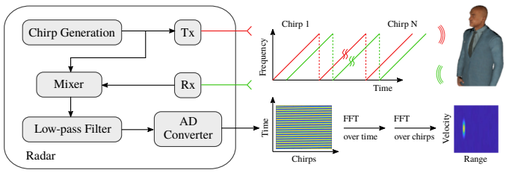
Fig. 13 . Principle of FMCW Radar: A transmitter (Tx) sends out a chirp signal (red), which gets reflected at object boundaries, e. g. a human. The reflected signal (green) at the receiver (Rx) is a delayed, attenuated copy of transmitter signal. The time delay corresponds to the distance and thus the frequency difference between transmitter and receiver is proportional to the distance. This frequency is obtained by mixing the transmitter and receiver signal. For a sequence of chirps, the phases of the received signal changes due to the Doppler shift. An FFT over the time extracts the frequencies, a subsequent FFT over chirps extracts the velocity, such that a 2D range distance map is obtained.
원문 · CC BY 4.0 · Stefan Escaida Navarro, Stephan Mühlbacher-Karrer, Hosam Alagi, Hubert Zangl, Keisuke Koyama, Björn Hein, Christian Duriez, Joshua R. Smith · Proximity Perception in Human-Centered Robotics: A Survey on Sensing Systems and Applications · 원문 그림 인용 · 원본 PDF 10쪽에서 그림 영역을 추출했습니다.반응형 예비 형상화
반응형 예비 형상화는 물체를 카메라로 찾은 뒤 손이 접근하는 동안 근접 센서 출력을 폐루프 제어 입력으로 사용해 손가락과 손바닥의 자세를 조정하는 방법입니다. 원문은 접촉 전에 물체 표면의 법선을 맞추면 접촉 면적이 커지고 파지가 안정된다고 설명합니다. 이 절의 구조는 근접 센서 피드백이 손의 자세를 어떻게 바꾸는지 보여 줍니다.
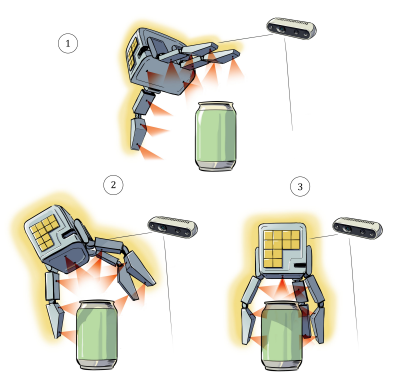
Fig. 2 . Reactive preshaping to an object based on proximity perception has three characteristic phases: (1) object detection by vision and approaching of the hand to the object, (2) detection of the object by the hand’s proximity sensors, start of closed-loop control and occlusion of the object in the camera view, and (3) finalized preshaping control, where the fingers and palm of the hand are aligned with the object.
원문 · CC BY 4.0 · Stefan Escaida Navarro, Stephan Mühlbacher-Karrer, Hosam Alagi, Hubert Zangl, Keisuke Koyama, Björn Hein, Christian Duriez, Joshua R. Smith · Proximity Perception in Human-Centered Robotics: A Survey on Sensing Systems and Applications · 원문 그림 인용 · 원본 PDF 2쪽에서 그림 영역을 추출했습니다.안전 기준과 분리 거리
ISO/TS 15066의 속도 및 분리 모니터링 모드에서는 인간과 로봇 표면 사이의 보호 분리 거리 Sp를 유지해야 합니다. 원문은 Sp를 인간 속도와 반응 시간, 로봇 정지 시간과 정지 거리, 침입 거리, 두 위치 불확실성의 합으로 제시합니다. 원문은 UR10e의 예시 설정에서 이 식으로 계산한 분리 거리가 0.236 m라고 보고합니다. 이 예시는 침입 거리와 인간 위치 불확실성을 제외한 값입니다.
현재 과제와 한계
원문은 광학 감지가 투명하거나 검은색이거나 반짝이는 물체에서 어려움을 겪기 때문에 다중 모달 감지가 필요하다고 서술합니다. 정전용량 감지의 일반적인 감지 속도는 20-125 Hz로 보고되며, 최근 광학 접근은 1 kHz를 넘는 갱신 속도를 보고합니다. 이 비교는 보고된 값의 범위이며 단일 센서 설계의 성능을 보장하지 않습니다. 산업적으로는 모듈 수준의 안전 인증이 아직 어렵다는 점도 과제로 제시됩니다.
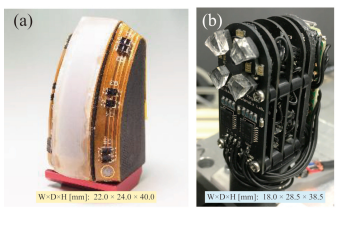
Fig. 11 . (a) High-speed proximity sensor [65], [66], [67]. (b) High-speed, high-precision proximity sensor [70], [71]. Both sensors detect tilt angles and distance of an object’s surface. The measurement time of both sensors is less than 1 ms. The distance resolution of the sensor (b) is less than 51 µm. Sensor type: O-RLI (©2013 and 2019 IEEE)
원문 · CC BY 4.0 · Stefan Escaida Navarro, Stephan Mühlbacher-Karrer, Hosam Alagi, Hubert Zangl, Keisuke Koyama, Björn Hein, Christian Duriez, Joshua R. Smith · Proximity Perception in Human-Centered Robotics: A Survey on Sensing Systems and Applications · 원문 그림 인용 · 원본 PDF 8쪽에서 그림 영역을 추출했습니다.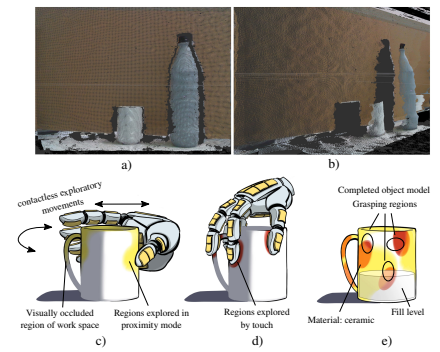
Fig. 19 . Proximity perception can play an important role in multi-modal exploration: a) Shows a typical scene with objects as captured by an RGBD- camera. b) A perspective shift reveals considerable gaps in the visual percep- tion, having occluded elements that could be explored contactless and contact- based exploration steps, c) and d) respectively. A multi-modal cognitive model controls the exploration and aggregates the information to the object model, which includes geometric, material property, fill-level information as well as potential grasping regions obtained from the exploration steps in c) and d). This aggregated information is illustrated in e). The yellow and red colors on the mug (in c)-d)) illustrate regions that are extracted from the proximity and touch-based perception, respectively.
원문 · CC BY 4.0 · Stefan Escaida Navarro, Stephan Mühlbacher-Karrer, Hosam Alagi, Hubert Zangl, Keisuke Koyama, Björn Hein, Christian Duriez, Joshua R. Smith · Proximity Perception in Human-Centered Robotics: A Survey on Sensing Systems and Applications · 원문 그림 인용 · 원본 PDF 18쪽에서 그림 영역을 추출했습니다.논문 정보
- 저자
- Stefan Escaida Navarro, Stephan Mühlbacher-Karrer, Hosam Alagi, Hubert Zangl, Keisuke Koyama, Björn Hein, Christian Duriez, Joshua R. Smith
- 학회·저널
- arXiv · 프리프린트
- 최초 공개일
- 2021년 8월 16일
- 등록일
- 2026년 11월 6일
- 수정일
- 2021년 8월 17일
- 버전
- v2
- arXiv
- 2108.07206
- DOI
- 10.1109/tro.2021.3111786
- 분류
- cs.RO
- 원문 이용 조건
- CC BY 4.0
- 제공 범위
- 논문 정보, 해설, 허용된 원문 그림
AI 해설은 논문 원문과 별개의 설명이며 오류가 있을 수 있습니다. 원문과 그림은 각 출처의 이용 조건과 따로 표시된 권리를 따릅니다.
초록
Proximity perception is a technology that has the potential to play an essential role in the future of robotics. It can fulfill the promise of safe, robust, and autonomous systems in industry and everyday life, alongside humans, as well as in remote locations in space and underwater. In this survey paper, we cover the developments of this field from the early days up to the present, with a focus on human-centered robotics. Here, proximity sensors are typically deployed in two scenarios: first, on the exterior of manipulator arms to support safety and interaction functionality, and second, on the inside of grippers or hands to support grasping and exploration. Starting from this observation, we propose a categorization for the approaches found in the literature. To provide a basis for understanding these approaches, we devote effort to present the technologies and different measuring principles that were developed over the years, also providing a summary in form of a table. Then, we show the diversity of applications that have been presented in the literature. Finally, we give an overview of the most important trends that will shape the future of this domain.
원문 인용
Stefan Escaida Navarro, Stephan Mühlbacher-Karrer, Hosam Alagi, Hubert Zangl, Keisuke Koyama, Björn Hein, Christian Duriez, Joshua R. Smith (2021). Proximity Perception in Human-Centered Robotics: A Survey on Sensing Systems and Applications. arXiv:2108.07206v2. https://doi.org/10.1109/tro.2021.3111786
BibTeX
@article{navarro2021proximity,
  title = {{Proximity Perception in Human-Centered Robotics: A Survey on Sensing Systems and Applications}},
  author = {Stefan Escaida Navarro and Stephan Mühlbacher-Karrer and Hosam Alagi and Hubert Zangl and Keisuke Koyama and Björn Hein and Christian Duriez and Joshua R. Smith},
  year = {2021},
  eprint = {2108.07206},
  archivePrefix = {arXiv},
  doi = {10.1109/tro.2021.3111786},
  url = {https://arxiv.org/abs/2108.07206v2}
}