논문 해설
Learning to Reason over Scene Graphs: A Case Study of Finetuning GPT-2 into a Robot Language Model for Grounded Task Planning
장면 그래프를 바탕으로 추론하는 학습: 근거 기반 작업 계획을 위해 GPT-2를 로봇 언어 모델로 미세 조정한 사례 연구
- 연구 문제 장기 과제 계획을 수행하는 로봇에서 기존 TAMP 방법은 수동 규칙과 높은 탐색 비용에 의존하므로, pre-training 언어 모델의 상식 지식을 활용할 수 있는지 검증합니다.
- 연구 방법 GPT-2를 ALFRED 데이터로 미세조정한 RobLM이 자연어 목표와 선택적 문맥을 받아 고수준 계획을 생성하며, Graph2NL은 장면 그래프의 기하 관계를 자연어 기호 문맥으로 바꿉니다.
- 주요 결과 문맥을 준 RobLM은 인수 예측 정확도가 향상되었지만 평가된 설정 모두 Fast Downward 기준선을 넘지 못했습니다. 성공률은 PickupObject에서 높고 PutObject에서 낮았습니다.
장기 과제 계획을 언어 모델로 풀려는 이유
가정용 로봇이 '소파 위의 물건을 치워 줘'처럼 여러 하위 목표가 얽힌 지시를 수행하려면, 환경의 객체 상태와 행동 순서를 함께 추론해야 합니다. 기존의 고전적 작업 및 운동 계획(TAMP) 방법은 기호적 계획과 기하학적 탐색을 결합하지만, 보통 수동으로 정한 규칙에 의존하고 기호 변수와 연속 변수를 함께 탐색할 때 조합 폭발이 일어납니다. 이 논문은 이러한 한계를 넘는 대안으로, 대규모 pre-training 언어 모델이 가진 상식 지식을 로봇 계획에 활용할 수 있는지 묻습니다. 연구 범위는 ALFRED 벤치마크의 가정 환경 과제에 한정되며, 시뮬레이터 AI2-THOR에서 계획을 실행하여 검증합니다.
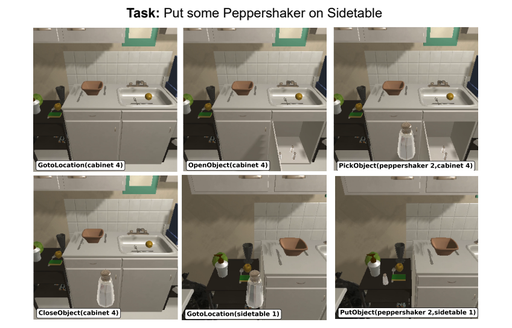
Figure 1 : AI2-THOR simulator rendering a sample rollout from the ALFRED [26]. The scenes show a room with household objects and the robot executing a task. Note that the robot does not have an arm, and the object automatically floats in front of the camera; it interacts with the environment through discrete actions. The discrete actions are shown underneath each frame in the form of PDDL commands.
원문 · CC BY 4.0 · Georgia Chalvatzaki, Ali Younes, Daljeet Nandha, An Le, Leonardo F. R. Ribeiro, Iryna Gurevych · Learning to Reason over Scene Graphs: A Case Study of Finetuning GPT-2 into a Robot Language Model for Grounded Task Planning · 원문 그림 인용 · 원본 PDF 4쪽에서 그림 영역을 추출했습니다.RobLM: 목표와 문맥으로 계획 전체를 생성하는 GPT-2 fine-tuning
RobLM은 GPT-2 base 모델을 ALFRED 학습 데이터로 미세조정한 Robot Language Model입니다. 입력은 자연어 작업 목표이며, 필요하면 방 이름, 대상 객체 이름, 또는 장면 설명 같은 선택적 문맥을 SEP 토큰으로 구분하여 덧붙입니다. 출력은 'GotoLocation(countertop); PickupObject(soap); ...' 형태의 번호가 붙은 고수준 행동 시퀀스로, BOS와 EOS 토큰 사이를 추출하여 계획으로 사용합니다. 학습은 다음 토큰을 예측하는 인과적 언어 모델링으로 이루어지며, 원문에 따르면 Adam 최적화기, 학습률 5e-5, 두 에폭 설정을 사용합니다.
추론 때에는 목표와 문맥을 입력받아 토큰을 하나씩 선택하는 자기회귀 생성으로 전체 계획을 한 번에 만듭니다. 이 방법의 핵심은 계획 모델의 구조를 새로 설계하기보다, 환경 정보를 자연어 문맥으로 바꾸어 pre-training 언어 모델의 입력 형식에 맞추는 데 있습니다.
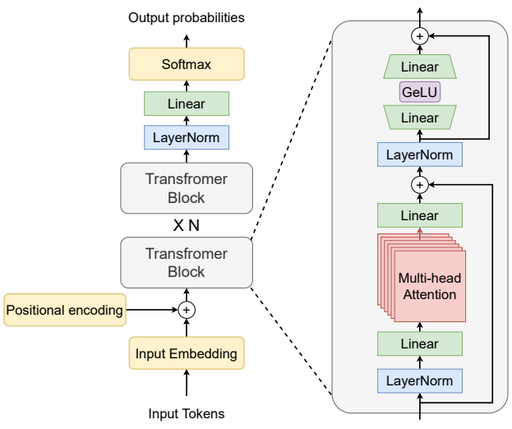
Figure 2 : Decoder-only Transformer architecture. The input to the decoder is tokenized text, and the output is probabilities over the tokens in the tokenizer vocabulary. The positional encoding is added to the embedded input to account for the order. Transformer’s decoder can have multiple transformer blocks, each of which contains multi-head attention with linear layers and layer normalization. GPT models uses GeLU activation between the last linear layers.
원문 · CC BY 4.0 · Georgia Chalvatzaki, Ali Younes, Daljeet Nandha, An Le, Leonardo F. R. Ribeiro, Iryna Gurevych · Learning to Reason over Scene Graphs: A Case Study of Finetuning GPT-2 into a Robot Language Model for Grounded Task Planning · 원문 그림 인용 · 원본 PDF 7쪽에서 그림 영역을 추출했습니다.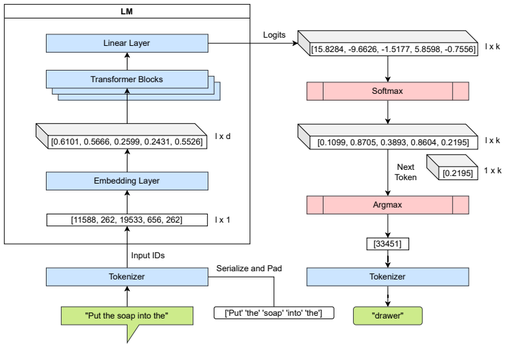
Figure 3 : Illustration of a forward pass through RobLM for text generation with a greedy next-token selection strategy. The forward passes are repeated in a recursive manner until an end-of-text token is encountered or the defined sequence limit is reached.
원문 · CC BY 4.0 · Georgia Chalvatzaki, Ali Younes, Daljeet Nandha, An Le, Leonardo F. R. Ribeiro, Iryna Gurevych · Learning to Reason over Scene Graphs: A Case Study of Finetuning GPT-2 into a Robot Language Model for Grounded Task Planning · 원문 그림 인용 · 원본 PDF 8쪽에서 그림 영역을 추출했습니다.Graph2NL: 장면 그래프를 자연어 문맥으로 바꾸는 방법
Graph2NL은 객체 중심 장면 그래프를 자연어 문맥으로 변환하는 방법입니다. 그래프의 노드는 에이전트와 객체이며, 간선에는 거리와 방향 벡터가 속성으로 붙습니다. 먼저 에이전트에서 대상 객체까지의 경로를 찾고, 경로상의 간선 속성을 거리, 피치, 요 값에 따라 기호로 바꿉니다. 거리는 8개 어휘, 피치는 4개, 요는 2개로 나뉘어 조합하면 64개의 기하 관계를 만들 수 있습니다. 예를 들어 욕실의 싱크대와 비누 사이 관계는 'fnk sink dnj soapbar'처럼 세 글자 기호로 줄여 표현됩니다. 이 방식은 경로를 따라 기하 관계를 압축하여 문맥 길이를 줄이려는 설계입니다.
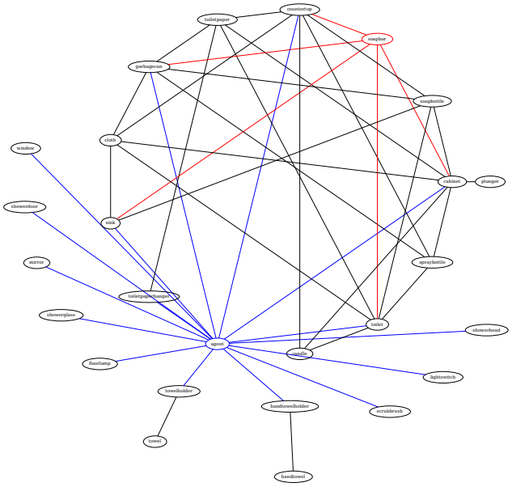
Figure 4 : Graph2NL example graph. After locating the root (‘agent’) and target node (‘soapbar’), the shortest paths connecting those nodes are found and summarized in NL by mapping all edge attributes along the path.
원문 · CC BY 4.0 · Georgia Chalvatzaki, Ali Younes, Daljeet Nandha, An Le, Leonardo F. R. Ribeiro, Iryna Gurevych · Learning to Reason over Scene Graphs: A Case Study of Finetuning GPT-2 into a Robot Language Model for Grounded Task Planning · 원문 그림 인용 · 원본 PDF 10쪽에서 그림 영역을 추출했습니다.계획 예측 정확도: 문맥이 인수 예측을 돕지만 기준선을 넘지는 못함
정확도 평가는 검증 데이터를 과제 범주별로 나누어, 행동의 개수와 이름, 인수의 개수와 이름, 그리고 전체 계획이 맞는지를 측정합니다. No context 설정은 목표만 입력받는데도 행동 예측은 높은 정확도를 보였습니다. Scene knowledge와 Scene graph 설정은 No context보다 인수 예측에서 뚜렷하게 높았고, Scene graph가 행동과 인수에서 조금 더 정확했습니다. 그러나 평가된 어떤 RobLM 설정도 Fast Downward 기준선을 넘지 못했습니다. 저자들은 목표만으로는 대상 객체가 놓인 위치가 드러나지 않아 모델이 학습 데이터의 가장 흔한 사례를 모방하므로, 인수 오류가 주로 발생한다고 해석합니다.
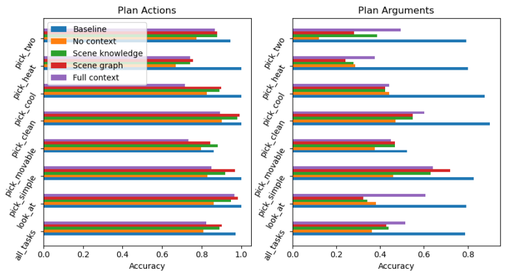
Figure 5 : Prediction accuracy of actions and arguments for previouslyunseen data across a set of tasks. Neither RobLM model is able to outperform the baseline (blue) but shows high accuracy in the prediction of plan actions. Context-driven models (green, red, and purple) perform better than the model without any scene-related context (orange).
원문 · CC BY 4.0 · Georgia Chalvatzaki, Ali Younes, Daljeet Nandha, An Le, Leonardo F. R. Ribeiro, Iryna Gurevych · Learning to Reason over Scene Graphs: A Case Study of Finetuning GPT-2 into a Robot Language Model for Grounded Task Planning · 원문 그림 인용 · 원본 PDF 14쪽에서 그림 영역을 추출했습니다.시뮬레이터 성공률: 객체 잡기는 강하지만 내려놓기는 약함
성공률은 RobLM이 예측한 행동을 AI2-THOR에서 실행한 뒤, 하위 작업의 목표 조건이 충족되었는지로 계산합니다. 이 비교는 No context 모델과 Fast Downward 기준선을 대상으로 합니다. 학습에 사용된 검증 데이터(seen)에서 PickupObject의 성공률은 기준선 0.466에 비해 RobLM 0.776이었고, 보지 않은 검증 데이터(unseen)에서는 0.474에 비해 0.749였습니다. 반면 PutObject는 seen에서 기준선 0.385보다 낮은 0.116, unseen에서 기준선 0.331보다 낮은 0.092였습니다. 원문은 기준선의 전체 성공률도 기대보다 낮다고 보고하며, 저수준 컨트롤러가 시각 정보 없이 '블라인드 비행' 방식으로 동작하여 대상이 보이지 않으면 상호작용이 실패할 수 있다고 설명합니다.
따라서 이 결과는 두 시스템을 같은 프레임워크에서 비교한 것이며, 계획 언어 모델의 가능성을 부정하는 근거로 보기에는 제한이 있습니다. 복합 작업은 높은 실패율 때문에 이 평가에서 제외되었습니다.
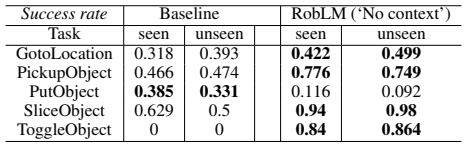
Table 2 : Success rates of sub-task completion in simulation — RobLM (‘No context’) compared to the baseline on seen and unseen validation data.
원문 · CC BY 4.0 · Georgia Chalvatzaki, Ali Younes, Daljeet Nandha, An Le, Leonardo F. R. Ribeiro, Iryna Gurevych · Learning to Reason over Scene Graphs: A Case Study of Finetuning GPT-2 into a Robot Language Model for Grounded Task Planning · 원문 그림 인용 · 원본 PDF 15쪽에서 그림 영역을 추출했습니다.생성 전략과 문맥 정제 실험
기본 실험은 다음 토큰을 가장 높은 확률로 고르는 greedy 탐색을 사용합니다. 추가 실험에서는 No context 모델을 Pick Simple 과제에 대해 top-k(k=10)와 top-p(p=0.9) 샘플링으로 세 번 실행했습니다. 세 번의 샘플링 결과는 행동 정확도 0.7746, 0.8169, 0.7817이었고 인수 정확도는 0.3803, 0.4085, 0.3944였습니다. 이 실험에서 샘플링 방식은 greedy보다 약간 낮은 성능을 보였으며, 실행 간 차이는 작은 편입니다. 또한 첫 번째 지시문의 자연어 설명을 문맥으로 추가하면 unseen 과제에서 RobLM이 기준선에 가까운 정확도에 도달했습니다.
이는 첫 번째 인수 예측이 가장 어려운 지점이라는 분석과 연결되며, 문맥을 과제에 맞게 좁히는 것이 계획 정확도를 높일 수 있음을 보여 줍니다.
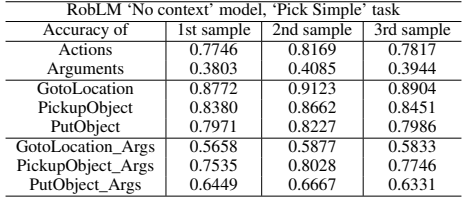
Table 3 : Top-k and top-p sampling (k = 10 and p = 0.9) — tokens are sampled three times for the ‘Pick Simple’ task, giving only slight deviations in the final accuracy.
원문 · CC BY 4.0 · Georgia Chalvatzaki, Ali Younes, Daljeet Nandha, An Le, Leonardo F. R. Ribeiro, Iryna Gurevych · Learning to Reason over Scene Graphs: A Case Study of Finetuning GPT-2 into a Robot Language Model for Grounded Task Planning · 원문 그림 인용 · 원본 PDF 16쪽에서 그림 영역을 추출했습니다.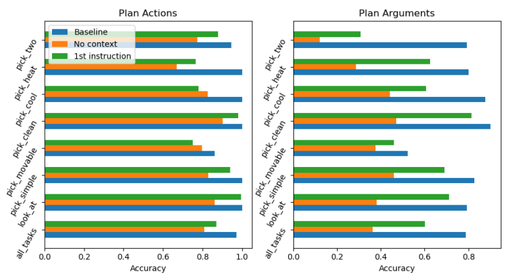
Figure 6 : Prediction accuracy of actions and arguments for unseen tasks of a model with a refined context. This experiment compares a model fine-tuned to the task goal and a context consisting of a NL description of the first plan instruction (green) with the baseline (blue) and previous RobLM ‘No context’ model (orange).
원문 · CC BY 4.0 · Georgia Chalvatzaki, Ali Younes, Daljeet Nandha, An Le, Leonardo F. R. Ribeiro, Iryna Gurevych · Learning to Reason over Scene Graphs: A Case Study of Finetuning GPT-2 into a Robot Language Model for Grounded Task Planning · 원문 그림 인용 · 원본 PDF 16쪽에서 그림 영역을 추출했습니다.추론 속도와 계산 비용
실제 응용에서는 계획 생성 시간이 중요합니다. 이 논문의 실행 시간 비교에서 기준선인 Fast Downward는 초당 2.9회 반복, RobLM No context는 초당 1.0회, RobLM Full context는 초당 0.2회로 측정되었습니다. RobLM의 속도 저하는 GPT-2의 전체 어휘 크기와 언어 모델 내부 생성 함수를 사용하는 것과 관련된 것으로 저자들이 설명합니다. 이 수치는 GPU 가속을 사용한 RobLM 측정과 기준선 측정의 조건이 다르므로, 두 값의 차이를 같은 하드웨어에서의 순수 알고리즘 비용 비교로 읽으면 안 됩니다.
결론과 한계
저자들은 LLM이 여러 조건에서 상식 지식을 활용하고 문맥에 따라 행동을 조정할 수 있음을 보였다고 결론짓습니다. 동시에 장기 계획 작업에서 LLM이 일관된 능력을 보이지 않으므로, 이 방법이 고전적 계획 시스템을 대체할 수는 없다고 밝힙니다. 실험에서는 평가된 RobLM 설정이 기준선을 넘지 못했고, 객체 배치와 인수 예측이 주요 실패 원인으로 제시되었습니다. 또한 더 큰 모델이나 구조화된 문맥, 시각 정보 같은 확장은 향후 과제로 남겨 두었습니다. GPT-3는 접근성과 하드웨어 비용 문제로 fine-tuning 기반에서 제외되었으므로, 대형 모델의 효과는 이 연구에서 검증되지 않았습니다.
논문 정보
- 저자
- Georgia Chalvatzaki, Ali Younes, Daljeet Nandha, An Le, Leonardo F. R. Ribeiro, Iryna Gurevych
- 학회·저널
- arXiv · 프리프린트
- 최초 공개일
- 2023년 5월 12일
- 등록일
- 2026년 11월 6일
- 수정일
- 2023년 5월 12일
- 버전
- v1
- arXiv
- 2305.07716
- 분류
- cs.RO · cs.AI
- 원문 이용 조건
- CC BY 4.0
- 제공 범위
- 논문 정보, 해설, 허용된 원문 그림
AI 해설은 논문 원문과 별개의 설명이며 오류가 있을 수 있습니다. 원문과 그림은 각 출처의 이용 조건과 따로 표시된 권리를 따릅니다.
초록
Long-horizon task planning is essential for the development of intelligent assistive and service robots. In this work, we investigate the applicability of a smaller class of large language models (LLMs), specifically GPT-2, in robotic task planning by learning to decompose tasks into subgoal specifications for a planner to execute sequentially. Our method grounds the input of the LLM on the domain that is represented as a scene graph, enabling it to translate human requests into executable robot plans, thereby learning to reason over long-horizon tasks, as encountered in the ALFRED benchmark. We compare our approach with classical planning and baseline methods to examine the applicability and generalizability of LLM-based planners. Our findings suggest that the knowledge stored in an LLM can be effectively grounded to perform long-horizon task planning, demonstrating the promising potential for the future application of neuro-symbolic planning methods in robotics.
원문 인용
Georgia Chalvatzaki, Ali Younes, Daljeet Nandha, An Le, Leonardo F. R. Ribeiro, Iryna Gurevych (2023). Learning to Reason over Scene Graphs: A Case Study of Finetuning GPT-2 into a Robot Language Model for Grounded Task Planning. arXiv:2305.07716v1. https://arxiv.org/abs/2305.07716v1
BibTeX
@misc{chalvatzaki2023learning,
  title = {{Learning to Reason over Scene Graphs: A Case Study of Finetuning GPT-2 into a Robot Language Model for Grounded Task Planning}},
  author = {Georgia Chalvatzaki and Ali Younes and Daljeet Nandha and An Le and Leonardo F. R. Ribeiro and Iryna Gurevych},
  year = {2023},
  eprint = {2305.07716},
  archivePrefix = {arXiv},
  url = {https://arxiv.org/abs/2305.07716v1}
}