논문 해설
Active Exploration for Robotic Manipulation
로봇 조작을 위한 능동 탐색
- 연구 문제 기울어진 테이블 위 공 밀기처럼 목표가 숨겨진 희소 보상 조작 과제에서 모델 기반 강화학습의 탐색 효율이 낮은 문제를 다룹니다.
- 연구 방법 앙상블 확률 모델의 에피스테믹 불확실성으로 계산한 정보 이득과 기대 보상을 함께 최적화하는 정보 탐색 MPC를 제안하며, 정보 이득 근사에 중첩 몬테카를로 추정기를 사용합니다.
- 주요 결과 시뮬레이션 Tilted Pushing에서 MI와 LI 구성 모두 보상을 찾았고 기준선은 찾지 못했으며, Tilted Pushing Maze에서는 대부분의 LI 실행이 보상을 찾았습니다. 실제 로봇에서는 MI 구성만 처음부터 학습해 시뮬레이션에 상응하는 성능을 보였습니다.
희소 보상 조작 과제의 탐색 문제
로봇 조작에서는 물체와 지속적으로 접촉하는 상황에서 환경의 동역학을 탐색하는 일이 어렵습니다. 기존 학습 방법은 단일 해에 과적합되거나 낮은 엔트로피의 행동으로 수렴하여 같은 과제의 새로운 변형에 일반화하지 못하는 경우가 많습니다. 이 논문은 목표 위치를 사전에 알지 못하고 보상이 희소한 기울어진 테이블 위 공 밀기 과제를 대상으로, 모델 기반 강화학습에서 미방문 상태-행동 쌍을 방향성 있게 탐색하는 능동 탐색 방법을 다룹니다. 제안 방법은 시뮬레이션과 실제 로봇에서 처음부터 학습하는 설정으로 검증됩니다.
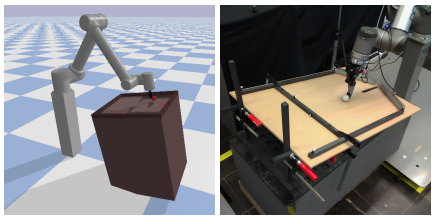
Fig. 1 : Our active exploration strategy evaluated on a challenging Tilted Pushing task in simulation (left) and on the real robot (right). The agent needs to learn the dynamics of the task and identify a sparse reward model in order to bring the ball to a target location. The robot learns to solve the task online in the real setting from scratch.
원문 · CC BY 4.0 · Tim Schneider, Boris Belousov, Georgia Chalvatzaki, Diego Romeres, Devesh K. Jha, Jan Peters · Active Exploration for Robotic Manipulation · 원문 그림 인용 · 원본 PDF 1쪽에서 그림 영역을 추출했습니다.정보 이득을 포함한 MPC 목적
제안 방법은 앙상블 확률 모델로 에피스테믹 불확실성을 추정하고, 기대 보상과 모델 파라미터 θ에 대한 기대 정보 이득을 함께 최대화하는 MPC를 사용합니다. 시점 t에서 정책 π는 기대 보상 합에 가중치 β를 곱한 내재 항 I(π, s_t)를 더한 목적을 최대화하도록 선택됩니다. 내재 항은 관측되는 상태와 보상에 대한 θ의 사후 분포와 사전 분포 사이의 KL 발산 기댓값으로 정의되는 상호정보량입니다. 이 값은 관측이 모델 신념을 크게 바꿀 것으로 기대될 때 커지므로 외재 보상이 없어도 탐색을 유도합니다. 두 항의 균형은 β로 명시적으로 조절됩니다. 정보 이득과 기대 보상은 닫힌 형태로 계산되지 않으므로 중첩 몬테카를로 추정기로 근사하며, 외부 추정에서 얻은 샘플을 내부 추정에서 재사용합니다.
상호정보량과 Lautum 정보의 대조
대안으로 역방향 KL 발산을 사용하는 Lautum 정보(LI)도 정의되며, 이는 사전 분포가 분자에 놓여 사전에 그럴듯했던 θ의 사후 확률을 낮추는 관측을 선호합니다. 상호정보량(MI)은 사전에 확률이 낮았던 θ가 사후에 높은 확률을 얻도록 하는 관측을 선호하므로 두 목적은 서로 다른 정책을 선택할 수 있습니다. LI는 외부 기대 안에서 (s, r)과 θ가 독립적으로 분리되어 같은 샘플을 여러 θ_j에 재사용할 수 있어 근사에 유리합니다. 그림 2에 따르면 이 설정의 무작위 이산 모델 실험에서 LI 근사는 MI 근사보다 샘플 효율이 높게 나타났습니다. 다만 이 비교는 이산 생성 모델에 대한 실험이며 본 논문의 전체 과제에 대한 이론적 결론은 아닙니다.
시뮬레이션 과제와 기준선 비교
Tilted Pushing과 Tilted Pushing Maze는 시뮬레이션에서 설계된 탐색 과제이고, Tilted Pushing Real은 실제 로봇 과제입니다. 시뮬레이션 실험에서 제안 방법은 MI와 LI 구성 모두로 Tilted Pushing 과제에서 300,000 스텝 이내에 보상을 찾았다고 보고됩니다. 기준선 PETS, SAC, MBPO는 같은 기간 내에 보상을 찾지 못하고 국소 최소점에 수렴했습니다. Tilted Pushing Maze에서는 제안 방법이 LI 구성 중 한 실행을 제외하고 1,500,000 스텝 이내에 보상을 찾았습니다. 이 결과는 시뮬레이션 과제, 사용된 기준선과 평가 보상, 스텝 예산에 한정된 관찰입니다.
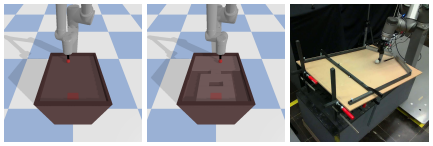
Fig. 3 : Visualization of the three environment configurations we test our methods on. The target zone (marked in red in the simulated environments) is always at the top center of the table and its location is not observed by the agent.
원문 · CC BY 4.0 · Tim Schneider, Boris Belousov, Georgia Chalvatzaki, Diego Romeres, Devesh K. Jha, Jan Peters · Active Exploration for Robotic Manipulation · 원문 그림 인용 · 원본 PDF 4쪽에서 그림 영역을 추출했습니다.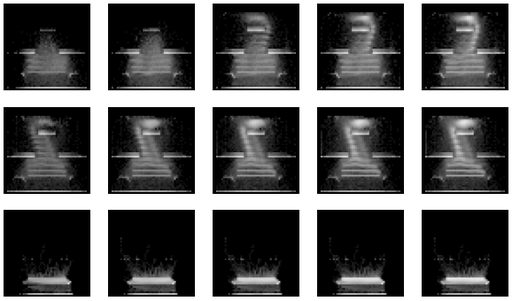
Fig. 5 : Comparison of the states visited by our MI and LI agents and PETS [20] in the Tilted Pushing Maze . The brightness of each pixel indicates how often the ball has visited the respective point of the table at the given point in the training. The coordinate origin is at the bottom of each image, meaning that the images are rotated 180 ° compared to the top-down view in Fig. 3. Both the LI agent and the MI agent succeed in solving the task because they achieve a much better coverage than PETS [20].
원문 · CC BY 4.0 · Tim Schneider, Boris Belousov, Georgia Chalvatzaki, Diego Romeres, Devesh K. Jha, Jan Peters · Active Exploration for Robotic Manipulation · 원문 그림 인용 · 원본 PDF 7쪽에서 그림 영역을 추출했습니다.실제 로봇 실험과 학습 설정
실제 로봇 실험은 UR10 로봇으로 Tilted Pushing을 재현하며, 이 설정에서는 MI 구성만 평가되었습니다. 원문은 실제 실험에서 공의 스핀이 관측되지 않아 마르코프 가정이 위반될 수 있다고 설명하며, 이를 다루기 위해 전이 모델의 평균뿐 아니라 분산도 학습했습니다. 분산 학습은 너무 이르게 시작하면 비관적 행동을 낳았기 때문에 60,000 스텝 이후에 시작되었습니다. 실제 실험은 pre-training 없이 처음부터 학습되었고, 에피소드 길이는 30 스텝이었습니다. 원문은 이 설정의 결과가 시뮬레이션에 상응하는 성능을 보였다고 보고합니다.
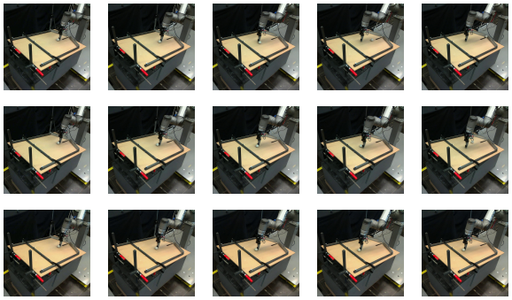
Fig. 6 : Training process of our agent on the real system. At 5k steps, the agent has not found the target yet, and thus it is not guided by any external reward signal. Instead, purely driven by its intrinsic drive, it learns to balance the ball on the finger and systematically explores the table. At 30k steps, the agent understood how to obtain the reward in this task and the extrinsic signal causes it to focus on exploitation from now on. At 150k steps, the agent’s model is accurate enough to repeatedly balance the ball at the goal location and solve the task.
원문 · CC BY 4.0 · Tim Schneider, Boris Belousov, Georgia Chalvatzaki, Diego Romeres, Devesh K. Jha, Jan Peters · Active Exploration for Robotic Manipulation · 원문 그림 인용 · 원본 PDF 7쪽에서 그림 영역을 추출했습니다.계산 비용과 적용 범위
저자들은 제안 방법이 계산적으로 비교적 무거워 상대적으로 느린 과제에 제한된다고 밝힙니다. 따라서 더 동적인 과제에 적용하려면 계획 모듈을 학습된 저수준 균형 제어기와 결합하는 계층적 제어가 향후 과제로 제시됩니다. 또한 β의 설정은 과제마다 조정해야 하며, 여러 과제에 대한 일반적인 설정법은 원문에서 아직 해결되지 않은 질문으로 남아 있습니다.
논문 정보
- 저자
- Tim Schneider, Boris Belousov, Georgia Chalvatzaki, Diego Romeres, Devesh K. Jha, Jan Peters
- 학회·저널
- arXiv · 프리프린트
- 최초 공개일
- 2022년 10월 23일
- 등록일
- 2026년 11월 4일
- 수정일
- 2022년 10월 23일
- 버전
- v1
- arXiv
- 2210.12806
- 분류
- cs.RO · cs.LG
- 원문 이용 조건
- CC BY 4.0
- 제공 범위
- 논문 정보, 해설, 허용된 원문 그림
AI 해설은 논문 원문과 별개의 설명이며 오류가 있을 수 있습니다. 원문과 그림은 각 출처의 이용 조건과 따로 표시된 권리를 따릅니다.
초록
Robotic manipulation stands as a largely unsolved problem despite significant advances in robotics and machine learning in recent years. One of the key challenges in manipulation is the exploration of the dynamics of the environment when there is continuous contact between the objects being manipulated. This paper proposes a model-based active exploration approach that enables efficient learning in sparse-reward robotic manipulation tasks. The proposed method estimates an information gain objective using an ensemble of probabilistic models and deploys model predictive control (MPC) to plan actions online that maximize the expected reward while also performing directed exploration. We evaluate our proposed algorithm in simulation and on a real robot, trained from scratch with our method, on a challenging ball pushing task on tilted tables, where the target ball position is not known to the agent a-priori. Our real-world robot experiment serves as a fundamental application of active exploration in model-based reinforcement learning of complex robotic manipulation tasks.
원문 인용
Tim Schneider, Boris Belousov, Georgia Chalvatzaki, Diego Romeres, Devesh K. Jha, Jan Peters (2022). Active Exploration for Robotic Manipulation. arXiv:2210.12806v1. https://arxiv.org/abs/2210.12806v1
BibTeX
@misc{schneider2022active,
  title = {{Active Exploration for Robotic Manipulation}},
  author = {Tim Schneider and Boris Belousov and Georgia Chalvatzaki and Diego Romeres and Devesh K. Jha and Jan Peters},
  year = {2022},
  eprint = {2210.12806},
  archivePrefix = {arXiv},
  url = {https://arxiv.org/abs/2210.12806v1}
}