논문 해설
Multimodal Image Synthesis and Editing: The Generative AI Era
멀티모달 이미지 합성 및 편집: 생성형 AI 시대
- 연구 문제 다중 모달 가이던스로 이미지를 합성하고 편집하는 연구를 가이던스 종류와 모델 유형 기준으로 정리하고, 각 방법의 장단점과 평가 방식을 비교합니다.
- 연구 방법 가이던스를 시각, 텍스트, 오디오, 기타 모달리티로 나누고, GAN, 확산 모델, 자기회귀 모델, NeRF 방식으로 생성과 편집의 연산 구조를 설명합니다.
- 주요 결과 GAN은 빠른 추론과 높은 품질의 장점이 있지만 학습 불안정성과 다중 모달리티 통합의 한계가 있습니다. 확산 모델과 자기회귀 모델은 현재 SOTA 방법에서 더 많이 쓰이며, 평가는 FID, LPIPS, mIoU, Inception Score 등 여러 지표를 함께 보아야 합니다.
다중 모달 가이던스로 이미지를 만드는 문제
이 서베이는 텍스트, 오디오, 씬 그래프, 뇌 신호, 마우스 트랙 같은 다양한 가이던스로 이미지를 합성하고 편집하는 연구를 정리합니다. 가이던스는 네트워크를 직접 명시적으로 감독하는 대신, 생성 과정을 조건화하는 직관적이고 유연한 수단으로 쓰입니다. 시각 가이던스는 세그멘테이션 맵이나 스케치처럼 픽셀 공간에 놓이는 정보이므로 공간 정렬이 쉽고 세밀한 제어를 제공합니다. 반면 텍스트는 더 넓은 개념을 표현할 수 있지만 같은 문장에 대응하는 이미지가 여러 개 존재하므로 의미를 안정적으로 연결하는 일이 어렵습니다. 오디오는 시간 정보를 담아 동적인 시각 콘텐츠를 만드는 데 쓰이며, 음성과 얼굴 움직임의 관계는 추상적입니다.
이 서베이는 이런 가이던스를 시각, 텍스트, 오디오, 기타 모달리티로 묶고, 각 가이던스를 어떤 방식으로 인코딩하는지부터 설명합니다. 이어서 GAN, 확산 모델, 자기회귀 모델, NeRF 기반 방법으로 모델 유형을 나누어 비교합니다.
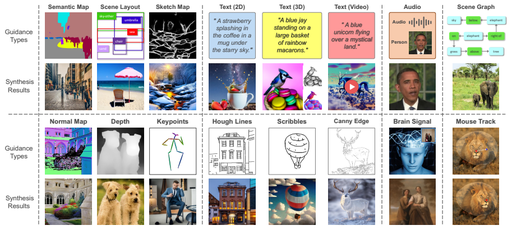
Fig. 1 . Illustration of multimodal image synthesis and editing. Typical guidance types include visual information (e.g.semantic maps, scene layouts, sketch maps), text prompts, audio signal, scene graph, brain signal, and mouse track. The samples are from [2], [8]–[16].
원문 · CC BY 4.0 · Fangneng Zhan, Yingchen Yu, Rongliang Wu, Jiahui Zhang, Shijian Lu, Lingjie Liu, Adam Kortylewski, Christian Theobalt, Eric Xing · Multimodal Image Synthesis and Editing: The Generative AI Era · 원문 그림 인용 · 원본 PDF 2쪽에서 그림 영역을 추출했습니다.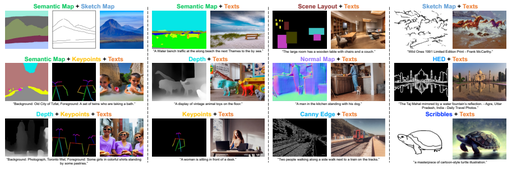
Fig. 8 . Image synthesis from the combination of different types of guidance. The samples are from [8], [62], [269].
원문 · CC BY 4.0 · Fangneng Zhan, Yingchen Yu, Rongliang Wu, Jiahui Zhang, Shijian Lu, Lingjie Liu, Adam Kortylewski, Christian Theobalt, Eric Xing · Multimodal Image Synthesis and Editing: The Generative AI Era · 원문 그림 인용 · 원본 PDF 13쪽에서 그림 영역을 추출했습니다.네 가지 모델 계열의 작동 방식
GAN 기반 방법은 조건부 GAN에서 가이던스를 생성기와 판별기에 함께 넣거나, 사전 학습된 무조건 GAN의 잠재 공간에서 GAN inversion으로 잠재 코드를 찾아 편집합니다. GAN inversion에서는 이미지를 잠재 코드로 되돌린 뒤, 텍스트나 다른 모달리티의 안내에 따라 잠재 코드를 조작합니다. 확산 모델은 데이터에 잡음을 점차 더하는 정방향 과정과 학습된 역방향 과정으로 이미지를 생성합니다. 조건부 확산 모델은 조건 임베딩을 교차 주의 집중 같은 방식으로 중간 계층에 넣고, pre-training 모델에서는 분류기 기울기나 fine-tuning을 통해 가이던스를 반영합니다. 자기회귀 모델은 VQ-VAE로 이미지를 이산 코드북 토큰으로 압축한 뒤, 래스터 스캔 순서에 따라 토큰을 순차적으로 예측합니다.
이 방식은 텍스트와 이미지를 같은 토큰 형식으로 다룰 수 있다는 점에서 여러 모달리티를 통합하기 쉽습니다. NeRF 기반 방법은 장면의 색과 밀도를 신경 복사장으로 표현하고 미분 가능한 볼륨 렌더링으로 2D 이미지를 얻습니다. 사전 학습된 CLIP이나 확산 모델을 이용해 장면을 최적화하거나, 생성형 NeRF의 잠재 공간에 조건을 매핑하는 방식이 함께 쓰입니다.
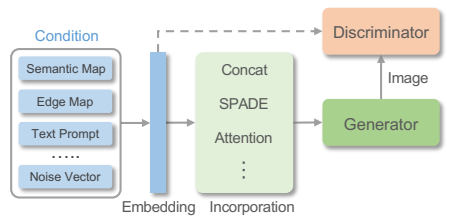
Fig. 2 . Illustration of conditional GAN framework with different condition incorporation mechanisms.
원문 · CC BY 4.0 · Fangneng Zhan, Yingchen Yu, Rongliang Wu, Jiahui Zhang, Shijian Lu, Lingjie Liu, Adam Kortylewski, Christian Theobalt, Eric Xing · Multimodal Image Synthesis and Editing: The Generative AI Era · 원문 그림 인용 · 원본 PDF 4쪽에서 그림 영역을 추출했습니다.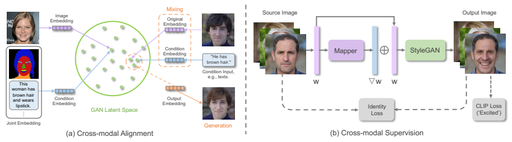
Fig. 3 . The architectures of GAN inversion for MISE, including (a) Cross-modal alignment [28] and (b) cross-modal supervision [29]. The cross- modal alignment embeds both images and conditions into the latent space of GAN ( e.g., StyleGAN [145]), aiming to pull their embeddings to be closer. Then image and condition embeddings can be mixed to perform multimodal image generation or editing. The cross-modal supervision inverts source image into a latent code and trains a mapper network to produce residuals that are added to the latent code to yield the target code, from which a pre-trained StyleGAN generates an image assessed by the CLIP and identity losses. The figure is reproduced based on [28] and [29].
원문 · CC BY 4.0 · Fangneng Zhan, Yingchen Yu, Rongliang Wu, Jiahui Zhang, Shijian Lu, Lingjie Liu, Adam Kortylewski, Christian Theobalt, Eric Xing · Multimodal Image Synthesis and Editing: The Generative AI Era · 원문 그림 인용 · 원본 PDF 6쪽에서 그림 영역을 추출했습니다.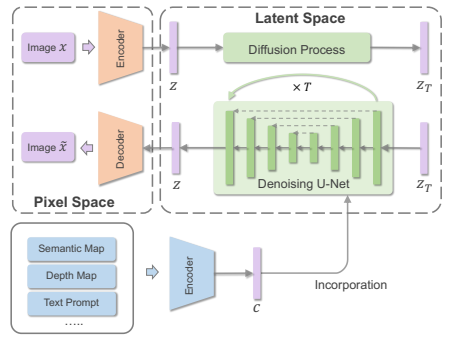
Fig. 4 . Overall framework of conditional diffusion model. With a certain model for latent representation, diffusion process models the latent space by reversing a forward diffusion process conditioned on certain guidance (e.g., semantic map, depth map, and texts). The image is reproduced based on [46].
원문 · CC BY 4.0 · Fangneng Zhan, Yingchen Yu, Rongliang Wu, Jiahui Zhang, Shijian Lu, Lingjie Liu, Adam Kortylewski, Christian Theobalt, Eric Xing · Multimodal Image Synthesis and Editing: The Generative AI Era · 원문 그림 인용 · 원본 PDF 7쪽에서 그림 영역을 추출했습니다.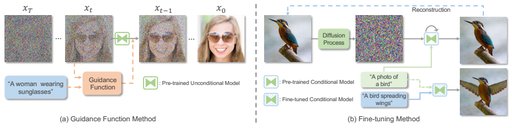
Fig. 5 . Typical frameworks of pre-trained diffusion models for MISE tasks, including guidance function method and fine-tuning method. The figure is reproduced based on [32] and [181].
원문 · CC BY 4.0 · Fangneng Zhan, Yingchen Yu, Rongliang Wu, Jiahui Zhang, Shijian Lu, Lingjie Liu, Adam Kortylewski, Christian Theobalt, Eric Xing · Multimodal Image Synthesis and Editing: The Generative AI Era · 원문 그림 인용 · 원본 PDF 8쪽에서 그림 영역을 추출했습니다.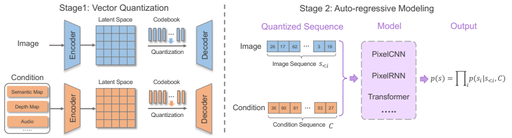
Fig. 6 . Typical framework of autoregressive methods for MISE tasks. A quantization stage is firstly performed to learn discrete and compressed representation by reconstructing the original image or condition (e.g., semantic map) faithfully via VQ-GAN [2], [42], followed by an autoregressive modeling stage to capture the dependency of discrete sequence. The image is reproduced based on [2] and [193].
원문 · CC BY 4.0 · Fangneng Zhan, Yingchen Yu, Rongliang Wu, Jiahui Zhang, Shijian Lu, Lingjie Liu, Adam Kortylewski, Christian Theobalt, Eric Xing · Multimodal Image Synthesis and Editing: The Generative AI Era · 원문 그림 인용 · 원본 PDF 9쪽에서 그림 영역을 추출했습니다.평가 지표와 비교 결과가 말해 주는 것
생성 품질은 주로 FID와 Inception Score로 평가됩니다. FID는 이미지 특징이 가우시안 분포를 따른다고 가정하며 품질을 측정하고, Inception Score는 여러 생성 모델에 두루 적용할 수 있는 간단한 지표입니다. 다양성은 LPIPS로 평가하지만, 이 지표는 생성 이미지가 현실적인지는 직접 보지 않으므로 품질 점수와 함께 읽어야 합니다. 의미 정렬은 segmentation-to-image 설정에서 mIoU로 측정하며, 생성 이미지를 사전 학습된 분할 네트워크에 넣어 원래 맵과 얼마나 일치하는지 봅니다. 표 3에서 SDM은 첫 번째 열 묶음에서 FID 18.8과 LPIPS 0.422를 기록합니다.
이 열이 CelebAMask-HQ에 해당한다는 점은 표 머리글 순서에 따른 것이므로, 다른 데이터셋의 값과 섞어 해석하지 않아야 합니다. 텍스트-이미지 생성에서는 COCO 비교표의 FID와 R-precision을 주로 참고합니다. 이 표의 점수들은 각 논문에서 가져온 값이 많으므로 모델 크기와 학습 조건이 다를 수 있습니다.
계열별 장점과 남은 한계
GAN 기반 방법은 FID와 Inception Score 측정에서 높은 품질을 보이며 추론 속도가 빠릅니다. 그러나 학습이 불안정하고 모드 붕괴가 발생하기 쉬우며, CNN 구조가 중심이어서 여러 모달리티를 하나의 방식으로 다루기 어렵다고 설명됩니다. 자기회귀 모델과 확산 모델은 안정적인 학습과 통합 가능한 조건 입력이라는 장점이 있지만, 추론 속도가 느린 것이 공통적인 한계입니다. 이 서베이는 현재 SOTA 방법들이 자기회귀 모델과 확산 모델을 더 많이 쓴다고 정리하면서도, 두 계열의 생성 능력 우열은 아직 명확하지 않다고 봅니다. NeRF 기반 방법은 3D 일관성을 제공하지만 다중 시점 데이터가 제한적이고 계산 비용이 높으며, 현재 고충실도 적용에는 제약이 큽니다.
따라서 이 서베이의 비교는 여러 논문의 점수를 모아 본 정리이며, 모든 방법을 동일한 조건에서 다시 측정한 결과로 읽으면 안 됩니다.
논문 정보
- 저자
- Fangneng Zhan, Yingchen Yu, Rongliang Wu, Jiahui Zhang, Shijian Lu, Lingjie Liu, Adam Kortylewski, Christian Theobalt, Eric Xing
- 학회·저널
- arXiv · 프리프린트
- 최초 공개일
- 2021년 12월 27일
- 등록일
- 2026년 11월 6일
- 수정일
- 2023년 8월 24일
- 버전
- v6
- arXiv
- 2112.13592
- 분류
- cs.CV
- 원문 이용 조건
- CC BY 4.0
- 제공 범위
- 논문 정보, 해설, 허용된 원문 그림
AI 해설은 논문 원문과 별개의 설명이며 오류가 있을 수 있습니다. 원문과 그림은 각 출처의 이용 조건과 따로 표시된 권리를 따릅니다.
초록
As information exists in various modalities in real world, effective interaction and fusion among multimodal information plays a key role for the creation and perception of multimodal data in computer vision and deep learning research. With superb power in modeling the interaction among multimodal information, multimodal image synthesis and editing has become a hot research topic in recent years. Instead of providing explicit guidance for network training, multimodal guidance offers intuitive and flexible means for image synthesis and editing. On the other hand, this field is also facing several challenges in alignment of multimodal features, synthesis of high-resolution images, faithful evaluation metrics, etc. In this survey, we comprehensively contextualize the advance of the recent multimodal image synthesis and editing and formulate taxonomies according to data modalities and model types. We start with an introduction to different guidance modalities in image synthesis and editing, and then describe multimodal image synthesis and editing approaches extensively according to their model types. After that, we describe benchmark datasets and evaluation metrics as well as corresponding experimental results. Finally, we provide insights about the current research challenges and possible directions for future research. A project associated with this survey is available at https://github.com/fnzhan/Generative-AI.
원문 인용
Fangneng Zhan, Yingchen Yu, Rongliang Wu, Jiahui Zhang, Shijian Lu, Lingjie Liu, Adam Kortylewski, Christian Theobalt, Eric Xing (2021). Multimodal Image Synthesis and Editing: The Generative AI Era. arXiv:2112.13592v6. https://arxiv.org/abs/2112.13592v6
BibTeX
@misc{zhan2021multimodal,
  title = {{Multimodal Image Synthesis and Editing: The Generative AI Era}},
  author = {Fangneng Zhan and Yingchen Yu and Rongliang Wu and Jiahui Zhang and Shijian Lu and Lingjie Liu and Adam Kortylewski and Christian Theobalt and Eric Xing},
  year = {2021},
  eprint = {2112.13592},
  archivePrefix = {arXiv},
  url = {https://arxiv.org/abs/2112.13592v6}
}