Paper commentary
AGORA: Reliability-Aware Aggregation of LLM Judges via Item-Response Theory
AGORA weights LLM judges by learned reliability instead of averaging them equally
- Problem Per-item means give weak LLM judges as much weight as strong ones, and Dawid-Skene needs too many parameters for the few hundred human-labeled items available.
- Method AGORA places each item on one latent quality scale and gives each judge a sensitivity parameter and ordered thresholds. Judge reliability is learned from all items jointly, without human labels.
- Results On full Topical-Chat, AGORA reached a Spearman ρ of 0.705, compared with 0.695 for Dawid-Skene.
Why averaging judges struggles on small sets
LLM judges carry systematic biases, so practitioners usually score each item with several judges and aggregate the scores. The per-item mean is the simplest blend, and it gives every judge equal weight. That equal weighting hurts when the pool is uneven, because a lower-reliability judge shifts the aggregate as much as a reliable one. The problem is sharpest in meta-evaluation, where the human reference sets are small: Topical-Chat has 360 dialogues and SummEval has 1,600 summaries.
Learned aggregators can down-weight weak judges, but they estimate reliability only from repeated judge–item overlap. Dawid–Skene estimates a per-judge error table over the rating categories, so a K-point scale needs K squared cells per judge. With a few hundred items, most of those cells are sparse and end up determined by the prior. MACE and GLAD need fewer parameters, but they treat ratings as unordered classes and don't model how each judge uses an ordinal scale.
AGORA responds to this gap by fitting a graded-response model to the judge-score matrix, which needs no human labels. The footnote notes that heterogeneity can be measured before any human labels are collected.
The key idea: one quality per item, one trust weight per judge
AGORA models each item with one latent quality and each judge with a discrimination plus ordered thresholds. The discrimination acts as a reliability weight, so judges whose scores track latent quality steeply get more influence. A judge with a near-zero discrimination has little influence on the aggregate. Figure 1 shows this on three judges rating five items, where judge B is lenient, judge A is severe, and judge C is flat.
The model is Samejima's graded-response model, where the cumulative probability of a rating at or above k is a logistic curve in alpha times theta minus beta. Each exact category probability is the difference between two neighbouring cumulative curves. The outer thresholds are fixed at minus and plus infinity, so every category gets a well-defined probability.
Each judge carries K parameters, one discrimination and K minus 1 thresholds, rather than K squared confusion-table cells. Every one of those parameters is informed by all items, so the trust estimates stay stable when the set is small.
The authors fix the latent scale with a standard normal prior on theta and keep every discrimination positive. Positive discriminations stop a judge from flipping sign, so a higher latent quality always raises every judge's expected rating. A regularized horseshoe prior then shrinks uninformative judges toward low trust while letting informative judges stay influential.
The authors argue this shape suits pools that mix informative and near-uninformative judges better than a log-normal prior.
How the parameters are fitted and read out
Estimation alternates between two steps in an EM procedure, and both steps work on the judge-score matrix alone. In the E-step, AGORA computes for each item a posterior over latent quality on a fixed grid G. The E-step combines the standard-normal prior with the likelihood of each judge's observed rating for that item. In the M-step, each judge's discrimination and ordered thresholds are updated by minimizing a posterior-expected penalized negative log-likelihood.
The penalty is the Gaussian term that the horseshoe prior induces, so the M-step shrinks discriminations as it fits them.
The horseshoe prior pulls the discriminations of uninformative judges toward zero, while informative judges keep large values when the likelihood supports them. The global scale τ controls overall shrinkage, the local scales λj let individual judges stay large, and the slab scale c caps the prior variance at extreme values. A log-normal prior would place little mass near zero and pull every discrimination toward one typical value.
The authors compare this prior against an unpenalized fit in §6, so the prior's value is tested rather than assumed. Each item's score starts as its posterior mean, the EAP estimate, computed on the grid G with the standard-normal prior discretized on that grid. The authors use the posterior mean instead of the posterior mode because the mean is more stable when item posteriors are diffuse.
The EAP estimate is a latent coordinate, not a score on the benchmark's rating scale, so AGORA maps it back. The mapping uses the fitted model's expected score, the multi-judge test characteristic curve, averaged over the J judges. Because the map is monotone in the latent quality, the mapped score keeps the item ranking that the latent quality induces.
The read-out weight of each judge is approximately its Fisher information at the item, which is α_j squared times an item-level factor. The global factor α_j squared makes the read-out judge-weighted, while the item-level factor makes each judge's effective weight vary across items. The authors state that all reported AGORA results use the exact EAP, and the α_j squared-weighted average is only a first-order interpretation.
Main comparison against baselines on full sets and 50-item subsets
The authors compared AGORA with the per-item mean, median, trimmed mean, Dawid–Skene, MACE, GLAD and CARE on one primary five-judge pool. Every method was scored with dimension-averaged Spearman ρ against the human references. The full evaluation sets were SummEval with 1,600 summaries, Topical-Chat with 360 dialogues and WMT22en–de with 19,725 segments.
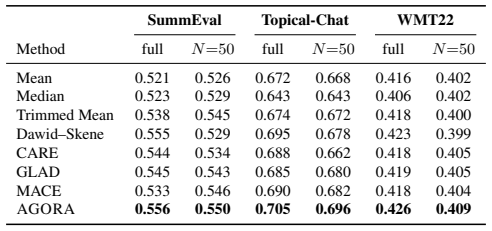
Table 1 : Main results on the primary five-judge pool. Dimension-averaged Spearman ρ against human references. full: the full evaluation set (SummEval N=1,600, Topical-Chat N=360, WMT22 N=19,725). N=50: mean over 50 random item subsets of 50 items, shared by all methods (paired tests in §5.1).Bold: best point estimate in each column.
Original paper · CC BY 4.0On full Topical-Chat, AGORA's Spearman ρ was 0.705, compared to 0.695 for Dawid–Skene. On full WMT22en–de, AGORA reached 0.426, compared to 0.423 for Dawid–Skene. Against the per-item mean, the full-set gains were +0.035 on SummEval, +0.033 on Topical-Chat and +0.010 on WMT22.
At N=50, the picture shifts, because Dawid–Skene's confusion tables have less evidence to work with. AGORA stayed at the top of Table 1 at N=50 on all three benchmarks, with 0.550, 0.696 and 0.409. Dawid–Skene dropped to 0.529 on SummEval and 0.399 on WMT22 at N=50, which is below the per-item mean on WMT22. Figure 2 shows that the margin of Dawid–Skene over the mean keeps shrinking as N falls from 400 to 50.
So on large sets the edge over Dawid–Skene is small, and the stronger case for AGORA rests on the smaller subsets. The paper's claim is that AGORA is best on the full sets and on the 50-item subsets, and the full-set margins are narrow.
What happens as evaluation sets shrink
Dawid–Skene's per-judge confusion tables get less evidence as the item set shrinks, and AGORA's margin over it widens. The authors re-fit every method on the same 50 random item subsets and step the sample size down from N=400 to N=50. On SummEval, Dawid–Skene moves from parity with AGORA at full N to a 0.021 deficit at N=50. On WMT22, Dawid–Skene falls below the per-item mean at small N.
Figure 2 plots the gap to the per-item mean for each aggregator, so AGORA's position is visible at every size.
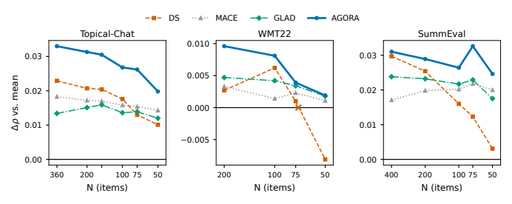
Figure 2 : Data efficiency on the primary five-judge pool in the small-sample regime ( N≤400 ). Dimension- averaged gap to the per-item mean, ∆ρ=ρ method −ρ Mean, as N shrinks (larger N on the left). AGORA is the top aggregator at every size; Dawid–Skene loses margin asNshrinks.
Original paper · CC BY 4.0 · Junhyung Ahn · AGORA: Reliability-Aware Aggregation of LLM Judges via Item-Response Theory · Original paper figure · Extracted the figure area from page 6 of the original PDF.The authors also count subsets rather than average them alone. The latent-trait model ties each judge's parameters to all items through the shared latent quality, so the fit stays stable when N falls. Dawid–Skene instead estimates a separate error table per judge, which is why it loses data at small N.
When trust weighting helps
Agreement dispersion is the paper's label-free signal for when trust weighting pays off, and it needs only the judge-score matrix. The authors define it as the standard deviation of judges' mean rank correlations divided by their mean. Each judge's mean rank correlation is taken against the other judges in the pool, so larger values mean more uneven agreement.
Because the statistic never touches human labels, a practitioner can compute it before any annotation is collected.
On 30 random five-judge pools, AGORA exceeded Dawid–Skene at N=50 in 93% of pools on SummEval, 100% on Topical-Chat and 83% on WMT22. On a second draw of 60 pools, AGORA's gain over the per-item mean grew with dispersion. The Spearman correlation between that gain and dispersion was +0.73 on SummEval and +0.61 on Topical-Chat. On the 60 pools, AGORA exceeded Dawid–Skene in 98% of pools on SummEval and 100% on Topical-Chat.
On those pools, AGORA exceeded the per-item mean in 100% of cases on SummEval and 93% on Topical-Chat. On the full 14-judge SummEval pool, dispersion is 0.21, below the primary pool's 0.29. There, AGORA obtained 0.577 against the mean's 0.572, so the gain shrinks toward the mean on balanced pools.
A controlled sweep tests whether dispersion keeps predicting the gain when pools become more uneven. This pushes dispersion from its natural range of about 0.3 up to about 1.1. Across that range, AGORA stays within 0.543 to 0.562 on SummEval, while the per-item mean falls from 0.536 to 0.436.
Where the gain comes from: trust weights, the prior and heuristics
The read-out decomposition isolates the trust vector, because the fitted model stays fixed while only the trust weights change. At full N, the fitted-discrimination read-out (R2) gains +0.023 on SummEval and +0.033 on Topical-Chat over the equal-trust latent read-out (R1). So most of the gain over the raw per-item mean at full N comes from the fitted trust weights rather than from the latent read-out itself.
At N=50, the latent parameterization by itself adds +0.014 on SummEval and +0.016 on Topical-Chat, so both sources matter in small samples.
The authors also swap the regularized horseshoe for an unpenalized flat maximum-likelihood fit to test the prior. On clean pools the two stay close, with 0.554 for the horseshoe against 0.551 for the flat fit on SummEval. On Topical-Chat the clean-pool scores are 0.705 for the horseshoe and 0.697 for the flat fit. The prior therefore buys robustness rather than clean-data accuracy.
AGORA is also compared with label-free continuous reliability weightings that use no human labels. On SummEval, AGORA reaches 0.556, while the best heuristic, mean-correlation weighting, reaches 0.550. On Topical-Chat, AGORA reaches 0.705, against 0.686 for the best heuristic.
The authors state that neither the prior nor the fixed estimation settings were tuned on human labels. They didn't tune the prior on human labels, so the ablation gains aren't fitted to the benchmark references.
Do trust weights track judge validity?
The authors ask whether AGORA's fitted trust weights agree with how valid each judge really is against human labels. The check uses the full 14-judge pool, so every judge gets a fitted discrimination and a post-hoc human correlation. The trust weight is the squared discrimination, α2j, and it is learned without any human label. Validity is measured as each judge's Spearman correlation with the human labels, computed after the fact.
The dimension-averaged correlation between the trust weights and validity is 0.65 on SummEval. It is 0.82 on Topical-Chat and 0.66 on WMT22. Figure 4 plots each judge on each dimension, with validity on the x-axis and the log of α2j on the y-axis. Each point is one judge on one dimension, so the correlation pools dimensions as well as judges.
Because the weights need no labels, a practitioner can screen judges before any annotation is collected. The authors present this as a practical screen, which is the use they claim for the diagnostic. The same learned discriminations also flag when trust weighting improves on the simple mean, through the dispersion statistic δ. The paper doesn't test the screen on pools outside its 14 candidate judges and three benchmarks.
Paper info
- Authors
- Junhyung Ahn
- Venue
- arXiv · Preprint
- First published
- 2026-11-3
- Added
- 2026-11-6
- Updated
- 2026-11-3
- Version
- v1
- arXiv
- 2611.05556
- Category
- cs.AI · cs.CL
- Original paper terms
- CC BY 4.0
- What we show
- Paper info, commentary and permitted figures from the original paper
AI commentary is a separate explanation from the original paper and may contain errors. The original paper and figures follow each source's terms of use and any rights noted separately.
Abstract
LLM-as-a-judge is a common substitute for costly human evaluation, and aggregating several judges is the standard remedy for any single judge's bias. Judge pools mix judges of very different reliability, while the human-labeled sets that validate them hold a few hundred items or fewer. In this regime the per-item mean weights weak judges as heavily as strong ones, and confusion-table models such as Dawid-Skene must estimate a per-judge error table from too few items. We propose AGORA (Aggregation Of Reliability-weighted Assessments), an item-response-theory aggregator that places every item on one latent quality scale and describes each judge by a sensitivity parameter and ordered rating thresholds, so judge reliability is learned from all items jointly and without human labels. Across three benchmarks, AGORA matches or exceeds Dawid-Skene on large evaluation sets, and its advantage widens as the set shrinks toward a few hundred items. It remains accurate as pools grow more uneven, a label-free dispersion statistic indicates in advance when trust weighting helps, and its learned trust weights track per-judge human validity.
Quote from the paper
Junhyung Ahn (2026). AGORA: Reliability-Aware Aggregation of LLM Judges via Item-Response Theory. arXiv:2611.05556v1. https://arxiv.org/abs/2611.05556v1
BibTeX
@misc{ahn2026agora,
  title = {{AGORA: Reliability-Aware Aggregation of LLM Judges via Item-Response Theory}},
  author = {Junhyung Ahn},
  year = {2026},
  eprint = {2611.05556},
  archivePrefix = {arXiv},
  url = {https://arxiv.org/abs/2611.05556v1}
}