Paper commentary
RECAP: Context-Aware Prediction Recycling with Request-Local and Persistent Memories for Multimodal Speculative Decoding
RECAP reuses a target model's cached predictions to speed up vision-language decoding
- Problem Token Recycling indexes cached predictions by the last token alone, so it reuses them under images and prefixes that differ from the ones that produced them. This fails most often at image-sensitive decoding states.
- Method RECAP fuses one-, two- and three-token keyed predictions by entropy-confidence weighting.
- Results On Qwen2.5-VL-7B across seven single-turn benchmarks, RECAP reaches a mean speedup of 1.66× over autoregressive decoding. Token Recycling, the strongest training-free baseline, reaches 1.51×.
Why token-keyed recycling misfires
A separately trained drafter brings extra training and serving expense for each target model. Recycling sidesteps that expense because tree verification already yields full next-token distributions at tens of candidate nodes. The target commits only a few tokens, so the rest of those predictions go unused unless they're stored. Stored predictions can later serve as proposals, so neither a draft model nor training is needed.
A recycled prediction holds only under the image and textual prefix that produced it. Token Recycling breaks this rule by indexing rows with the last token alone, keeping one Top-k row per vocabulary token. The adjacency matrix gets overwritten on every verification pass but survives across requests. Any two contexts that end in the same token share one entry, which the authors name condition aliasing.
Along the prefix, a her to head row cached after one phrase gets reused after another, where the target picks feet instead.
The image matters as well, because reuse also fails at image-sensitive states. That same swap changed the root prediction for only 12.4% of drafts that accepted five or more tokens. The authors read this as evidence that the drafts that fail depend more on the image.
Longer keys would reduce aliasing, but they recur less often and match far fewer decoding states. When a longer key does match, it recalls the target token more reliably, which the authors call the specificity–coverage trade-off. Suffix-matching methods like Prompt Lookup Decoding and SAM Decoding condition on longer contexts. Each of those matches copies one observed continuation instead of combining predictions from several context lengths.
Splitting the condition into key length and memory lifetime
RECAP splits the condition of a recycled prediction into two separate controls: key length and memory lifetime. Shorter keys still matter, because they keep coverage when longer keys were never observed.
Neither key length wins everywhere, because contextual and token-level candidates depend on which source carries more visual support. The paper's Evidence 2 compares the two sources at equal candidate budgets, and the sign of their difference reverses with candidate alignment. So candidate selection should combine several resolutions rather than pick the longest key.
Memory lifetime decides which image a prediction belongs to, since a lexical key can't encode the image itself. The image stays fixed within one request, so the contextual maps C and G reset per request and carry that image implicitly. Token transitions recur across requests, so the token-level map U persists within an inference stream.
Each row's weight comes from a specificity prior and an entropy-based confidence, so RECAP doesn't simply prefer the longest key. The prior favors specific matches, while the confidence favors concentrated predictions, and weights are recomputed at every tree node. Shared candidates reinforce each other, while confident alternatives survive the mixture.
How one lookup builds and verifies a candidate tree
RECAP keeps the target's predictions in three maps, G, C and U, keyed by the last three, two and one tokens of the history. Each stored row keeps only the K highest-scoring tokens, and its probabilities are the softmax of the logits restricted to those tokens. Figure 2 lays out the whole loop, from lookup and fusion through tree search, verification and memory writes.
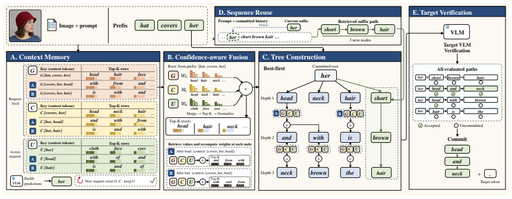
Figure 2 : The RECAP framework. (A) Three-, two-, and one-token keys retrieve Top-K prediction rows from G, C, and U; only U survives request boundaries. (B) Entropy-confidence weighting fuses the retrieved rows under specificity priors and normalizes the retained candidates. (C) Best-first tree search repeats retrieval and fusion under each node’s path context. (D) Suffix retrieval inserts a contiguous continuation from the prompt and committed history. (E) One packed target pass commits the matching path plus one target-selected token. All evaluated nodes refresh prediction memory; only committed tokens extend sequence history. Tokens and scores are illustrative.
Original paper · CC BY 4.0 · Hengjie Zhu, Dayan Wu, Xinze Liu, Peng Fu, Zheng Lin, Weiping Wang · RECAP: Context-Aware Prediction Recycling with Request-Local and Persistent Memories for Multimodal Speculative Decoding · Original paper figure · Extracted the figure area from page 3 of the original PDF.At each lookup, every matching row gets a weight that is a specificity prior times an entropy-based confidence. The confidence for row j is \(c_j(h)=\exp(-H(\hat P_{M_j}))\), where H is the entropy of that row, and the weight is \(w_j(h)=\alpha_j c_j(h)/\sum_i \alpha_i c_i(h)\), with \(\alpha_1\ge\alpha_2\ge\alpha_3>0\). The priors follow specificity rank among the rows that matched, so if only C and U match they receive α1 and α2.
The fused distribution is the mixture \(m(z|h)=\sum_j w_j(h)\hat P_{M_j}(z)\), which is then cut back to the Top-K tokens and renormalized to give q(z|h).
The mixture has a principled reading as the weighted Kullback–Leibler center of the stored rows, which minimizes the weighted divergences from those rows. The authors argue that the normalized proposal is the closest distribution on at most K tokens to that mixture, and they give the derivation in an appendix. Setting every confidence to one gives the fixed-prior variant, which the authors use as a control later.
Best-first search then ranks paths by \(\phi(\pi)=\prod_j \eta_j q(z_j|h_j)\), where \(h_j\) carries the path so far and the \(\eta_j\) control depth-dependent expansion. Because the fusion is recomputed at every node under that node's own path, the tree is assembled from local predictions and need not match any stored continuation. A suffix automaton over the prompt and committed history adds short continuations to the tree, sharing common prefixes with what is already there.
One packed target pass verifies the whole tree, with ancestral attention confining each node to its own path. The longest path that matches greedy decoding is committed, plus one target-selected token, and if no candidate agrees the target supplies the next token directly. Every evaluated node, including uncommitted branches, writes its predictions back into U, C and G, but only committed tokens enter the suffix automaton.
Speedups on the seven single-turn benchmarks
The main test covers seven single-turn benchmarks, with 1,000 inputs each, on Qwen2.5-VL-7B and LLaVA-1.6 Vicuna-7B. Each benchmark forms one inference stream, so the persistent token memory U is cleared before it and then carried across that benchmark's inputs. The comparison covers six draft-model-free baselines, including PLD, Lookahead, Token Recycling, Tree Recycling, SAM, and SAM+ViSkip.
On Qwen2.5-VL-7B, RECAP reaches a mean speedup of 1.66×, compared to 1.51× for Token Recycling, the strongest training-free baseline by mean speedup. On LLaVA-1.6-7B, the same comparison gives 1.56× for RECAP and 1.37× for Token Recycling. LLaVA reaches 1.81× on OCRBench and 1.71× on MathVista, which covers text-centric and reasoning inputs.
Acceptance length follows the same order, with RECAP at 3.02 on Qwen and 2.92 on LLaVA. Token Recycling reaches 2.71 and 2.55 on the same two models, so RECAP holds the highest τ throughout. The τ metric adds the target-selected token to the mean number of draft tokens accepted per verification iteration.
Token Recycling and Tree Recycling run token-indexed recycling on the same prefill and verification path as RECAP. Each method is timed on identical input lists against the same backbone's autoregressive run. Since both token-indexed baselines share that path, the difference lies in what each method stores for reuse.
Multi-turn results and the trained-drafter comparison
MMSpec extends the evaluation to six categories, including multi-turn conversations. RECAP reaches overall speedups of 1.89× on Qwen and 1.59× on LLaVA on this benchmark. Token Recycling, the strongest baseline on both models, reaches 1.56× and 1.43× there. On Qwen, RECAP's multi-turn speedup is 2.09×, with an acceptance length of 2.80. Only complex reasoning scores higher on Qwen, at 2.16×, so multi-turn ranks second.
On LLaVA, the multi-turn speedup of 1.73× is RECAP's largest category gain, with an acceptance length of 2.93.
Trained drafters are a different kind of comparison, so Table 3 sets RECAP against released DREAM and ViSpec drafters. DREAM and ViSpec reach mean acceptance lengths of 3.68 to 3.76 on the same single-turn inputs. RECAP reaches 2.92 on LLaVA and 3.02 on Qwen, which is 78 to 80% of their acceptance length. Their speedups of 1.05 to 1.26× look lower, but they were measured against autoregressive baselines of 41.9 to 61.2 tokens per second.
RECAP's baselines ran at 29.9 to 39.4 tokens per second, so the speedup figures don't rank the methods directly. The authors don't claim that RECAP decodes faster than these drafters.
RECAP adds no parameters or GPU-resident state. Its proposal state takes at most 8.70 MiB of host memory at the default budget. Because it needs no training stage, RECAP moves to a new VLM without data collection or a drafter checkpoint.
Which components carry the throughput
The ablations in Table 4 ask how much each design choice adds to throughput when everything else stays fixed. The authors run them on a 120-input MMSpec subset with Qwen2.5-VL-7B, with 20 inputs per category and 160 generation turns. Every policy in a comparison shares one tree builder and a 63-node transition budget, so only one component changes at a time.
Most of these rows use the fixed-prior special case, where every confidence term is set to 1.
An independent repeat of the same 120-input comparison gave 2.42%. Persistence gave the largest memory effect: keeping U across requests beat per-request reset by 5.42% on average over five runs. That gain ranged from 4.36% to 7.18% across the runs, so the effect holds but varies.
Entropy-confidence weighting added a smaller gain over fixed priors, 0.73% on Qwen and 1.09% on LLaVA. These four-dataset controls used 200 inputs per model for confidence, reported as Qwen and LLaVA. Confidence-based gating on a single source lowered throughput by 0.66% on Qwen, against 1.90% on LLaVA. That contrast suggests that combining source evidence helps in these settings, while the size of the confidence benefit stays modest.
Suffix insertion added 0.61% to fusion on average, using 100 inputs each from ChartQA, TextVQA, OCRBench, and MMT-Bench.
Specificity against coverage in replayed states
The authors replay 23,811 states from 400 inputs to isolate the specificity–coverage trade-off, with 100 inputs each from ChartQA, TextVQA, OCRBench and MMT-Bench. Retrieval starts with empty memories and reads only the rows written by earlier states. Query coverage counts the states that have a matching row, while conditional Recall@8 measures how often the reference next token appears among the covered states.
Finer keys raised conditional Recall@8 and lowered coverage on all four datasets, as Figure 3(a) shows. On OCRBench, U covered 54.9% of states and G covered 18.6%, while recall climbed from 63.6% to 90.6%. In a prompt-seeded variant, the authors restricted evaluation to states where both G and U match, and G beat U on Recall@8 by 5.00 to 29.54 percentage points.
Stored rows also keep source-image information, which the authors test by fixing the query image, question and prefix. They vary the image used for earlier predictions, and matching-image rows beat swapped-image rows by 0.89 to 6.35 percentage points in fused Recall@8.
Backoff keeps the coverage that G alone loses, so U plus C handles states where the finest key misses. At equal actual candidate counts, U plus C backoff lengthened matched continuations from 0.516 to 0.709 tokens on ChartQA. The same comparison moved OCRBench from 0.632 to 1.135 tokens. The offline metric counts the longest tree prefix that agrees with the saved target continuation, excluding the root and target correction token.
Online, U plus C backoff gave 1.11 to 3.64% paired throughput gains over U, so context refinement supplies more precise candidates that backoff keeps reachable.
Suffix reuse and per-iteration overhead
Suffix insertion gets its own test because the local transition fusion doesn't capture sequence evidence on its own. The suffix automaton indexes the prompt and committed history, and it finds the continuation that follows a match to the current suffix. It inserts that continuation into the tree by sharing common prefixes, which leaves the fused transition scores unchanged.
Suffix insertion lengthened the mean matched sequence by 0.059 to 0.190 tokens across the four replay datasets.
Suffix complementarity was tested separately from the other ablations, on 100 inputs each from ChartQA, TextVQA, OCRBench and MMT-Bench. Adding suffix insertion to fusion raised mean paired throughput by 0.61%, but the per-dataset changes ranged from −0.67% to +2.23%. The online gain therefore depends on the dataset rather than appearing uniformly.
The bookkeeping cost is measured per iteration, and the timing includes retrieval, insertion and overlap handling. At the default budget, retrieval, fusion, tree construction and packing together take 0.907 ms per Qwen iteration. For LLaVA, the same stages take 1.121 ms per iteration. These totals equal 8.20% and 5.61% of decoding wall time, respectively.
These overhead figures cover host-side decoding work, so they don't measure end-to-end application latency.
Limitations and what the speed numbers don't establish
The evidence covers greedy, batch-one generation on image-based inputs, using two 7B vision-language models. Larger models, concurrent serving and video remain untested operating regimes, so the paper doesn't speak to them. The authors didn't test those settings, and their results don't extend to them.
The default specificity priors, confidence weighting and tree settings may trade latency against memory differently across hardware and request lengths. The paper doesn't map that trade-off across hardware or request lengths, so the defaults shouldn't be read as universal.
The reported efficiency results measure generation throughput, which is the quantity the speedups S report. They don't establish downstream task accuracy, because the evaluation scores speed rather than answer quality. They also don't establish application-level latency distributions, so tail latency under real traffic remains open.
The ethics note asks deployments to follow model and dataset licenses and to isolate online prediction memories at user or service boundaries.
Paper info
- Authors
- Hengjie Zhu, Dayan Wu, Xinze Liu, Peng Fu, Zheng Lin, Weiping Wang
- Venue
- arXiv · Preprint
- First published
- 2026-11-4
- Added
- 2026-11-6
- Updated
- 2026-11-4
- Version
- v1
- arXiv
- 2611.05894
- Category
- cs.AI
- Original paper terms
- CC BY 4.0
- What we show
- Paper info, commentary and permitted figures from the original paper
AI commentary is a separate explanation from the original paper and may contain errors. The original paper and figures follow each source's terms of use and any rights noted separately.
Abstract
Recycling a target model's own predictions offers a training-free source of proposals for speculative decoding. In vision-language models, however, existing recycling indexes predictions by the last token alone, conflating predictions computed under different images and prefixes; we find that such reuse fails most often at image-sensitive decoding states. Longer keys reduce this aliasing but match fewer states. We introduce \method, which stores target predictions under one-, two-, and three-token keys: contextual memories live only for the current request and are thus implicitly conditioned on its image, while token-level memory persists across requests to retain coverage. At each lookup, entropy-confidence weighting fuses the retrieved predictions according to their key specificity and concentration. Best-first search composes the fused transitions into a candidate tree, supplemented by suffix-matched continuations, and one target pass verifies the tree under greedy decoding. Without training or an auxiliary draft model, \method\ achieves mean speedups over autoregressive decoding of $1.66\speed$ and $1.56\speed$ across seven single-turn benchmarks on Qwen2.5-VL-7B and LLaVA-1.6-7B, exceeding the strongest training-free baseline, Token Recycling ($1.51\speed$ and $1.37\speed$). Our implementation is available in https://github.com/Senmo996/RECAP-official-code.
Quote from the paper
Hengjie Zhu, Dayan Wu, Xinze Liu, Peng Fu, Zheng Lin, Weiping Wang (2026). RECAP: Context-Aware Prediction Recycling with Request-Local and Persistent Memories for Multimodal Speculative Decoding. arXiv:2611.05894v1. https://arxiv.org/abs/2611.05894v1
BibTeX
@misc{zhu2026recap,
  title = {{RECAP: Context-Aware Prediction Recycling with Request-Local and Persistent Memories for Multimodal Speculative Decoding}},
  author = {Hengjie Zhu and Dayan Wu and Xinze Liu and Peng Fu and Zheng Lin and Weiping Wang},
  year = {2026},
  eprint = {2611.05894},
  archivePrefix = {arXiv},
  url = {https://arxiv.org/abs/2611.05894v1}
}