Paper commentary
MemU-Bench: Benchmarking GUI Agents on Long-Horizon User Interactions
Agents that recall past user history beat GUI benchmarks built on precise instructions
- Problem Existing GUI benchmarks assume precise, self-contained instructions, but everyday requests are vague and depend on past use. Agents must recover missing context from long, noisy histories, and no benchmark tested that.
- Method MemU-Bench is a mobile benchmark of 118 vague tasks built on 29 long user histories. AppMem is a training-free framework that builds an app-centric memory bank and retrieves memories by inferring the target app.
- Results AppMem raises GPT-5.5's SPL from 15.7% to 66.9% on MemU-Bench. The best end-to-end system without history reaches only 16.4% SPL with Gemini-3.1-Pro.
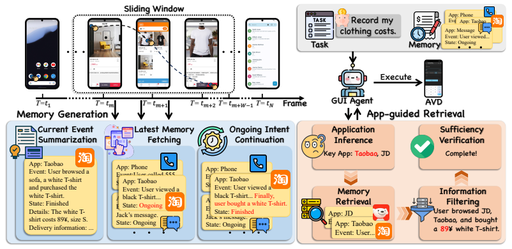
Figure4 :OverviewofAppMem.Duringthememorygenerationphase,ourmethodconcatenatestheuser’sinterruptedhistorical intents. In the retrieval phase, relevant information is retrieved on an app-centric basis to reduce Token consumption.
Original paper · CC BY 4.0 · Yizhou Liu, Zhengxi Lu, Fei Tang, Yiwen Qiu, Yong Du, Tongbo Chen, Bofan Chen, Tao Jiang, Wenhao Xu, Yunfeng Shu, Wenqi Zhang, Weiming Lu, Jun Xiao, Yueting Zhuang, Yongliang Shen · MemU-Bench: Benchmarking GUI Agents on Long-Horizon User Interactions · Original paper figure · Extracted the figure area from page 5 of the original PDF.Why vague instructions break current GUI agents
Most GUI benchmarks hand an agent a precise, self-contained instruction and check whether the resulting action sequence finishes it. Everyday requests rarely look like that, because users seldom remember the exact details of their past interactions. A request such as "modify the meeting time" can't be resolved unless the agent knows which meeting was created, when, and in which application.
So the agent can't rely on being a capable executor alone; it must distill its interaction stream into memory and retrieve the right piece on demand.
The authors argue that a fair test needs three things: raw long histories, intents that are split and interleaved, and proof that success came from recall. Real histories are long and noisy, so the decisive state changes sit among hundreds of visually redundant screenshots. End-to-end GUI agents remain below 5%, and their trajectories drift into aimless exploration across applications.
The benchmark therefore pairs Success Rate with Interaction Efficiency (IE) and Success weighted by Path Length (SPL), which penalize wandering.
How MemU-Bench is built
MemU-Bench splits its 118 tasks into 71 Level-1 tasks and 47 Level-2 tasks, based on how much history each one sits behind. Level-1 tasks draw on histories of fewer than 400 screenshots, while Level-2 tasks sit inside flows of more than 700 screenshots. The longer Level-2 histories test whether an agent's memory keeps working as the record grows.
Operators begin with an intent-level sketch that lists high-level goals for a session, such as ordering food and then casual gaming. The sketch names no particular apps or operation paths, so the operator chooses how each step is carried out. Because the information for the final vague task is embedded in the session, the history itself holds the answer.
Operators add accidental touches and redundant app switches, so the logs stay noisy, as real phone use does.
When a trajectory ends, the emulator state is frozen and the SQLite databases of every involved application are copied out. Restoring these snapshots reproduces the exact device state the operator left, so each historical effect can be checked against stored records. Grading starts with rule-based verification, which reads backend database records for tasks with deterministic goals.
For open-ended text, only the free-text fields go to an LLM judge, while a VLM grades the few tasks whose database is inaccessible. Of the tasks, 44.9% are graded by rules alone, and the remaining 55.1% need the LLM judge.
Measuring success and recall efficiency
IE only looks at successful tasks and divides the human step count by the larger of the agent and human step counts. Because the ratio uses the larger count in its denominator, an agent that wanders scores lower even when it reaches the goal. The authors use IE as a proxy for whether the agent recalls history or explores blindly to find clues during execution.
SPL multiplies that same step ratio by an indicator of success and averages over all tasks. Each failed task therefore contributes zero, so SPL penalizes both failure and wandering in one number. The paper adapts SPL from Anderson et al. (2018) to joint task success and interaction efficiency. Because SPL averages over all tasks while IE averages only over successes, a slow but successful run still lowers SPL.
The baseline numbers show this gap: without user history, Gemini-3.1-Pro reaches an SPL of only 16.4%. End-to-end GUI agents remain below 5% in the same setting, and their trajectories drift across applications. Such runs inflate interaction cost even when the task eventually succeeds, which is why SPL matters here. AppMem then sets up the memory side that these metrics are meant to test, starting from a sliding window over the raw log.
How AppMem builds its memory bank from raw screenshots
AppMem builds its memory bank by sliding a fixed-size window over the raw screenshot-action log. Each window holds W consecutive screenshot-action pairs, and the paper sets W to 10 in its experiments. Current Event Summarization reads each window and writes memory entries, one for each application the window touches. Each entry is a 6-tuple holding the app, an event description, on-screen details, start and end times, and a state of ongoing or finished.
The summarizer prompt asks it to record hard data such as numbers and proper nouns in the details field, because that data serves later retrieval.
Latest Memory Fetching runs next, looking up the most recent entry for the same app in the global memory bank. If that older entry is still ongoing, Ongoing Intent Continuation merges the two through an update step. If the older entry is finished or no matching entry exists, AppMem appends the new entry as a separate record. This design keeps an app's unfinished activity in one coherent entry, so a half-finished task survives detours into other apps.
Completed events aren't overwritten, which protects finished results from later updates.
Removing Ongoing Intent Continuation lowers SPL by 4.7% on Qwen3.5-397B-A17B. Without it, the memory size grows from 8.8K to 15.3K tokens. The authors read this as evidence that stitching interrupted intents yields memory that is both more complete and more compact. Algorithm 1 loops over the windows, and an app match with an ongoing state triggers an update instead of an append.
How app-guided retrieval narrows the search
At run time, a vague instruction first goes to Application Inference, which picks the subset of apps that might hold the missing facts. The agent works from the set of distinct applications appearing in the memory bank, so the choice is limited to apps the user actually touched. Memory Retrieval then keeps only the entries from those apps, so the search space shrinks before any text is read.
AppMem builds this app-specific sub-bank by filtering the global memory bank on the inferred application set.
Information Filtering then distills those retrieved entries into the key information κ for the instruction. The GUI agent runs this synthesis step itself, and the paper calls the function that does it f_filter. Sufficiency Verification asks whether κ covers what execution needs, and the agent checks this on its own. If κ doesn't cover the need, the explored applications are removed from the candidate set and the loop runs again.
The loop stops after at most K iterations, and the experiments set K to 3. The Summary baseline uses the same sliding window size W of 10, so both settings share the memory-building budget. Each model runs once at temperature 0, because the long trajectories make repeated runs costly. This retrieval design is what the paper's main results then compare against the Vanilla and Summary settings.
Main results: SPL and success across backbones
Summary lifts general models by large margins, and Qwen3.5-397B-A17B reaches 35.6% SR with it. The authors attribute this gap to long-text processing, which GUI-specific tuning appears to weaken. Each end-to-end figure comes from one complete run per model at temperature 0.
AppMem raises the SPL of GPT-5.5 from 15.7% to 66.9%, a gain of 51.2%. AppMem outperforms the naive summary baseline by 9.3% on the same model. On end-to-end agents, AppMem raises the SR of MAI-UI-8B by 16.9%.
Vanilla agents that do succeed still wander, with Gemini-3.1-Pro at an IE of 0.65.
Which AppMem components carry the gain
The authors remove one AppMem component at a time from the Qwen3.5-397B-A17B pipeline. In the authors' reading, merging interrupted intents yields memory that is both more complete and more compact.
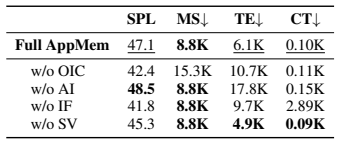
Table 3 : Component ablation of AppMem on Qwen3.5- 397B-A17B, removing one component at a time. MS: final memory size; TE: retrieval token overhead over successful tasks; CT: context tokens of retrieved information appended at execution. Lower is better for MS, TE, and CT.
Original paper · CC BY 4.0Removing Information Filtering drops SPL to 41.8, and the context appended at execution grows from 0.10K to 2.89K tokens. It does raise retrieval overhead, from 6.1K to 17.8K tokens, and the authors describe this axis as mainly governing cost.
Replacing App-guided Retrieval with standard RAG, a bge-m3 retriever over the top-3 memory entries, lowers the average SPL on Qwen3.5-397B-A17B from 47.1 to 37.5. The authors attribute the loss to dense similarity missing the heavy lexical overlap and fine-grained intent tracking that the tasks need.
Asking the user as an alternative to memory
The authors test an inquiry setting in which the agent actively asks the user for coarse directional clues, without any access to user history. This setup imitates users who forget the fine-grained details of a task, so the agent has to rely on what the user can still say. The experiment runs on Qwen3.5-397B-A17B, and Table 6 places it beside the no-history, Summary, and AppMem settings.
Without history, this model reaches an IE of 0.72, an SR of 13.6, and an SPL of 9.7.
Active inquiry lifts the SR by 25.4% over that no-history baseline, reaching 39.0. Its SPL rises to 24.1, which still sits below the 29.3 that the Summary baseline achieves. The inquiry setting also lowers efficiency, because the agent must take extra operational steps to collect the answers. The authors report that inquiry reaches an IE of only 0.62.
AppMem beats this asking baseline on both axes, reaching an SR of 52.5 against 39.0. It also improves interaction efficiency to 0.90 from 0.62, so the gain doesn't come from extra questioning. Inquiry therefore buys some success, but at a steep efficiency cost compared with recalling the history. The paper reports this inquiry experiment only for Qwen3.5-397B-A17B, so the result isn't shown for other backbones.
Where the remaining failures sit
For the Summary baseline, 57.6% of tasks fail because the retrieved information lacks the missing context. Another 11.0% succeed without sufficient information by reading on-screen clues at execution time. The authors conclude that retrieval, not navigation, is the main bottleneck. End-to-end agents execute well under clear instructions, so their failure under vague instructions is a memory problem.
For AppMem with Qwen3.5-397B-A17B, 14.4% of tasks retrieve accurate information but still fail because of navigation limits. In those cases, the model succeeded by searching autonomously for supplementary data.
The gap is measured as δ, the SPL of L1 minus the SPL of L2, where a smaller δ means more robust performance. The Summary baseline drops sharply, with δ at 15.5 for GPT-5.5. AppMem stays stable at δ of 3.2, because its structured memory filters noise. Summarization struggles as histories grow because the agent can't know the future instruction while it summarizes.
AppMem also cuts retrieval overhead, dropping Gemini-3.1-Pro from 8.5K to 4.2K tokens per successful task. Relative to the summary baseline, that reduction equals 50.6%. Claude-Opus-4.8 drops from 12.0K to 9.9K tokens, a 17.5% cut.
Limitations of the reported numbers
The main results come from one complete run per model at temperature 0, because processing long-horizon trajectories is costly. They didn't repeat runs for the other backbones, so their run-to-run variance is unmeasured.
The manual error analysis of AppMem covers Qwen3.5-397B-A17B alone. Missing information still accounts for 33.1% of AppMem's tasks, so retrieval remains the open problem. The component ablation in Table 3 also runs only on Qwen3.5-397B-A17B. The RAG comparison in Table 4 covers only GPT-5.5 and Qwen3.5-397B-A17B. The clue-based inquiry baseline was measured on Qwen3.5-397B-A17B only.
Of the tasks, 55.1% need an LLM judge, while 44.9% are checked by rules alone. The judge is Qwen3.5-35B-A3B, and the paper doesn't compare it against a second judge. Models other than the end-to-end agents act as planners, and Qwen3-VL-32B-Instruct grounds their actions into coordinates.
The paper sets the sliding window size W to 10 and the maximum retrieval rounds K to 3, and it reports no sweep over either. Operators produced the histories by simulating daily phone usage on an Android Virtual Device emulator, not by recording real long-term users.
Paper info
- Authors
- Yizhou Liu, Zhengxi Lu, Fei Tang, Yiwen Qiu, Yong Du, Tongbo Chen, Bofan Chen, Tao Jiang, Wenhao Xu, Yunfeng Shu, Wenqi Zhang, Weiming Lu, Jun Xiao, Yueting Zhuang, Yongliang Shen
- Venue
- arXiv · Preprint
- First published
- 2026-10-30
- Added
- 2026-11-7
- Updated
- 2026-10-30
- Version
- v1
- arXiv
- 2611.00191
- Category
- cs.AI · cs.CV
- Original paper terms
- CC BY 4.0
- What we show
- Paper info, commentary and permitted figures from the original paper
AI commentary is a separate explanation from the original paper and may contain errors. The original paper and figures follow each source's terms of use and any rights noted separately.
Abstract
Existing Graphical User Interface (GUI) benchmarks predominantly rely on precise and stateless user instructions. In everyday usage, however, instructions are often \emph{vague and history-dependent}: users omit the exact details of their past operations because they no longer remember them, leaving the agent to recover the missing context from long and noisy interaction histories. To bridge this evaluation gap, we introduce \textbf{MemU-Bench}, a mobile benchmark of \textbf{118 vague tasks} grounded in 29 long-horizon user trajectories, where agents must distill raw interaction streams into memory and retrieve the missing context on demand, with task outcomes verified against serialized application databases. Alongside Success Rate, we incorporate Interaction Efficiency (IE) and Success weighted by Path Length (SPL) to expose agents that succeed by exhaustively searching across different applications rather than by \emph{genuinely recalling} the history. Evaluations show that without user history, state-of-the-art systems struggle under such ambiguity: the best-performing Gemini-3.1-Pro achieves an SPL of only 16.4\%, and end-to-end GUI agents fall below 5\%. To address this, we further propose \textbf{AppMem}, a training-free framework that distills user history into a \emph{structured, app-centric} memory bank, tracks interrupted intents across application switches, and selectively retrieves relevant memories via target-app inference. AppMem raises the SPL of GPT-5.5 from 15.7\% to 66.9\% (\textbf{+51.2\%}), outperforms a naive summary baseline by 9.3\%, and delivers consistent gains across evaluated backbones.
Quote from the paper
Yizhou Liu, Zhengxi Lu, Fei Tang, Yiwen Qiu, Yong Du, Tongbo Chen, Bofan Chen, Tao Jiang, Wenhao Xu, Yunfeng Shu, Wenqi Zhang, Weiming Lu, Jun Xiao, Yueting Zhuang, Yongliang Shen (2026). MemU-Bench: Benchmarking GUI Agents on Long-Horizon User Interactions. arXiv:2611.00191v1. https://arxiv.org/abs/2611.00191v1
BibTeX
@misc{liu2026memu,
  title = {{MemU-Bench: Benchmarking GUI Agents on Long-Horizon User Interactions}},
  author = {Yizhou Liu and Zhengxi Lu and Fei Tang and Yiwen Qiu and Yong Du and Tongbo Chen and Bofan Chen and Tao Jiang and Wenhao Xu and Yunfeng Shu and Wenqi Zhang and Weiming Lu and Jun Xiao and Yueting Zhuang and Yongliang Shen},
  year = {2026},
  eprint = {2611.00191},
  archivePrefix = {arXiv},
  url = {https://arxiv.org/abs/2611.00191v1}
}