Paper commentary
What Has a Foundation Model Found? Using Inductive Bias to Probe for World Models
Probes reveal whether foundation models learn world models
- Problem Accurate next-token predictions don't show whether a foundation model learned the world model behind its data. Probing weights is hard, and one fixed task misses how these models get used.
- Method The inductive bias probe fine-tunes a model on small synthetic datasets generated from a postulated world model. It then checks whether the model's extrapolations respect that world model's state structure.
- Results The orbital transformer reached R2 above 0.9999 on held-out data. Fine-tuned to predict force vectors, its forces implied a gravitational law unlike Newton's.
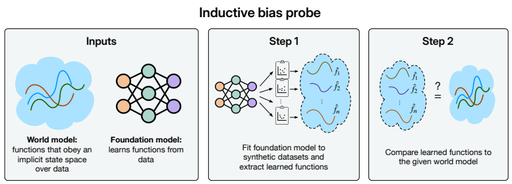
Figure 2 . An inductive bias probe measures whether a foundation model has an inductive bias toward a given world model. The probe involves repeatedly fitting a foundation model to small, synthetic datasets and comparing the functions it learns to the functions in the given world model.
Original paper · CC BY 4.0 · Keyon Vafa, Peter G. Chang, Ashesh Rambachan, Sendhil Mullainathan · What Has a Foundation Model Found? Using Inductive Bias to Probe for World Models · Original paper figure · Extracted the figure area from page 3 of the original PDF.Why good predictions don't settle the question
Sequence models trained to predict the next token now forecast planetary motion and board games well. Good accuracy on that task doesn't show whether the model captured the mechanism behind the data. Kepler's geometric patterns could pinpoint where planets would be, but they didn't explain why orbits took those shapes. Newton's laws of motion later explained those shapes, and they also gave concepts like force and gravity.
The paper asks how we would know if foundation models have made the same leap from accurate predictions to reliable world models.
The authors first looked at a transformer trained on orbital trajectories, which predicts the next position well. Yet the same model, fine-tuned to predict force vectors, produces poor force vectors instead of Newtonian ones.
Probing the internal weights of a large model is hard, and the results may not match how the model acts on new data. Studying behavior on one fixed task misses how foundation models get used in practice, as tools for new tasks. The authors instead look at inductive bias, the functions a learning algorithm tends to learn from limited data.
A world model restricts the possible functions, so a model that learned it should favour functions that obey its state structure.
The inductive bias probe
The probe asks whether a foundation model has learned a postulated world model by checking how it extrapolates from small synthetic datasets. The authors build on the no-free-lunch theorem, which says every learning algorithm is better for some collection of functions. Those functions a learning algorithm tends to learn represent its inductive bias.
A world model restricts the possible functions to those obeying its state structure, so a model that has learned it should prefer such functions. It doesn't score accuracy, because several extrapolations can be allowed by the same true world model.
For a finite state space and binary outputs, the probe scores two properties of the extrapolations. R-IB measures whether inputs in the same state receive the same predictions across synthetic datasets. D-IB is one minus how often inputs from different states receive similar predictions, so higher values mean stronger inductive bias. A model that makes the same prediction on every input scores high on R-IB but its D-IB suffers.
The authors compare R-IB and D-IB to precision and recall, so both are needed. Figure 3 illustrates both metrics, with low R-IB meaning learned functions don't respect state and low D-IB meaning they don't distinguish state.
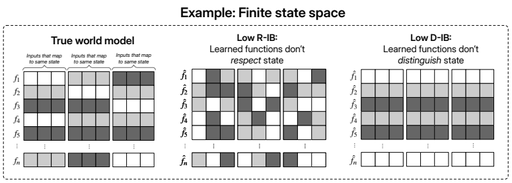
Figure 3 .An illustration of the inductive bias probe when the given world model has a finite state space. Each row represents a function and each column represents an input xi, with inputs belonging to the same state grouped together. The shading illustrates each function’s value at the corresponding input. A foundation model has low R-IB (middle) if it learns functions that divide states, while a foundation model has low D-IB (right) if it learns function that merge states.
Original paper · CC BY 4.0Extrapolative predictability scores how well the predictions for one input can be forecast from the predictions for another. An oracle foundation model, given the true state space and admissible functions, returns the admissible function that best fits each dataset. The probe bins input pairs by the oracle's extrapolative predictability and compares the model's value in each bin with the oracle's.
If the model behaves like the oracle, its points should lie on the 45-degree line, as Figure 4 illustrates for a transformer. R-IB and D-IB are special cases of this measure when the output is binary, the state space is finite, and G contains all mappings.
Orbital trajectories: accurate prediction, weak Newtonian bias
The authors simulated solar systems in which planets orbit a sun under Newton's laws, with initial conditions drawn to match known exoplanet orbits. Planet masses are much smaller than the sun's, so the simulation omits interactions between planets. Each sequence interleaves the (x, y) positions of every planet and the sun into 1,000 observations.
Half of the sequences use 6-month intervals between observations, and the other half use 1-week intervals. A special token at the start of each sequence signals which interval length the sequence uses.
A 109M parameter transformer was trained on 10M sequences and 20B tokens to predict the next token. Discretized coordinates with cross-entropy loss worked better for the authors than continuous coordinates with MSE loss. Each coordinate was split into 7K bins spanning -50 to 50 AU, and the model trained for 25 epochs on 8 H100 GPUs.
On held-out data the transformer reached an R2 above 0.9999 and clearly beat baselines that predict the latest position or the per-orbit mean. So the model is a strong sequence predictor, but that alone doesn't show it learned the mechanism. Newtonian mechanics ties each observation to a state vector of masses, relative velocities and relative positions.
The probe therefore asks whether the model's extrapolations follow that state, since a Newtonian world model would require it.
To test this, the authors fine-tuned the model on a small dataset whose target is the force vector at each point in a trajectory. Figure 1 places the true Newtonian forces beside the forces the transformer predicts. The predicted forces imply a gravitational law that bears no resemblance to Newton's law. The probe itself showed a low inductive bias toward Newtonian mechanics, and the authors read this as piecemeal heuristics rather than a compact world model.
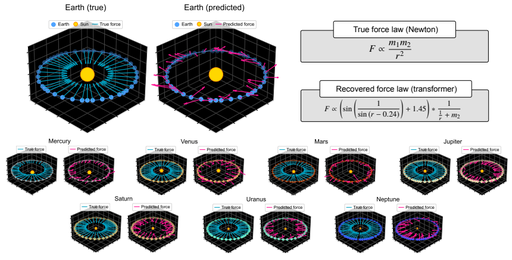
Figure 1 . Each pair of panels illustrates the trajectory of a planet in the solar system and its gravitational force vectors, comparing the true Newtonian forces (left) to the predicted forces (right) from a transformer foundation model pretrained on orbital sequences and fine-tuned to predict forces. While the model excels at generating accurate predictions of planetary trajectories, it does not have an inductive bias toward true Newtonian mechanics; moreover, its force predictions recover a nonsensical force law, as revealed by symbolic regression.
Original paper · CC BY 4.0Lattice and Othello probes
The lattice problem is a language over three tokens that move a state up one step, hold it in place, or move it down one step on a line of S states. The initial state is 1, and the move L is invalid at state 1 while R is invalid at state S. The authors varied S from 2 to 5 and generated sequences of length 100 by sampling a valid move uniformly at random at each step.
The authors trained RNN, LSTM, transformer, Mamba and Mamba-2 models with next-token prediction on this data. Each model was also compared with an untrained copy of the same architecture, fine-tuned from a random initialization on the same synthetic tasks.
Each game is tokenized into at most 60 moves, and the training set contains 20M games with 3.8M hold-out games. Before the probe, the authors checked next-token training: the top predictions were legal about 90% of the time on Othello and 100% on the five-state lattice. The probe fine-tunes each model on small datasets of randomly generated outputs and checks whether the extrapolations obey state structure.
On the lattice, the authors report that inductive biases are high when the number of states is small and drop off as the number of states grows. The transformer does worse than the other models, which all have recurrent or state-space architectures. On the five-state lattice, the transformer scored 0.483 on R-IB after next-token training, compared to 0.782 for the LSTM.
Its untrained R-IB was 0.268, so next-token training raised it. Table 2 gathers these R-IB and D-IB numbers for both the lattice and Othello domains.
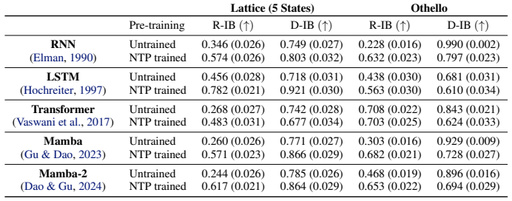
Table 2 . Theinductive bias towards respecting state(R-IB) andinductive bias towards distinguishing state(D-IB) metrics (1 is perfect performance, 0 is equivalent to noninformative model). “NTP-trained” represents a model pre-trained on next-token prediction, while “untrained” refers to a model trained on the same synthetic tasks, initialized from scratch.
Original paper · CC BY 4.0Othello is harder, and every model scores lower there than on the lattice problems. Next-token training also lowered the transformer's Othello D-IB, from 0.843 untrained to 0.624. Those poor Othello scores set up the next question, which asks how these models transfer to new functions of the board.
Transfer to new functions of the board
The authors test whether a higher inductive bias score predicts better transfer to new functions of the Othello board. They built three sequence-to-sequence datasets on Othello game transcripts, with the original game transcript as the input for each.
The authors compare the transfer results against the R-IB and D-IB scores that they reported for each model in Table 2. The last row of the transfer table reports the unsigned correlation for each metric. They also report the ratio R-IB/(1-D-IB), which summarizes the two inductive bias measures in one number. The authors find a strong correlation across all of these metrics.
Models that score higher on the inductive bias metrics also transfer better to these functions of state.
This pattern matters because the models predict token sequences well without appearing to learn the underlying board. The authors ask what the inductive bias is toward if it isn't toward the given world model. Two distinct Othello boards can have the same set of allowable next moves, so a model could treat them as equivalent.
Legal next moves as the inductive bias
The authors suggest that next-token training might push models to group states that share the same set of legal next tokens. Two Othello boards can differ yet allow the same next moves, so the grouping would be coarser than the board itself. The authors frame this as a hypothesis motivated by the next-token pretraining objective rather than as a proven mechanism.
If the model doesn't learn the full board, the authors ask what it extrapolates from, and this hypothesis is their candidate answer.
The authors fine-tuned a model pretrained on 1M games to predict the true board of each sequence. Even when the predicted board was wrong, the legal moves it implied often matched the legal moves of the true board. The authors describe the model as recovering enough of the board to compute legal next moves. Figure 6 shows a true board next to a predicted board whose set of next moves matches.
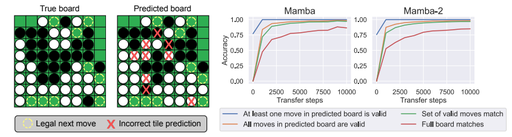
Figure 6 . On the left, a true Othello board implied by a sequence, and on the right, the predicted board from a model fine-tuned to predict boards. Although the prediction has errors, the set of predicted next tokens exactly matches the true board. On the right, metrics about board reconstruction during fine-tuning. Consistently, even as Mamba models struggle to recover full boards, they recover them well enough such that the sets of valid next moves match those in the true boards.
Original paper · CC BY 4.0To test the grouping, the authors defined a next-token coarsening q, where two states are equal when their valid next-token sets are equal. They split D-IB into pairs of different states with the same legal next tokens, written D-IB q=, and pairs with different legal next tokens, written D-IB q≠. If D-IB q= is smaller than D-IB q≠, the model extrapolates by the next-token partition rather than by the true board.
The authors computed these refined metrics for lattice and Othello, with results in Table 9. For all models, the gap between D-IB q= and D-IB q≠ is statistically significant. The authors take this as evidence that the models group distinct states by their legal next tokens.
Limits of the probe
The probe needs a world model written down before it can run, and that requirement limits what it can find. Because the metrics require a specified world model, they can't identify the representation a model uses without a candidate to test. The authors say this requirement matches other world-model studies, which also start from a specified model.
They propose testing candidates such as next-token partitions, and they call for methods that build candidate world models automatically.
The experiments span orbital sequences, lattice problems with 2 to 5 states, and Othello. The orbital analysis examines one transformer, with 109M parameters, so the force-law result applies to that model. The probe gives no answer for models outside the tested set, such as the transformer trained on orbital data.
Paper info
- Authors
- Keyon Vafa, Peter G. Chang, Ashesh Rambachan, Sendhil Mullainathan
- Venue
- arXiv · Preprint
- First published
- 2025-7-9
- Added
- 2026-10-30
- Updated
- 2025-12-27
- Version
- v4
- arXiv
- 2507.06952
- Category
- cs.LG · cs.AI
- Original paper terms
- CC BY 4.0
- What we show
- Paper info, commentary and permitted figures from the original paper
AI commentary is a separate explanation from the original paper and may contain errors. The original paper and figures follow each source's terms of use and any rights noted separately.
Abstract
Foundation models are premised on the idea that sequence prediction can uncover deeper domain understanding, much like how Kepler's predictions of planetary motion later led to the discovery of Newtonian mechanics. However, evaluating whether these models truly capture deeper structure remains a challenge. We develop a technique for evaluating foundation models that examines how they adapt to synthetic datasets generated from some postulated world model. Our technique measures whether the foundation model's inductive bias aligns with the world model, and so we refer to it as an inductive bias probe. Across multiple domains, we find that foundation models can excel at their training tasks yet fail to develop inductive biases towards the underlying world model when adapted to new tasks. We particularly find that foundation models trained on orbital trajectories consistently fail to apply Newtonian mechanics when adapted to new physics tasks. Further analysis reveals that these models behave as if they develop task-specific heuristics that fail to generalize.
Quote from the paper
Keyon Vafa, Peter G. Chang, Ashesh Rambachan, Sendhil Mullainathan (2025). What Has a Foundation Model Found? Using Inductive Bias to Probe for World Models. arXiv:2507.06952v4. https://arxiv.org/abs/2507.06952v4
BibTeX
@misc{vafa2025what,
  title = {{What Has a Foundation Model Found? Using Inductive Bias to Probe for World Models}},
  author = {Keyon Vafa and Peter G. Chang and Ashesh Rambachan and Sendhil Mullainathan},
  year = {2025},
  eprint = {2507.06952},
  archivePrefix = {arXiv},
  url = {https://arxiv.org/abs/2507.06952v4}
}