Paper commentary
Polygraph: Large-Scale Multi-Session Trajectory Optimization using Pose Graphs
- Problem Independently recorded sessions drift in their own frames, and map-based fusion is costly to store and optimize, while the existing map-less single-session method cannot relate sessions to one another.
- Method Polygraph keyframes each session online, groups keyframes into spatial clusters, matches closed clusters against other sessions with MegaLoc retrieval, verifies candidate pairs with XFeat and LighterGlue, Metric3D depth and PnP RANSAC, admits cross-session edges through a two-tier consensus gate, and solves one shared pose graph with iSAM2 and graduated non-convexity.
- Results In the production configuration on KITTI-00, Polygraph runs 1.9× faster than 2GO with 26 committed loop-closure edges, against 517 for 2GO.
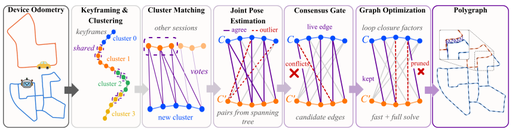
Fig. 2 : Polygraph pipeline. Each session’s odometry is keyframed and grouped online into spatial clusters. A closed cluster is matched against every other session by image retrieval, candidate pairs are verified by joint pose estimation into one confirmed match, which enters the shared pose graph once the consensus gate admits it. A fast incremental solve runs after every closed cluster, and a periodic full solve prunes outliers.
Original paper · CC BY 4.0 · Lukovic, Petar, Lim, Tian Yi, Pollefeys, Marc, Speciale, Pablo, Blum, Hermann, Bauer, Zuria · Polygraph: Large-Scale Multi-Session Trajectory Optimization using Pose Graphs · Original paper figure · Extracted the figure area from page 3 of the original PDF.Why independent sessions stay disconnected
Each pass through an environment yields a session whose visual or visual-inertial odometry is accurate locally, drifts over time, and lives in its own coordinate frame. Merging sessions means finding where they overlap, using those overlaps to correct the drift, and expressing every session in one shared frame. The classical route keeps a 3D map of visual landmarks and matches new observations against it, as ORB-SLAM3 Atlas, Maplab and COVINS do.
The geometric evidence from such a map is strong, but its cost grows with the landmarks and poses it holds, so it grows with every added session.
Map-less multi-robot systems such as DOOR-SLAM, Swarm-SLAM and FLOCC-SLAM treat cross-robot closures as pose-graph edges, but they still assume that every robot is known in advance. 2GO avoids the map by building a sparse keyframed pose graph for one session, with learned retrieval, two-view verification and a monocular depth prior for metric scale.
It handles only one session, and its consistency check depends on a live trajectory estimate that a newly arriving session does not yet have.
The shared pose graph objective
Each session s has raw odometry poses in its own local frame, which are thinned to keyframe poses T_{s,j}, and the graph has one vertex per keyframe. The raw odometry poses \(T^{raw}_{s,i} \in SE(3)\) are expressed in a local frame that has no known relation to any other session, so the graph starts with no shared frame at all.
The graph is solved over the poses \(X_v\) of the vertices in the shared frame of each connected component. Each residual compares a measurement with the relative pose implied by two vertices, using the residual below. \[ r(X_u, X_v, z) = \mathrm{Log}\left(z^{-1} X_u^{-1} X_v\right) \] Gauge-fix priors are written against \(p_v\) in the tangent space, as \[ X_v \ominus p_v = \mathrm{Log}\left(p_v^{-1} X_v\right) \], and there is one such prior per session in the set \(V_0\).
Odometry edges use an identity robust function, while loop-closure edges use a Cauchy loss, so that a single bad loop closure has less pull on the solution.
Keyframes and spatial clusters
Computing the descriptor only for keyframes keeps the retrieval index small relative to the raw odometry rate.
Keyframes are grouped using only the session's own travel distance. A cluster closes once it has at least \(n_{min}\) keyframes and has travelled more than \(d_{max}\) from its first keyframe, or once it reaches \(n_{max}\) keyframes. The last \(n_{ov}\) keyframes of a closing cluster seed the next cluster, so neighbouring clusters overlap and there is no coverage gap between them.
Retrieval votes between clusters
When s' is the session of C, the two clusters adjacent to C are excluded, because they share keyframes with C by construction. A session in which fewer than \(n_{part}\) keyframes of C cast any vote is dropped. Each remaining candidate C' is scored by its vote share, which is the votes it receives within s' divided by all votes cast within s'.
\[ \mathrm{share}(C, C') = \frac{\text{votes for } C' \text{ within } s'}{\text{all votes cast within } s'} \] Candidates whose share is above \(\tau_{share}\) are kept, up to \(k_{cl}\) per session. The output is a short list of cluster pairs to verify, not a list of matches.
Proximity retrieval is a second candidate source inside the same session that uses odometry position and heading instead of descriptors. It is off by default and helps on long trajectories that contain few loops.
Verifying a candidate with image content
The surviving depth-lifted points and their pixel observations go to PnP RANSAC, which yields the metric pose \(\hat{T}_{k,k'} \in SE(3)\).
A candidate is confirmed only if the consensus set contains at least \(n_{vote}\) estimates, so a single uncorroborated estimate never suffices.
When a match is admitted, every member of the consensus set is also added as its own factor, not only the mean. The optimizer then sees the spread of the evidence, which the authors found especially useful for densifying the graph when revisits are sparse.
The two-tier consensus gate
Under tier 1, a query session with no live cross-session edge pools the candidates that target it, and these are checked only against each other. Once at least \(m_{corrob}\) pooled candidates give mutually consistent placements within \(\tau_{pool}\), and are independent with anchor-side clusters at least \(g_{min}\) apart, they commit together.
Committing as a group means the query session joins with two or more edges at once and never with exactly one.
Under tier 2, a query session that already has a live cross-session edge gets each new candidate checked at once against its current estimate, using a translation and rotation tolerance. A consistent candidate commits.
Incremental and batch pose graph solves
Every admitted edge becomes a factor in the objective. A fast update runs iSAM2 after every closed cluster and folds in new vertices and edges incrementally.
Single-session refinement on KITTI and VBR
Table I reports RMSE ATE on the KITTI loop sequences and on VBR for ORB-SLAM3 and VINS-Fusion odometry, with single-session and multi-session Polygraph beside 2GO and Maplab. The setup follows 2GO, with each sequence treated alone for single session and a dataset run together for multi-session. ORB-SLAM3 lost tracking on diag train0, which is excluded from that column.
VBR's VINS-Fusion backbone uses one configuration per platform, with keyframe spacing of 5.0 m for vehicles and 2.5 m for handheld devices, while its ORB-SLAM3 backbone uses one configuration per location.
The authors attribute the accuracy gain to the extra filtering and consensus steps applied to clusters, which make the graph sparser than 2GO's direct keyframe loop closures or ORB-SLAM3's dense bundle adjustment without losing accuracy.
Figure 5 shows four VBR routes with single-session results only. Odometry drifts by tens to hundreds of metres on these routes, and Polygraph pulls each route back close to ground truth using retrieval, two-view matching and the monocular depth prior, with only the session's own revisits.
Multi-session results on KITTI and VBR improve on the single-session results overall, and multi-session never falls behind single-session by more than 0.03 m on any sequence. These datasets have trajectories that barely overlap geographically, so this gain rests on the few overlaps that exist.
Two- and three-robot splits of KITTI-00
KITTI-00 is cut into two or three equal parts, each treated as its own session on its own odometry and run concurrently, following the split protocol of DOOR-SLAM and Swarm-SLAM. The comparison uses RTAB-Map stereo odometry for both baselines.
HYDRO and HGE across devices
HYDRO has 10 sessions, with 5 Spot and 5 iOS sessions, and HGE has 9 sessions, with 5 HoloLens and 4 iOS sessions. Their footprint diagonals are 89 m and 167 m, so anchoring errors are also reported as a percentage of the diagonal. The configuration is tuned on each site's primary device, Spot at HYDRO and HoloLens at HGE, and then run unchanged on the iOS sessions.
Table IV reports ATE per device for odometry only, for single-session and multi-session Polygraph, and for mixed multi-device graphs. On the Spot sessions, mean ATE falls from 0.299 m for odometry only to 0.149 m for multi-session, and the L2 value falls from 0.727 to 0.336.
At HGE the HoloLens sessions split into two disconnected reference groups when they are processed alone. Adding the iOS sessions bridges the two groups into one shared frame.
Table V compares a single-camera baseline with the best camera combination. At HYDRO, the four cameras on the Spot more than double the cross-session edges and improve single-session ATE from 0.236 m to 0.197 m, while the second camera of KITTI's stereo rig changes nothing.
Choosing the pose estimation chain
On HGE, MASt3R succeeds on 91.8% of pairs and XFeat with LighterGlue on 76.8%. Yet MASt3R's mean translation error on its successful pairs is 0.961 m, against 0.544 m for XFeat with LighterGlue.
Averaged across KITTI, HGE, HGE iOS and HYDRO, XFeat with LighterGlue and Metric3D ties MASt3R with Metric3D at 2.20 m mean ATE each, and it takes 21% less wall time.
Retrieval is generally robust to substitution. Replacing MegaLoc with BoQ, NetVLAD or SALAD changes ATE by only a few percent.
What the two-tier gate changes
The gate ablation admits every confirmed match immediately, with no corroboration or consistency check. With the gate off, the pipeline runs 5.7 to 10.3% slower, because it commits far more edges and these cost more downstream cleanup than the gate costs to run. The gate also raises accuracy. Per committed edge, translation error is about 2.5 times higher with the gate off, and rotation error is almost 6 times higher.
Runtime against 2GO
The authors attribute most of this speedup to the consensus gate rejecting single, uncorroborated matches.
MASt3R-native is the fastest of these because it skips the depth-lifting stage entirely.
Sensitivity to the odometry realization
The Total L2 across these runs lies between 5.97 and 6.63 m, close to the single-realization value in Table I.
Committed-edge accuracy on EuRoC
On MH01 to MH05, committed cross-session edges are measured against ground truth before graph optimization. The stereo-inertial ORB-SLAM3 front end gives 43 edges with translation error 0.48±0.29 m and rotation error 1.61±0.96 degrees. The stereo ORB-SLAM3 variant gives 62 edges with translation error 0.57±0.41 m. The COVINS-G variant with the 17-point front end on ORB-SLAM3 gives 406 edges at 0.07±0.12 m, and the COVINS-G variant on VINS-Mono gives 1823 edges at 0.10±0.17 m.
The authors compare their committed edges with the 17-point variant at 0.07 m, and describe COVINS-G as a genuinely two-view, IMU-fused system. This measures the edges that pass the gate, not the final graph after optimization, and it does not show that the committed edges are as accurate as the 17-point variant.
Limitations
Trajectories in the KITTI and VBR evaluation barely overlap, so the multi-session results on those datasets rest on sparse overlaps. The odometry-consistency check covers five realizations of ORB-SLAM3 odometry only.
On EuRoC, the committed edges of the stereo-inertial variant average 0.48 m translation error, which is higher than the 0.07 m of the 17-point COVINS-G variant. MASt3R-depth variants land 18 to 78 m off once anchored, so a locally corroborated edge can still make the global frame wrong.
The HYDRO and HGE sites have no external baseline, so their results are compared only with Polygraph's own odometry-only and single-session variants.
The 2GO timings come from its paper rather than a re-run, and the gate-off timings were measured on an RTX 2080.
Paper info
- Authors
- Lukovic, Petar, Lim, Tian Yi, Pollefeys, Marc, Speciale, Pablo, Blum, Hermann, Bauer, Zuria
- Venue
- arXiv · Preprint
- First published
- 2026-11-16
- Added
- 2026-11-17
- Updated
- 2026-11-16
- Version
- v1
- arXiv
- 2611.21163
- Category
- cs.RO
- Original paper terms
- CC BY 4.0
- What we show
- Paper info, commentary and permitted figures from the original paper
AI commentary is a separate explanation from the original paper and may contain errors. The original paper and figures follow each source's terms of use and any rights noted separately.
Abstract
Robots, vehicles, and wearable devices often traverse the same environment many times. Each pass produces its own trajectory from onboard visual or visual-inertial odometry. These trajectories are locally accurate but drift over time and live in unrelated coordinate frames. Turning many such independent trajectories into one globally consistent set is the large-scale multi-session trajectory optimization problem. Existing solutions largely work offline. All sessions must be available up front, one session is fixed as the reference frame, and a single fused map is then optimized. This paper presents Polygraph, a multi-session trajectory optimization pipeline that processes sessions online, one keyframe and one spatial cluster at a time, and never builds a 3D map. Keyframes are grouped into local clusters. When a cluster closes, it is matched against every other session through learned image retrieval. Candidate pairs are verified with sparse feature matching, monocular metric depth, and robust pose estimation. A two-tier consensus gate admits a cross-session edge into the shared pose graph only once independent evidence corroborates it. A cheap incremental solve keeps the graph current, and a periodic robust batch solve prunes outliers. We evaluate Polygraph on stereo outdoor driving, HoloLens and iPad indoor traversals, legged indoor locomotion with a Boston Dynamics Spot, and large-scale outdoor vehicle and handheld routes. Against the closest prior work on the same GPU model, using its reported timings, Polygraph runs faster, commits fewer loop-closure edges, and matches or improves on accuracy.
Quote from the paper
Lukovic, Petar, Lim, Tian Yi, Pollefeys, Marc, Speciale, Pablo, Blum, Hermann, Bauer, Zuria (2026). Polygraph: Large-Scale Multi-Session Trajectory Optimization using Pose Graphs. arXiv:2611.21163v1. https://arxiv.org/abs/2611.21163v1
BibTeX
@misc{petar2026polygraph,
  title = {{Polygraph: Large-Scale Multi-Session Trajectory Optimization using Pose Graphs}},
  author = {Lukovic, Petar and Lim, Tian Yi and Pollefeys, Marc and Speciale, Pablo and Blum, Hermann and Bauer, Zuria},
  year = {2026},
  eprint = {2611.21163},
  archivePrefix = {arXiv},
  url = {https://arxiv.org/abs/2611.21163v1}
}