Paper commentary
Machine Hearing: Can Audio LLMs Generalize Beyond Human Auditory Perception?
Audio LLMs struggle with inputs humans cannot hear, and a small encoder helps
- Problem Audio LLMs were built for human-audible sound, so their audio front ends miss many physical signals. Zero-shot transfer to machine hearing is limited, and finetuning the Whisper encoder does not fully close the gap.
- Method MachEar is a lightweight encoder that runs beside the pretrained Whisper encoder. It uses an FFT pathway and a 1D CNN pathway, then passes their features through Transformer blocks into a fixed number of tokens for the LLM.
- Results Adding MachEar raised weighted Macro-F1 from 67.02% to 72.30% on the Machine Hearing Benchmark, while largely preserving existing audio understanding.
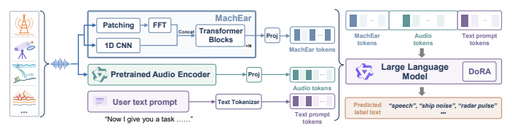
Figure 3 : Overview of MachEar integrated with a pretrained audio pathway. Given an input signal, MachEar and the pretrained audio encoder process the same input in parallel to produce comple- mentary representations. The resulting MachEar tokens, audio tokens, and text prompt tokens are concatenated and jointly fed into the LLM for prediction.
Original paper · CC BY 4.0 · Liwei Liu, Jun Tao, Xingyuan Li, Xuenan Xu, Chen Zhang, Junyi Wang, Boya Zhang, Xiaoyu Yang, Zhen-Hua Ling, Wen Wu, Chao Zhang · Machine Hearing: Can Audio LLMs Generalize Beyond Human Auditory Perception? · Original paper figure · Extracted the figure area from page 4 of the original PDF.Why audio LLMs stall outside hearing range
Audio LLMs handle speech, music and environmental sound well, but their audio front ends were built for human-audible audio. Encoders such as Whisper, WavLM and EAT set the range of what these models can perceive. The physical world, however, extends well beyond that range, since only a small fraction of its waves and vibrations are directly audible to humans.
Earthquakes, machine vibration, radio and radar, heart sounds and light curves all carry oscillatory patterns that humans cannot hear. So the open question is whether current ALLMs can understand such inputs at all.
The authors frame this as a question about the perceptual boundary itself, not about speech or music quality. To test it, they built the Machine Hearing Benchmark (MHB), with 6,128 instances across 13 tasks and seven domains. Its inputs include both single- and multi-channel signals, acquired through markedly different sensing devices. The authors benchmarked seven current ALLMs on MHB, and the results reveal a striking gap.
The authors argue that existing audio benchmarks such as SUPERB and AIR-Bench mostly cover human-audible audio. That scope leaves the ability of Audio LLMs on heterogeneous, non-audible input regimes largely unstudied. MHB is meant to fill that gap within a unified LLM-compatible framework. The benchmark therefore tests whether the audio front end, not the language model alone, limits generalization.
What the Machine Hearing Benchmark contains
MHB packs 6,128 instances across 13 tasks and seven domains into one benchmark for Audio LLMs. The authors built it from 13 public datasets and domain-specific sources, with numerical simulations added where they fit. Each instance keeps its original measurement and target labels, so the scientific objective of each task stays intact.
The domains range from Astronomy and Earth Science to Electromagnetic and Manufacturing. Figure 2 gives the instance count N, the sequence length L and the sampling rate fs for each domain. Inputs include both single- and multi-channel signals, since the signals come from very different sensing devices. In Electromagnetic, the tasks are modulation scheme classification and waveform-type classification from radar pulses.
Zero-shot results and invalid answers
Before scoring accuracy, the authors counted a response as valid only if it was parseable and inside the task's label set. Success rate is the share of evaluated instances that produce such a valid response, so an invalid answer lowers the score before any label is compared. Invalid answers were common across models, and short-input failures made up a large share for Qwen2.5-Omni-3B and Qwen2.5-Omni-7B.
GPT-Audio-Mini had the lowest success rate, with its invalid answers split almost evenly between unrecognized-input and short-input failures.
Failure types differ by model, which matters when someone tries to fix the input pipeline. Audio Flamingo 3 mostly breaks label format, for example answering "Tank" instead of "Tanker". Representative invalid responses are listed in Appendix D.
Macro-F1 is computed over all MHB instances, and invalid responses count as incorrect predictions. Taking the best Audio LLM for each task, performance still stays below random guessing on 9 of the 13 tasks. On LEAVES, the best model scored 1.87 Macro-F1, compared to 8.94 for random guessing.
Even when the models return valid responses, their predictions stay largely uninformative. Relative strengths vary across models and domains, so no single Audio LLM leads on every task. Taken together, the authors conclude that current Audio LLMs struggle to generalize beyond human auditory perception.
Domain foundation models as a reference for MHB
Each foundation model stays frozen, and 5-nearest-neighbor classification runs in its representation space with the task's training set as the reference set. The five models are Time-MoE for general time series, SpectrumFM for radio spectrum, SeisLM for seismic waveforms, FISHER for industrial signals, and SPEAR for speech and audio. Success Rate counts an instance only when the ALLM returns a valid and parseable response inside the task's label set, while the foundation models are scored by Macro-F1.
Domain pretraining helps when the pretraining data matches the target task. FISHER achieves the best performance on both Manufacturing tasks, which is the clearest case of alignment in Table 2. The advantage isn't universal, because SeisLM leads on Iquique but not on Llaima. SpectrumFM doesn't rank first on either Electromagnetic task.
Strong transfer also appears outside nominally matched domains. SPEAR, an audio foundation model, stays competitive across many tasks outside conventional audio. The general time-series model Time-MoE leads on LEAVES and RadSeg. Domain specialization alone doesn't guarantee consistently strong transfer across the heterogeneous MHB tasks. This result matters later, because the authors next ask whether supervised adaptation of an ALLM can close the gap.
Can supervised adaptation close the gap?
Qwen2.5-Omni-7B serves as the backbone, and its audio encoder starts from Whisper-large-v3. The authors finetune the LLM with DoRA on machine-hearing adaptation data, which tests whether data exposure alone is enough. They compare Whisper frz, where the audio encoder stays frozen, with Whisper, where the encoder is jointly finetuned with the LLM.
Finetuning the Whisper encoder as well improves performance on most tasks, so the pretrained front end itself needs to adapt. LEAVES, RadSeg and RadioML stay hard even after finetuning. The authors attribute the persistent difficulty to architectural constraints of conventional audio front ends rather than to a simple data-domain mismatch.
The weighted average Macro-F1 is 57.95 for the frozen Whisper setting and 67.02 for the finetuned Whisper setting. Unfreezing the encoder raises the weighted average, but the hardest tasks still limit the result. This remaining gap motivates the architectural extension that MachEar provides in the next section. MachEar, which operates alongside the pretrained Whisper encoder, outperforms the finetuned Whisper setting on a substantial subset of tasks.
That advantage is clearest on LEAVES and RadSeg, which involve shorter input sequences.
MachEar: a second path beside the pretrained encoder
MachEar keeps the pretrained audio encoder and adds a small parallel branch next to it. The LLM receives the MachEar tokens, the audio tokens and the text prompt tokens concatenated together for prediction.
Inside MachEar, an FFT pathway and a 1D CNN pathway extract features from the input in parallel. The two feature sets are concatenated, and the concatenated features then pass through Transformer blocks. Projection layers turn these features into a fixed number Q of compact MachEar tokens. Because Q is fixed, the LLM always receives the same number of MachEar tokens, whatever the input length.
The authors ran two MachEar configurations on the same Qwen2.5-Omni-7B backbone. In the first, MachEar directly replaces the pretrained Whisper encoder, while in the second, Whisper + MachEar adds MachEar and jointly finetunes both encoders. MachEar alone outperforms the finetuned Whisper configuration on a substantial subset of MHB tasks, especially LEA VES and RadSeg.
Accordingly, augmenting Qwen2.5-Omni-7B with MachEar raises the overall weighted Macro-F1 from 67.02% to 72.30%.
MachEar compared with fine-tuned Whisper
The authors compare four configurations on the same Qwen2.5-Omni-7B backbone with DoRA: Whisper frz, Whisper, MachEar alone and Whisper + MachEar. MachEar alone replaces the Whisper encoder, and it beats fine-tuned Whisper on a substantial subset of tasks, especially LEAVES and RadSeg. Its overall weighted average is lower, at 64.46 compared to 67.02 for fine-tuned Whisper.
Adding MachEar to the jointly finetuned Whisper raises the weighted average to 72.30.
The authors describe the gains as more consistent across tasks than direct adaptation of the encoder gives. They conclude that MachEar adds machine-hearing capacity beyond what adapting the pretrained encoder provides.
Which MachEar branch matters, and where
MachEar's benefit is largest for short sequences, and the ablations show where that benefit comes from. The authors split the 13 MHB tasks into four input regimes by sequence length and sampling rate. Adding MachEar to Whisper gives the largest gains in G1 and G2, with weighted Macro-F1 rising from 57.22 to 69.72 in G1. The advantage is smaller for the longer-sequence G3 and G4 regimes.
The authors read this pattern as MachEar compensating for the original audio front end on short sequences outside the conventional audio range.
The component ablation keeps the Whisper encoder frozen, so the comparison isolates MachEar itself. The full configuration in this ablation is called Whisper* + MachEar. Removing the 1D CNN pathway lowers weighted Macro-F1 from 70.31% to 64.04% in G1. In G2, removing the 1D CNN drops the score from 75.55% to 62.63%. The 1D CNN therefore matters most in the shorter-sequence regimes.
Removing the FFT pathway instead hurts all four regimes. The drops are 2.82, 5.15, 1.68 and 5.46 percentage points in G1 to G4. The authors conclude that the FFT contributes more consistently across signals with a broader range of sampling rates. So the two branches play complementary roles: the 1D CNN handles short sequences, while the FFT covers the wider sampling-rate range.
Does conventional audio performance survive machine-hearing adaptation
Adapting Qwen2.5-Omni-7B to machine hearing could erode its conventional audio skills, so the authors tested two of them. They measured ASR on LibriSpeech test-clean and test-other, and audio captioning on AudioCaps. The comparison pits the machine-hearing-adapted Whisper + MachEar against the original Qwen2.5-Omni-7B. Degradation was expected after adaptation, but the authors describe the observed drop as surprisingly modest.
Adding ASR and audio-captioning data during machine-hearing adaptation narrows the gap further. The authors read this as evidence that MachEar extends ALLMs toward machine hearing without substantially disrupting their original audio capabilities.
Open limits of the evidence
The MachEar results all sit on one backbone, Qwen2.5-Omni-7B, whose audio encoder is initialized from Whisper-large-v3. They didn't test MachEar on any other backbone, so the gains are shown only for this one model. In that frozen setting, removing the 1D CNN lowers weighted Macro-F1 from 70.31% to 64.04% in G1.
After task-specific finetuning, LEAVES, RadSeg and RadioML remain the hardest tasks. That explanation points to the front end, but the paper doesn't isolate it from the amount of adaptation data. They didn't test whether a different finetuning recipe would close the gap on these three tasks.
The zero-shot evaluation covers seven ALLMs, three open-source and four proprietary. The five domain foundation models were scored with frozen features and 5-nearest-neighbor classification, not with finetuning. So the foundation-model comparison and the finetuned ALLM comparison use different adaptation protocols. They didn't test whether finetuning the foundation models would change their ranking on MHB.
The main MachEar gain is weighted Macro-F1 on MHB, rising from 67.02% to 72.30%. The four regimes G1 to G4 cover only part of the sampling-rate and length space that MHB spans. Whether the gains hold for sampling regimes outside those groups was not tested. The FFT drops of 2.82, 5.15, 1.68 and 5.46 points were measured only with the Whisper encoder frozen.
Paper info
- Authors
- Liwei Liu, Jun Tao, Xingyuan Li, Xuenan Xu, Chen Zhang, Junyi Wang, Boya Zhang, Xiaoyu Yang, Zhen-Hua Ling, Wen Wu, Chao Zhang
- Venue
- arXiv · Preprint
- First published
- 2026-11-7
- Added
- 2026-11-10
- Updated
- 2026-11-7
- Version
- v1
- arXiv
- 2611.10693
- Category
- cs.SD · cs.CL
- Original paper terms
- CC BY 4.0
- What we show
- Paper info, commentary and permitted figures from the original paper
AI commentary is a separate explanation from the original paper and may contain errors. The original paper and figures follow each source's terms of use and any rights noted separately.
Abstract
Multimodal LLMs have made remarkable progress in perceiving the physical world, while their perceptual scope remains largely human-centric, focusing on what humans can directly see or hear. This progress raises the prospect of perception beyond human limits, such as extending hearing to sounds that are inaudible to humans. More broadly, the physical world is full of waves, vibrations, and oscillations, only a small fraction of which are directly audible to humans. This invites the extension of multimodal LLMs toward a broader form of machine hearing, which remains largely underexplored. To investigate this direction, we introduce the Machine Hearing Benchmark (MHB), comprising 6,128 instances across 13 tasks and seven domains. MHB spans highly heterogeneous input regimes, with sampling rates from approximately $10^{-5}$ to $10^6$ Hz, sequence lengths from $10^1$ to $10^6$ samples, and both single- and multi-channel inputs. Evaluations of current open-source and proprietary Audio LLMs (ALLMs) reveal limited zero-shot transfer to machine hearing. Supervised adaptation on machine-hearing data alone does not close this gap, suggesting that the challenge extends beyond data exposure to a systematic mismatch between existing audio front ends and machine-hearing inputs. To address this mismatch, we introduce MachEar, a lightweight encoder extension that complements the pretrained Audio LLM for machine-hearing inputs. The results show that MachEar equips a pretrained Audio LLM with stronger machine-hearing capabilities while largely preserving its existing audio understanding performance.
Figures from the paper
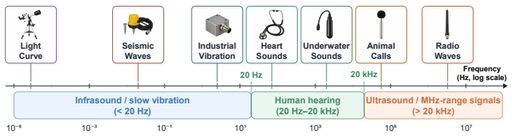
Figure 1 : Conceptual illustration of waves, vibrations, and oscillations across characteristic fre- quency scales. Human-audible sound constitutes only a small subset of the broader signal space considered in machine hearing.
Original paper · CC BY 4.0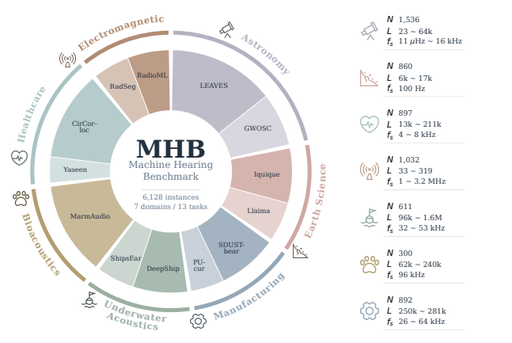
Figure 2 : Overview of the Machine Hearing Benchmark (MHB), comprising 6,128 instances across 13 tasks and seven domains. For each domain,N,L, andf s denote the number of instances, sequence length, and sampling rate, respectively.
Original paper · CC BY 4.0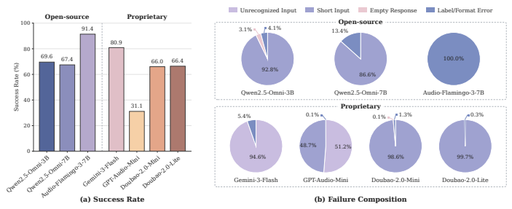
Figure 4 : Response validity of Audio LLMs on MHB. (a) Overall success rate (SR), defined as the percentage of valid responses. (b) Composition of invalid responses across four failure categories.
Original paper · CC BY 4.0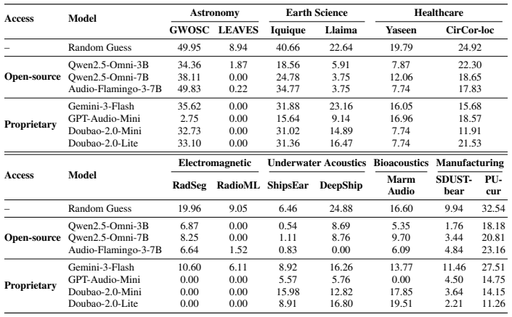
Table 1 : Zero-shot Macro-F1 (%) of Audio LLMs on MHB, with invalid responses treated as incor- rect predictions. Random Guess is included as a reference.
Original paper · CC BY 4.0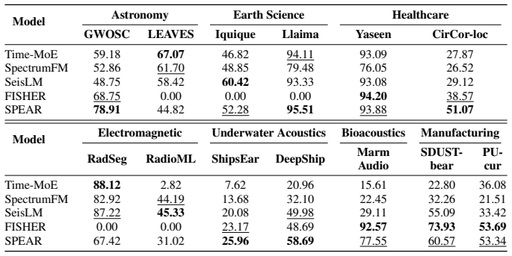
Table 2 : Macro-F1 (%) of pretrained foundation models on MHB using frozen representations and 5-NN classification. Best and second-best results are shown in bold and underlined, respectively.
Original paper · CC BY 4.0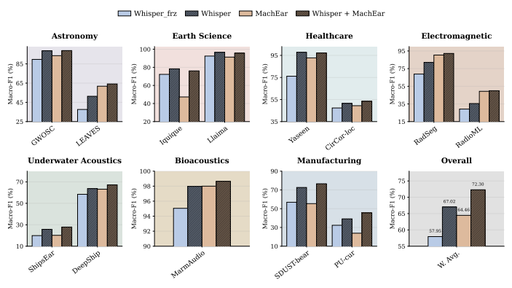
Figure 5 : Task-level Macro-F1 (%) of four adaptation configurations on MHB. All use DoRA for LLM adaptation:Whisper frzfreezes Whisper;Whisperfinetunes Whisper;MachEarre- places Whisper; andWhisper + MachEarjointly finetunes both encoders.W. Avg.denotes the test-set-size-weighted average.
Original paper · CC BY 4.0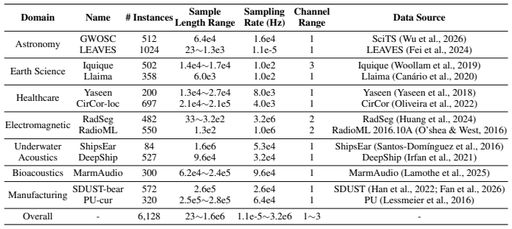
Table 3 : Task-level statistics of MHB, including the number of instances, input sequence length, sampling rate, number of channels, and data source for each task.
Original paper · CC BY 4.0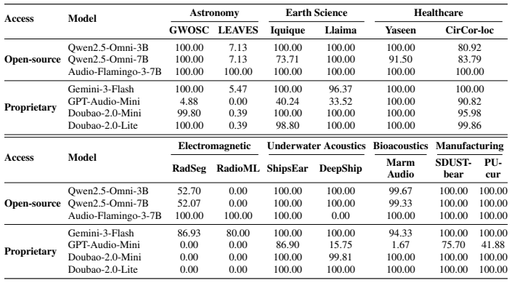
Table 4 : Task-level success rates (%) of Audio LLMs on the 13 MHB tasks. A response is considered successful only if it matches the predefined task-specific label set and required output format.
Original paper · CC BY 4.0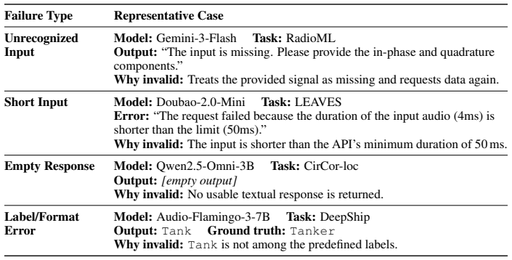
Table 5 : Representative examples of the four invalid-response categories. Each example is selected from a different model and task.
Original paper · CC BY 4.0Quote from the paper
Liwei Liu, Jun Tao, Xingyuan Li, Xuenan Xu, Chen Zhang, Junyi Wang, Boya Zhang, Xiaoyu Yang, Zhen-Hua Ling, Wen Wu, Chao Zhang (2026). Machine Hearing: Can Audio LLMs Generalize Beyond Human Auditory Perception?. arXiv:2611.10693v1. https://arxiv.org/abs/2611.10693v1
BibTeX
@misc{liu2026machine,
  title = {{Machine Hearing: Can Audio LLMs Generalize Beyond Human Auditory Perception?}},
  author = {Liwei Liu and Jun Tao and Xingyuan Li and Xuenan Xu and Chen Zhang and Junyi Wang and Boya Zhang and Xiaoyu Yang and Zhen-Hua Ling and Wen Wu and Chao Zhang},
  year = {2026},
  eprint = {2611.10693},
  archivePrefix = {arXiv},
  url = {https://arxiv.org/abs/2611.10693v1}
}