Paper commentary
ETPNav: Evolving Topological Planning for Vision-Language Navigation in Continuous Environments
- Problem Waypoint-based VLN-CE agents plan only over nearby waypoints, and their controllers can leave the agent stuck against obstacles.
- Method Builds an online topological graph from depth-based waypoints, scores graph nodes with a graph-aware transformer planner, and escapes deadlocks with the Tryout heuristic.
- Results Reached 55 SR and 48 SPL on the R2R-CE test unseen split, and 51.21 SR and 41.30 SDTW on the RxR-CE test unseen split.
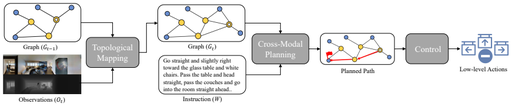
Fig. 1 : Overview of the proposed model, ETPNav. It consists of three modules, a topological mapping module that gradually updates the topological map as it receives new observations, a cross-modal planning module that computes a navigational plan based on the instruction and map, and a control module that executes the plan with low-level actions.
Original paper · CC BY 4.0 · Dong An, Hanqing Wang, Wenguan Wang, Zun Wang, Yan Huang, Keji He, Liang Wang · ETPNav: Evolving Topological Planning for Vision-Language Navigation in Continuous Environments · Original paper figure · Extracted the figure area from page 3 of the original PDF.Why waypoint-based agents stall in continuous environments
In VLN-CE the agent follows a language instruction by issuing low-level actions on a 3D mesh instead of moving over a predefined graph. Recent systems split this job into waypoint generation, subgoal selection and control, which narrowed the gap with discrete VLN.
The authors identify three weaknesses in these systems. Predicted waypoints are local, so returning to a remote place for correction takes several plan-control cycles that can accumulate bias. The input used by the waypoint predictor had not been examined, even though the predictor only needs to judge spatial accessibility while the prior design also consumed RGB.
Controllers used for waypoint-reaching were not known to tolerate obstacles, and an intolerant controller can trap the agent.
How the three modules pass data in one decision loop
ETPNav runs topological mapping, cross-modal planning and control in every decision loop. The mapping module first updates the topological map with the current observations, then the planning module reasons over that map and the instruction to produce a high-level path, and finally the control module turns that path into low-level actions.
Each location yields a panorama of 12 RGB images and 12 depth images taken at 30-degree heading steps. The agent is assumed to know its ground-truth pose from the simulator, which the mapping and control rely on.
Turning predicted waypoints into graph nodes
The graph stores visited nodes, the current node and ghost nodes, where a ghost node is a place seen but not yet entered. Edges link nodes that can be reached directly from each other and carry the Euclidean distance between them.
At each step a heatmap from the depth-based predictor is sampled with non-maximum suppression to give K candidate waypoints, each expressed as a relative pose to the agent. A waypoint seen from a panorama view takes that view's embedding; for example, a relative heading within 0 to 30 degrees uses the first view's embedding.
Each waypoint is checked by the Waypoint Localization function FL, which computes its Euclidean distance to every node and returns the closest node if that distance is below the threshold gamma. A waypoint that lands on a visited node is dropped and an edge is added from the current node to that visited node. A waypoint that lands on a ghost node is averaged into that ghost node's position and representation.
A waypoint that matches no node becomes a new ghost node.
Choosing the input for the waypoint predictor
The waypoint predictor fuses depth and orientation features with a linear layer, passes them through a two-layer transformer and a multi-layer perceptron, and outputs a heatmap.
Three predictor inputs are compared on R2R-CE: RGBD, RGB only and depth only. On val unseen, the depth-only predictor reaches 57.21 SR and 49.15 SPL, against 56.44 SR and 48.53 SPL for the RGBD predictor. The RGB-only predictor reaches 51.66 SR on val unseen, 4.78 below the RGBD predictor.
In the table's Val-Seen columns, the %Open value is 65.34 for RGB only, 82.87 for RGBD and 84.05 for depth only, so the RGB-only predictor places fewer waypoints in open space. The authors suggest that low-level RGB semantics let the predictor overfit to seen environments, while spatial accessibility does not need them.
How the cross-modal planner scores nodes
The instruction passes through a text encoder that adds positional and type embeddings, followed by a multi-layer transformer. Each node embedding adds a pose encoding, covering orientation and distance relative to the current node, and a navigation step encoding that holds the latest visit time for visited nodes and 0 for ghost nodes. A stop node is linked to every other node so that the STOP action can be scored alongside the places.
Standard self-attention among nodes uses only visual similarity, which can miss nearby nodes that matter more than distant ones. Graph-aware self-attention adds a term built from E, the matrix of all-pair shortest distances over the graph edges, so that the attention scores reflect graph topology. As printed in the paper, the attention is \( \mathrm{GASA}(X)=\mathrm{softmax}\left(\frac{XW_q(XW_k)^\top}{\sqrt{d}}+EW_e\right)XW_v \), where W_q, W_k, W_e and W_v are learnable.
Each node receives a score \( s_i = \mathrm{FFN}(\tilde{n}_i) \) from its multimodal representation. Visited nodes and the current node are masked, so the long-term goal is chosen among ghost nodes or the stop node. If a ghost node is selected, Dijkstra's algorithm gives the shortest path over the graph, and the path's node positions form the plan.
Global versus local planning space
The local planning space takes only ghost nodes adjacent to the agent as candidate goals, while the global planning space takes all observed ghost nodes along the traversed path.
On val unseen, global planning with GASA reaches 57.21 SR, against 53.92 SR for local planning with GASA. The authors read this as backtracking to an earlier location being cheap under global planning, whereas local planning needs several plan-control cycles to get back.
The authors suspect the larger gain under global planning arises because it requires an understanding of the house structure.
Rotate-then-forward control and the Tryout heuristic
The rotate-then-forward controller, named RF, computes the relative orientation and distance from the agent to the current subgoal. These values are quantized into ROTATE actions of 15 degrees followed by FORWARD actions of 0.25m, and the subgoal is consumed once reached.
A selected ghost node may be off the navigation mesh because its position was estimated from predicted waypoints. ETPNav deletes the selected ghost node from the graph before navigating to it, so the same unreachable goal cannot be picked again.
Tryout runs during the FORWARD flow and detects a deadlock by checking whether the agent's position is still changing, which matters when sliding along obstacles is forbidden. It follows a trial-and-error pattern similar to the brute force untrap mode cited from prior work.
Controller comparison and chassis radius
The RF variants take fewer actions and shorter paths than the other controllers, which the authors connect to higher SPL and NDTW.
The classical FMM controller shows the highest collision count, at 231.62 CT per episode on RxR-CE.
As chassis radius increases, the success rate of both the PointGoal and RF controllers decreases. The RF controller stays more robust across radii and beats PointGoal by about 3 SR on RxR-CE for all chassis radii tested.
With Tryout, the agent twists away from the wall after the collision at step 4 and reaches the goal at step 6.
Two-stage training and what gets updated
Pre-training runs for 100,000 iterations with a batch size of 64, a learning rate of 5e-5 and the AdamW optimizer. The model starts from LXMERT pre-trained on R2R-CE, or from RoBERTa for the multilingual RxR-CE data, and topological maps during pre-training are built offline from the discrete VLN graph. Pre-training uses discrete paths from R2R and RxR, augmented with synthetic instructions from Prevalent and RxR-Markey.
Fine-tuning runs the agent online in Habitat and trains it with student-forcing, where the next long-term goal is sampled from the predicted score distribution. The loss sums, over the T steps, the negative log probability of the teacher action given the instruction W and graph G_t: \( \mathcal{L}=\sum_{t=1}^{T}-\log p(a^*_t \mid W, G_t) \).
Scheduled sampling moves training from teacher-forcing to student-forcing, with the decay applied every 3000 iterations at a ratio of 0.75. The visual encoders and the waypoint predictor are fixed, while the panorama encoder and the cross-modal planning module are trained.
That limit is 15 goal predictions on R2R-CE and 25 on RxR-CE.
What separates R2R-CE from RxR-CE
R2R-CE contains 5,611 shortest-path trajectories with an average path length of 9.89m and instructions averaging 32 words. On R2R-CE the agent has a 0.10m chassis radius and can slide along obstacles.
Agents on RxR-CE cannot slide along obstacles, and their 0.18m chassis radius makes collisions more likely.
Trajectory Length, Navigation Error, Success Rate, Oracle SR, SPL, NDTW and SDTW are used, with SR counting an episode as successful when its navigation error is below 3 meters. R2R-CE reports SR and SPL as primary metrics, while RxR-CE reports NDTW and SDTW.
R2R-CE results against prior waypoint methods
On the test unseen split, ETPNav reaches 55 SR and 48 SPL. On val unseen it is 13 SR and 10 SPL above CWP-RecBERT, the second-best model in the comparison. On test unseen it is 11 SR and 11 SPL above Sim2Sim.
Reborn, which uses a local planning space of nearby waypoints and an unstructured memory bank, is 6 SR and 3 SPL below ETPNav on test unseen. The authors credit the gap to the global planning with topological maps, which encodes structured environmental priors.
Under aligned controllers and configurations, ETPNav reaches 3.5 SR and 2.72 SPL above DUET on val unseen.
RxR-CE results and the path-fidelity trade-off
On the test unseen split, ETPNav reaches 51.21 SR and 41.30 SDTW, with NDTW at 54.11. On val unseen, it is 27.71 SR, 22.24 SPL and 15.19 NDTW above CWP-RecBERT.
Without the Marky-mT5 synthetic instructions, ETPNav still beats CWP-RecBERT by 25.99 SR and 14.78 NDTW on val unseen.
The authors attribute this to the global planning space promoting backtracking, which can reduce path fidelity while improving success.
Map construction: threshold, accumulation and deletion
The localization threshold gamma is varied from 0.25 to 1.00m, and the average node count per episode falls as gamma increases. The authors explain that a larger gamma makes more waypoints merge into existing nodes, and too few nodes leave the map too coarse for accurate perception and planning.
The default setting uses gamma at 0.50m with both accumulation and deletion, reaching 57.21 SR and 49.15 SPL on val unseen. Removing accumulation lowers SR by 1.32 and SPL by 1.23. Removing ghost node deletion lowers SR by 4.80 and SPL by 4.13, because unreachable ghost nodes can be selected again and again.
A larger node count also hurts, since 56.71 SR at gamma 0.25m with the same settings is below the default, which the authors attribute to a larger candidate set making the planner harder to train.
Limitations
ETPNav uses ground-truth poses from the simulator, and estimating pose from noisy sensor readings is not addressed. The authors suggest visual odometry may be adaptable, and they plan noise analysis and robustness study as future work.
Reported results cover R2R-CE and RxR-CE in the Habitat simulator only. Each split reports one value per metric in the comparison tables, and no confidence intervals or seed counts appear. Reborn keeps a higher NDTW than ETPNav on RxR-CE test unseen.
Paper info
- Authors
- Dong An, Hanqing Wang, Wenguan Wang, Zun Wang, Yan Huang, Keji He, Liang Wang
- Venue
- arXiv · Preprint
- First published
- 2023-4-6
- Added
- 2026-11-6
- Updated
- 2024-1-22
- Version
- v3
- arXiv
- 2304.03047
- Category
- cs.CV · cs.CL · cs.RO
- Original paper terms
- CC BY 4.0
- What we show
- Paper info, commentary and permitted figures from the original paper
AI commentary is a separate explanation from the original paper and may contain errors. The original paper and figures follow each source's terms of use and any rights noted separately.
Abstract
Vision-language navigation is a task that requires an agent to follow instructions to navigate in environments. It becomes increasingly crucial in the field of embodied AI, with potential applications in autonomous navigation, search and rescue, and human-robot interaction. In this paper, we propose to address a more practical yet challenging counterpart setting - vision-language navigation in continuous environments (VLN-CE). To develop a robust VLN-CE agent, we propose a new navigation framework, ETPNav, which focuses on two critical skills: 1) the capability to abstract environments and generate long-range navigation plans, and 2) the ability of obstacle-avoiding control in continuous environments. ETPNav performs online topological mapping of environments by self-organizing predicted waypoints along a traversed path, without prior environmental experience. It privileges the agent to break down the navigation procedure into high-level planning and low-level control. Concurrently, ETPNav utilizes a transformer-based cross-modal planner to generate navigation plans based on topological maps and instructions. The plan is then performed through an obstacle-avoiding controller that leverages a trial-and-error heuristic to prevent navigation from getting stuck in obstacles. Experimental results demonstrate the effectiveness of the proposed method. ETPNav yields more than 10% and 20% improvements over prior state-of-the-art on R2R-CE and RxR-CE datasets, respectively. Our code is available at https://github.com/MarSaKi/ETPNav.
Quote from the paper
Dong An, Hanqing Wang, Wenguan Wang, Zun Wang, Yan Huang, Keji He, Liang Wang (2023). ETPNav: Evolving Topological Planning for Vision-Language Navigation in Continuous Environments. arXiv:2304.03047v3. https://arxiv.org/abs/2304.03047v3
BibTeX
@misc{an2023etpnav,
  title = {{ETPNav: Evolving Topological Planning for Vision-Language Navigation in Continuous Environments}},
  author = {Dong An and Hanqing Wang and Wenguan Wang and Zun Wang and Yan Huang and Keji He and Liang Wang},
  year = {2023},
  eprint = {2304.03047},
  archivePrefix = {arXiv},
  url = {https://arxiv.org/abs/2304.03047v3}
}