Paper commentary
DriveMLM: Aligning Multi-Modal Large Language Models with Behavioral Planning States for Autonomous Driving
- Problem Language-model driving work so far produces text decisions that cannot be executed as vehicle control, so such systems cannot be tested in closed loop. DriveMLM targets this gap by having a multimodal LLM emit the same decision states that a modular behavioral planner produces.
- Method A multimodal LLM takes multi-view images, LiDAR points, a system message and user instructions, then outputs one speed decision, one path decision and a text explanation, which are passed to an existing motion planning and control module. The model is trained on a 280-hour CARLA dataset whose decision and explanation labels come from a semi-automatic data engine.
- Results Reached a Driving Score of 76.1 on CARLA Town05 Long, 4.7 points above Apollo (71.4).
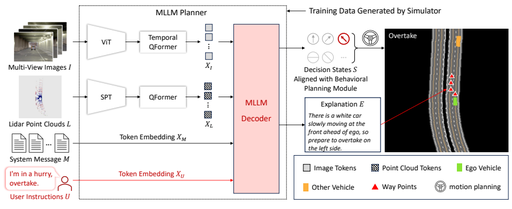
Fig. 3 DriveMLM frameworkconsists of three parts: (1) behavioral planning states alignment, which aligns linguistic output to executable decisions for vehicle control. (2) MLLM planner, consisting of multi-modal tokenizer and MLLM decoder. It transforms multi-modality sensor input I, L, system message M , and user instructions U to drive explanation and aligned decisions. (3) Efficient data collection strategy, which generates rich driving explanations and aligned decisions at low cost. SST stands for single-stride sparse transformer.
Original paper · CC BY 4.0 · Erfei Cui, Wenhai Wang, Zhiqi Li, Jiangwei Xie, Haoming Zou, Hanming Deng, Gen Luo, Lewei Lu, Xizhou Zhu, Jifeng Dai · DriveMLM: Aligning Multi-Modal Large Language Models with Behavioral Planning States for Autonomous Driving · Original paper figure · Extracted the figure area from page 5 of the original PDF.Why language outputs stall at the planner
Most recent LLM-based driving work generates language decisions in response to scenes, and those outputs are mainly linguistic and conceptual. A language answer has no direct mapping to steering, throttle or braking, so these systems cannot be run in a simulator that reacts to the car's own motion. Modular stacks solve the same gap with a behavioral planning module, whose discrete decision states are easy to turn into control signals by the motion planner that follows it.
DriveMLM takes that bridge as its design target: the LLM is aligned to the decision states of the behavioral planner rather than to free text. Prior LLM driving systems that read images are constrained by their input, for example DriveGPT4 works from a monocular camera, which limits the scene information it can build. The study therefore combines multi-view images and LiDAR point clouds with traffic rules, system messages and user instructions as inputs.
From decision states to vehicle control
The output space is split into two groups, one for speed and one for path. The speed group is KEEP, ACCELERATE, DECELERATE and STOP, and the path group is FOLLOW, LEFT CHANGE, RIGHT CHANGE, LEFT BORROW and RIGHT BORROW. Each decision step produces one speed label and one path label, and these two labels are sent together to the motion planning framework.
The decision state token S is passed to a motion planning and control module, which computes the trajectory the vehicle follows.
The model input is a set of multi-view image tensors, a LiDAR point array, a system message and a user instruction, each with its own tensor shape. Each input is tokenized into embeddings of its own size, and the MLLM decoder reads these tokens and generates the decision token S together with a text explanation E. Figure 3 lays out the three parts of the framework: the state alignment, the MLLM planner and the data collection.
Tokenizing sensors and writing the decision
Temporal multi-view images are encoded by a CLIP vision encoder and passed through a projector that maps them to the text embedding width. A cross-attention layer uses the current frame as the query, and the historical frames, flattened into tokens, serve as keys and values.
Because text descriptions of LiDAR scenes are hard to obtain, the image domain serves as the bridge between LiDAR and language. A frozen ViT-L/14 image encoder provides the target feature, and a LiDAR encoder based on a randomly initialized single-stride sparse transformer is trained with a cosine similarity loss to match that image feature.
The LiDAR feature is then projected linearly to a single LiDAR token with the same width as the language tokens. In training, points are projected into the image plane and points outside the image boundary are dropped; at test time no points are dropped because several views cover each timestep.
The system message lists the path and speed decision definitions, the traffic rules and the expected answer format, and it is combined with the sensor tokens. Training uses cross-entropy with next-token prediction, so the decision and the explanation are learned as text in the same format as the example dialogue. The example turns show a caption answer, a path and speed answer for a navigation command, and an explanation answer for the same decision.
Model components and training settings
The MLLM is built on LLaMA, using ViT-g/14 from EVA-CLIP as the visual encoder and LLaMA-7B as the language model. The LiDAR encoder is GD-MAE fine-tuned on ONCE.
The QFormer and the LLM are trained on instruction-following data so that the output follows the fixed path and speed format.
Collecting decisions without frame-by-frame labels
Challenging scenarios are first built in CARLA, and experienced drivers or agents drive them safely from one of several passable trigger locations. Interaction data arise when the expert randomly raises a driving demand and responds to it, and a run is saved once the expert reaches the destination safely.
Path and speed labels are derived from the expert trajectories by hand-crafted rules, which avoids labelling each frame by hand. Explanations are first generated from the nearby elements of each scenario, then refined by human annotators, and their wording is broadened with GPT-3.5. Human-requested interactions, both accepted and rejected, are also annotated and refined by humans.
The collected data cover 280 hours, 50k routes, 30 scenarios and 8 maps in CARLA, with four cameras and a LiDAR per frame. Table 1 compares this dataset with earlier driving-language datasets by the presence of perception, reasoning, planning, state alignment and interaction annotations. Town05 is excluded from the training maps, and the 30 scenarios in Table 2 are all made dynamic so they can be placed on any map.
Decision and explanation accuracy in open loop
The open-loop test set consists of 10 human-annotated routes for each scenario in Town05.
Its path F1 is 0.90 for FOLLOW, 0.52 for CHANGE and 0.89 for BORROW, and its speed F1 is 0.91 for KEEP, 0.61 for ACCELERATE, 0.66 for DECELERATE and 0.89 for STOP. The authors read the gap over Apollo's F1 as evidence that the learned planner copes with varied road situations better than the rule-based state machine.
Driving score on CARLA Town05 Long
Driving Score is the product of Route Completion and Infraction Score, and Infraction Score penalizes collisions and violations of traffic rules on the completed part of a route. Miles Per Intervention counts the distance driven divided by the number of human takeovers, and an agent that breaks a rule or collides is taken over and must still finish the route.
Replacing the decision modules of Autopilot and Apollo with DriveMLM raised their Town05 Long results by 3.2 and 4.7 points.
ThinkTwice has a higher Driving Score than Interfuser but a lower MPI, since it often crosses the stop line, which CARLA penalizes lightly but MPI counts as a takeover. DriveMLM's lower Infraction Score compared with Apollo sits next to its higher Route Completion, so the authors attribute its Driving Score gain to handling state transitions on hard cases.
Which inputs matter
Without any sensor input, decision accuracy is 47.83, with path F1 0.55 and speed F1 0.61.
Concatenating the query tokens of all frames would give T×N_I×N_Q tokens, which grows with the number of frames, whereas the temporal QFormer gives N_I×N_Q tokens, one set per view. The default setting uses T equal to 2. Point clouds did not improve the scores in this setting, and the authors suspect the representation gap between the sparse transformer and the MLLM decoder.
Interaction and zero-shot checks
For the instruction to overtake, the model outputs LEFT_CHANGE with ACCELERATE when the left lane ahead is empty, and FOLLOW with DECELERATE when no lane allows an overtake. In a comparison with Interfuser and Apollo on an unknown obstacle, Apollo stops, Interfuser crashes and DriveMLM chooses a borrow-lane maneuver, and for an emergency vehicle behind, the two baselines fail to yield while DriveMLM yields.
On the nuScenes validation set, 6,019 frames were annotated and the zero-shot decision accuracy is 0.395. Two real driving scenes with a red light and an approaching intersection are shown as examples of stopping and slowing down.
Inference speed of the candidate backbones
The table reports seconds per token for LLaVA-1.5 and mini-InternVL under lmdeploy and vLLM, with one or four images.
The table measures fine-tuned LLaVA-1.5 variants and mini-InternVL, not DriveMLM under the same conditions, so these figures do not describe the closed-loop model's latency.
Limits of the evidence
Closed-loop results are reported only on CARLA Town05 Long, and open-loop evaluation uses 10 routes per scenario in Town05. The open-loop baselines are few-shot prompted models and Apollo replay, so the comparison does not match a fine-tuned setup for each method. The real-scene evaluation is zero-shot and reports one accuracy figure on 6,019 validation frames.
Explanation labels were generated and expanded with GPT-3.5 before human refinement, and the explanation scores measure overlap with those labels. The inference table covers other checkpoints, so the latency of the full DriveMLM system was not measured.
Paper info
- Authors
- Erfei Cui, Wenhai Wang, Zhiqi Li, Jiangwei Xie, Haoming Zou, Hanming Deng, Gen Luo, Lewei Lu, Xizhou Zhu, Jifeng Dai
- Venue
- arXiv · Preprint
- First published
- 2023-12-14
- Added
- 2026-11-6
- Updated
- 2025-12-17
- Version
- v3
- arXiv
- 2312.09245
- DOI
- 10.1007/s44267-025-00095-w
- Category
- cs.CV
- Original paper terms
- CC BY 4.0
- What we show
- Paper info, commentary and permitted figures from the original paper
AI commentary is a separate explanation from the original paper and may contain errors. The original paper and figures follow each source's terms of use and any rights noted separately.
Abstract
Large language models (LLMs) have opened up new possibilities for intelligent agents, endowing them with human-like thinking and cognitive abilities. In this work, we delve into the potential of large language models (LLMs) in autonomous driving (AD). We introduce DriveMLM, an LLM-based AD framework that can perform close-loop autonomous driving in realistic simulators. To this end, (1) we bridge the gap between the language decisions and the vehicle control commands by standardizing the decision states according to the off-the-shelf motion planning module. (2) We employ a multimodal LLM (MLLM) to model the behavior planning module of a module AD system, which uses driving rules, user commands, and inputs from various sensors (e.g., camera, lidar) as input and makes driving decisions and provide explanations; This model can plug-and-play in existing AD systems such as Autopilot and Apollo for close-loop driving. (3) We design an effective data engine to collect a dataset that includes decision state and corresponding explanation annotation for model training and evaluation. We conduct extensive experiments and show that replacing the decision-making modules of the Autopilot and Apollo with DriveMLM resulted in significant improvements of 3.2 and 4.7 points on the CARLA Town05 Long respectively, demonstrating the effectiveness of our model. We hope this work can serve as a baseline for autonomous driving with LLMs.
Quote from the paper
Erfei Cui, Wenhai Wang, Zhiqi Li, Jiangwei Xie, Haoming Zou, Hanming Deng, Gen Luo, Lewei Lu, Xizhou Zhu, Jifeng Dai (2023). DriveMLM: Aligning Multi-Modal Large Language Models with Behavioral Planning States for Autonomous Driving. arXiv:2312.09245v3. https://doi.org/10.1007/s44267-025-00095-w
BibTeX
@article{cui2023drivemlm,
  title = {{DriveMLM: Aligning Multi-Modal Large Language Models with Behavioral Planning States for Autonomous Driving}},
  author = {Erfei Cui and Wenhai Wang and Zhiqi Li and Jiangwei Xie and Haoming Zou and Hanming Deng and Gen Luo and Lewei Lu and Xizhou Zhu and Jifeng Dai},
  year = {2023},
  eprint = {2312.09245},
  archivePrefix = {arXiv},
  doi = {10.1007/s44267-025-00095-w},
  url = {https://arxiv.org/abs/2312.09245v3}
}