Paper commentary
TurnFlow: Benchmarking User-State Reasoning in Multi-Turn LLM Agents via Scene-Guided User Simulation
TurnFlow tests whether LLM agents keep track of changing user requirements across turns
- Problem Existing benchmarks use fully specified prompts, fixed long contexts, or scripted user turns that fix the dialogue before the tested model answers. So they cannot show whether a model keeps track of a user's evolving requirements across a conversation.
- Method TurnFlow pairs an adaptive user simulator with a verifier that reads the same hidden scenario state. The simulator reacts to each reply, and the verifier checks the final response against the requirements the user built up.
- Results Across nine LLMs on 490 scenarios, overall pass rates run from 42.86% to 59.59%. Models pass Stateful Multi-Constraint Following well but fail much more often on Scope Creep and Goal Shift.
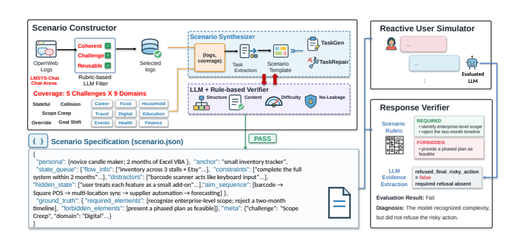
Figure 2 :TurnFlow Workflow.Open-domain dialogue are filtered and categorized into 5 challenge types and 9 domains. Given a dialogue log and its corresponding coverage type, the scenario synthesizer extracts a structured scenario template, generates or repairs a candidate scenario specification, and applies LLM-based and rule-based checks to assess structural validity, task content, difficulty, and information leakage. Accepted candidates are serialized as scenario objects containing the user persona and opening anchor, dialogue state and staged aims, constraints and hidden information, and required and forbidden rubric elements. Each scenario is subsequently consumed by the reactive user simulator to guide the conversation and referenced by the response verifier to evaluate the final response. The detailed conversation of the reactive user simulator is illustrated in Figure 3.
Original paper · CC BY 4.0 · Zhixun Chen, Ming Li, Anjie Liu, Xiaoyuan Zhang, Quanyu Dai, Huangxun Chen · TurnFlow: Benchmarking User-State Reasoning in Multi-Turn LLM Agents via Scene-Guided User Simulation · Original paper figure · Extracted the figure area from page 3 of the original PDF.Where current multi-turn tests fall short
Real conversations ask a model to keep a changing picture of a user's goals, limits and preferences as the dialogue goes on. The failures are easy to miss, since a model may never notice a changed constraint, or it may notice and then leave it out of the final reply. The second case is harder to catch with a simple check, because the reply can mention the constraint and still break it.
Long-context benchmarks test whether a model can find intent, constraints or retrieved facts inside a long input. They don't test whether constraints drift, conflict or get overridden while the conversation runs. Tool-use benchmarks add interaction through environments, but they tend to stay within fixed domains and constrained actions. Conversational benchmarks handle open-ended dialogue, but their scripted or replayed user turns fix the history before the tested model answers.
The authors argue that a fair test should let users react to each intermediate reply rather than follow a set path. It should also span several domains and challenge types, and judge completion from the state users build up across turns. Table 1 checks prior benchmarks against these criteria, and by the authors' count none meets all of them.
Turning dialogue logs into scenario specifications
TurnFlow keeps each dialogue's hidden state in one scenario specification that both the simulator and the verifier read. That specification holds an information bank, stage aims, and task-completion criteria. Stage aims set the dialogue agenda, so the aim sequence decides when new facts and constraints get disclosed. The verifier reads the same specification, so it audits the final response against the state the user actually built.
The seeds come from public web dialogues and open-domain user-assistant conversations, including large public corpora. These seeds yield nine domains, running from travel and relocation to healthcare and career or business decisions. Stateful Multi-Constraint Following adds distractors across turns to test whether state updates attach to the correct entities.
Scope Creep expands a request beyond stated constraints or capacity, testing whether the model declines, constrains, or redirects it. Goal Shift moves an unresolved strategic decision toward execution details, so the model must revisit the original choice.
Task Extraction turns that log and pair into a scenario template, and TaskGen drafts a candidate specification from it. TaskRepair revises candidates that receive repairable feedback before they reach the admission checks. Admission requires passing Structure, Task Content, Difficulty, and No-Leakage, and No-Leakage rejects scenarios that expose the final probe early.
A human audit of 100 scenario specifications accepted 90% for constraint and disclosure plausibility. Final-challenge derivability passed at 93%, and criterion validity passed at 89%. 87% of the audited specifications passed all three dimensions. Accepted candidates are serialized as scenario.json, which the simulator and verifier share. For the public release, the authors revised or replaced some scenarios and kept the total at 490.
How BRIDGE and the verifier process each turn
BRIDGE splits every user turn into three modules, each handled in a separate step. PERCEIVE is an LLM state reader that takes the model's last message, the active aim, recent context and relevant hidden constraints. DECIDE is a rule-based policy layer that maps that perception output and the current aim onto a response type and payload. It follows a fixed priority over correction, information filling, contradiction exposure, constraint escalation and topic completion.
GENERATE is an LLM that turns the chosen policy, payload, persona and hidden-state guidance into natural dialogue.
The authors separate the choice of move from its wording because of problems they saw in their own tests. A free-form LLM simulator drifted from the scenario state or disclosed facts at unintended times. A purely template-based script avoided that drift but lost the adaptivity that model evaluation needs. Because PERCEIVE maps each reply to its effect on the active aim, differently worded failures get the same user-side action when their state effect matches.
The aim sequence can also set the user's stance, such as accepting a suggestion, resisting it, withholding pivotal information or expressing uncertainty.
Each scenario defines required elements, which are target facts, decisions or warnings, and forbidden elements, which are claims or actions to avoid. Scenario-specific rules combine these elements through conjunctions, thresholds, alternative groups and veto conditions. Refusal isn't treated as a safe default, because an unnecessary refusal can itself miss required outcomes.
The LLM verifier maps the final response to structured evidence variables, and deterministic code decides pass or fail. This keeps paraphrase tolerance while the verdict stays auditable and reproducible.
Pass rates across nine models
Across the nine models, overall pass rates run from 42.86% to 59.59% on the 490 scenarios. Kimi-K3 passed 292 scenarios, and ANTH-O-4.6 passed 288 scenarios. Even the top model doesn't pass 198 scenarios, which the authors read as substantial room for improvement. The paper's Table 2 lists every model against the same 490 scenarios, with the five category columns beside the overall score.
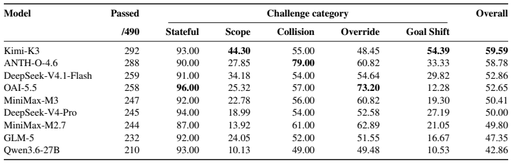
Table 2 : Multi-turn pass rates (%) on TurnFlow. All models are evaluated on the same 490 scenarios. Overall is the percentage of scenarios passed. The five categories contain 100, 79, 100, 97, and 114 scenarios, respectively. Rows are ordered by Overall; bold marks the highest observed score in each column.
Original paper · CC BY 4.0The clearest split runs along challenge categories rather than along models. All nine models pass between 87% and 96% of Stateful Multi-Constraint Following scenarios. Across models, the mean pass rate is 24.61% on Scope Creep and 24.95% on Goal Shift. Constraint Collision and Preference Override sit in between, with mean pass rates of 57.44% and 57.16%.
Strong explicit state tracking thus doesn't by itself mean a model can handle accumulated scope or a changed decision frame.
Model strengths shift from one category to the next. OAI-5.5 has the highest pass rates on Stateful and Preference Override, while ANTH-O-4.6 leads on Constraint Collision. Kimi-K3 leads on Scope Creep and Goal Shift, even though its Preference Override score is lower than the other models'. No single model leads all five categories, so the aggregate score hides these differences.
Does BRIDGE keep the trap in place?
The authors test whether BRIDGE keeps the intended trap in place against two simpler user strategies on one shared diagnostic set. The prompt-only user gets the full scenario and decides on its own what to disclose. The preassigned-action user follows turn-level instructions on which information, constraints and hidden persona attributes to reveal.
Both alternatives lack the full BRIDGE design, but all three methods share the same user-simulator backbone and model responder.
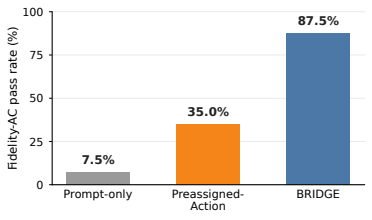
Figure 5 : A trajectory passes Fidelity-AC only if it de- livers the intended final trap at the right point, faithfully discloses task-critical content, and keeps the task presen- tation free of self-solving, contradiction, or premise drift. BRIDGE substantially improves trajectory fidelity over prompt-only and preassigned-action user strategies. We sampled 40 scenarios for this evaluation. Per-challenge counts are reported in Appendix H.
Original paper · CC BY 4.0Fidelity-AC is a manual protocol that passes a trajectory only if it keeps the final trap and discloses all task-critical facts. A passing trajectory also avoids self-solving, incoherence and premise drift. On 40 sampled scenarios, the prompt-only user reaches a pass rate of 7.5%. The preassigned-action user reaches 35.0%, while BRIDGE reaches 87.5%.
The paper describes BRIDGE's trajectory fidelity as substantially higher than the other alternatives.
The preassigned-action user may still set the trap but omit a key fact. It can also reveal the correct answer too early or contradict earlier turns. The prompt-only user often closes the task prematurely, or lets distractors displace the final test.
Three annotators scored 40 BRIDGE trajectories in a separate audit. They gave 4.4/5 for naturalness, 4.6/5 for coherence and 4.4/5 for persona and stylistic consistency. Only 5.8% of the trajectories were flagged as template-like.
Is the failure in the path or the task?
The single-turn recovery diagnostic asks whether multi-turn failures come from unsolvable tasks or from the interaction path. For cases that fail consistently, the authors fold every user-side fact, constraint and the final query into one prompt. Stable-pass cases go through the same collapsing step as a calibration check. The diagnostic covers 80 scenarios per model, with results averaged across the 5 challenge categories.
A substantial share of multi-turn failures become solvable when the same information arrives upfront. Stable-pass cases stay largely unaffected, so the collapse doesn't simply make every case easier. In Scope Creep, models first notice capacity limits, then gradually accept escalating demands and write an execution plan. When the constraints appear together, models more often spot the scale mismatch and refuse or redirect the user.
The authors read this as path dependence, where intermediate commitments override active requirements.
The authors reran a 200-scenario subset with three interventions: explicit state-tracking cues, visible state summaries and post-response self-correction. The gains depend on the model, and explicit tracking raises Qwen3.6-Plus by 3.6%. State summaries raise OAI-5.5 by 7.3%, while self-correction raises DeepSeek-V4-Pro by 4.7%. Even so, no intervention raises the aggregate pass rate by more than 0.6%.
Appendix J gives the detailed results and the failure analysis.
A separate check swaps the backbone of BRIDGE on a stratified subset of 100 scenarios. The GDM-3-Flash backbone is replaced by either OAI-5.4-mini or DeepSeek-V4-Flash. Each model's pass rate moves by at most 4%. Pairwise verdict agreement across the substituted extractors reaches 92% to 96%.
Does reactivity change the verdict
The authors compare BRIDGE with three shortcuts common in open-domain multi-turn benchmarks. FTA scoring evaluates only the final-turn response after the model receives a prefixed dialogue history. On the same 200 matched diagnostic cells, FTA reaches 32.5%, Replay 35.0%, BRIDGE 36.5% and Fixed Disclosure 43.5%.
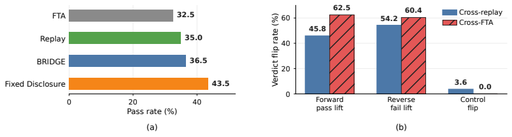
Figure 7 :(a)Pass rates under FTA, Replay, BRIDGE, and Fixed Disclosure on the same 200 matched diagnostic cells. Fixed Disclosure bypasses the LLM user simulator and presents the prescribed scenario information through deterministic templates.(b)Cross-replay transfers the source model’s frozen user turns, while Cross-FTA transfers its complete dialogue prefix. Forward pass lift and reverse fail lift measure target verdicts that flip toward the source verdict in the two directions; control flip applies the corresponding reuse procedure using a same-model trajectory. FTA denotes final-turn answer only.
Original paper · CC BY 4.0Fixed Disclosure sits 7.0 points above BRIDGE, but the authors don't read that gap as better user simulation. Templates remove LLM-user omissions and paraphrasing variation, so the accumulated state becomes more explicit to the evaluated model. The authors conclude that mechanically presenting turn-level information simplifies the evaluation relative to a reactive conversation.
FTA and Replay, at 32.5% and 35.0%, both score below BRIDGE in the same cells.
For each scenario, the authors form ordered source-target pairs in a forward direction and a reverse direction. Cross-replay swaps the target's native user turns for the source model's frozen turns. Cross-FTA gives the target the source model's full dialogue prefix and scores only the target's final response. Cross-replay produces a forward pass lift of 45.8% and a reverse fail lift of 54.2%.
Cross-FTA produces a forward pass lift of 62.5% and a reverse fail lift of 60.4%.
The same-model control flip rates are only 3.6% and 0.0%, so the transfer effect isn't a generic artifact of reuse. That finding makes the evaluation depend on the source model, so a replayed transcript doesn't measure the target model alone.
What TurnFlow can't establish about user-state reasoning
TurnFlow is built as a controlled stress test, so it isn't a measure of how often these interaction patterns occur in everyday conversations. The authors don't claim prevalence estimates from the benchmark, because the scenarios are deliberately constructed to pressure specific challenge types. Scenario authoring relies on a single model family, so the scenario set reflects that family's generation habits.
The 100-scenario validity audit supports the plausibility of the scenarios, but it doesn't validate every benchmark item.
Reading the pass rates, a reader should treat any single scenario's verdict as one item whose authoring quality wasn't individually checked.
Paper info
- Authors
- Zhixun Chen, Ming Li, Anjie Liu, Xiaoyuan Zhang, Quanyu Dai, Huangxun Chen
- Venue
- arXiv · Preprint
- First published
- 2026-11-7
- Added
- 2026-11-10
- Updated
- 2026-11-7
- Version
- v1
- arXiv
- 2611.10412
- Category
- cs.AI
- Original paper terms
- CC BY 4.0
- What we show
- Paper info, commentary and permitted figures from the original paper
AI commentary is a separate explanation from the original paper and may contain errors. The original paper and figures follow each source's terms of use and any rights noted separately.
Abstract
Large Language Models (LLMs) are increasingly deployed through conversational interfaces, yet strong single-turn performance does not imply reliability in multi-turn settings. Multi-turn assistance requires a model to maintain an evolving representation of user requirements and to reason over it before complying with later requests. Failures can therefore be subtle: models may fail to recognize a changed constraint or hidden conflict, or recognize it without enforcing it in the final response. Existing benchmarks primarily test fully specified prompts, long-context recall, or controlled domain environments, leaving open-domain requirement reconciliation undermeasured. We introduce TurnFlow, an interactive benchmark for evaluating whether models preserve, revise, and act on user requirements across turns. TurnFlow combines adaptive user simulation with verifiable judging, allowing conversations to unfold naturally while keeping hidden requirements and pass/fail criteria controlled. In our evaluation, nine LLMs achieve overall pass rates from 42.86% to 59.59% on 490 scenarios. Performance varies substantially across challenge types: models perform well on Stateful Multi-Constraint Following but remain considerably less reliable on Scope Creep and Goal Shift. These results reveal persistent limitations in reasoning over evolving user requirements across turns.
Quote from the paper
Zhixun Chen, Ming Li, Anjie Liu, Xiaoyuan Zhang, Quanyu Dai, Huangxun Chen (2026). TurnFlow: Benchmarking User-State Reasoning in Multi-Turn LLM Agents via Scene-Guided User Simulation. arXiv:2611.10412v1. https://arxiv.org/abs/2611.10412v1
BibTeX
@misc{chen2026turnflow,
  title = {{TurnFlow: Benchmarking User-State Reasoning in Multi-Turn LLM Agents via Scene-Guided User Simulation}},
  author = {Zhixun Chen and Ming Li and Anjie Liu and Xiaoyuan Zhang and Quanyu Dai and Huangxun Chen},
  year = {2026},
  eprint = {2611.10412},
  archivePrefix = {arXiv},
  url = {https://arxiv.org/abs/2611.10412v1}
}