Paper commentary
DexFormer 2.0: Towards a Cross-Embodiment Foundation Policy for Dexterous Grasping
- Problem Not stated in the paper.
- Method Maps every robot onto 29 canonical joint slots with validity masks, encodes each joint with a 16-dimensional morphology descriptor, and trains one shared recurrent actor–critic with PPO across mixed arm–hand embodiments.
- Results Reached 89.01% stable success on seen arm–hand combinations and 51.18% on six held-out pairs, with the seen primitive objects.
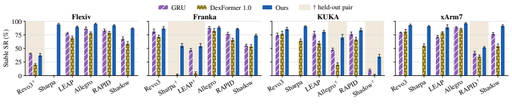
Figure 6 . Stable SR (%) for all 24 arm–hand combinations on seen objects (1,000 episodes each). Error bars: sample standard deviation over five seeds. Shaded groups marked†are the six held-out pairs. Exact values: Supp. Table 7.
Original paper · CC BY 4.0 · Lixin Xu, Ke Zhang, Xinyu Liu, Jie Tan, Senming Tan, Jiaju Yin, Yating Feng, Xiaoyi Lin, Xiyue Dong, Renjing Xu · DexFormer 2.0: Towards a Cross-Embodiment Foundation Policy for Dexterous Grasping · Original paper figure · Extracted the figure area from page 7 of the original PDF.Why one policy must span arm and hand changes
Changing the arm or the hand alters the kinematic chain, the reachable workspace, the joint limits, the control response and the contact geometry, so a policy tuned to one pairing does not transfer directly to another. Training one policy per pairing multiplies the work with each added arm or hand, and it stops knowledge from being shared between related robots.
The study asks whether one policy can control 4 arms and 6 hands, which gives 24 arm–hand combinations, and transfer to combinations and hands it has not seen during training. Of the 24 combinations, 18 are used for training and 6 are held out.
A shared joint interface for different robots
Each robot is mapped onto a canonical interface with 7 arm slots and 22 hand slots, 29 slots in total, and a binary validity mask marks which slots are physically active. Padding slots carry zero observations, zero descriptors, zero action means and no policy-loss contribution, so inactive slots affect neither the rollout nor the gradient.
Each joint gets a 16-dimensional descriptor built from its axis in the parent-link frame (3 values), its attachment position (3), the centre and half-range of its position limits (2), its velocity limit (1), a one-hot semantic role for arm or finger identity (6) and a normalized kinematic depth (1). The descriptor describes local physical structure rather than an identity label, so joints on held-out robots can share what the policy has learned about similar joints.
The mount pose, which is the wrist-to-palm pose, adds seven values, and kinematic ancestry is used to compute tree distances between joints.
How MorphNode turns joint features into a spatial code
MorphNode has a body path and an attention residual. The body path encodes masked arm and hand features, and a mount pose, through separate MLPs with widths 128–96, 64–96 and 64–64, and a fusion MLP with two 128-unit layers produces the body feature b_t.
The attention logits add learned tree-distance and joint-role biases to the scaled dot product of the query and key:\n\[ \ell_{ij} = \frac{q_i^\top k_j}{\sqrt{d}} + B_{\mathrm{dist}}(D_{ij}) + B_{\mathrm{role}}(R_{ij}) \]
The role term separates same-role, different-finger and arm–hand relations, and the distance term follows the tree distance D_ij. These are soft preferences, so they do not block attention between joints that are far apart in the tree.
Temporal memory and the shared actor
A three-layer, eight-head Transformer-XL with a 512-dimensional SwiGLU feed-forward layer processes the 128-dimensional spatial features s_t with a memory of 16 steps. The memory is kept separately for each environment and reset at episode boundaries, so the temporal module can infer interaction history that static geometry does not specify.
The history feature and the task feature are concatenated into a 256-dimensional context:\n\[ c_t = [c^{\mathrm{hist}}_t ; c^{\mathrm{task}}_t] \in \mathbb{R}^{256} \]
The shared actor head is a single MLP with widths 256→256→256→29. Its output is multiplied elementwise by the validity mask, \(\mu_t = v_e \odot f_\theta(c_t)\), so inactive action dimensions are zeroed out.
Training with PPO on mixed embodiments
The policy runs at 60 Hz inside a 240 Hz simulation, with 64-step rollouts. Rewards encourage fingertip reaching, thumb-and-finger contact and target tracking once in contact, plus a success bonus and action penalties.
Gravity is raised from zero to its full value through a curriculum, and physical parameters are randomized, with details given in the supplementary material. Invalid canonical slots stay masked during observation normalization, action sampling and the policy loss, so padding does not shift the running statistics or the update.
Seen and held-out results against GRU and DexFormer 1.0
The comparison trains all policies with PPO in Isaac Lab and evaluates them at iteration 5,000 with frozen weights, deterministic actions and no observation noise, using 1,000 episodes per embodiment and condition over five random seeds. The GRU baseline uses MLP encoders, and DexFormer 1.0 conditions on observation history without explicit morphology descriptors.
On the seen-object mixture, Ours reaches 89.01% on the seen combinations and 51.18% on the held-out pairs. GRU reaches 64.82% and 31.28%, and DexFormer 1.0 reaches 66.02% and 14.15%. Table 1 gives the same values with standard deviations over five seeds, for example 89.01±0.56 for Ours on seen combinations and 51.18±1.72 on held-out pairs.
Figure 6 reports stable SR for each of the 24 combinations on seen objects, with 1,000 episodes each and error bars over five seeds, and the six held-out pairs are marked. The authors note that the training curves in Figure 5 follow the same ranking.
Which components carry transfer
Relative to Ours, removing memory lowers held-out SR by 26.73 percentage points, and removing the tree-distance bias lowers it by 27.03 points. The authors summarize the memory and tree-bias results as roughly halving success on held-out pairs. The tree-bias variant keeps the joint-role biases and the morphology descriptors, so only the distance term is removed.
How much training pairing coverage matters
Training sets of 6, 12 and 18 combinations are nested and each keeps all four arm types and all six hand types. The architecture, optimizer, rollout length, environment count and checkpoint iteration are kept fixed, so fewer training embodiments receive more samples each. Every run is evaluated on the same six held-out pairs, which keeps the evaluation set fixed while training coverage changes.
On the common held-out set, SR rises from 0.07% to 5.65% to 51.18% as training grows from 6 to 12 to 18 combinations. Across all 24 embodiments, SR rises from 14.21% to 32.22% to 79.55%. The 18-combination policy is 45.53 percentage points above the 12-combination policy on this fixed set. The authors attribute the gain to pairing coverage, since every arm and hand type is already present in the smallest training set.
Transfer to unseen hands and grippers
Four unseen hands are each paired with one of the four training arms and driven directly by the frozen policy, and are evaluated on the ten seen objects. Across the four hands the mean SR is 17.45%, which is 2,792 of 16,000 episodes.
Mapping the thumb and index commands straight to the jaws produced one stable grasp in 16,000 episodes, which is why the retargeting route was used. Because the policy observes a LEAP hand during gripper trials, the authors present this as retargeting of actions to a gripper, not as zero-shot transfer to gripper morphology.
Robustness to hand-joint target-hold faults
On held-out pairs, Ours scores 51.18, 45.53 and 49.63 in the same three conditions.
Training with the same faults reduces the initial-hold drop to 5.12 percentage points but lowers held-out SR to 34.75%, so the authors train Ours without fault injection.
Real-world transfer on a Flexiv arm
Each hand grasps each of five objects five times. Revo3 succeeds in 17 of 25 trials (68%), and LEAP succeeds in 23 of 25 (92%). The simulation policy reaches 37.90% on Flexiv with Revo3, lower than the 68% on the robot. The authors explain this by the student being distilled with DAgger on that pair itself, so it trains on the pair and can exceed its teacher.
Limitations
The real-world study uses five objects, one table layout and a fixed target, while the simulated evaluation uses randomized scenes. Only two hands, Revo3 and LEAP, are tested on the physical Flexiv arm.
Gripper results come from retargeting a virtual LEAP hand, so they do not show zero-shot transfer to gripper morphology. Object generalization is measured on ten YCB objects, and held-out pairs still score 51.18% against 89.01% on seen combinations.
Paper info
- Authors
- Lixin Xu, Ke Zhang, Xinyu Liu, Jie Tan, Senming Tan, Jiaju Yin, Yating Feng, Xiaoyi Lin, Xiyue Dong, Renjing Xu
- Venue
- arXiv · Preprint
- First published
- 2026-11-15
- Added
- 2026-11-17
- Updated
- 2026-11-15
- Version
- v1
- arXiv
- 2611.20273
- Category
- cs.RO
- Original paper terms
- CC BY 4.0
- What we show
- Paper info, commentary and permitted figures from the original paper
AI commentary is a separate explanation from the original paper and may contain errors. The original paper and figures follow each source's terms of use and any rights noted separately.
Abstract
Dexterous grasping policies are usually trained for one arm paired with one hand. Every new pairing then needs its own policy, and the number of policies grows with every arm and hand added. We ask whether a single policy can control many arm-hand combinations and transfer to pairings and hands it has never seen. This is hard because robots differ in the number, layout, and dynamics of their joints, so their observations and actions share no common interface. We present DexFormer 2.0, a single reinforcement learning policy for cross-embodiment dexterous grasping. It maps every robot to a canonical joint interface with validity masks, encodes each joint's morphology with attention biased by the kinematic tree, and uses a Transformer-XL memory to infer embodiment-dependent dynamics from recent interaction. Trained on 18 combinations of four arms and six hands, it reaches 89% stable success on seen combinations and 51% on six held-out arm-hand pairs, outperforming GRU and DexFormer 1.0 baselines. Without fine-tuning, it also grasps with four new hand types and, through retargeting, with parallel grippers. Ablations show that memory, the kinematic-tree bias, and broader pairing coverage each matter for transfer. On a physical Flexiv arm, distilled students transfer zero-shot from simulation with two hands, including a held-out pair. Project website: https://davidlxu.github.io/dexformer2-web/.
Quote from the paper
Lixin Xu, Ke Zhang, Xinyu Liu, Jie Tan, Senming Tan, Jiaju Yin, Yating Feng, Xiaoyi Lin, Xiyue Dong, Renjing Xu (2026). DexFormer 2.0: Towards a Cross-Embodiment Foundation Policy for Dexterous Grasping. arXiv:2611.20273v1. https://arxiv.org/abs/2611.20273v1
BibTeX
@misc{xu2026dexformer,
  title = {{DexFormer 2.0: Towards a Cross-Embodiment Foundation Policy for Dexterous Grasping}},
  author = {Lixin Xu and Ke Zhang and Xinyu Liu and Jie Tan and Senming Tan and Jiaju Yin and Yating Feng and Xiaoyi Lin and Xiyue Dong and Renjing Xu},
  year = {2026},
  eprint = {2611.20273},
  archivePrefix = {arXiv},
  url = {https://arxiv.org/abs/2611.20273v1}
}