Paper commentary
PAIR: Proprioception-Aligned Image-Ray Representations for Viewpoint-Robust Manipulation
PAIR aligns camera rays and robot state for viewpoint robustness
- Problem Images change a lot when the camera moves, so one robot state can look different and different states can look alike. Policies that rely on images therefore generalize poorly to unseen viewpoints.
- Method PAIR is a contrastive learning framework that adds camera rays to image tokens. It then pulls observations with similar robot states closer in representation space across viewpoints.
- Results On simulated and real-world manipulation benchmarks with camera variation, PAIR outperforms the behavior cloning baseline without ray conditioning by 12.7% and 26.7% points.
Why camera motion breaks image-based policies
An image records the robot from one camera pose, so it captures a viewpoint-dependent projection rather than the physical state itself. When the camera moves, one underlying state can produce very different pixels, and different states can produce similar pixels. A policy therefore has to infer the task-relevant state and also how the camera projected it.
The mug example makes this concrete: the gripper can look left of the mug from one view and right of it from another. The correct action stays the same in both views, so image geometry alone can't supply the answer. Because the action targets stay fixed as the camera changes, the policy must reason about the projection itself.
A policy could look for extra cues, such as the robot base, that fix the robot's spatial frame. The authors argue that such visual context isn't always fully available, and isn't reliably used when learning from demonstrations. Common policies, they note, process images with a vision encoder and add robot state only later through simple fusion.
Camera-ray conditioning feeds the camera geometry to the policy, but it doesn't tie visual features to the projected task state. Proprioception-based alignment groups observations with similar robot states, but without camera context it can introduce spurious correspondences. PAIR addresses this gap by jointly learning image-ray representations with supervised proprioceptive alignment.
It uses Plücker embeddings and can train Diffusion Policy or post-train VLA models.
Joining camera rays with proprioception
PAIR aligns image features together with camera-ray features, and robot state decides which observations should match. The rays tell the encoder which camera geometry produced each patch, so the alignment can check whether two images show the same robot state from different viewpoints. Each visual token gets two ray embeddings, one expressed relative to the end-effector and one relative to the fixed robot base.
The end-effector-relative ray tracks a moving target, while the base-relative ray gives a persistent physical anchor across observations.
Proprioception alone is ambiguous, because it names a state in a fixed physical frame while the image depends on camera-robot geometry. The end-effector's appearance follows the relative transform T_CE = T_BC^-1 T_BE, so two views can match while their base-relative poses differ. Aligning such pairs without the camera pose pulls together images that look alike but describe different states.
Adding rays addresses this by giving the encoder the camera geometry for each patch before the alignment runs.
Plücker rays suit this job because their reciprocal product is bilinear, with B(r_i, r_j) = u_i^T m_j + m_i^T u_j. Ray features are concatenated with the vision patch and projected back to the visual dimension by one linear layer W. W starts as the identity on the vision part and zero on the ray part, and the bias b starts at zero. The pretrained SigLIP position embedding is therefore unchanged at initialization, so ray injection adds minimal architectural change.
Injecting rays into the encoder
For every visual token and every robot arm, PAIR builds Plücker rays and runs them through small convolutional encoders. One embedding is measured relative to the end-effector, so it follows a target that moves as the arm moves. The other is measured relative to the fixed robot base, giving a stable anchor that stays put across observations.
Together, the two references capture both dynamic and static geometry, which the alignment step can later use.
The encoder concatenates each token's features with both ray embeddings for every arm. A single linear layer W then maps this concatenation back to the original visual width c. W starts as the identity on the token features and as zeros on the ray columns, and the bias starts at zero. Because of that start, each patch passes through unchanged at the first training step, so the rays add nothing yet.
The output is then added to the pre-trained SigLIP position embedding, so the ray signal enters as a positional term.
The paper ablates the two ray references one at a time to test whether each one carries useful information. The authors read these consistent drops as evidence that the two ray modalities provide complementary geometric information.
Aligning images by proprioceptive distance
PAIR turns each observation into a latent vector that it normalizes to unit length before any comparison. The similarity score Sij divides the dot product of the anchor latent and the second latent by the temperature τ. In single-view training, the second latent for index j is the latent of that same observation, so no new view is needed.
In multi-view training, the second latent comes from a different camera view of observation j, which gives a cross-view pair.
PAIR builds the ground-truth distance Dij from robot proprioception, which it treats as the signal for spatial grounding. Dij sums three terms: the end-effector position distance, a quaternion term, and the gripper width difference. The quaternion term takes twice the arccosine of the absolute inner product of qi and qj, scaled by λq in Dij.
The coefficient λq is 0.05 in both Diffusion Policy and SmolVLA training. For multi-robot settings, PAIR averages the pairwise distances between corresponding arms.
PAIR converts raw distances into weights by ranking each pair's distance as a global percentile rank αij. A pair ranked below the percentile cutoff β gets weight 1 minus αij divided by β, and every other pair gets zero. The closest pairs therefore act as hard positives with weight 1, and the weight falls linearly to zero at the cutoff. The cutoff β is 0.025 in both Diffusion Policy and SmolVLA training.
The alignment loss is a weighted InfoNCE, where each pair's log-softmax probability is multiplied by its weight wij. The loss normalizes each anchor's sum by B times the sum of its weights, so the weights control how positives count. In single-view training, PAIR leaves out the diagonal pairs, so an observation never counts as its own positive.
PAIR adds λPA times the alignment loss to the behavior cloning loss, so the alignment term works as an auxiliary objective. The coefficient λPA is 0.02 for Diffusion Policy and 0.05 for SmolVLA. The temperature τ is 0.05 in both settings, with a BC batch size of 64 and a PAIR batch size of 192.
Benchmarks, policies and camera variation
The experiments vary the camera viewpoint and the policy setup, while the task definitions stay the same. MimicGen uses the Square, Three Stack and Three Piece Assembly tasks under the D1 distributions, with 1,000 demonstrations per task. AlohaGym's cube transfer task has 100 episodes, made of 50 human and 50 motion-planned demonstrations.
LIBERO spans 6,500 episodes in 130 tasks, and its evaluation uses language conditioning to tell the tasks apart. The benchmarks differ in embodiment, with MimicGen and LIBERO using a single arm and AlohaGym using a bimanual setup.
This keeps the underlying task definitions unchanged, so the visual observations vary in a controlled way. The sampling criterion keeps the robot end-effector visible throughout each rollout. Camera positions change across episodes but stay fixed within each episode.
Diffusion Policy is a U-Net policy with a pre-trained SigLIP2 visual encoder, trained on one task at a time for MimicGen and AlohaGym. Diffusion Policy keeps the SigLIP2 MAP projection, which is used both for proprioceptive alignment and for pooling the tokens. SmolVLA is fine-tuned for language-conditioned multi-task learning and evaluated across the four LIBERO suites.
Because its SigLIP encoder doesn't keep the MAP head, the authors initialize that head from scratch. Diffusion Policy trains for 200K steps, and SmolVLA trains for 160K steps.
The auxiliary loss is either none, the TCN objective, or the PAIR proprioceptive alignment loss. Proprioception is given as an input modality in every case, so the alignment signal is not the only difference.
Simulation results: alignment with and without rays
Table III shows how Diffusion Policy behaves on the single-task MimicGen and ALOHA Transfer tasks under three objectives. On 3-Stack D1 with rays, the TCN objective reaches 39.0, so temporal alignment helps too. That TCN gain is smaller than the one PAIR gives on the same setting. Each seed reports the best of five checkpoints, and the table covers three seeds.

Figures from the paper TABLE III: Success rate (%) ofDiffusion Policy (DP)on three MimicGen tasks and ALOHA Transfer across 3 seeds. For each seed, the maximum success rates from 5 checkpoints is reported.
Original paper · CC BY 4.0Across single-task settings, PAIR with ray conditioning improves the maximum success rate by 16.2 points over BC without rays. Against ray-conditioned BC the gain is 9.1 points, and against PAIR without rays it is 9.5 points. Each of those last two comparisons changes one factor, so together they separate what alignment adds from what rays add.
On LIBERO, the SmolVLA results cover four task suites, each averaged over 3 seeds. PAIR with rays reaches an average of 88.9, which is 5.6 points above ray-conditioned BC. Compared with TCN, PAIR improved the maximum success rate by 4.9 points with rays and 3.3 points without them. The proprioceptive signal therefore keeps its lead over the temporal signal in both ray settings.
The headline figure of 12.7 points over the BC baseline without ray conditioning comes from the simulated benchmarks. Since the simulation comparisons use the same demonstrations, the ray effect stays separate from the data.
Real-world tasks with unseen camera poses
Real-world tests use a Franka Research 3 arm with two RealSense D435 cameras, each capturing images at 30 FPS. Each of the three tasks has 100 demonstrations collected through VR-controlled teleoperation. Before every rollout, the cameras are repositioned and their poses are re-estimated with AprilTags.
SmolVLA is fine-tuned jointly on all three tasks with language conditioning, following the LIBERO setup. Each setting compares BC and PAIR with and without ray conditioning, and runs 30 rollouts per task. Each comparison flips one factor, so the differences isolate one contribution at a time.
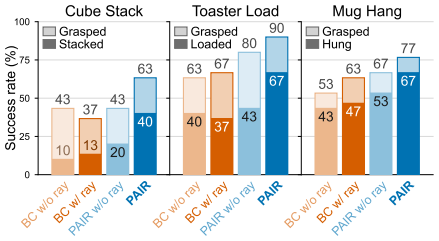
Fig. 4 :Success rates (%) of BC (red) and PAIR (blue), with and without ray conditioning, in three real-world tasks.Both subtask completion rates and final task success rates are reported.
Original paper · CC BY 4.0 · Lee, Sung-Wook, Kang, Xuhui, Losey, Dylan, Kuo, Yen-Ling · PAIR: Proprioception-Aligned Image-Ray Representations for Viewpoint-Robust Manipulation · Original paper figure · Extracted the figure area from page 6 of the original PDF.Against BC without ray conditioning, that is a gain of 23.3 points on subtasks and 26.7 points on final tasks. Compared to ray-conditioned BC, PAIR is 21.1 points higher on subtasks and 25.6 points higher on final tasks. Against PAIR without rays, the margins shrink to 13.3 points on subtasks and 18.9 points on final tasks. The 26.7-point final-task gain over BC matches the real-world figure quoted in the abstract.
Rays and proprioceptive alignment both help on hardware, and the gains add up in the full PAIR model. The authors test only two cameras on the physical robot, so they don't show results for other camera counts. Fig. 4 reports both subtask and final success for every setting, so the reader can check each gap directly.
Which ray references matter
The ablation removes one of the two camera-ray references at a time to test whether both are needed for proprioceptive alignment. Removing either the end-effector-relative ray or the base-relative ray lowers performance, which points to complementary geometric information. The study covers two multi-view tasks, Square D1 and Aloha Transfer, plus LIBERO, and reports each drop from the full PAIR score.

Figures from the paper TABLE V: Ablation of end-effector-relative (r CE) and robot-base- relative (r CB) camera rays in PAIR. Average success rates (%) are reported, with the performance drop shown in parentheses.
Original paper · CC BY 4.0On the multi-view Square D1 task, PAIR falls from 38.5 to 28.8 without the base-relative ray and to 35.3 without the end-effector ray. LIBERO behaves differently, because PAIR scores 87.2 without the base ray and 86.8 without the end-effector ray, against 88.9 for the full model.
The λq sweep in Fig. 5 runs Diffusion Policy on Square D1 and SmolVLA on LIBERO, with the ray-conditioned BC baseline shown for reference. PAIR improves over that baseline across the tested λq values, and the best result comes at λq = 0.05 for both policies. For the alignment coefficient λPA, Diffusion Policy peaks at 0.02 while SmolVLA peaks at 0.05.
Diffusion Policy is more sensitive to larger λPA, because the alignment loss then dominates the imitation learning loss. The authors use these values as the defaults in Table I, and they ran the sweeps on one task per policy rather than on every benchmark.
Where attention lands
Values are normalized so that 1 equals the expected attention under a uniform distribution. Ray conditioning raises this attention, and PAIR gives the highest value, reported as 2.51 times that of BC without rays.
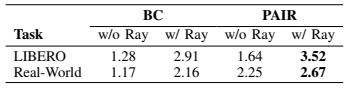
Figures from the paper TABLE VI: Normalized average attention assigned to the visual token containing the ground-truth tool center point. The raw atten- tion score is normalized by the expected attention under a uniform distribution, where a value of 1 denotes the expected value.
Original paper · CC BY 4.0The per-task rows are less clear-cut than the 2.51 figure. The paper doesn't say how the 2.51 figure is aggregated across tasks.
Training cost of the alignment loss
The cost table compares SmolVLA training with BC, TCN and PAIR, both without and with ray conditioning. TCN and PAIR both add overhead over BC because of their auxiliary alignment objectives. PAIR needs 58.8% fewer FLOPs than TCN, which makes it substantially more efficient than TCN. Decoded frames count the camera frames read during dataloading for each training batch, so this gap comes from the dataloading side of training.

Figures from the paper TABLE VII: Computational and dataloading cost of training SmolVLA with BC, TCN, and PAIR. FLOPs are reported per forward pass for models without and with ray conditioning, re- spectively. Decoded Frames denotes the number of camera frames decoded during dataloading for each training batch. Training set- tings are provided in Table I.B.
Original paper · CC BY 4.0Ray input adds only a small computational overhead to each method. Rays add 3.0% FLOPs for BC and 3.8% for TCN and PAIR. PAIR still costs more than BC, so the alignment loss is cheap relative to TCN but isn't free. The FLOPs for BC are 1.68 without rays and 1.73 with rays, while PAIR reaches 5.83 and 6.05.
The authors treat this overhead as a cost they accept, and they list it as a limitation of the method.
Alignment alone versus alignment with rays
Proprioceptive alignment by itself gives uneven results, because its gains without ray conditioning are mixed. In Table III's single-view rows, PAIR without rays reaches 20.7 on Square D1, against 11.7 for BC without rays. With rays, PAIR outperforms the baseline across all evaluated settings, which the authors take as a sign that rays unlock the alignment benefit.
Ray input adds only 3.0% FLOPs for BC and 3.8% for TCN and PAIR, so the authors treat camera-ray conditioning as a cheap lever.
Proprioceptive alignment beats temporal alignment, and ray conditioning helps both methods. The authors report these gains across robot embodiments, single-task and multi-task learning, and both Diffusion Policy and VLA models.
In the multi-view setting, PAIR uses observations of the same scene from several cameras during training. The authors credit this gain to cross-view signals that PAIR extracts from the same task scene for proprioceptive alignment. Table III puts the single-view and multi-view rows for Diffusion Policy side by side. The authors suggest this cross-view use could scale to more diverse viewpoint settings.
Where the results stop
The authors say PAIR's benefit may depend on how much viewpoint diversity the existing datasets contain. Many robotic datasets, they note, come from a limited or skewed set of camera viewpoints. Collecting data across diverse viewpoints with accurate camera calibration takes extra human effort. That collection also lengthens data-collection time.
The alignment objective adds training overhead on top of the behavior cloning loss. TCN costs 14.1 and 14.7 in the same setting, while PAIR costs 5.83 and 6.05. PAIR decodes 256 frames per training batch, against 64 for BC and 640 for TCN. Ray input adds only 3.0% FLOPs for BC and 3.8% for TCN and PAIR.
The real-world study uses three tasks, two RealSense D435 cameras, and 30 rollouts per task per setting. The text gives no variance estimate for these real-world results. Diffusion Policy is more sensitive to larger λPA values, where the alignment loss dominates the imitation loss. The best λPA is 0.02 for DP and 0.05 for SmolVLA.
Paper info
- Authors
- Lee, Sung-Wook, Kang, Xuhui, Losey, Dylan, Kuo, Yen-Ling
- Venue
- arXiv · Preprint
- First published
- 2026-11-9
- Added
- 2026-11-10
- Updated
- 2026-11-9
- Version
- v1
- arXiv
- 2611.11798
- Category
- cs.RO
- Original paper terms
- CC BY 4.0
- What we show
- Paper info, commentary and permitted figures from the original paper
AI commentary is a separate explanation from the original paper and may contain errors. The original paper and figures follow each source's terms of use and any rights noted separately.
Abstract
While imitation learning has made substantial progress toward generalizable robot manipulation through scaling, viewpoint robustness remains a major bottleneck. Visuomotor policies rely heavily on visual inputs, yet images provide an inherently ambiguous signal under viewpoint change: similar scenes may appear markedly different across viewpoints, while distinct states may share certain visual overlaps. A policy must therefore infer not only the task-relevant state, but also how it is visually projected under a particular camera configuration. This entanglement of viewpoint-dependent appearance and task-relevant state can make learning inefficient and limit generalization to unseen viewpoints. Recent work has begun to address this challenge through camera-ray conditioning and representation learning using geometric cues to induce invariance. However, providing camera information as additional context does not by itself ground visual representations in how the task scene is visually projected, while geometric alignment without camera context can introduce spurious correspondences by ignoring viewpoint-dependent projection. We propose PAIR, a contrastive learning framework that aligns joint image-ray representations using robot proprioception. PAIR encourages observations with similar robot states to remain close in representation space across viewpoints, providing a structured grounding signal for learning viewpoint-robust features. PAIR is a highly adaptable framework: it can be used to train Diffusion Policy (DP) or post-train vision-language-action (VLA) models. In simulated and real-world manipulation benchmarks with camera variation, PAIR consistently outperforms the behavior cloning baseline without ray conditioning by 12.7% and 26.7% points, respectively, demonstrating stronger generalization to unseen viewpoints. Project website: PAIRrobot.github.io.
Quote from the paper
Lee, Sung-Wook, Kang, Xuhui, Losey, Dylan, Kuo, Yen-Ling (2026). PAIR: Proprioception-Aligned Image-Ray Representations for Viewpoint-Robust Manipulation. arXiv:2611.11798v1. https://arxiv.org/abs/2611.11798v1
BibTeX
@misc{sungwook2026pair,
  title = {{PAIR: Proprioception-Aligned Image-Ray Representations for Viewpoint-Robust Manipulation}},
  author = {Lee, Sung-Wook and Kang, Xuhui and Losey, Dylan and Kuo, Yen-Ling},
  year = {2026},
  eprint = {2611.11798},
  archivePrefix = {arXiv},
  url = {https://arxiv.org/abs/2611.11798v1}
}