Paper commentary
Fade to... Red? Scheduling Coloured Noise Exploration Supports Efficient Robot Learning with Reduced Movement Jerk
Noise colour schedules smooth robot exploration in deep RL
- Problem White noise cancels out over time, so robots seldom reach sparse rewards. It also makes jerky motor commands that strain physical hardware.
- Method The authors change the noise colour during training instead of fixing it once. They fade it from a start colour to an end colour in 20 equal blocks.
- Results Fading toward red noise learns as efficiently as pink noise with almost 2-fold less movement jerk.
Why white noise stalls robot exploration
Soft Actor-Critic (SAC), an off-policy method, samples a fresh perturbation at every time step, so its exploration is temporally uncorrelated white noise. Eberhard et al. (2023) showed that these white noise perturbations cancel out over time. As a result, the robot seldom encounters the sparse rewards that its manipulation tasks depend on.
The second drawback is physical: white noise produces jerky, high-frequency motor commands. On physical hardware, such commands cause vibrations and actuator wear, and they can be unsafe. Raffin et al. (2022) and Ibarz et al. (2021) both raise this concern about hardware.
Coloured noise tackles both problems by correlating samples over time, which shifts more power to low frequencies. Its power spectral density follows S(f) ∝ f^(−β), and larger β gives more temporal autocorrelation and smoother movements.
Letting the noise colour change during training
The key idea is to change the noise colour during training instead of fixing it once. Pink noise is now treated as the default, because intermediate colours achieved the highest average scores on common RL environments. Those benchmark results come from constant colours, so the authors ask whether a colour that moves over training works better in robotics.
A fixed colour gives the same temporal correlation from the first episode to the last, even though exploration matters at different stages. The authors suggest that the balance between local and global exploration should shift as learning progresses. Figure 1 shows that increasing colour produces longer, smoother excursions, which is the trade-off a schedule can move along.
Earlier work found that a schedule rising from 0.7 to 0.9 gave marginally better performance than any fixed coloured noise. To the best of their knowledge, no previous study had systematically compared the start and end colours of noise schedules.
The authors test this with linear schedules over seven colours: 0, 0.5, 0.75, 1, 1.25, 1.5 and 2. They evaluate all 49 combinations of start and end colour, and the seven constant schedules sit on the diagonal. Each schedule runs on four sparse-reward manipulation tasks, with gSDE included as a robotics baseline. On Fetch-Reach, constant pink and red noise improved the success AUC from 0.55 to 0.67 and 0.66, respectively.
On Fetch-Push, a constant coloured noise with β = 0.5 performed best, with AUC 0.26 versus 0.16 for white noise.
No strategy reached significantly higher end performance than white noise. The start colour matters for learning mainly on one task, which the later results confirm.
How a colour schedule feeds SAC
SAC draws each action as a squashed Gaussian, so the policy mean and scale modulate a noise term. Because the noise term is redrawn at every step, the default exploration noise is white. The schedule replaces exactly this noise term, which is why the rest of the learning machinery can stay untouched.
Coloured noise is generated by spectral shaping of white noise. Gaussian random Fourier coefficients are scaled by f to the power of minus beta over two, then transformed back with an inverse Fourier transform. The result is normalised to unit variance, so it keeps the standard normal marginal of white noise but differs in temporal correlation.
The schedule divides the training into K blocks of equal length, and the colour stays constant inside each block. The first block uses beta_s and the last block uses beta_e, so constant noise is the case where beta_s equals beta_e. K is 20 for all tasks, so the schedule resolution doesn't depend on the training budget. Each action dimension gets its own independent noise sequence.
Only the interaction noise is coloured, because the authors study exploration alone. In common SAC implementations, the same noise routine serves environment interaction and gradient updates, but here gradient updates keep the standard i.i.d. Gaussian reparameterisation. All agents run the Stable-Baselines3 SAC with HER and four relabelled goals per transition.
Actor and critic each have two hidden layers of 256 units, and hyperparameters stay identical across strategies. Training budgets are 20,000 steps for Fetch-Reach, 500,000 for Fetch-Push, and 1,000,000 for Fetch-PickAndPlace and ShadowHand-BlockRotateZ. Each of the 200 task-noise pairs ran with 30 seeds, giving 6,000 runs.
Learning efficiency is the area under the learning curve of the deterministic policy's success rate, averaged over 50 evaluations. End performance is the mean success over the last five evaluations, which covers the last 10% of training. Smoothness is measured as action jerk over every training episode, and the jerk ratio divides it by the jerk of white noise.
Learning and end scores are z-scores relative to white noise, so the paper compares every schedule against the SAC default.
Learning efficiency depends on the task
Coloured noise raised learning efficiency in aggregate, but the gain depended strongly on the task. Of the 48 coloured strategies, 37 learned significantly more efficiently than white noise. None of them learned significantly less efficiently than white noise.
On Fetch-Reach, 44 of the 48 coloured noises outperformed white noise. Constant pink and red noise lifted the success AUC from 0.55 to 0.67 and 0.66. On Fetch-Push, only two coloured noises were significantly better than white noise, and two were significantly worse. The best Fetch-Push schedule used a coloured noise with β = 0.5, reaching an AUC of 0.26 compared to 0.16 for white noise.
On Fetch-PickAndPlace, 15 of the 48 coloured noises learned significantly more slowly, and on ShadowHand-BlockRotateZ, no difference from white noise was significant.
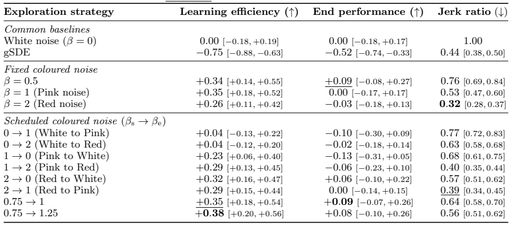
Table 1 : Aggregate learning efficiency and end performance (z-scores relative to white noise, mean over tasks) and jerk ratio relative to white noise (geometric mean over tasks) for some representative exploration strategies. Brackets indicate 95% paired bootstrap confidence intervals over 30 seeds. The best values in each column are highlighted in boldand the second best values are underlined .
Original paper · CC BY 4.0In the aggregate, constant pink noise reached a learning-efficiency z-score of +0.35, with interval [+0.18,+0.52]. Constant red noise reached +0.26 with interval [+0.11,+0.42], against 0.00 for white noise. The text instead gives +0.26 with interval [0.04, 0.49] for red noise over white noise, so the two intervals disagree.
The authors conclude that coloured noise speeds up learning on some tasks without raising the final success rate. No strategy reached a significantly higher end performance than white noise. Learning gains therefore came from the early phase of training, not from a better final policy.
Start and end colours do different jobs
The authors kept the seed and start colour fixed, so the end colour is the only difference between paired runs. Under that comparison, the end colour had no significant effect on learning efficiency on any task (Friedman tests, p ≥ 0.22).
Next, the authors compared each scheduled noise with the constant noise of its own start colour. None of the 42 scheduled noises differed significantly in learning efficiency or end performance after Bonferroni correction. The regression coefficient for the colour change Δβ was −0.03 [−0.08, 0.01] for learning. For end performance, the coefficient was +0.00 [−0.03, 0.04], so the direction of the schedule doesn't matter for final success.
The start colour did matter on Fetch-Reach, where starting with more correlated noise led to faster learning.
The authors read the gap as a sign that the colour early in training matters more. SAC's automatic entropy tuning shrinks the policy's standard deviation σθ as training proceeds. So the remaining noise, whatever its colour, perturbs the agent's behaviour less, and its colour mainly shapes the motion. At equal mean colour, decreasing schedules gave slightly lower jerk than increasing ones, with a coefficient of +0.04 [0.02, 0.07].
Red noise gives the smoothest exploration
Driving the Fetch arm with noise alone shows how colour changes motion before any learning happens. Action jerk falls 19-fold, from 2.35 to 0.12, over the same 100 episodes. Pink noise gives 47.0 cm, so the trend holds at the intermediate colour as well. This is a check with no learning, so it shows what each colour does to motion rather than to learning.
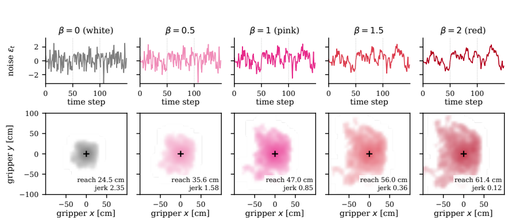
Figure 1 : Coloured noise in a Fetch arm.T op: Examples of noise sequences with noise colours ranging from white (β= 0) to red (β= 2). All sequences were generated from the same initial Gaussian white noise sequence with unit variance.Bottom: Densities of gripper positions relative to the start position (black cross) over 100 episodes of 50 steps with the arm driven by exploration noise alone. Inset values show the maximal gripper displacement and average action jerk over those 100 episodes. These illustrative examples show that increasingly correlated noise generated from the same initial Gaussian white noise reaches a wider area with smoother movements.
Original paper · CC BY 4.0 · López, Francisco M., Cruz, Francisco · Fade to... Red? Scheduling Coloured Noise Exploration Supports Efficient Robot Learning with Reduced Movement Jerk · Original paper figure · Extracted the figure area from page 2 of the original PDF.During training, all 48 coloured schedules explore significantly more smoothly than white noise. The jerk ratio falls from 1 for white noise to 0.53 for constant pink noise and 0.32 for constant red noise. gSDE reaches a jerk ratio of 0.44, but its learning efficiency and end performance are the worst overall. Ending with red noise instead of white cuts jerk to 0.49 [0.47,0.50] of its value on Fetch-Reach.
On ShadowHand-BlockRotateZ, the same switch gives 0.60 [0.58,0.63].
Compared with pink noise, constant red noise doesn't differ in learning (−0.08 [−0.29,0.11]). End performance also shows no difference from pink noise (−0.03 [−0.24,0.17]). Red noise explores with almost 2-fold less jerk than pink noise, a ratio of 0.60 [0.52,0.68]. Red noise beats gSDE in learning (+1.01 [0.81,1.22]) and end performance (+0.49 [0.25,0.76]).
Constant red noise has the lowest jerk of all 50 strategies. It sits on both Pareto frontiers, the learning-versus-jerk and the end-performance-versus-jerk ones. Thirty-nine strategies are statistically tied with the best in learning efficiency, and 40 in end performance.
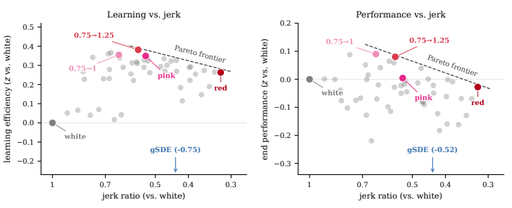
Figure 4 : Trade-offs between learning efficiency (left) and end performance (right) with jerk ratio. Each point shows the aggregate from one of the 50 exploration schedules. Highlighted dots show the constant white, pink, and red noises, the two schedules with highest learning efficiency (0.75→1.25) and end performance (0.75→1), and gSDE. The dashed lines indicate the Pareto frontiers.
Original paper · CC BY 4.0Why red matches pink in these tasks
Red noise matched pink in learning here, even though earlier work had judged it too strongly correlated as a default. The authors name two features of their experiments that could explain this result. The first feature is the episode length, since manipulation tasks often combine integrator-like dynamics within short episodes. Fetch actions are Cartesian displacements of the gripper, and episodes last 50 to 100 steps.
DeepMind Control Suite episodes run up to 1,000 steps, so the comparison is with much longer horizons. The authors observed that more strongly correlated noise moved the Fetch gripper further within an episode.
The second feature is the low-frequency cutoff set at the episode length. The authors also point to hindrances from highly correlated actions, which could keep a gripper open or closed for long periods. Such behaviour could make the discovery of grasps difficult, which is a plausible limit for red noise on gripper actuators.
The authors conclude that pink noise may remain the better default for long-horizon control. Short-horizon manipulation, by their account, benefits from the smoothness of red noise. Their explanation also covers the start and end colour asymmetry, which they link to exploration early in training. As training proceeds, SAC's automatic entropy tuning reduces the policy's standard deviation, so the noise perturbs the agent less.
The colour of the remaining noise then shapes the motion and jerk without necessarily changing what the agent learns.
Limitations of the study and what remains untested
The experiments ran only in simulation, so the smoothness benefit on physical hardware is still unconfirmed. The authors don't claim that the reduced jerk would translate into less vibration or actuator wear on a real arm. Only one algorithm was tested, SAC with HER, so the results don't show whether other off-policy methods behave the same way.
The study used linear schedules over seven noise colours, from white to red, and four manipulation tasks.
Fetch-Reach contributed most of the aggregate learning gains, so the aggregate learning picture rests heavily on one task. Seed-to-seed variability on the harder tasks was large, so many per-task learning differences were not significant. Despite training 30 random seeds per strategy, the authors could not separate most learning differences on individual tasks.
Adaptive schedules that follow learning progress were not tested, and the authors list them as future work.
Paper info
- Authors
- López, Francisco M., Cruz, Francisco
- Venue
- arXiv · Preprint
- First published
- 2026-11-9
- Added
- 2026-11-10
- Updated
- 2026-11-9
- Version
- v1
- arXiv
- 2611.11868
- Category
- cs.RO · cs.LG
- Original paper terms
- CC BY 4.0
- What we show
- Paper info, commentary and permitted figures from the original paper
AI commentary is a separate explanation from the original paper and may contain errors. The original paper and figures follow each source's terms of use and any rights noted separately.
Abstract
Exploration in deep reinforcement learning (RL) for continuous control is commonly driven by temporally uncorrelated Gaussian (white) action noise, which leads to jerky motions with locally constrained exploration. In contrast, temporally correlated coloured noise, particularly pink noise, has been shown to support more efficient exploration in RL. Motivated by these findings, we inquire whether scheduling changes to the noise colour over the course of training can outperform white noise for continuous control robotics. We perform a systematic study of 49 linear schedules between white and red noise, together with generalised state-dependent exploration (gSDE), on four sparse-reward manipulation tasks with a Fetch arm and a Shadow Dexterous Hand. We find that the noise colour at the end of training does not affect learning efficiency or end performance, whereas fading towards red noise halves the jerk of exploration in every task. Balancing learning efficiency, end performance and smoothness, red noise emerges as the preferred strategy: it learns as efficiently as pink noise with almost 2-fold less movement jerk. We therefore recommend exploration schedulers that fade towards red noise as the default for off-policy robot learning.
Quote from the paper
López, Francisco M., Cruz, Francisco (2026). Fade to... Red? Scheduling Coloured Noise Exploration Supports Efficient Robot Learning with Reduced Movement Jerk. arXiv:2611.11868v1. https://arxiv.org/abs/2611.11868v1
BibTeX
@misc{m2026fade,
  title = {{Fade to... Red? Scheduling Coloured Noise Exploration Supports Efficient Robot Learning with Reduced Movement Jerk}},
  author = {López, Francisco M. and Cruz, Francisco},
  year = {2026},
  eprint = {2611.11868},
  archivePrefix = {arXiv},
  url = {https://arxiv.org/abs/2611.11868v1}
}