Paper commentary
Variational Approach to Optimal IPS Estimator for Multi-logger Off-Policy Evaluation
Optimal variance weights make IPS estimates more reliable with several logging policies
- Problem Balanced and weighted IPS each win on some multi-logger datasets and lose on others, so no fixed weighting rule works everywhere. Practitioners have had no single reliable choice for combining logs from several policies.
- Method The authors let each logged sample get its own weight, chosen to minimize variance while keeping the estimator unbiased. Solving a small K by K linear system gives the closed-form weights, so no reward model is needed.
- Results The estimator is unbiased and asymptotically optimal within the generalized weighted-IPS class when logging policies are known. It generally improves on existing multi-logger IPS methods in experiments on benchmark datasets.
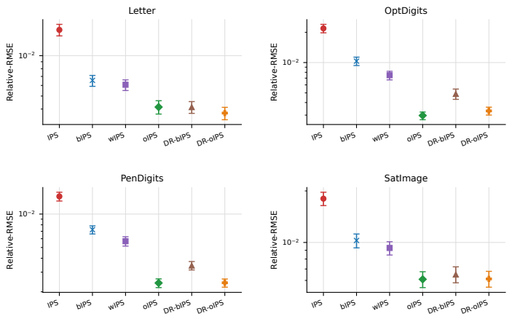
Figure 4 : Rel-RMSE across five heterogeneous logging policies where they are known. Lower is better. Error bars show95%paired percentile-bootstrap intervals (§5).
Original paper · CC BY 4.0 · Huh, Joon Suk, Seo, Junghoon · Variational Approach to Optimal IPS Estimator for Multi-logger Off-Policy Evaluation · Original paper figure · Extracted the figure area from page 20 of the original PDF.Why multi-logger weighting is hard
Off-policy evaluation estimates the value of a target policy from logs that other policies generated. With several logging policies, each stratum overlaps the evaluation policy to a different degree. Combining those strata poorly can lead to large variance, so the weighting choice matters as much as the estimator itself. Naive IPS treats every logged sample with its own propensity ratio, so each logger's stratum is never reweighted as a block.
Each of the three rules answers the question of how much each logger should count in its own way.
Neither balanced nor weighted IPS consistently dominates the other across problem instances, so a rule that works on one dataset can fail on another. Naive IPS is dominated in their analysis, which leaves no single fixed rule that wins everywhere.
Kallus et al. later characterized the semiparametrically efficient estimator over a broader class, and it serves as the benchmark here. That efficient estimator uses the conditional mean reward as a control variate, so it needs a reward model. The authors instead propose a generalized weighted-IPS class in which each sample's weight can depend on the state, action, reward, and logger.
A variational route to the weights
Instead of picking one fixed IPS rule, the authors let each logged sample receive its own weight and optimize those weights directly. Two constraints keep the estimator unbiased: a normalization condition on the weights across loggers and a dominance condition on the logging policies. Because the estimator is linear in the weights, its variance is convex in them, so the minimization has a closed-form solution.
The optimal weight for logger i combines a term scaled by the coefficient alpha_i with a residual term built from the reward and the coefficients of all loggers. The coefficient vector alpha solves the K by K linear system T alpha = c, where T holds propensity moments and c holds reward-weighted moments. Because the weights are constructed this way, the authors call T the technique matrix and c the contribution vector.
The estimator therefore needs only these moments, not a fitted conditional mean reward, which is the main practical difference from the Kallus et al. [2021] estimators.
The authors rewrite the optimal estimator in a control-variate form, where a mean-zero term built from the logging policies reduces variance. Naive, balanced and weighted IPS all sit inside the generalized class, so the optimal estimator is at least as efficient asymptotically. Choosing the weights for the rule-based estimators recovers them exactly, which is why the optimum cannot do worse than them asymptotically.
The optimal weights and the K by K system
The optimal weight for each logger has two parts, a coefficient times the logger's propensity ratio and a residual term scaled by the stratum's share. The residual subtracts a weighted sum of the logger propensities, divided by the evaluation policy, from the observed reward. Each entry of T and c is an expectation under one logger, so the authors write T as a K×K matrix and c as a K-vector.
Estimating T and c therefore takes the place of estimating the conditional mean reward function.
Substituting these weights into the estimator gives a control-variate form, where the correction term has mean zero. That mean-zero term reduces variance without shifting the expectation, which is why it works as a control variate. In the L2 space with the µlog inner product, the solution is the projection of q·πe onto the span of the logging policies.
Tα⋆ = c holds exactly when the residual of q·πe is orthogonal to every logging policy πi under that inner product.
The authors use this projection view later to relate the residual's squared norm to the excess variance over the semiparametric oracle. This makes the K×K system the normal equation of an orthogonal projection, not just a computational shortcut. In practice, the authors estimate T and c from data with logger-wise cross-fitting, so no reward model is needed.
Each fold estimates T and c on its training part and computes α with the Moore–Penrose pseudoinverse.
From moments to a feasible estimator
The oracle weights need the true technique matrix T and contribution vector c, so the paper replaces them with sample averages computed inside each fold. Each stratum Di is split into Z folds, with Z at least 2, and the fold partition is chosen independently of the observed values. For each fold z, the estimator computes T-hat and c-hat on the complement D(-z), so the nuisance moments never see the samples they evaluate.
Cross-fitting in this way keeps the estimation of the nuisance parameter and the final evaluation on different samples.
The averaged logging policy is recomputed from the complement counts, because it depends on the stratum sizes through ni over n. The coefficient is then alpha-hat equal to the Moore-Penrose pseudoinverse of T-hat applied to c-hat, so a singular estimate does not stop the solve. The pseudoinverse keeps the solve well defined even when T-hat is rank deficient, as happens with mixtures of the same two policies.
Each fold's estimate is then evaluated on the held-out fold D(z) with its own alpha-hat and its own averaged policy.
The final estimator averages the fold estimates, weighting each fold by its share n(z) of the total sample n. The averaged logging policy on each fold is set to a stratum-size weighted mixture of the logging policies, which keeps the weights consistent with the oracle form. When the logging policies are unknown, the authors plug consistent estimates of the propensities into the same procedure, as detailed in Appendix A.
With known logging policies, Theorem 4.2 states that the cross-fitted estimator is unbiased and asymptotically normal. Its asymptotic variance is n times the variance of the infeasible weighted estimator, which is the optimal value within the class. Remark 2 warns that estimated propensities change the limit, because propensity error enters at first order.
What the known-propensity theory guarantees
It also asks that the weighted scores have finite second moments and that the optimal weights in (3.2) are square-integrable. Because the paper drops the dominance condition from the variance minimization problem, the solution still satisfies it anyway. Each summand computed with the fold estimate must converge in probability to the oracle summand in L2(µπi), with finite second moments.
Under these conditions, with known logging policies, the feasible estimator Ĵ_oIPS is unbiased. Its scaled error is asymptotically normal, with variance n times the variance of the infeasible weighted estimator Ĵ(πe, w⋆; D). The asymptotic regime lets each logger's count grow as n′i = m·ni, and the paper takes m to infinity. Here n is the sum of the base stratum sizes ni, and the variance is computed at those base sizes.
Because naive, balanced and weighted IPS are particular weight choices in ΓwIPS, the optimal oIPS variance is no larger than theirs. The weights for naive IPS, balanced IPS and weighted IPS are set to ni/n times r, ni/n times πi/πavg times r, and ni γ̂i times r.
The guarantee has limits: with estimated logging policies, the limiting distribution generally differs from Theorem 4.2. Remark 1 notes that for a deterministic evaluation policy, Assumption 1(i) fails, and the comparisons extend only by continuity.
Cost relative to the semiparametric oracle
The oracle is the estimator of Kallus et al. that uses the conditional mean reward q and attains the efficiency bound. The oIPS estimator drops the reward model and instead uses the logging policies to build its control variate. The authors quantify the efficiency cost as a gap between the two asymptotic variances, written with a projection residual term.
The projection is onto the span of the logging policies, measured in the norm of the log measure mu_log.
Theorem 4.3 gives the gap as one over n, times an infimum projection residual minus the variance of q(S, pi_e) under p_s. The gap is nonnegative, so oIPS never beats the semiparametrically efficient oracle in this setting. The gap is zero exactly when q pi_e lies in the span of the logging policies. When the logging policies can't express that reward structure, the residual becomes the excess variance over the oracle.
Kallus et al. showed that their DR balanced IPS estimator reaches the optimal asymptotic variance for any consistent reward estimator. Combining that result with Theorem 4.2 gives an ordering of the asymptotic variances of the DR balanced IPS and oIPS estimators. The authors close this gap in the doubly robust extension, which applies the control-variate form to the residual R minus q-hat.
The doubly robust extension and its comparison with DR-bIPS
The DR extension, DR-oIPS, adds a reward model to the variational construction and keeps the same logger-based correction. It applies the control-variate form to the residual R minus q-hat of S and A, then adds the direct-method term q-hat of S and pi_e. The same conditional reward estimator q-hat drives DR-bIPS, which makes the two estimators directly comparable.
The DR-bIPS baseline uses the averaged logging policy as its inverse propensity and cross-fitting for q-hat.
When the conditional reward estimator is consistent, DR-oIPS matches the asymptotic variance of DR-bIPS. Both DR estimators reach the semiparametric efficiency bound in that case, so the reward model is the deciding factor.
With known logging policies, DR-oIPS has asymptotic variance no larger than DR-bIPS. Suppose both estimators use the same misspecified reward q-prime, with q-prime different from q. If the misspecification (q minus q-prime) times pi_e lies in the span of the logging policies, DR-oIPS still attains the oracle variance. DR-bIPS in general does not attain that oracle variance under the same misspecification.
DR-oIPS projects the misspecification (q minus q-prime) times pi_e onto the span of the logging policies in L2 of mu-log. Only the component orthogonal to that span adds excess variance, which is why the correction helps under misspecification.
The authors use the same logistic-regression reward model and the same two-fold cross-fitting folds for both DR estimators in the experiments. The experiments show DR-oIPS often reaches lower estimation error than DR-bIPS, but the paper's DR theory covers only the asymptotic cases above.
How the UCI experiments were built
Four UCI classification datasets are turned into contextual bandit datasets, with each label treated as an action. OptDigits, SatImage, PenDigits and Letter have 5620, 6435, 10992 and 20000 samples, with 10, 6, 10 and 26 classes. A correct action earns reward 1 and any other action earns 0, so the reward is deterministic given the label. The authors follow the benchmark protocols of Agarwal et al.
[2017] and Kallus et al. [2021] for choosing these datasets.

Table 1 : Dataset Statistics
Original paper · CC BY 4.0The remaining 70% forms the evaluation pool, and the empirical accuracy of the deterministic policy on that pool is treated as the ground-truth value J(πe). Two logging policies mix the deterministic policy with a uniform policy: π1 uses 0.95 and 0.05, while π2 uses 0.05 and 0.95. Because π1 is well aligned with πe, while π2 is much less aligned, the two loggers differ in overlap.
Each context in the pool is assigned to either D1 or D2, and an action is sampled from the assigned logger.
The stratum-size ratio n1/n2 is varied over 0.1, 0.25, 0.5, 1, 2, 4 and 10. Performance is scored with Relative-RMSE, which divides the root mean squared error across trials by the mean ground-truth value. The authors use M = 200 trials and 2,000 paired percentile-bootstrap resamples to report 95% intervals. Each trial redraws the data split, logged actions and cross-fitting folds, so the intervals cover all three sources of variation.
The two DR estimators share one logistic-regression reward model with two-fold cross-fitting.
What the comparisons show
The authors say oIPS generally lowers Relative-RMSE against the existing multi-logger IPS baselines. The per-setting numbers sit in the appendix, so the main text shows only the summary.
That is one synthetic setting, so it shows the size of the gap in that case rather than across instances.
The DR comparison is the second claim: DR-oIPS achieves lower Relative-RMSE than DR-bIPS in many finite-sample settings. The wording is many finite-sample settings, so the paper doesn't claim a win in every case. Both DR estimators use the same logistic regression reward model with two-fold cross-fitting. Because the reward model and folds match, differences in the results come from the weighting step.
The authors also describe DR-oIPS as often improving over DR balanced IPS in finite samples.
Each comparison uses M = 200 trials with 95% paired percentile-bootstrap intervals from B = 2,000 resamples. The theory says oIPS is asymptotically at least as efficient as the IPS baselines, but it doesn't settle finite-sample behavior. The authors also note that the method relies on sufficient overlap, and that the experiments cover UCI benchmarks and one synthetic environment.
Where the guarantees stop applying
The optimality result holds only inside the generalized weighted-IPS class ΓwIPS, which is the scope of the variance comparison. The asymptotic guarantees assume known logging policies, and the authors state that this is the main limitation. Because of that, the limiting distribution generally differs from the known-policy result in Theorem 4.2.
Assumption 1(i) requires strictly positive densities for all policies, and a deterministic evaluation policy breaks it. In that case the weights in (3.2) are undefined wherever πe(a|s) = 0. The control-variate form (3.4) remains unbiased for every α, so the authors compute the estimator through it.
The method relies on sufficient overlap between the evaluation and logging policies. Their experiments cover UCI benchmarks and one synthetic environment, so wider settings remain untested.
Paper info
- Authors
- Huh, Joon Suk, Seo, Junghoon
- Venue
- arXiv · Preprint
- First published
- 2026-11-9
- Added
- 2026-11-10
- Updated
- 2026-11-9
- Version
- v1
- arXiv
- 2611.11712
- Category
- cs.LG
- Original paper terms
- CC BY 4.0
- What we show
- Paper info, commentary and permitted figures from the original paper
AI commentary is a separate explanation from the original paper and may contain errors. The original paper and figures follow each source's terms of use and any rights noted separately.
Abstract
We study off-policy evaluation (OPE) in contextual bandits with data collected from multiple logging policies. Inverse propensity scoring (IPS) is a standard approach to OPE and extends naturally to the multi-logger setting. However, as highlighted by Agarwal et al. [2017], neither balanced nor weighted IPS consistently outperforms the other in this setting. We resolve this dilemma by deriving an optimal IPS estimator with sample-dependent weights that minimize variance subject to unbiasedness. Using a variational calculus approach, we obtain closed-form optimal weights, yielding an estimator that is unbiased and achieves asymptotically optimal variance within a generalized weighted-IPS estimator class. Instead of a reward model, the estimator needs only a $K\times K$ matrix and a $K$-vector of moments, where $K$ is the number of logging policies, and we quantify how much efficiency this costs relative to the semiparametric oracle. Experiments on benchmark datasets show that our estimator generally improves on existing multi-logger IPS methods. We also extend our estimator to a doubly robust form by incorporating a conditional reward estimator. We compare the resulting DR extension with the semiparametrically efficient DR estimator of Kallus et al. [2021], both theoretically and empirically. We show that the two estimators achieve the same asymptotic variance when the conditional reward estimator is consistent, while our estimator can retain semiparametric efficiency under certain forms of reward misspecification. Empirically, the proposed DR estimator often achieves lower estimation error than the existing DR baseline.
Quote from the paper
Huh, Joon Suk, Seo, Junghoon (2026). Variational Approach to Optimal IPS Estimator for Multi-logger Off-Policy Evaluation. arXiv:2611.11712v1. https://arxiv.org/abs/2611.11712v1
BibTeX
@misc{suk2026variational,
  title = {{Variational Approach to Optimal IPS Estimator for Multi-logger Off-Policy Evaluation}},
  author = {Huh, Joon Suk and Seo, Junghoon},
  year = {2026},
  eprint = {2611.11712},
  archivePrefix = {arXiv},
  url = {https://arxiv.org/abs/2611.11712v1}
}