論文解説
PAIR: Proprioception-Aligned Image-Ray Representations for Viewpoint-Robust Manipulation
PAIR:視点に頑健な操作のための固有受容感覚整列画像光線表現
- 課題 視点が変わると、同じロボット状態でも見える画像が変わり、異なる状態が似て見えることもあるため、視覚ポリシーは視点変化に弱くなります。
- 手法 カメラ光線をPlücker座標で表して視覚トークンに注入し、ロボットの固有受容感覚を基準にした重み付きの対照損失で画像-光線表現を整列させます。
- 結果 光線条件付けを適用したPAIRは、単一タスクのDPでは光線条件付けのないBCより最大成功率が平均16.2%ポイント高く、LIBEROのマルチタスクのSmolVLAでは平均88.9%でした。
視点変化に弱い視覚ポリシー
ロボットの模倣学習では、同じ物理状態でもカメラの視点が変わると、視覚ポリシーが受け取る画像はまったく異なるものになります。逆に、異なるロボット状態が特定の視点では似て見えることもあります。そのため、ポリシーはタスクに必要な状態だけでなく、その状態が特定のカメラ構成でどのように投影されるかも合わせて推論する必要があります。
既存のアプローチは2つの方向に分かれます。カメラ光線を入力の文脈として与える方法は視点情報を提供しますが、それ自体では視覚表現をタスク場面の投影状態に固定しません。固有受容感覚(proprioception)情報で物理的に似た状態を整列させる方法は、カメラの文脈なしに視点依存の投影を無視するため、互いに矛盾する教師信号を生むことがあります。PAIRは、この2つの方向を組み合わせ、画像-光線表現を固有受容感覚を基準に整列させる手法として提案されています。
光線の注入と固有受容感覚による対照整列
PAIRは、各視覚トークンについて、エンドエフェクタ基準の光線とロボットベース基準の光線をPlücker座標で計算します。2つの光線集合は軽量な畳み込みネットワークで符号化された後、視覚特徴と結合されます。結合の投影は恒等写像で初期化されるため、学習の初期には既存の表現がそのまま保たれます。光線項は位置埋め込みと同様に各トークンへ加算されるため、構造の変更は最小限です。
整列段階では、バッチ内のロボット状態どうしの幾何距離を、位置、クォータニオン距離、グリッパ幅の和として定義します。この距離のグローバルなパーセンタイル順位αijがカットオフβより小さい組にだけ、1から0まで線形に減少する正の重みwijを与えます。重み付きInfoNCE形式の損失LPAにより、近い状態の表現は引き寄せられ、遠い状態は押し離されます。最終的な目的はLtotal = LBC + λPA LPAであり、行動複製損失に補助項を加える構造です。
シミュレーションと実環境での評価設計
評価は、MimicGen、AlohaGym、LIBEROのシミュレーションと3つの実環境タスクで、カメラの外部パラメータを変えてデモを収集し直す形で行われます。単一タスクの実験はSigLIP2ベースのU-Net拡散ポリシー(Diffusion Policy)に対して行われ、マルチタスクの実験ではSmolVLAをLIBEROと実環境タスクにファインチューニングして行われます。2つのポリシークラスはどちらも同じバックボーンと最適化条件を共有し、補助目的だけがBC、TCN、PAIRの間で異なります。
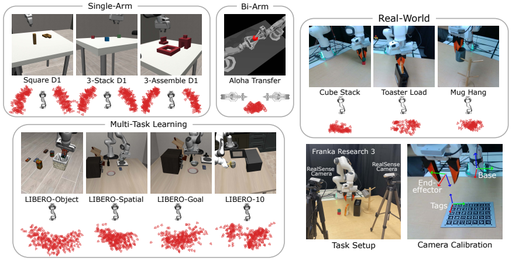
Fig. 3 :Simulated benchmarks and real-world experiments.PAIR is evaluated across both simulated and real-world manipulation tasks. In simulation, MimicGen and LIBERO use a Franka Panda arm with two side views and one front view, respectively, while AlohaGym uses a bimanual Aloha platform with two front views. In the real world, we evaluate three tabletop tasks using a Franka Research 3 (FR3) arm with two front view cameras, where the camera poses are randomized and estimated using AprilTags [21] at the start of each rollout.
出典 · CC BY 4.0 · Lee, Sung-Wook, Kang, Xuhui, Losey, Dylan, Kuo, Yen-Ling · PAIR: Proprioception-Aligned Image-Ray Representations for Viewpoint-Robust Manipulation · 論文の図を引用 · 元のPDFの5ページ目から図の部分を抽出しています。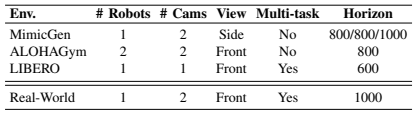
論文の図 TABLE II: Comparison of environments, including robot and camera counts, viewpoint, multi-task setting, and task horizon. MimicGen uses separate task horizons for three tasks.
出典 · CC BY 4.0 · Lee, Sung-Wook, Kang, Xuhui, Losey, Dylan, Kuo, Yen-Ling · PAIR: Proprioception-Aligned Image-Ray Representations for Viewpoint-Robust Manipulation · 論文の図を引用 · 元のPDFの5ページ目から図の部分を抽出しています。比較対象は、補助目的を持たない行動複製、時間対照学習に基づくTCN、そしてPAIRです。光線条件付けの有無も同時に変えて、2つの要素の効果を切り分けています。複数のチェックポイントのうち最大成功率を3シードにわたって報告しています。実環境の実験では、デモ収集後にカメラを配置し直し、学習時には含まれていなかった姿勢だけを評価に用いています。
単一タスクとマルチタスクの主な結果
単一タスクの実験では、光線条件付けを適用したPAIRは、光線条件付けのないBCより最大成功率が平均で16.2%ポイント高くなりました。この数値は、MimicGenの3タスクとAlohaGymに対するDPの結果の平均で、タスクごとの結果は表IIIに従います。

論文の図 TABLE III: Success rate (%) ofDiffusion Policy (DP)on three MimicGen tasks and ALOHA Transfer across 3 seeds. For each seed, the maximum success rates from 5 checkpoints is reported.
出典 · CC BY 4.0 · Lee, Sung-Wook, Kang, Xuhui, Losey, Dylan, Kuo, Yen-Ling · PAIR: Proprioception-Aligned Image-Ray Representations for Viewpoint-Robust Manipulation · 論文の図を引用 · 元のPDFの6ページ目から図の部分を抽出しています。この実環境の結果は、3つの卓上タスクを合わせた平均で、各タスクの値は図4に従います。
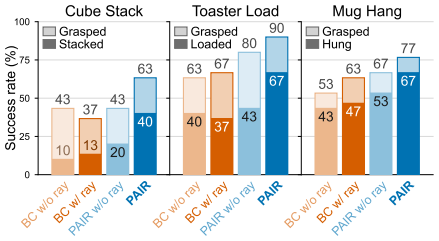
Fig. 4 :Success rates (%) of BC (red) and PAIR (blue), with and without ray conditioning, in three real-world tasks.Both subtask completion rates and final task success rates are reported.
出典 · CC BY 4.0 · Lee, Sung-Wook, Kang, Xuhui, Losey, Dylan, Kuo, Yen-Ling · PAIR: Proprioception-Aligned Image-Ray Representations for Viewpoint-Robust Manipulation · 論文の図を引用 · 元のPDFの6ページ目から図の部分を抽出しています。光線構成と整列係数の分析
2つの光線参照をそれぞれ取り除くアブレーション実験では、エンドエフェクタ基準の光線だけを残した場合も、ベース基準の光線だけを残した場合も、性能は下がりました。この結果は、2つの光線モダリティが互いに補完的な幾何情報を与えるという著者らの解釈を支持しています。

論文の図 TABLE V: Ablation of end-effector-relative (r CE) and robot-base- relative (r CB) camera rays in PAIR. Average success rates (%) are reported, with the performance drop shown in parentheses.
出典 · CC BY 4.0 · Lee, Sung-Wook, Kang, Xuhui, Losey, Dylan, Kuo, Yen-Ling · PAIR: Proprioception-Aligned Image-Ray Representations for Viewpoint-Robust Manipulation · 論文の図を引用 · 元のPDFの6ページ目から図の部分を抽出しています。また、品質係数λqと整列係数λPAを変えた分析では、拡散ポリシーは大きいλPAにより敏感でした。著者らは、これを整列損失が模倣学習の損失を支配する傾向として解釈しています。この感度はSquare D1の多視点タスクとLIBERO設定で見られたもので、すべてのタスクに一般化できる結論ではありません。
計算コストとデータ条件の限界
整列の目的は、学習中に追加の計算コストを生みます。表VIIでは、TCNはBCよりFLOPsが大きく増えており、PAIRはTCNよりFLOPsが58.8%少ないと報告されています。一方、光線入力は、BCではFLOPsを3.0%、TCNとPAIRでは3.8%増やす小さなオーバーヘッドを示しました。

論文の図 TABLE VII: Computational and dataloading cost of training SmolVLA with BC, TCN, and PAIR. FLOPs are reported per forward pass for models without and with ray conditioning, re- spectively. Decoded Frames denotes the number of camera frames decoded during dataloading for each training batch. Training set- tings are provided in Table I.B.
出典 · CC BY 4.0 · Lee, Sung-Wook, Kang, Xuhui, Losey, Dylan, Kuo, Yen-Ling · PAIR: Proprioception-Aligned Image-Ray Representations for Viewpoint-Robust Manipulation · 論文の図を引用 · 元のPDFの7ページ目から図の部分を抽出しています。また、既存のロボットデータセットの視点分布が限られている場合、PAIRの効果はデータの視点の多様性によって変わる可能性があります。体系的な視点多様性をもつデータを収集するには、追加の人手とカメラ較正が必要です。この限界は著者らが明らかにしたものです。条件外への一般化は、本論文の実験では確認されていません。
論文情報
- 著者
- Lee, Sung-Wook, Kang, Xuhui, Losey, Dylan, Kuo, Yen-Ling
- 学会・ジャーナル
- arXiv · プレプリント
- 公開日
- 2026年11月9日
- 登録日
- 2026年11月10日
- 更新日
- 2026年11月9日
- バージョン
- v1
- arXiv
- 2611.11798
- カテゴリ
- cs.RO
- ライセンス
- CC BY 4.0
- 掲載内容
- 論文情報・解説・論文の図
この解説は、Refivuの韓国語解説をAIで翻訳したものです。不正確な翻訳や誤りが含まれる可能性があります。論文と図の利用条件は各出典に従います。
アブストラクト
While imitation learning has made substantial progress toward generalizable robot manipulation through scaling, viewpoint robustness remains a major bottleneck. Visuomotor policies rely heavily on visual inputs, yet images provide an inherently ambiguous signal under viewpoint change: similar scenes may appear markedly different across viewpoints, while distinct states may share certain visual overlaps. A policy must therefore infer not only the task-relevant state, but also how it is visually projected under a particular camera configuration. This entanglement of viewpoint-dependent appearance and task-relevant state can make learning inefficient and limit generalization to unseen viewpoints. Recent work has begun to address this challenge through camera-ray conditioning and representation learning using geometric cues to induce invariance. However, providing camera information as additional context does not by itself ground visual representations in how the task scene is visually projected, while geometric alignment without camera context can introduce spurious correspondences by ignoring viewpoint-dependent projection. We propose PAIR, a contrastive learning framework that aligns joint image-ray representations using robot proprioception. PAIR encourages observations with similar robot states to remain close in representation space across viewpoints, providing a structured grounding signal for learning viewpoint-robust features. PAIR is a highly adaptable framework: it can be used to train Diffusion Policy (DP) or post-train vision-language-action (VLA) models. In simulated and real-world manipulation benchmarks with camera variation, PAIR consistently outperforms the behavior cloning baseline without ray conditioning by 12.7% and 26.7% points, respectively, demonstrating stronger generalization to unseen viewpoints. Project website: PAIRrobot.github.io.
この論文を引用
Lee, Sung-Wook, Kang, Xuhui, Losey, Dylan, Kuo, Yen-Ling (2026). PAIR: Proprioception-Aligned Image-Ray Representations for Viewpoint-Robust Manipulation. arXiv:2611.11798v1. https://arxiv.org/abs/2611.11798v1
BibTeX
@misc{sungwook2026pair,
  title = {{PAIR: Proprioception-Aligned Image-Ray Representations for Viewpoint-Robust Manipulation}},
  author = {Lee, Sung-Wook and Kang, Xuhui and Losey, Dylan and Kuo, Yen-Ling},
  year = {2026},
  eprint = {2611.11798},
  archivePrefix = {arXiv},
  url = {https://arxiv.org/abs/2611.11798v1}
}