Paper commentary
Chronos Policy: Learning Robot Policies on Physical Time
Robot policies can read physical time to handle varying sensor and inference timing
- Problem Fixed-rate robot policies treat sequence position as elapsed time. That breaks when observation rates, delays, or inference latency change.
- Method Chronos Policy conditions a diffusion transformer on capture and execution times. Instead of adding timestamp embeddings, it rotates attention by physical time using time-aware RoPE.
- Results On Conveyor under moderate observation variation, Chronos Policy retains 77.6% success, while Diffusion Policy drops to 15.6%.
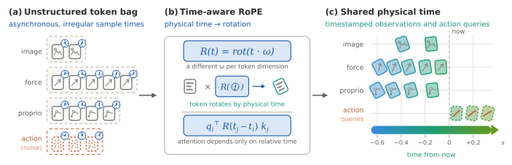
Figure 2 :Overview of Chronos Policy.Tokens are paired with their physical times. Time-aware RoPE uses these physical timestamps as positional coordinates, so attention depends on elapsed time rather than sequence index. The diffusion transformer then predicts an action chunk at the requested execution times.
Original paper · CC BY 4.0 · Changhao Wang, Jaden Clark, Shuran Song · Chronos Policy: Learning Robot Policies on Physical Time · Original paper figure · Extracted the figure area from page 4 of the original PDF.Why sequence position fails under timing shifts
Many imitation learning pipelines turn demonstrations into fixed-rate observation-action sequences. The sequence index then stands in for elapsed time. That shortcut only works while the spacing between samples stays fixed. When the spacing changes, the policy can't tell how much time has passed between observations. It also can't tell how far in the future an action will run.
Take a robot grasping an object from a conveyor belt. Two frames with the same pixel displacement imply very different speeds if they were taken 20 ms apart or 200 ms apart. The right grasp therefore depends on timing, and a fixed index can't express that. Timing varies at every stage: sensors run at different rates and latencies, inference takes time, and controllers may run at other frequencies.
Earlier fixes handle particular effects like latency matching and asynchronous chunk execution. The authors instead treat timing as part of the policy input rather than as an outside mismatch to correct.
Putting physical time into attention
Chronos Policy keeps token content fixed and lets physical time act only as a rotation coordinate inside attention. Adding a timestamp embedding to each token would mix what a token represents with when it occurs. Observation tokens rotate by their capture times, while noisy action tokens rotate by their queried execution times.
Each timestamp is first made relative to the policy request time, so the rotary coordinate is the difference between a token's time and the request time. Queries and keys are rotated by R(t̃i), so the rotated query is R(t̃i) qi and the rotated key is R(t̃i) ki. The query-key product then reduces to qi transposed times R(tj minus ti) times kj, so it depends only on the gap between times.
Shifting every timestamp by the same amount leaves attention unchanged, so the clock origin doesn't matter. Two observations separated by 20 ms and 200 ms get different temporal relationships, even when they sit at the same sequence position.
Because time enters only through this rotation, attention depends on elapsed time for observation-to-action and action-to-action pairs. For action tokens, the rotation uses d_t plus j times Δt_a, so inference latency pushes queried action times into the future. The authors compare this with the additive alternative, which encodes Fourier features through an MLP and adds the result to each token.
On Pivoting, Chronos-RoPE beats Chronos-AddTime in every condition, improving the perturbed-condition average from 33.5% to 55.3%. The authors attribute the gap to the cleaner split between token content and time, and to elapsed time directly modulating attention.
Temporal randomization and asynchronous execution in Chronos Policy
Chronos Policy's training loop resamples each demonstration so it mimics other sensing and execution schedules. For each modality, the observation rate and delivery delay are drawn on their own. Only the measurements available at each sampled request time are kept, and each one keeps its original capture timestamp. The start of the action chunk is randomized as well.
Sampling that start delay sets the queried execution times in Eq. 2. Because fixed-rate downsampling would discard many of these measurements, randomization lets training use them.
After randomization, the same token positions can stand for different physical intervals, so the timestamps must travel with each sample. Observation values enter the network as token content, while the times act only as coordinates in time-aware RoPE. Changing the queried execution times at inference asks the same policy for actions at other future moments.
The training target is a noised action chunk, A(k) = α_k A* + σ_k ε, with ε drawn from a standard normal. The denoiser takes the noised chunk, the step k, the observations, and the times as its inputs. The denoiser is trained with an ℓ1 loss on clean-action prediction in both simulation and the real world.
At deployment, each available observation keeps its capture time, while the noisy action tokens take their queried execution times. The robot keeps executing the previous chunk while the next one is being predicted. When a new chunk arrives, Chronos Policy drops the actions whose execution times have already passed. The remaining actions run at their queried times.
In simulation, the start delay is set from the injected inference latency. On the real robot the inference time isn't known in advance, so the delay is estimated from previously completed requests.
Conveyor and Pivoting results in simulation
Under nominal timing, Chronos Policy improves success from 73.1% to 82.0% over Diffusion Policy. The nominal gap is modest, so the perturbed settings carry most of the difference.
Under moderate observation variation, Diffusion Policy drops to 15.6%, while Chronos Policy retains 77.6%. Under the combined perturbation, Chronos Policy retains 32.7% success, and Diffusion Policy fails entirely. The authors argue that sequence order alone can't show how fast an object moves when observation gaps vary. Sequence order also doesn't tell the policy how far ahead to act when execution lags, so providing both observation and action times lets it read these changes directly.
Under mild timing changes, the two methods perform similarly, and the gap widens as mismatch grows. With inference delays up to 200 ms, success rises from 51.3% to 60.2%. In the combined condition, success rises from 19.6% to 38.4%. The authors explain that timestamps matter most when sequence positions no longer show when each reading was taken.
The ablation in Figure 3 separates temporal randomization from the time representation on both tasks. On Conveyor, temporal randomization alone raises Diffusion Policy's perturbed-condition average from 6.3% to 26.9%. On Pivoting, the same randomization without timestamps cuts the perturbed-condition average from 48.4% to 21.6%.
Which ingredients carry the gain
The ablation separates two design choices: temporal randomization during training, and how physical time enters the transformer. Temporal randomization without timestamps helps Conveyor, where Diffusion Policy's perturbed-condition average rises from 6.3% to 26.9%. On Pivoting, the same randomization without timestamps drops the perturbed-condition average from 48.4% to 21.6%.
The authors explain this drop by saying that the same sequence positions can correspond to different physical intervals.
With timestamps, randomization turns into a clear gain on both tasks, because the policy can read the schedule it sees. Randomization raises the perturbed-condition average from 48.8% to 63.1% on Conveyor. On Pivoting, the same step raises the average from 33.3% to 55.3%. The authors read this as randomization broadening the training distribution while timestamps keep that variation interpretable.
The second ablation compares Chronos-AddTime with Chronos-RoPE, which keeps the token embeddings unchanged. AddTime maps each timestamp through Fourier features and an MLP, then adds the resulting embedding to each token. On Conveyor, AddTime is slightly better under nominal timing, but RoPE wins in every other setting. The temporal-condition average moves from 51.5% for AddTime to 63.1% for RoPE on Conveyor.
On Pivoting, RoPE beats AddTime in every condition and lifts the perturbed-condition average from 33.5% to 55.3%. The authors hypothesize that the cleaner split between content and time, and direct elapsed-time effects on attention, cause this gap. They use Chronos-RoPE as Chronos Policy in all later experiments.
Quasi-static tasks and the cost of explicit time
The authors test whether explicit time hurts six standard quasi-static manipulation tasks, where precise timing matters less. Under nominal timing, the two policies reach comparable performance, so explicit time doesn't cost success when timing matches training. The per-task numbers sit in the appendix rather than in the main text.
Over the five perturbed conditions on average, Diffusion Policy reaches 59.7% and Chronos Policy reaches 73.4%. The largest gains appear under wide sensing variation and under combined perturbations. The perturbed conditions change sensing timing, inference timing, or both, so the baseline lacks timing information that Chronos Policy receives.
The authors read this as time information giving the policy what the baseline lacks when sensing or inference timing shifts.
Chronos Policy keeps nominal performance while gaining robustness to temporal mismatch. When sensing or inference timing changes, the policy gets observation and action timing that the baseline doesn't see. The next test moves to real robots, where sensing and inference timing vary naturally.
Real-robot results on three tasks
The real-world tests cover Dynamic Cup, Peg Insertion and Pivoting. Dynamic Cup asks the robot to place a cup onto a moving saucer, while the other two are contact-rich multisensory tasks. The comparison is Diffusion Policy, Diffusion Policy with Real-Time Chunking, and Chronos Policy.
Real-Time Chunking constrains the next chunk with committed actions while inference overlaps execution. Under asynchronous updates, the robot keeps executing the previous chunk while the next prediction is computed. Both RTC and Chronos Policy estimate inference latency from completed requests.
On all three tasks, Chronos Policy comes out top under each timing condition. The authors read this as one physical-time interface handling both moving-target and contact-rich work.
RTC helps against inference latency in several settings, but it doesn't model changes in observation timing. So its benefit doesn't reliably carry over to sensing perturbations. The authors suggest that asynchronous execution and explicit time awareness cover different parts of temporal mismatch.
Where the claims stop
The real-world study covers only three tasks: Dynamic Cup, Peg Insertion, and Pivoting. On the robot, the authors don't know the current inference time in advance, so they estimate the start delay from earlier requests. The paper doesn't report how much estimation error would change the real-world results. Chronos Policy and RTC both rely on this estimate from completed requests, so the same limit applies to both.
Temporal randomization alone lowers Pivoting's perturbed-condition average from 48.4% to 21.6%, so the representation of time matters too. With physical time made explicit, temporal randomization raises the Pivoting perturbed average from 33.3% to 55.3%. Under nominal Conveyor timing, Chronos-AddTime performs slightly better than Chronos-RoPE.
In the other Conveyor settings, Chronos-RoPE wins, raising the temporal condition average from 51.5% to 63.1%. The ablation compares only AddTime and RoPE, so other ways of encoding time remain untested.
On six quasi-static tasks, Chronos Policy's nominal performance is comparable to Diffusion Policy rather than better. Averaged over the five perturbed conditions, success moves from 59.7% for Diffusion Policy to 73.4% for Chronos Policy.
The real-world comparison sets Chronos Policy against RTC rather than combining the two methods. Because the two methods were never combined in the paper, the complementarity of asynchronous execution and time awareness stays a hypothesis.
Paper info
- Authors
- Changhao Wang, Jaden Clark, Shuran Song
- Venue
- arXiv · Preprint
- First published
- 2026-10-9
- Added
- 2026-10-20
- Updated
- 2026-10-9
- Version
- v1
- arXiv
- 2610.13929
- Category
- cs.RO · cs.CV
- Original paper terms
- CC BY 4.0
- What we show
- Paper info, commentary and permitted figures from the original paper
AI commentary is a separate explanation from the original paper and may contain errors. The original paper and figures follow each source's terms of use and any rights noted separately.
Abstract
Robot policies often convert sensing and control into fixed-rate observation-action sequences, leaving physical time implicit in sequence position. This assumption breaks when observation rates or delays vary, or when inference latency changes. We introduce Chronos Policy, which makes physical time explicit by conditioning on observation capture times and desired action execution times. We study two ways to incorporate time into a diffusion transformer: adding timestamp embeddings to token features, or encoding physical time in positional encoding through time-aware rotary positional encodings (time-aware RoPE). We find that time-aware RoPE is more robust, allowing attention to depend directly on physical time while keeping token content unchanged. During training, we temporally randomize which observations are sampled and when the action chunk begins, exposing the policy to a wider range of sensing and execution schedules that may occur during deployments. This also enables learning from asynchronous, multi-rate data without forcing all measurements onto a fixed temporal grid. Across simulation and real-world experiments, Chronos Policy improves performance on dynamic tasks, where observation-to-action timing is critical, and on multisensory tasks, where the relative timing between observations matters. On standard quasi-static tasks, it preserves nominal performance while improving robustness to changes in sensing and inference timing.
Figures from the paper
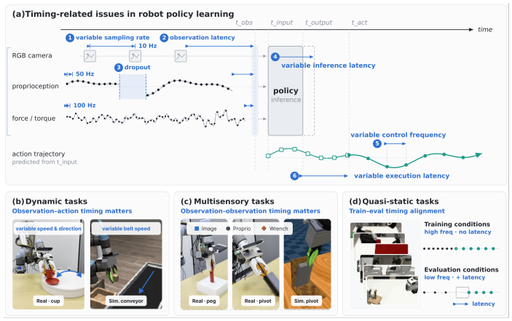
Figure 1 :Timing-related issues in robot policy learning.(a) Real robot systems exhibit multiple sources of temporal variation, including variable sensor sampling rate, observation latency and dropout, inference latency, control frequency, and execution latency. These timing effects matter differently across tasks. (b) In dynamic tasks, the key temporal relationship is betweenwhen an observation is capturedandwhen an action takes effect. (c) In multisensory tasks, the key temporal relationship is betweenwhen different observations are captured. (d) Even in quasi-static tasks, differences between data-collection and deployment timing can create temporal mismatch. Standard fixed-rate policy representations obscure these distinctions by treating sequence position as a proxy for time.
Original paper · CC BY 4.0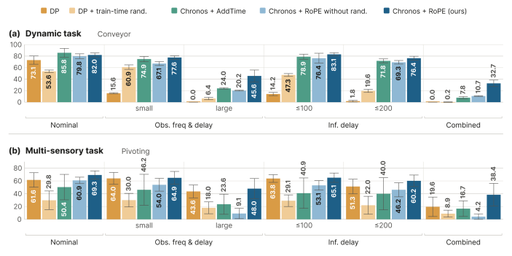
Figure 3 :Simulation ablation of Chronos Policy design.We compare temporal randomization, additive time encoding, and time-aware RoPE to identify an effective recipe for time awareness. Temporal randomization is most effective when paired with explicit timestamps, while time-aware RoPE provides the strongest robustness across Conveyor and Pivoting.
Original paper · CC BY 4.0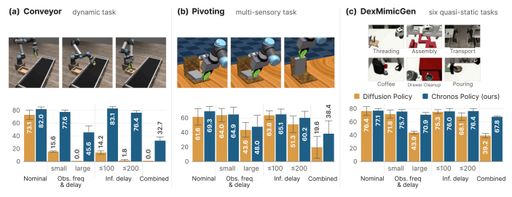
Figure 4 :Simulation evaluation across manipulation settings.We compare Diffusion Policy and Chronos Policy on (a) dynamic Conveyor, (b) multisensory Pivoting, and (c) six standard DexMimicGen tasks under nominal and perturbed sensing and inference timing.
Original paper · CC BY 4.0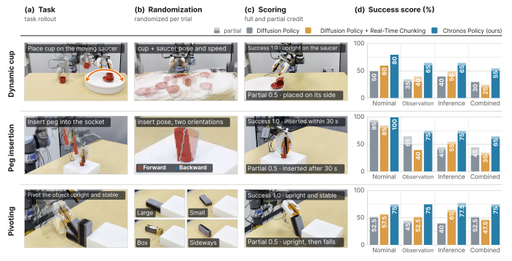
Figure 5 :Real-world evaluation under timing variation.We compare Diffusion Policy, Diffusion Policy with RTC, and Chronos Policy on Dynamic Cup, Peg Insertion, and Pivoting under nominal, observation, inference, and combined timing conditions. Lighter bar segments indicate partial success.
Original paper · CC BY 4.0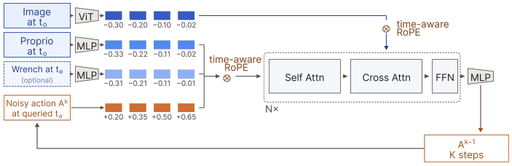
Figure 6 :Architecture of Chronos Policy.Proprioceptive, optional force/torque, and noisy action tokens interact through self-attention and attend to image features through cross-attention. Time- aware RoPE encodes observation capture times and queried action times in attention. The transformer iteratively denoises the action chunk.
Original paper · CC BY 4.0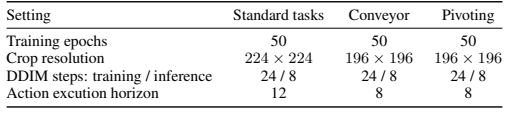
Table 1 :Simulation training and execution settings.The action prediction horizon is 16 and action frequency is 20 Hz for every task.
Original paper · CC BY 4.0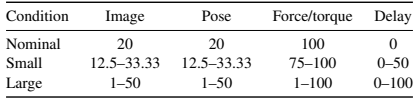
Table 2 :Simulation observation-timing conditions.Sensor frequencies are in Hz and delivery delays are in ms. Small and Large correspond to the observation perturbations used in the main figures; sensor streams are sampled independently.
Original paper · CC BY 4.0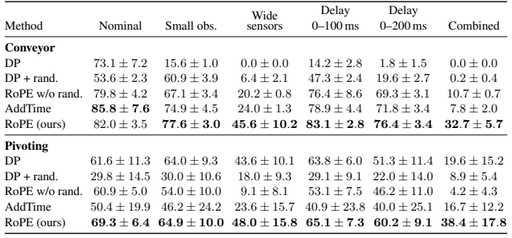
Table 3 :Full Conveyor and Pivoting results and design ablations.Success rate (%), mean ± sample SD across three training seeds after averaging three paired evaluation batches within each seed. Each condition contains 450 episodes per method. RoPE is the full Chronos Policy; AddTime changes only the time encoding. Rand. denotes temporal randomization. Best mean performance within each task and condition is shown inbold.
Original paper · CC BY 4.0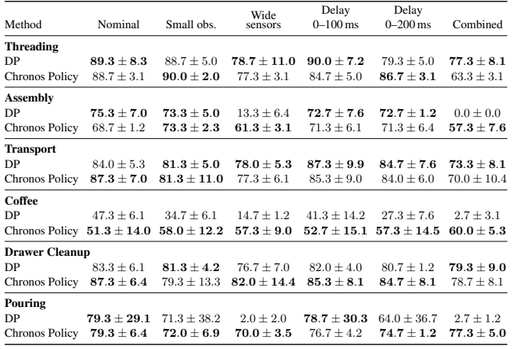
Table 4 :Full results on the six standard manipulation tasks.Success rate (%), mean ± sample SD over three training seeds. Each seed is evaluated for 50 episodes per condition. DP denotes the transformer-based Diffusion Policy baseline. Best mean success within each task and condition is shown inbold.
Original paper · CC BY 4.0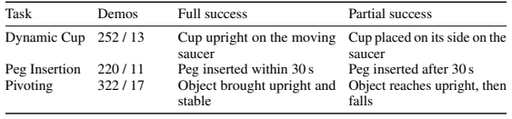
Table 5 :Real-world datasets and scoring.Full success receives one credit, partial success half a credit, and failure zero. Demonstration counts are training / validation.
Original paper · CC BY 4.0
Table 6 :Real-world observation-timing settings.Each stream has an independent delivery delay. Force/torque applies to Peg Insertion and Pivoting.
Original paper · CC BY 4.0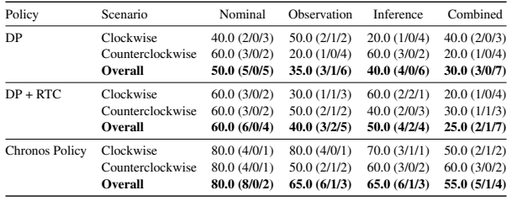
Table 7 :Dynamic Cup results by motion direction.Each direction contains five trials; Overall aggregates all 10 trials per policy and timing condition. Each cell reports task score (%) followed by full/partial/failure counts.
Original paper · CC BY 4.0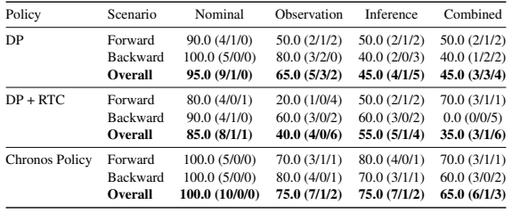
Table 8 :Peg Insertion results by hole orientation.Forward and backward orientations each contain five trials; Overall aggregates all 10 trials. Each cell reports task score (%) followed by full/partial/failure counts.
Original paper · CC BY 4.0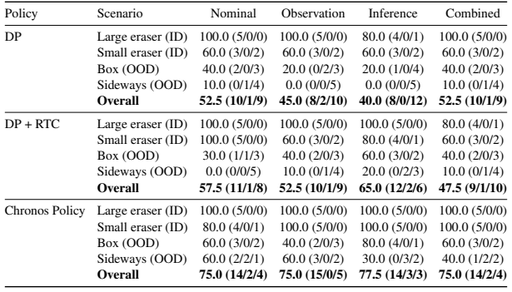
Table 9 :Pivoting results by object and generalization setting.Large and small erasers are in-distribution (ID); the box and sideways setting are out-of-distribution (OOD). Each individual scenario contains five trials, and Overall aggregates all 20 trials. Each cell reports task score (%) followed by full/partial/failure counts.
Original paper · CC BY 4.0Quote from the paper
Changhao Wang, Jaden Clark, Shuran Song (2026). Chronos Policy: Learning Robot Policies on Physical Time. arXiv:2610.13929v1. https://arxiv.org/abs/2610.13929v1
BibTeX
@misc{wang2026chronos,
  title = {{Chronos Policy: Learning Robot Policies on Physical Time}},
  author = {Changhao Wang and Jaden Clark and Shuran Song},
  year = {2026},
  eprint = {2610.13929},
  archivePrefix = {arXiv},
  url = {https://arxiv.org/abs/2610.13929v1}
}