Paper commentary
Diagnostic Accuracy Is Not Deployment Value: Decision-Aligned Reliability Evaluation for Foundation MLIPs in Materials Discovery
Reliability metrics for ML potentials don't guarantee better materials screening decisions
- Problem Standard reliability metrics such as uncertainty and calibration check the predictions themselves. A model can score well on them yet still send the wrong materials to expensive DFT checks.
- Method The authors score each reliability intervention by the DFT calls it avoids at a fixed near-hull recall instead of by its own metric.
- Results Each intervention improves its own metric, but none reliably saves DFT calls. Calibration raises pooled pairwise accuracy by +1.4 and +1.5 percentage points, yet screening does not improve.
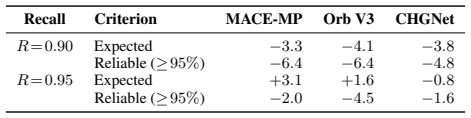
Table 2 : Net deployment value of audit routing, ∆SR =SR(audit)−SR(MLIP-only) (pp); negative means it costs more DFT than it saves. 200 seeds.
Original paper · CC BY 4.0 · Harry Sevi, Joonatan E. M. Laulainen · Diagnostic Accuracy Is Not Deployment Value: Decision-Aligned Reliability Evaluation for Foundation MLIPs in Materials Discovery · Original paper figure · Extracted the figure area from page 4 of the original PDF.Why a good diagnostic can still waste DFT
Foundation MLIPs such as MACE-MP, CHGNet and Orb V3 now prefilter large candidate pools before expensive first-principles checks. Much reliability research focuses on uncertainty, distribution shift, calibration and ranking consistency. Those questions concern the predictions themselves, so a model can pass all of them and still send the wrong materials to DFT.
An automated lab needs a different answer: what it gains by acting on a reliability signal, and what that action costs.
The authors therefore change the yardstick, judging each intervention by the DFT calls it avoids at a fixed near-hull recall. Each one improves the metric it was built for, yet none reliably turns that gain into a better screening decision.
How DFT savings are measured
Candidates are grouped into chemsys, meaning structures that share the same set of elements, and an MLIP ranks each group by predicted formation energy. At a retain fraction f, each chemsys sends its top \( \lceil f N_c \rceil \) candidates to DFT.
The deployment saving is \[ S_R(\pi) = 1 - \frac{C_\pi(f^\star_R)}{N} \] Here C_π counts the unique DFT calls the policy needs at that retain fraction, including calls spent acquiring information, and N is the pool size. The retain fraction f⋆R is the lowest value at which retained candidates capture a share R of all DFT near-hull structures.
An S_R of 0.70 therefore means 70% of the DFT calls are avoided at the target recall.
This is an offline frontier, because f⋆R is chosen from complete DFT labels, so no lab could apply it prospectively as a stopping rule. Because the audit draws its samples at random, results are reported as expected recall, averaged over 200 draws, and as reliable recall, met on at least 95% of draws.
The main deployment benchmark is 15 Materials Project chemsys with Nc ≥ 12, giving 1,147 structures. GNoME quaternaries and a Zintl-phase set serve only as shifted stress-test pools for the novelty and audit diagnostics. The three interventions use zero DFT for novelty and K = 10 DFT calls for calibration and audit, with a separate 250-chemsys pool for out-of-fold checks.
Novelty and calibration: strong diagnostics, weak decisions
The novelty score is a Mahalanobis++ distance computed from each MLIP's per-atom embeddings, measured against that model's training-side reference. It separates 1,225 MP structures from 300 GNoME quaternaries almost perfectly, with AUROC of 0.995, 0.998 and 1.000 for MACE-MP, Orb V3 and CHGNet, in that order. Severity is the weak point: the Spearman correlation with absolute formation-energy error is +0.32, −0.10 and +0.16, with every |ρ| below 0.35.
Pooled to the chemsys level, the score recovers 3 of the 5 failure pairs by the tenth audited chemsys, versus 1.42 at random. It misses an in-distribution failure, Mn–Na–O, which ranks 19 to 24 of 35.
Calibration spends the same K = 10 DFT labels to correct MLIP formation energies per chemsys, then asks whether a validation gain reaches the screening decision. A per-chemsys mean shift cannot reorder candidates inside a chemsys, so its ∆S0.95 is exactly zero, even though pooled pairwise accuracy rises by +1.4 and +1.5 percentage points.
The affine fit is harmful at −3.7 percentage points, and that loss traces to about 2% of fits with a negative slope that invert the ordering. A better validation number, in other words, is not a better decision.
The audit detects unsafe pairs but misroutes DFT
The audit spends K = 10 DFT labels per chemsys and checks the 45 pairwise orderings among those structures. An MLIP–chemistry pair counts as UNSAFE when its population pairwise accuracy is below 0.75. Across 105 pairs, five of them population-unsafe, one-shot audits reach a true-positive rate of about 0.85 at a false-positive rate of about 0.009.
The authors note that these rates describe sampling variability on this benchmark's five positives, not how common unsafe cases are.
The natural routing rule sends unsafe chemistries to all-DFT and verifies the rest with the MLIP's top-f candidates. That rule pays K DFT calls on every chemistry, while the benefit appears only on rare unsafe chemistries, one of the 15 chemsys.
At R = 0.95 the MACE-MP expected-recall value turns positive, because of the Mn–Na–O rescue. So the signal is informative, but acting on it costs DFT across every chemistry.
Target misalignment or costly information?
Audit-based selection replaces all-DFT routing: the K = 10 audit picks which of the three MLIPs ranks each chemistry, and Orb V3 is the single best fixed baseline. To tell whether the signal or the target is at fault, the authors add two free oracles: a pairwise oracle that picks the MLIP with the best true pairwise accuracy, and a deployment oracle that picks the MLIP with the best near-hull outcome.
Under formation-energy screening the pairwise oracle still loses, at −3.7 percentage points, while the deployment oracle gains +0.9 and +2.9 percentage points. So chemistry-specific model choice has value, yet the pairwise target does not find it, which the authors read as target misalignment.
Switching the ranked quantity to predicted distance above the hull changes the picture for MACE-MP and CHGNet, where the pairwise oracle gains +1.1 and +4.1 percentage points. At R = 0.95 that matches the deployment oracle, so the target is now aligned. The audit still loses, at −5.0 and −1.8 percentage points, because a larger audit improves the selector while consuming the gain.
At R = 0.95 the cost-matched oracle falls from +2.8 percentage points at K = 2 to −1.0 at K = 10.
Do the conclusions survive the robustness checks?
Ranking by predicted hull distance instead of formation energy lifts the MLIP-only baseline by +8.4 and +15.0 percentage points for MACE-MP at R = 0.90 and 0.95. The single positive audit cell in Table 2 therefore depends on the scoring rule, while the routing cost does not.
Under predicted-hull scoring a per-chemsys mean shift cancels, so that correction has zero effect by construction. Affine fits with a negative slope are 2.3%, 1.9% and 0.0% of the MACE-MP, Orb V3 and CHGNet fits.
Weighting each chemsys equally keeps the finite-budget conclusion, with audit-select moving to −13.6 and −11.2 percentage points. The MACE-MP expected-recall audit cell at R = 0.95 falls to −13.0 percentage points under equal-chemsys weighting. The deployment oracle stays positive, at +0.8 and +1.7 percentage points.
A normalised budget sweep shows selector accuracy rising from 0.67 to 0.95 as the audit grows. Over the same sweep, deployment value falls to −41.8 percentage points at R = 0.90. The authors read this as an audit that keeps getting more accurate long after it stops paying for itself.
The authors test whether the headroom is only formation-versus-hull rank distortion, and the correlation of +0.10 at R = 0.90 suggests it isn't. Statistical power is limited, with 15 chemsys and nonzero headroom on only two. On the disjoint 250-chemsys pool, a disagreement score correlates with headroom at ρ = +0.22 at R = 0.95, yet the gated policy has ∆S0.95 of −0.04 percentage points.
Its 95% interval, from −1.72 to +2.47, includes zero.
Limitations
The evaluation is offline and retrospective, on a 15-chemsys deployment pool and only the policies tested. The 250-chemsys extension is deployment-neutral, and every conclusion depends on the scoring regime, formation energy or predicted hull.
Orb V3 is absent from the predicted-hull check because its hull-support predictions are not in the release. Whether a positive break-even K exists on pools with more between-MLIP headroom is not tested.
With five unsafe pairs across three chemistries, the audit statistics carry high sampling uncertainty. The authors also note that statistical power is limited with n = 15 chemsys.
Open problems for automated acquisition
The authors argue that the central challenge is choosing which measurements to acquire, and where, by their expected decision benefit minus their cost. Reliability should be measured on the part of the ranking that decides discovery, the low-energy or hull tail, rather than on global ranking.
Paper info
- Authors
- Harry Sevi, Joonatan E. M. Laulainen
- Venue
- arXiv · Preprint
- First published
- 2026-11-23
- Added
- 2026-11-24
- Updated
- 2026-11-23
- Version
- v1
- arXiv
- 2611.30066
- Category
- cs.LG · cond-mat.mtrl-sci
- Original paper terms
- CC BY 4.0
- What we show
- Paper info, commentary and permitted figures from the original paper
AI commentary is a separate explanation from the original paper and may contain errors. The original paper and figures follow each source's terms of use and any rights noted separately.
Abstract
In AI-guided materials discovery, machine-learning models increasingly decide which candidate materials should receive expensive first-principles or experimental evaluation. Standard reliability metrics such as uncertainty, calibration, novelty, and ranking accuracy evaluate properties of the predictions, but success on these metrics does not necessarily imply a better downstream screening decision. We study this mismatch for foundation machine-learned interatomic potentials (MACE-MP, CHGNet, Orb V3) used to rank candidate crystal structures before DFT verification. We evaluate three representative reliability interventions (novelty detection, sparse DFT calibration, and chemistry-level ranking audits) using a deployment objective that measures how much DFT can be avoided while maintaining a required recall of near-hull candidates. Across all three, a reliability signal can succeed on its immediate target without improving the final screening decision: novelty detects distribution shift but weakly ranks failure severity; calibration can improve pooled ranking metrics while leaving screening unchanged or degrading it; and sparse audits identify MLIP-chemistry combinations with poor ranking reliability without yielding a robustly beneficial routing policy. A two-oracle analysis further shows that the source of failure depends on the screening decision itself: under formation-energy screening, even perfect knowledge of average ranking reliability can select the wrong model, whereas in the evaluated hull-aligned variant the oracle target becomes decision-aligned but finite-budget audits still fail to realize the value. Reliability should be evaluated relative to the decision it supports: the relevant question is not whether a model is uncertain or inaccurate, but whether acquiring and acting on additional information will improve the final discovery decision enough to justify its cost.
Quote from the paper
Harry Sevi, Joonatan E. M. Laulainen (2026). Diagnostic Accuracy Is Not Deployment Value: Decision-Aligned Reliability Evaluation for Foundation MLIPs in Materials Discovery. arXiv:2611.30066v1. https://arxiv.org/abs/2611.30066v1
BibTeX
@misc{sevi2026diagnostic,
  title = {{Diagnostic Accuracy Is Not Deployment Value: Decision-Aligned Reliability Evaluation for Foundation MLIPs in Materials Discovery}},
  author = {Harry Sevi and Joonatan E. M. Laulainen},
  year = {2026},
  eprint = {2611.30066},
  archivePrefix = {arXiv},
  url = {https://arxiv.org/abs/2611.30066v1}
}